
 Add us as a preferred source on Google
 Mobile banking is a growing trend, and many banks are embracing the concept. It is crucial to adopt this change, as it provides numerous benefits compared to the traditional brick-and-mortar system. Additionally, it relies on technological advancements. With more and more people around the world abandoning traditional banks in favor of online transactions, mobile banking app like Santander have risen to prominence.
The Santander app, in particular, has set a new standard in mobile banking. With its robust capabilities and user-friendly interface, the app not only keeps pace with the market but also sets the course for its future. The success of the app is a great example of why companies should consider developing mobile banking applications.
As consumers increasingly seek online banking options, the demand for advanced and intuitive app like Santander continues to grow, presenting an ideal opportunity for those interested in entering the development space.
If you’re planning to build an app like Santander, now is the perfect time to start. However, there are questions about the costs involved in mobile banking app development
Key Market Statistics For Banking Apps
Here are some impressive market stats for banking apps:
- With more than 5 million downloads, the Santander app has played a significant role in improving Santander’s financial performance. In 2024, the institution posted an attributable loss of 13,815 dollars, an increase of 14% compared to the previous year.
- By 2025, the global fintech market is expected to reach $305 billion.
- The growing popularity and acceptance of mobile banking apps have had a significant impact on the global mobile banking industry, which is projected to reach $1.36 billion by 2028.
- 57% of millennials and 64% of Gen Z have a financial account at a non-traditional institution.
What Is The Santander App?
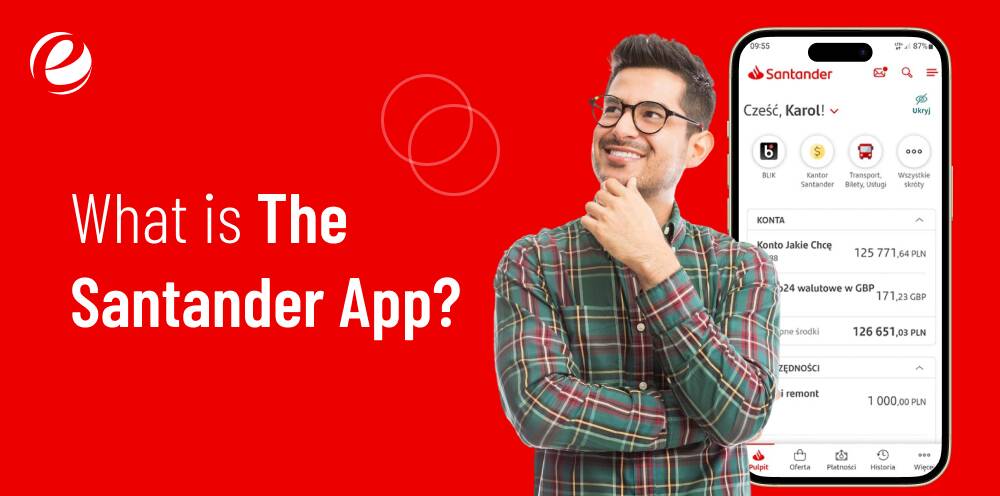
The Santander bank app is a smartphone application that allows you to manage your Santander bank account directly from your mobile. It facilitates routine transactions, provides working capital, and offers an online marketplace for purchasing and managing services and products. This makes it an excellent resource for micro-entrepreneurs and freelancers, providing easy solutions and additional services.
With the Santander app, you can view your balance, check recent transactions, and transfer money between your accounts. It also enables you to pay bills, set up direct debits, and send funds to friends and family. You can manage your debit and credit cards, lock or unlock them as needed, and set up alerts for bill due dates or low balances.
The app like Santander is designed with security in mind, featuring functions like face or fingerprint recognition to protect your account. In case you encounter issues, customer service is readily available through the app. Ultimately, the Santander banking app allows you to keep track of all your finances at any time and anywhere, which gives you much greater control over your financial life.
Top Reasons To Invest In Developing a Banking App Like Santander
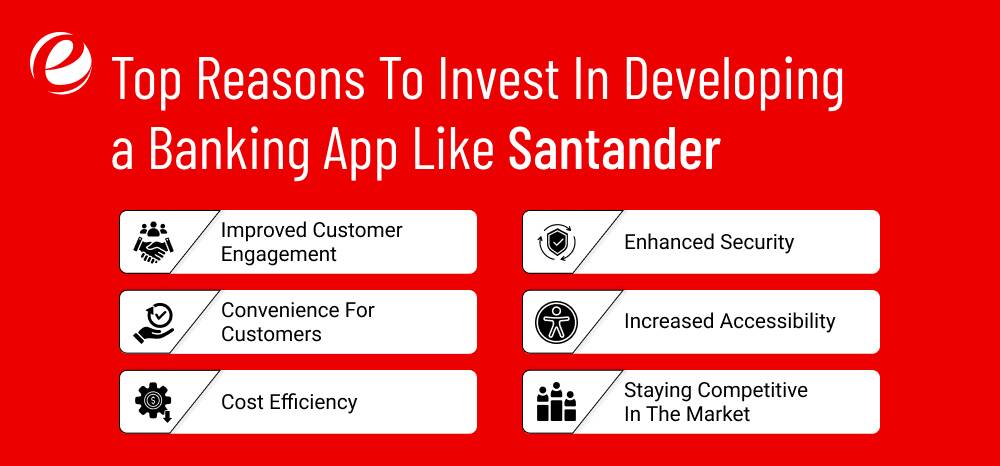
Developing a banking app like Santander offers numerous benefits for banks. Let’s take a closer look at these advantages:
1. Improved Customer Engagement
Banking app like Santander offer many features to keep customers engaged more effectively. Features such as push notifications for transaction alerts, payment reminders, and updates on the latest product offerings keep customers connected with their banking institution.
Personalized offers and relevant information can be sent directly to users’ smartphones. Continuous engagement encourages customers to use the app frequently, increasing the chances of upselling or cross-selling other services like loans, savings accounts, or credit cards. This is a simple way to keep users engaged and build long-term relationships.
2. Convenience For Customers
A banking app like Santander gives customers the flexibility to manage their finances anytime, anywhere. With the banking app, users can check their account balance, transfer funds, pay bills, and access a range of banking services without needing to visit a branch.
This level of convenience increases customer satisfaction and loyalty. In today’s fast-paced world, people expect immediate access to their bank accounts, and a mobile app meets this demand. The app saves time and makes banking more efficient and accessible in the digital age.
3. Cost Efficiency
Developing a banking app helps banks reduce operational costs in the long run. Physical branches require significant investment, including staff, utilities, and infrastructure. With an app, many functions traditionally performed in branches such as transferring money or checking balances can be done electronically.
Reduced foot traffic to physical branches cuts expenses for banks. Additionally, automated features like chatbots and online support can handle simple customer queries, freeing staff to focus on more complex issues. Over time, this leads to substantial savings for banks.
4. Enhanced Security
Security is a top priority in banking. A well-developed app like Santander incorporates advanced security features to protect user data. Options like two-factor authentication, fingerprint recognition, and encryption technologies ensure the safety of customers’ financial and personal information.
Banks can also use real-time monitoring to detect suspicious activity as well as prevent fraud before it happens. A secure banking app builds customer trust, making users more comfortable conducting transactions on their mobile devices. It also demonstrates the bank’s commitment to protecting sensitive data.
5. Increased Accessibility
Mobile banking app development services
The app helps banks connect with a wider audience which includes those who may not have easy access to physical branches. It can also be designed to assist people with disabilities by incorporating features like voice commands and screen reader compatibility. This allows banks to broaden their customer base and strengthen their reputation for accessibility.
6. Staying Competitive In The Market
The digital banking landscape with time is becoming more competitive, and customers expect access to mobile banking. Banks that fail to invest in a user-friendly, robust mobile app risk falling behind competitors that offer these features. By developing an app similar to Santander’s, banks can stay ahead in an ever-evolving market.
This ensures the bank remains at the forefront of technology for customers who demand fast, convenient options. A well-designed app creates a fresh, attractive image that appeals to new customer base while also retaining existing ones who prefer digital banking over traditional methods.
Understanding The Cost To Develop a Banking App Like Santander
How much does it cost to build a banking app? Simply put, there’s no fixed answer. The cost depends on what the app is meant to do and how complex it needs to be. Different apps require different plans and approaches.
On average, the cost of developing an app like Santander can range from $40,000 to $400,000. This is an approximate figure, and the final cost may greatly differ depending on various factors that influence the scope and complexity of the app.
For a basic banking app, you can expect to pay between $40,000 and $80,000. This app would include essential functions such as balance checking, money transfers, and bill payments. The simpler the app, the lower the cost, but it will include fewer features and have limited customization options.
A mid-level app with more advanced features, such as loan management, integrated customer service, and enhanced security features, could cost between $80,000 and $150,000. This type of app requires more time and resources, offering a more polished design and improved user experience.
For a sophisticated, feature-rich app like Santander, with advanced capabilities such as real-time fraud detection, AI-driven recommendations, and full integration with various banking services, the cost could range from $150,000 to $300,000 or higher. This type of app would also require extensive testing, robust security measures, and legal compliance, all of which contribute to the overall cost.
Factors Affecting The Cost To Develop An App Like Santander
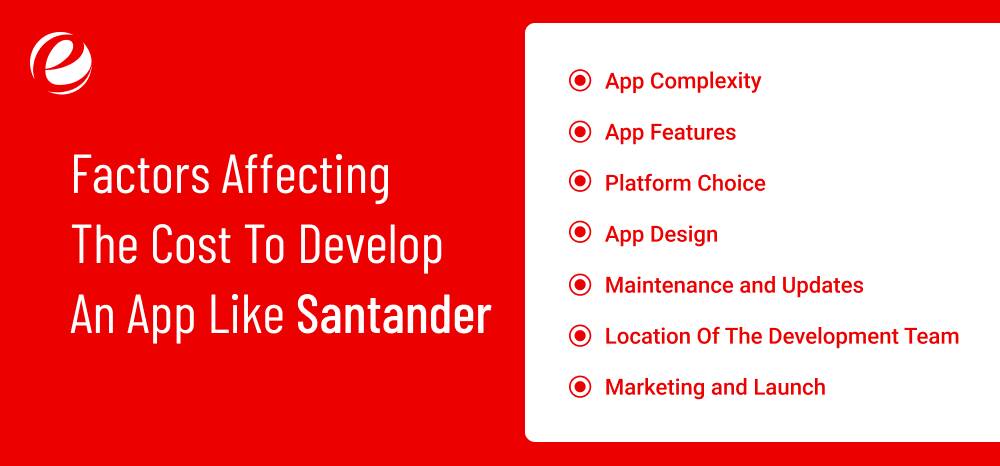
If you’re planning to create a mobile banking app like Santander, it’s important to understand the factors that affect the cost of development. Let’s take a look at the key elements:
1. App Complexity
The level of complexity in a banking app is a main factor in determining its development cost. Simple apps with basic functions, such as checking balances or transferring money, are cheaper to build. However, if the app includes advanced features like Blockchain integration, AI, and real-time fraud detection, the cost can rise significantly.
These features require more time, specialized skills, and advanced technology, all of which increase development costs. Moreover, more complex apps typically require more time for testing, security measures, and ongoing support. The greater the number of features and functions your app has, the higher the development cost and time required.
2. App Features
The features included in a banking app also impact the cost of development. Simple apps with basic functions like balance checking, fund transfers, and payments are more affordable to develop. However, if the app includes advanced functions like Blockchain integration, real-time fraud detection, or AI-powered recommendations, the price will go up.
More complex features demand additional time, effort, and expertise to develop. Features like personal financial guidance, instant payments, and biometric security (e.g., facial recognition or fingerprints) can drive up costs. In general, the more advanced the features, the higher the cost to develop the app.
3. Platform Choice
The platform you choose for your banking app will also affect the price. If you decide to create two different apps for iOS and Android, the cost will be higher, as you’ll need to develop two versions of the app. However, native apps usually offer better quality and performance.
On the other hand, creating a cross-platform app that works on both iOS and Android is typically less expensive. While cross-platform apps can save money, they may not perform as well as native apps. Your choice between cross-platform or native development depends on your budget and performance needs.
4. App Design
The design of a mobile banking app like Santander has a significant impact on development costs. A minimalist, simple look may seem easy, but it can be expensive. Creating an attractive and user-friendly layout requires careful planning, graphic design, and an understanding of how users interact with the app. The more unique and customized the design, the higher the cost.
Features like animations, smooth transitions, and custom interfaces can also add to the costs. A well-designed app enhances the user experience, making it easier and more enjoyable for users. Therefore, investing in good design is essential, though it will increase development costs.
5. Maintenance and Updates
After a banking app like Santander is launched, regular maintenance and updates are necessary to keep it running smoothly. This includes fixing bugs, improving security, and ensuring compatibility with the new versions of iOS and Android. As both the mobile operating systems as well as devices are updated, your app will need continuous updates to stay safe and compatible.
These ongoing costs arise because the app must be tested and adjusted to provide a seamless experience for users. Without timely updates, the app could become outdated, leading to user issues or security risks.
6. Location Of The Development Team
The location of your app development team can significantly impact the cost of building a banking app. Developers in the US and Western Europe tend to charge higher rates, typically between $100 and $150 per hour, due to their expertise and higher living costs. On the other hand, hiring mobile banking app developers
Although cheaper options may seem appealing, it’s important to consider the quality, experience, and communication factors that can affect the final product. Balancing price and quality is crucial when making the best choice.
7. Marketing and Launch
The process of marketing and launching a banking app can be costly. Promoting your app to attract clients through ads, social media, and other channels requires a significant investment. Additionally, providing user support during the initial launch, addressing queries, and resolving issues can add to the costs.
A successful launch is crucial for the app’s success. This often involves investing in strategies that increase downloads and visibility. Effective marketing strategies help bring the app to a larger audience and ensure it gains the attention needed to grow.

Hidden Factors Impacting The Cost To Develop An App Like Santander
While the direct expenses involved in the development of a mobile banking app like Santander are considerable, there are additional hidden factors that can affect the overall cost. These factors are often overlooked during the initial budgeting phase but can have a significant impact on the financials as the app develops. Let’s take a look at these factors below:
1. Regulatory Compliance and Legal Costs
One of the major factors that affect the cost of developing a banking app like Santander is ensuring the application complies with financial regulations. Financial institutions must adhere to strict laws regarding data security, data protection, and privacy.
These regulations also require additional design work, legal consulting, and certification processes to ensure the app meets both international and local standards. Compliance can be costly, especially if the app needs to comply with regulations across multiple regions or countries.
2. Security and Fraud Prevention Features
Banking apps require advanced security features to protect sensitive customer data. Features like encryption, two-factor authentication (2FA), and biometric logins are necessary to secure transactions and personal information. Implementing and maintaining these security measures is both complex and expensive.
Moreover, banks often need to implement real-time fraud detection systems, which rely on machine learning and artificial intelligence. These tools help safeguard against cyberattacks, but they come at a high cost, along with the need for regular updates and security testing to ensure the app remains secure.
3. Testing and Quality Assurance (QA)
Testing is a very important yet often overlooked aspect of app development. Banking apps must undergo rigorous testing to ensure they function efficiently and effectively across different platforms and devices. This includes functional testing, security testing, and user interaction (UX) testing.
QA teams focus on identifying bugs, errors, or vulnerabilities. This process can be time-consuming and costly. The more complex the app, the more detailed the testing process, which will contribute to the overall development costs.
4. Integration Of Third-Party Services
A banking app like Santander must integrate with various third-party services, which includes payment gateways, credit bureaus, or data providers. These integrations allow the app to process transactions, access credit scores, and offer additional banking services.
Integrating with third-party platforms can add extra work during development, as well as incur licensing costs and require ongoing maintenance. If a third-party service encounters issues or updates its system, the app may need modifications, which could lead to hidden costs for the institution.
Tips To Reduce The Cost Of Developing An App Like Santander

Making the most efficient use of a mobile banking app like Santander is crucial to maintaining financial efficiency while maximizing return on investment. Below are some of the best ways for businesses to reduce the cost of developing a mobile banking app:
1. Create the Minimum Viable Product (MVP)
Create an MVP that has only the essential functions. This method helps you to save money by focusing only on the core functions, like checking accounts or money transfer, as well as the payment of bills. When the application is running, you will be able to gather customer feedback, and eventually add additional features in response to the need. An MVP can lower initial costs and allows for more focused development while avoiding unnecessary features early on.
2. Use Cross-Platform Development
Instead of creating two separate apps for iOS and Android, consider using cross-platform development tools like React Native or Flutter. These tools allow you to develop the app once and deploy it across both platforms, reducing development time and costs. While cross-platform apps may face minor performance limitations, they offer a more affordable way to reach a broader audience without the hassle or need to build two separate versions.
3. Outsource to Cost-Effective Locations
Finding development teams to hire in regions with lower costs for labor could significantly lower your application cost. Outsourcing to countries like Ukraine, or Eastern Europe offers experienced developers for a fraction of the costs compared with US-based teams. Make sure that the developers have proven themselves with regard to financial apps, and keep a clear line of communication in order in order to avoid miscommunications that can slow development.
4. Leverage Ready-Made Solutions and APIs
Instead of developing the entire feature from scratch utilize existing tools as well as APIs (Application Programming Interfaces) for specific functions. As an example, you can use the third parties services to provide payment gateways, fraud detection or identity verification, rather than creating these functions in-house. This method saves time and money. It also allows you to focus on the unique elements of your app, without having to reinvent the wheel.
5. Focus on Essential Features
In order to save money, try not adding too many sophisticated features at the beginning. Concentrate on the most important features of banking including balance checks, money transfer and bill payments. Plan for more options, like advanced software for budgeting or AI-powered assistance for future updates to the app. When you release a basic version at first, you will be easily able to receive feedback from your customers and enhance your app over time without committing to costly features in the beginning.
6. Use Template Designs for UI/UX
Designing custom-made designs can be costly. In order to save money, choose the pre-designed UI/UX templates which can be adapted to the needs of your application. The majority of templates are modern and easy-to-use designs that are customized to suit the needs of banks. This method lets you retain a professional design and feel, without the expense of an entirely custom-designed layout. It’s a budget-friendly option that won’t compromise quality.
7. Automate Testing and QA
The quality assurance (QA) tests are essential in ensuring that your bank application functions properly. But it is costly when conducted in a manual manner. Automating a portion of the testing process will help cut costs. Test tools that are automated can swiftly look for errors, bugs as well as compatibility problems saving both time and cash. Automating repetitive tasks is possible to speed up the development process, and eliminate the requirements for massive QA teams.
Why Choose EmizenTech To Develop Your Banking App Like Santander
EmizenTech is a leading mobile app development company, with years of experience in creating secure, flexible, and feature-rich mobile applications. Our developers are highly skilled in delivering effective mobile banking solutions. We have a proven track record, having developed numerous high-performance apps across various industries, including finance.
We offer flexible engagement models, advanced technology stacks, and cross-platform solutions that streamline the development process, saving both time and money. Our extensive knowledge of the fintech app development ensures that we provide secure and reliable banking app like Santander, that meet your budget.
Contact us today and start your app development journey.
Conclusion
The total cost of building a mobile banking app like Santander doesn’t have to be unclear or confusing. By understanding the factors that influence the development costs of an app like Santander, you can make informed decisions during the design process. Additionally, implementing best practices for app development results in a more robust and secure application.
Staying updated on the latest trends in banking mobile app development will help ensure your app meets user expectations and remains relevant in the ever-evolving fintech market.
FAQs
What are the advantages of developing banking apps for businesses?
Digital banking apps help businesses improve customer satisfaction through ease of use, speed, and 24/7 accessibility. These apps reduce operational costs by automating banking processes, enhancing scalability to serve a larger customer base.
What is the time frame to create an app like Santander?
The development time for a mobile application typically ranges from a few months to over a year, depending on the complexity and specific features required. For a robust mobile banking app like Santander, the development process may take six to twelve months.
What are the factors that influence banking app development costs?
Several factors affect the cost of developing a banking app, including the chosen platform (iOS, Android, or cross-platform), desired features, UI/UX design, financial regulatory requirements, security measures, and third-party integrations.
Can you reduce app costs without impacting quality?
It is definitely possible to cut costs without compromising quality. Strategies include prioritizing key tasks, effective project planning and management, selecting efficient technologies, and considering outsourcing or hybrid development models.



 +1 (989) 535-9295
 info@emizentech.com
 emizentech


