
 Add us as a preferred source on Google
 Custom CRM development cost is a crucial concern for businesses that invest in digital transformation in 2026. Research indicates that almost 91% of fast-growing companies are using a customer relationship management system (CRM) to increase sales and provide better customer service.
However, before estimating the development costs, it is vital to understand what is CRM, as this clarifies how to streamline sales and support operations. Customer Relationship Management (CRM) is a centralized system that helps businesses handle customer data, monitor interactions, automate workflows, and enhance their overall relationship management efficiency.
Off-the-shelf CRM platforms begin as low as $10 per user per month; when you scale them, they can instantly boost expenses. Now, it has become crucial to understand the full cost of a CRM system, from SaaS pricing to bespoke CRM builds. This blog will walk you through pricing, features, cost drivers, and practical considerations to help you manage your investment efficiently
CRM Development Cost Overview
The cost to develop a CRM system is dependent upon the system type, the level of functionality required, the integration requirements, and the long-term scalability objectives. In the U.S. market, SaaS CRM platforms generally cost between $10 and $300+ per user each month. In contrast, when you build a fully customized CRM solution, it requires an investment that ranges from $20,000 to $250,000 or more, depending on complexity and organizational size. Many founders ask, how much does it cost to build a CRM system, and what truly impacts that investment? To better understand this, let’s explore the cost breakdown by CRM type below.
Cost by CRM Type
When you plan your CRM investment, one of the first queries firms ask is, “How much does it cost to develop a CRM that aligns with their needs?” Let’s discuss the cost per CRM type.
Startup/Basic CRM
- Cost: $10–$50/user/month
- Timeline: 1–3 weeks
Mid-Market CRM
- Cost: $50–$150/user/month
- Timeline: 4–8 weeks
Enterprise CRM
- Cost: $300+/user/month
- Timeline: 3–6 months
If your requirements fall outside the CRM Development cost outlined above, you can contact us to discuss a properly customized solution tailored to your specific business needs. Now let’s identify the critical components needed to build a practical and cost-efficient CRM MVP.
Must-Have Features for Your Custom CRM MVP
- Contact and Account Management: A centralized database that handles, views, and stores customer data with a single source of truth and minimizes data duplication.
- Sales Pipeline and Deal Tracking: This improves forecast accuracy & deal velocity as it visually represents the sales phases to monitor opportunities from lead to close.
- Custom Layouts and Fields: The ability to modify layouts & add custom fields to meet specific business requirements. Proper planning helps manage the custom CRM development cost effectively.
- Clear Analytics and Reporting: An easy-to-read overview that keeps an eye on essential metrics like team performance, pipeline strength, and sales outcomes.
- User Roles and Permissions: Built-in safeguards that control who sees what, ensuring everyone can view only the information they truly need, which keeps overall custom CRM development cost under control.
- Integration Capabilities: Seamless connections with calendars, Outlook, and email to keep workflows running smoothly.
Factors Influencing CRM Development Cost
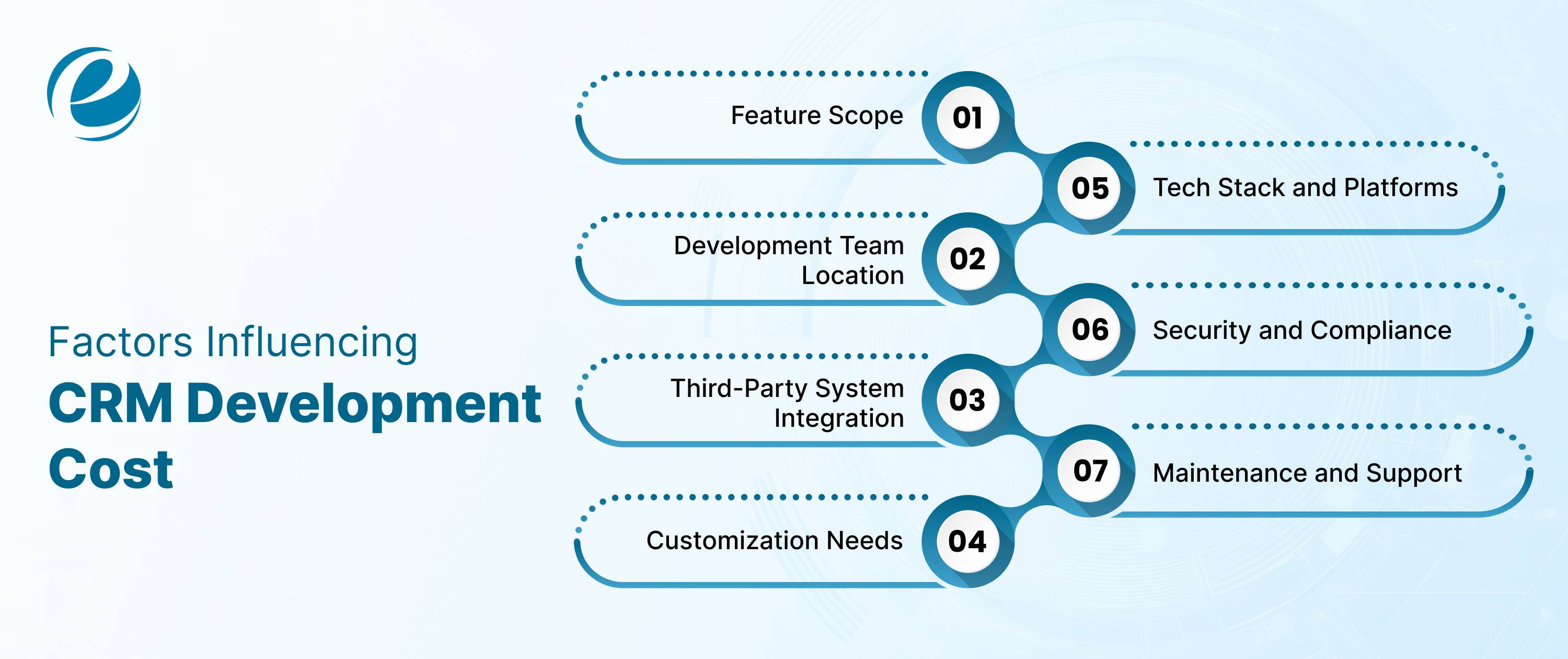
It is crucial to understand the key facts that affect the custom CRM development cost. If you’re evaluating digital solutions alongside CRM investment, you can explore comprehensive CMS development services that can help you build a scalable and cost-efficient digital ecosystem. Now, let’s take a closer look at the core factors that directly influence CRM development costs.
Feature Scope
The range of functionality from simple contact management to advanced AI-driven analytics and automated marketing processes is the primary factor that influences cost.
Development Team Location
Hourly rates vary widely depending on region ($25–$200/hour), making the decision between in-house, local, or offshore teams a key budget consideration.
Third-Party System Integration
Linking the CRM with existing systems like ERP, accounting software, email, or marketing platforms can be costly, particularly when working with legacy infrastructure.
Customization Needs
Tailoring the CRM for specific industry processes, custom dashboards, and detailed reporting increases both development effort and overall expense.
Tech Stack and Platforms
Building the CRM for web, iOS, and Android simultaneously raises costs, and adding AI/ML features may add $30,000–$80,000 to the budget.
Security and Compliance
Moving large volumes of data from previous systems and implementing strict security measures (such as GDPR or HIPAA compliance) contribute significantly to costs.
Maintenance and Support
Post-launch services, which include updates, bug fixes, & technical help, typically account for 15–25% of the original development cost annually.
Custom CRM vs SaaS CRM Cost Comparison
SaaS CRMs are in demand due to their lower initial investment, long-term subscription fees, and limited flexibility, which can hinder the growth of your business. On the other hand, a custom CRM provides full control and scalability, which makes it cost-effective over time for medium-sized and enterprise organizations. Evaluating the custom CRM development cost upfront helps businesses understand the long-term value and return on investment compared to SaaS solutions. Here is a side-by-side look at the costs of CRM vs. SaaS:
| Cost Factor | Custom CRM | SaaS CRM |
| Initial Investment | A large upfront payment | Low startup costs |
| Monthly Fees | Just maintenance and hosting | Subscription-based pricing |
| Customization | Fully personalized | Limited opportunity for change |
| Scalability | Designed to expand as needed | The plan tier determines this |
| Data Ownership | Ownership of Data | Vendor-controlled and fully managed |
| Long-Term Expense | Might decrease over time | Gradually raises subscription costs |
Step-by-Step CRM Development Timeline to Control Project Costs
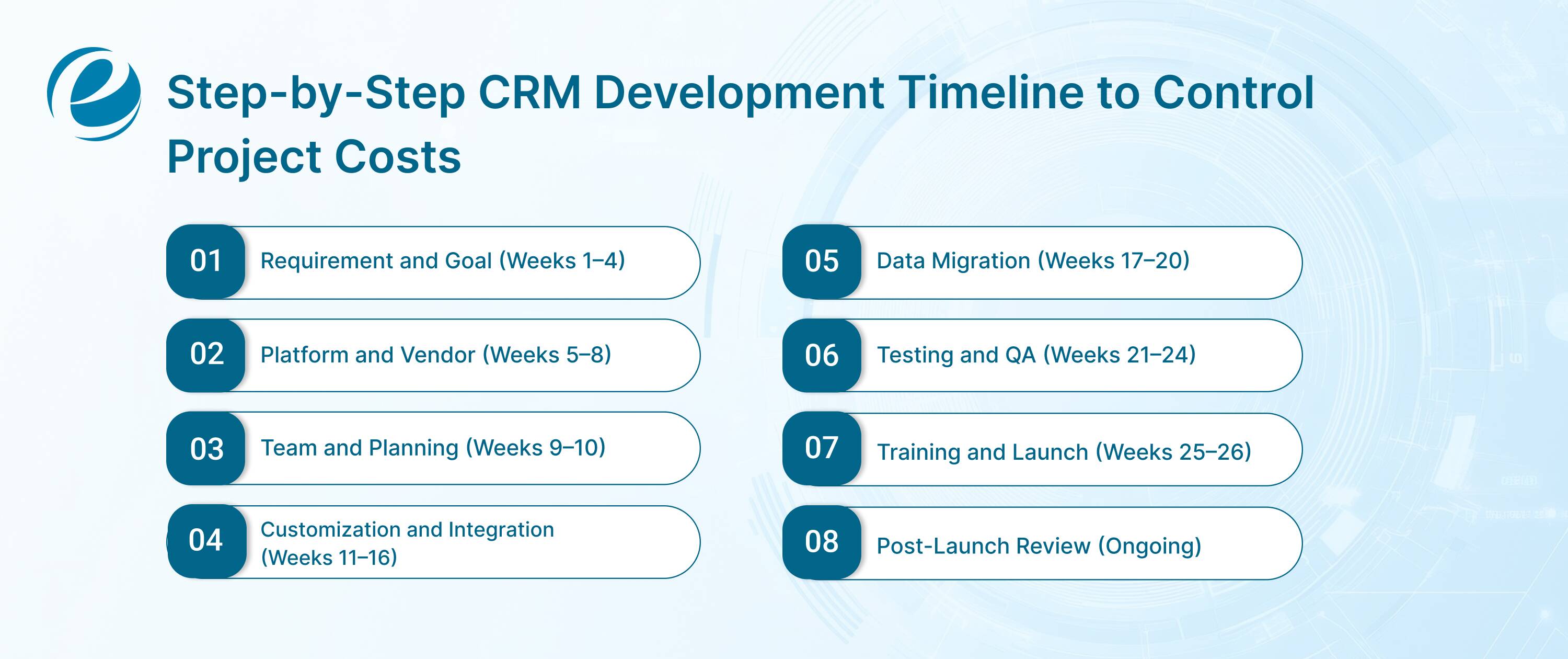
If you want to launch a powerful CRM without going over budget or facing delays, a clear strategy is key. Learn how the right CRM software development company can guide each stage, reduce costs, and support steady business growth. Now, let’s walk through the step-by-step CRM development timeline to better control project costs.
Step 1: Requirement and Goal (Weeks 1–4)
- Examine clear, measurable business goals & map customers’ journeys early to prevent scope creep or misalignment.
- Prioritize crucial features first and delay non-crucial features to keep the budget under control.
Step 2: Platform and Vendor (Weeks 5–8)
- Examine CRM platforms that align with your needs, scalability plans and budget.
- SaaS solutions are a cost-effective choice because of their lower upfront investment and faster deployment.
Step 3: Team and Planning (Weeks 9–10)
- Bring together a cross-functional team, which may include IT, marketing, and sales, to align execution with strategy.
- Clear roles and timelines help you keep the project organized and prevent delays.
Step 4: Customization and Integration (Weeks 11–16)
- Tailor the CRM to match your daily workflows and connect it with existing tools.
- Using built-in integration first enables you to reduce complexity and extra expenses.
Step 5: Data Migration (Weeks 17–20)
- With the system configured, transfer only clean and relevant data into the CRM.
- A focused data migration process reduces errors, avoids rework, and helps control overall project costs.
Step 6: Testing and QA (Weeks 21–24)
- Perform thorough testing to ensure system accuracy and usability.
- Early issue resolution prevents costly post-deployment fixes.
Step 7: Training and Launch (Weeks 25–26)
- After testing, train your teams to ensure confident system adoption.
- Proper training supports a smooth launch and reduces long-term support needs.
Step 8: Post-Launch Review (Ongoing)
- Following deployment, continuously track performance and collect feedback.
- Ongoing optimization enhances efficiency and prevents major system overhauls.
Final Thoughts
Evaluation of the CRM cost is more than a budget exercise. It is a strategic decision for business growth. While SaaS solutions deliver instant deployment & initially low investment. Growing businesses prefer to hire a CRM developer to build a system tailored exactly to their processes and future goals.
Custom CRMs offer scalability, full data ownership, and customized workflows as per your needs. Understanding custom CRM development cost identifies cost drivers, prioritizes features, and follows a structured development timeline to make sure of maximum ROI.
Businesses that invest mindfully in custom CRM solutions often see faster adoption, improved process efficiency, and better alignment between sales, marketing, and support teams. Careful management of the CRM system cost today sets the stage for a scalable, efficient, & future-proof customer management system.
FAQs
What Types of CRM Systems Are on the Market?
There are generally three types of CRM systems, which include operational, analytical, and collaborative CRM. They rule the market with industry-specific, cloud-based, and enterprise solutions for scalability.
How Much Does It Cost to Implement a CRM System?
Its cost ranges broadly from $10,000 to $15,000. Furthermore, it depends on customization, deployment models, & integrations.
Which Features Increase CRM Development Costs the Most?
There are diverse features that increase CRM development costs. Some of these may involve advanced automation, mobile apps, AI-driven analytics, and robust security.
What Tech Stack is Best for CRM Development?
A trustworthy CRM stack may involve React and Angular, Python, Node.js, PostgreSQL, AWS infrastructure, and Ribus AI integrations.



 +1 (989) 535-9295
 info@emizentech.com
 emizentech


