
 Add us as a preferred source on Google
 Building an Ecommerce website in 2026 is less about simply selling online and more about setting up a space for intelligent customer experiences. You don’t want to just show up, but also deliver services that convert. That’s the crux of choosing to hire dedicated developers who can build scalable, secure, and high-performing Ecommerce platforms while keeping development costs under control.
The evolution of technology, tools, and platforms has given the Ecommerce website development cost a push. After all, what once was a straightforward website setup is now a pack of AI-powered personalization, complex integrations, mobile responsiveness, and multi-channel adaptability. So, what is the average cost to hire an ecommerce website developer?
This blog breaks it down globally, by platform, and by the factors that truly tweak the figure.
Why Should Online Businesses Hire an Ecommerce Developer?
It is easier for small businesses to consider low-cost freelancers or DIY website developers for their Ecommerce projects. However, the truth is that a professional brings more than just coding expertise to the table. With the right eCommerce development company or individual, you get structure, scalability, and performance.
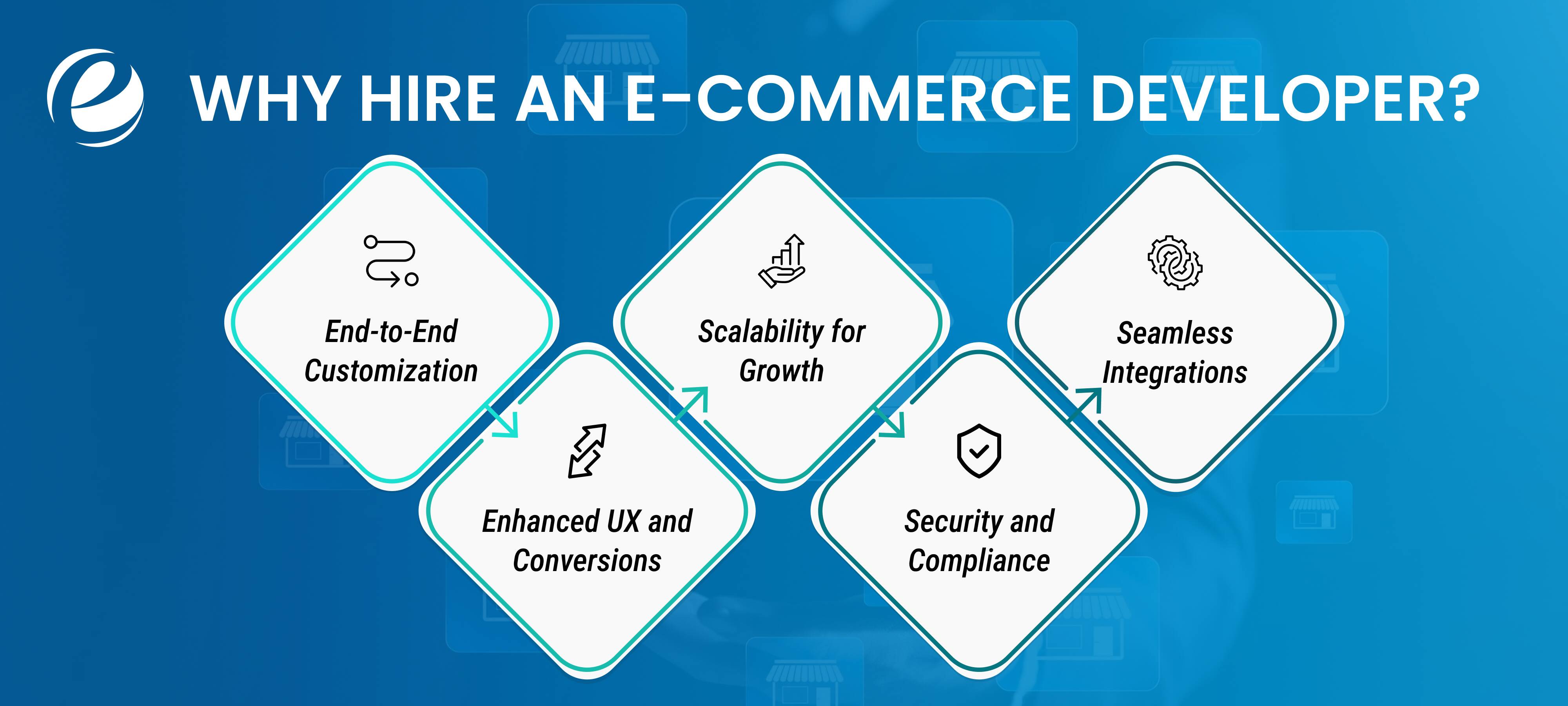
Here’s why hiring one makes real business sense in 2026:
- End-to-End Customization: A professional can tailor every aspect of your site, from homepage layout to backend order management, to reflect your brand identity.
- Scalability for Growth: Whether you plan to expand globally or introduce new product lines, a well-built architecture supports long-term scalability.
- Seamless Integrations: Developers ensure your store syncs smoothly with CRMs, ERPs, marketing tools, and third-party logistics systems.
- Enhanced UX and Conversions: A developer focuses on clean navigation, fast load times, and intuitive interfaces that turn visitors into buyers.
- Security and Compliance: Professional developers implement secure payment gateways and comply with international data protection standards.
In short, hiring a seasoned eCommerce developer is an investment (not an expense) that pays off in performance, trust, and customer satisfaction.
Average Cost to Hire an Ecommerce Website Developer: Country-Wise Breakdown
The average cost to hire eCommerce developers depends on a number of factors, including where you hire from. Developer salaries and service rates differ dramatically between countries due to labor costs, demand, and experience levels.
Here’s a roundup of what you can expect to pay eCommerce experts in 2026:
| Region / Country | Average Hourly Rate (USD) | Estimated Project Cost |
| United States | $80 – $150 | $12,000 – $60,000+ |
| Canada | $70 – $130 | $10,000 – $45,000 |
| United Kingdom | $60 – $120 | $9,000 – $40,000 |
| Western Europe (Germany, France, Netherlands) | $55 – $110 | $8,000 – $35,000 |
| Eastern Europe (Poland, Ukraine, Romania) | $30 – $70 | $5,000 – $25,000 |
| Australia | $70 – $140 | $10,000 – $45,000 |
| India | $20 – $50 | $3,000 – $15,000 |
| Latin America (Mexico, Brazil, Argentina) | $25 – $60 | $4,000 – $20,000 |
Note:
- Businesses in Western Europe and North America pay a premium price for key reasons: Time zone convenience and local expertise.
- Companies that hire offshore teams (especially in India or Eastern Europe) save up substantially on the project, without necessarily compromising quality, especially when partnering with established development companies.
Pricing Breakdown by Ecommerce Platforms
The platform you choose significantly affects total development costs. Different platforms require different skill sets, licensing fees, and customization levels.
| Platform | Typical Development Cost (USD) | Notes |
| Shopify / Shopify Plus | $5,000 – $30,000 | Fast deployment, best for small to medium stores. Costs rise for advanced theme customization and private apps. |
| Magento (Adobe Commerce) | $15,000 – $100,000+ | Ideal for enterprise-level stores; highly customizable but requires advanced expertise and maintenance. |
| WooCommerce (WordPress) | $4,000 – $25,000 | Affordable and flexible, but scaling large stores may need custom optimization. |
| BigCommerce | $7,000 – $35,000 | Cloud-based, secure, and less maintenance-heavy. Moderate customization flexibility. |
| Odoo eCommerce | $8,000 – $40,000 | Perfect for integrated business ecosystems (ERP + CRM + Store). |
| Custom-Built eCommerce (Laravel, React, Node.js) | $20,000 – $150,000+ | Tailored from scratch for unique experiences; highest flexibility and cost. |
Note: The decision of choosing an Ecommerce platform is not just about budget, but also (and to a greater extent) about your business goals. For instance, Shopify and WooCommerce suit well for businesses looking for quick deployment, while Odoo and Magento are ideal for projects with complex backends.
Key Factors that Determine Ecommerce Website Developer Cost
Let us walk a little beyond rates and platforms and catch up on those underlying checkpoints that impact your budget to hire Ecommerce website experts.
Project Complexity and Scope
If you are planning to set up a basic online store with just a few product pages, a basic checkout, and a standard design, you can build it within a few weeks. On the other hand, complex setups (read multi-store architecture, regional language support, subscription models, or advanced analytics) demand expertise, time, and testing.
Here’s what this means for your budget:
- Small business site costs range from $3,000 – $10,000.
- Mid-sized Ecommerce site costs range from $10,000 – $40,000.
- Enterprise-grade solutions cost from $40,000 – $150,000 and beyond.
That’s not all. Your project team size also comes into play here. For example, big projects often involve project managers, QA testers, DevOps specialists, and UX designers in addition to developers.
Platform Choice
This one is non-negotiable. Each Ecommerce platform brings a unique ecosystem, customization scope, and licensing requirements. You will spend less on Shopify or WooCommerce than on Magento developers due to the latter’s technical depth and modular structure.
Moreover, open-source systems give more flexibility but consume a good deal of time while Shopify reduces the development maneuvers at the cost of deep customization.
Design Customization and UX
User experience is the make-or-break ingredient in modern Ecommerce settings. Brands are now prioritizing unique, captivating layouts, more personalization, and micro-interactions. But guess what? These aspects add both development time and cost.
Ecommerce developers have to collaborate with UI/UX designers to create smooth checkout flows, responsive layouts, and accessibility compliance. That’s not all. UX gives you measurable ROI through higher conversions. So, it may cost you extra today but will help save up in the long run.
Integration Requirements
Integrations play a key role in the shopping experience. Each connection, from CRM tools to payment gateways, demands a strategic configuration, testing, and maintenance. The more integrations you use in your store, the more complex your codebase becomes. For instance, enterprise-level stores handling automation, customer data, and logistics spend between 20% to 30% on Ecommerce development.
Developer’s Experience
Experience and expertise are two of the major development cost drivers. You will pay a specialized Ecommerce development company more and enjoy faster turnarounds and fewer revisions. On the other hand, small updates done by freelance developers will cost you less. Also, when you partner with an Ecommerce website development company, they provide you with a team to handle end-to-end execution, including design, development, and post-launch support. These are the variables that can impact the budget significantly.

Hire Top Ecommerce Website Developers with Us
As we discussed, the average cost to Hire Ecommerce website developers in 2026 is way more than just a matter of an exact figure. From location and experience to project needs and platform, a lot of factors affect the cost. But it should not keep you from investing in skilled developers, as it is the most important aspect of building a high-performing, secure, and future-ready online store.
Working with a trusted Ecommerce development company is the smartest route you will take to set up a scalable, secure, and seamless store. Choose a team that understands your vision and gives it life with a creative and strategic approach, be it for an all-new website or just an upgrade. After all, you are spending on the project for long-term growth and stability.
Inspired to take the next step? Hire eCommerce developers with EmizenTech. With over a decade of experience in building Ecommerce solutions at a global scale, our experts build stores that do it all: Connect, engage, and scale. We offer flexible engagement models along with transparent pricing and expertise across Magento, Shopify, Odoo, and custom stacks.



 +1 (989) 535-9295
 info@emizentech.com
 emizentech


