 Add us as a preferred source on Google
In 2026, AWS, Azure, and Google Cloud remain the top cloud providers. They collectively control over 62% of the global cloud market. AWS holds the largest share, followed by Azure and GCP. Each of them excels in different domains like enterprise integration and AI workloads.
The top three cloud providers each offer feature-packed platforms, backed by years of experience. Which one emerges as the best? GCP vs AWS vs Azure?
In this blog, we will walk you through a comparison of Amazon Web Services, Google Cloud, and Azure. It also investigates various features, pricing, AI capabilities, and their real-world applications.
Amazon Web Services (AWS)
Amazon Web Services was launched in 2006. It is the world’s leading cloud computing platform, which is trusted by companies like Netflix, BMW, Pfizer, Adidas, and Adobe. It improves over 200 IaaS, PaaS, and SaaS solutions, which power millions of apps across the US and globally. Additionally, it is recognized for its enterprise-grade security and flexibility as users navigate through its services.
Pros:
- Broadest range of cloud services, from networking to robotics
- Mature, reliable, and industry-proven infrastructure
- Strong security and global availability
Cons:
- Advanced support requires paid plans.
- Complex pricing structure
- Steep learning curve for beginners
However, if you are looking to leverage the power of AWS for your business, don’t hesitate to hire AWS developers today to build scalable, secure, and innovative cloud solutions.
Microsoft Azure
Microsoft Azure was launched in 2010. It is the second-largest global cloud platform, which delivers 200+ IaaS, PaaS and SaaS services across computing, IoT, hybrid cloud environment, and AI. Further, it is trusted by 95% of Fortune 500 companies, including Coca-Cola, Samsung, Walmart, eBay, and Boeing.
Pros:
- Advanced hybrid cloud capabilities
- Enterprise-grade AI, ML, and analytics tools
- Competitive pricing for many business services
Cons:
- Fewer services than AWS
- Primarily enterprise-focused
- Less flexibility for startups
If you want to optimize your cloud infrastructure and leverage AI & analytics, you can hire Azure developers for expert solutions.
Google Cloud Platform (GCP)
Google Cloud Platform (GCP), launched in 2008, is a leading cloud provider that provides over 200 IaaS, PaaS, and SaaS services. Built on the same global infrastructure that powers Google Search, Gmail, and YouTube, GCP delivers scalable solutions for big data, AI, machine learning, analytics, and enterprise applications. Major companies such as Meta, Spotify, PayPal, Target, and Ford Motor Company use GCP.
Pros:
- Seamless integration with Google services
- High-performance Google Compute Engine
- Fast global network infrastructure
Cons:
- Fewer services than AWS and Azure
- Limited enterprise-focused solutions
- Some features are less mature than competitors.
In case you want to unlock GCP’s full potential for your business, feel free to hire google cloud developers to build secure and intelligent cloud solutions.
AWS vs Azure vs GCP: The 2026 Comparison Table

The table below highlights the AWS vs Azure vs GCP comparison to help you quickly evaluate which cloud provider aligns best with your business needs.
| Feature | AWS (Amazon Web Service) | Azure (Microsoft) | GCP (Google Cloud Platform) |
| Age | 20 years old | 16 years old | 18 years old |
| Best For | Enormous scale, various services, and versatility | Microsoft shops, hybrid cloud environment and regulated industries | Data-driven startups, AL/ML focused firms, and K8s-native apps |
| Market Position | Market leader; largest ecosystem | Strong enterprise & hybrid adoption | High-growth; Leader in Data & AI |
| Strengths | Offers 200+ services, 34+ regions and 120+ availability zones | Seamless integration with M365, active director and Azure arc | Combines powerful tools like BigQuery, Vertex AI, and Google Kubernetes Engine |
| AI/ML | Comprehensive tools (SageMaker) | Provides strong integration with OpenAI | Leads AI research & Vertex AI platform |
| Pricing | Offers flexible and high-commitment discounts | Structured to align with enterprise agreements | Provides competitive pricing supported by sustained use discounts |
| Security | Provides an extensive and mature toolkit | Uses AI-driven threat detection & built-in compliance | Built on a security-first foundation and follows zero-trust architecture |
| Ideal User | Well-suited for global enterprise, startups and DevOps teams | This is ideal for corporate IT departments, finance departments, and legacy migrants. | Data-driven startups, Cloud-native teams |
Core Cloud Services Offered by AWS, Azure, and GCP
| Service | AWS | Azure | GCP |
| Virtual Machines (Compute Instances) | EC2 (Elastic Compute) | Azure Virtual Machine | Google Compute Engine |
| Platform as a Service (PaaS) Solutions | AWS Elastic Beanstalk | App Service | Google App Engine |
| Container Services | AWS Elastic Container/Kubernetes Service | Azure Kubernetes Service (AKS) | Google Kubernetes Engine |
| Serverless Functions | AWS Lambda | Azure Function | Google Cloud Functions |
When you compare AWS vs Azure vs GCP security, all three providers offer robust tools and frameworks, from AI-driven threat detection to zero-trust architectures.
Factors to Consider When Choosing a Cloud Provider
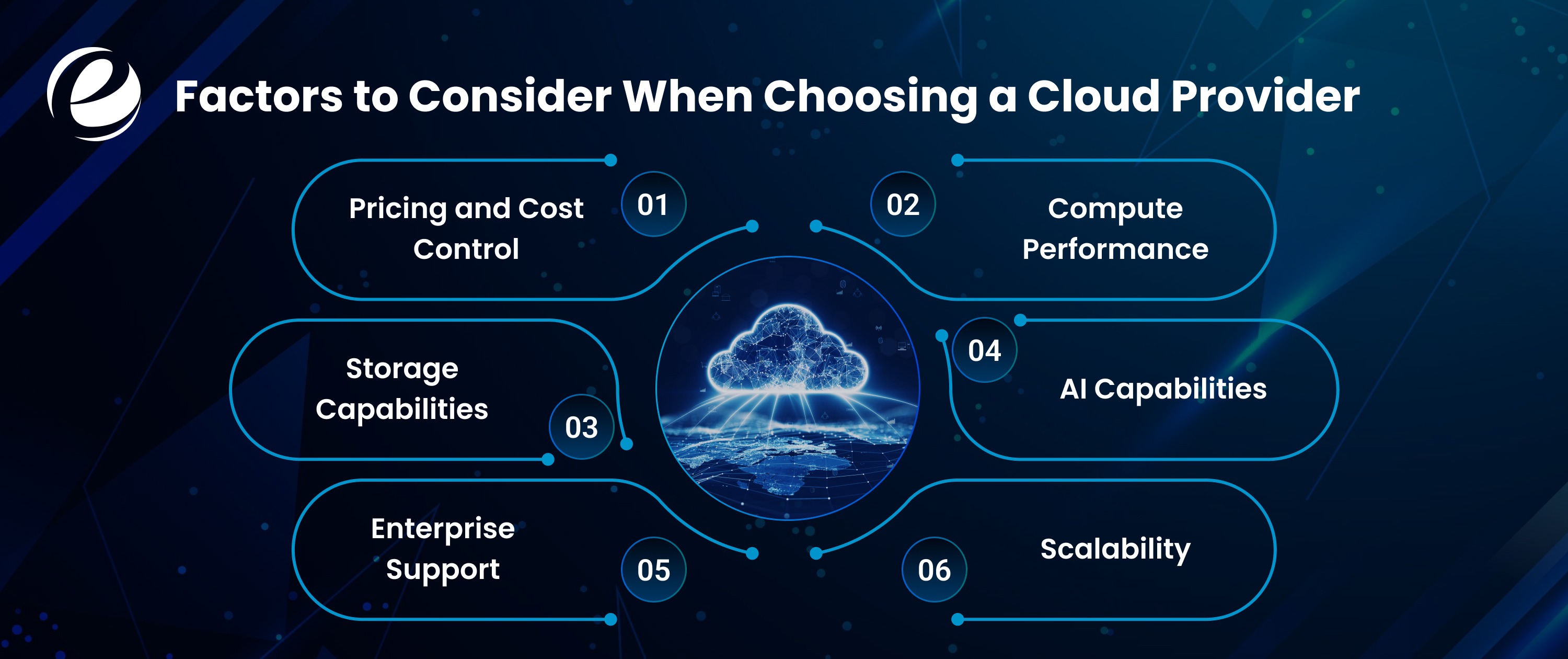
A business must consider multiple critical factors while selecting cloud providers. Let’s investigate them one by one below.
Pricing and Cost Control
Evaluate pay-as-you-go, subscription models, & reserved instances. Also, improve costs by analyzing workload needs, potential hidden charges, and usage patterns.
Compute Performance
Assess CPU, GPU and memory resources. Select a provider that offers high-performance computing for your workload. It might involve low-latency processes and auto-scaling abilities.
Storage Capabilities
Review storage types, access speed, durability, and redundancy. Ensure that support for objects and file states aligns with application needs and regulatory compliance.
AI Capabilities
Explore machine learning and AI, which includes pre-built models, integration options, and frameworks. GCP leads in AI, whereas AWS and Azure provide a wide range of AI service portfolios.
Enterprise Support
Review the support tiers, response times, and managed services offered. Robust assistance makes sure of a smooth deployment process, troubleshooting and guidance for mission-critical apps.
Scalability
Look for flexibility to manage the increase in traffic, growth, & seasonal demand. Multi-region availability, a serverless preference, and container orchestration improve scalability.
Consideration of these aspects ensures informed decision-making, cost efficiency, and optimal performance when you choose between AWS vs Azure vs GCP services.
Real-World Applications of GCP vs AWS vs Azure
Selecting between GCP vs AWS vs Azure depends on your workload and scalability goals. Let’s discover their real-world applications below:
SaaS Startup Scaling Globally
- GCP: Excellent if analytics or AI features are core.
- AWS: It is best for scale and diverse workloads.
- Azure: Strong if Microsoft technology is primary.
Enterprise Digital Transformation
- GCP: A Good choice for data modernization.
- AWS: Perfect for hybrid enterprise systems.
- Azure: Great for large-scale infrastructure.
AI-Driven Application
- GCP: It is considered a leading tool for data and AI projects, which includes generative AI development for applications like chatbots and intelligent automation.
- AWS: Offers a wide and mature machine learning ecosystem.
- Azure: Combines AI services seamlessly within enterprise-grade solutions.
E-Commerce Platform
- GCP: Preferable for data-centric e-commerce analytics, which makes it a smart foundation for scalable and data-driven data.
- AWS: Frequently chosen for global performance and high-traffic resilience.
- Azure: It is good for enterprise commerce stacks and for implementing advanced e-commerce development services.
Conclusion
GCP vs AWS vs Azure: each delivers powerful cloud abilities, but there’s no universally applicable solution. AWS is excellent in breadth and maturity. Azure shines for hybrid and enterprise ecosystems, and GCP excels at AI, machine learning, and modern analytics.
The ideal choice varies based on your business goals, existing tech stack, and long-term strategy. It doesn’t matter if your goal is to scale globally or to accelerate AI-driven innovation. Yet, to leverage the cloud’s AI capabilities effectively, you can seek experienced AI consulting services.
Select the cloud that aligns with your vision and back it up with the right talent to boost sustainable growth in 2026 and beyond.
FAQs
What are the Cloud Service Providers?
Cloud service providers offer internet-based computing resources such as storage, servers, and software. Some leading providers include AWS, Microsoft Azure, and Google Cloud.
Which is Better, AWS Azure or GCP?
AWS leads in the market. Azure integrates well with the Microsoft tools. GCP is excellent for AI, and this choice varies with business requirements.
Why Do Companies Prefer Azure Over AWS?
Firms prefer Azure for its easy integration with Microsoft software, hybrid cloud capabilities, enterprise support, and familiar development environment.
Which is Costly AWS or Azure?
It depends on the usage, services, and contracts. AWS can be costly for compute-heavy workloads, while Azure is cheap for enterprise licensing.
Do Startups Use AWS or Azure?
Startups often prefer AWS for its flexibility and scalability. Whereas Azure is chosen if he has invested in Microsoft's products.
Which Cloud Will Win the AI?
Google Cloud is highly leading in AI services with TensorFlow and Vertex AI, yet AWS and Azure aggressively expand AI offerings globally.
Which PaaS Cloud is Better, AWS or Azure?
Azure PaaS is better in enterprise app development. AWS PaaS is strong, versatile, and integrated with a wider range of cloud services efficiently.
How Much Does the Cloud Cost?
The cost of the cloud depends on storage, compute, and services. The pay-as-you-go model enables firms to scale without upfront infrastructure investment.



 +1 (989) 535-9295
 info@emizentech.com
 emizentech


