
 Add us as a preferred source on Google
One of the most critical strategic decisions a company has to make in 2026 is choosing between in-house vs remote mobile app developers. With a constantly changing workforce and a competitive talent pool, this is one of the most critical strategic decisions that companies are making this year.
Based on research conducted this year, it is estimated that by the end of 2026, 80 percent of software engineers will be working remotely or at least half remotely. In this blog, we will be discussing comparisons between in-house vs remote mobile app developers and how to use each.
What Is an In-House Mobile App Developer?
The in-house mobile application developer refers to an individual working for the same organization to create and manage applications on mobile phones. Such individuals are part of the company’s team, work closely with different departments within the company, and deal with projects related to the company’s objectives and needs.
Pros and Cons of Hiring In-House Developers
Understanding the advantages and disadvantages of in-house developers would help businesses make the best decisions in the effective management of projects. Let’s take a look at some of them.
Pros:
- Company Alignment & Loyalty: In-house developers are more closely aligned with company goals and culture, leading to stronger commitment to long-term product success and consistent execution of business objectives.
- Control and Quality Assurance: Provides full visibility and control over the entire development process, including coding standards, architecture decisions, and security practices, ensuring consistent quality and governance throughout the project lifecycle.
- Improved Collaboration & Communication: Working in the same location or time zone enables smoother communication, reduces language and scheduling barriers, and improves day-to-day collaboration efficiency.
- Higher Focus on Quality: A dedicated team is better suited for long-term projects, ensuring consistent coding standards, improved stability, and sustained quality over time.
- Knowledge Retention: Developers who remain at your organization will retain institutional knowledge related to your systems, products, and codebase, which can be critical for long-term projects.
Cons:
- Slow Hiring Process: Recruiting skilled in-house developers can be lengthy and challenging, especially when looking for specialized expertise.
- Higher Operational Costs: Maintaining an in-house team involves ongoing expenses such as salaries, benefits, infrastructure, training, and compliance, making it more expensive than outsourcing or freelancing models.
- Dependency on Team Stability: The departure of key team members can disrupt ongoing projects and lead to delays, requiring additional time and resources for replacement.
- Skill Gaps: Maintaining skills in all the required technologies could be difficult, particularly as tools and frameworks continue to evolve rapidly.
If your project requires specialized Android expertise, you can also hire Android app developers to complement your in-house team.
When to Hire In-House Developers for Your Project

Selecting the most suitable developer can be the making or breaking point for the success of your project. Let’s discuss the underlying reasons for that.
- Strategic Business Projects: Best suited for core initiatives that directly contribute to your company’s value creation and long-term competitive advantage.
- Long-term development needs: Suitable when ongoing updates, maintenance, and improvements are required over time.
- Deep System Knowledge Required: Best when working with internal processes, legacy systems, or proprietary technology.
- Need for Full Control: Ideal for in-house when you need to control workflow, quality, and internal processes.
- Cross-Department Collaboration: Enables smoother collaboration between departments such as marketing, design, product development, and operations.
What Is a Remote Mobile App Developer?
The term remote mobile application developer refers to someone who develops and tests mobile applications while not being physically present within an office environment. This involves collaboration through software tools of communication and organization for the development of apps running on either iOS or Android.
Pros and Cons of Hiring Remote Developers
Evaluating the advantages and limitations of remote developers helps businesses improve flexibility while managing costs effectively. Below are the key pros and cons to consider.
Pros:
- Ability to Access Global Talent: Remote hiring allows companies to access skilled developers from anywhere in the world, giving them a wider talent pool and the ability to find specialized expertise that may not be available locally.
- Cost-Efficiency: It can help reduce overall expenses by lowering costs related to office space, utilities, equipment, and in some cases, employee compensation compared to hiring locally.
- Increased Productivity: Developers tend to have fewer distractions, which can lead to increased concentration and productivity.
- Around-The-Clock Productivity: With a workforce dispersed around various time zones, work can proceed 24 hours a day, which will speed up the time it takes to deliver a product.
- Flexibility and Scalability: Remote developers make it easier to adjust team size based on project requirements, allowing businesses to scale resources up or down more efficiently than with in-house hiring.
Cons:
- Communication & Time Zone Challenges: Differences in time zones can slow down collaboration and require more structured communication to avoid misunderstandings.
- Reduced Team Cohesion: Remote employees may feel disconnected from the organization, which can impact collaboration and company culture.
- Onboarding & Management Complexity: Integrating and managing remote teams often requires more structured processes and greater managerial effort.
- Security Risks: Ensuring secure access to sensitive data and maintaining strong cybersecurity controls can be more complex with distributed teams.
- Variable Quality of Work: Especially when working with freelancers, there may be inconsistencies in skill levels and output quality, requiring careful vetting and oversight.
When to Hire Remote Developers for Your Project
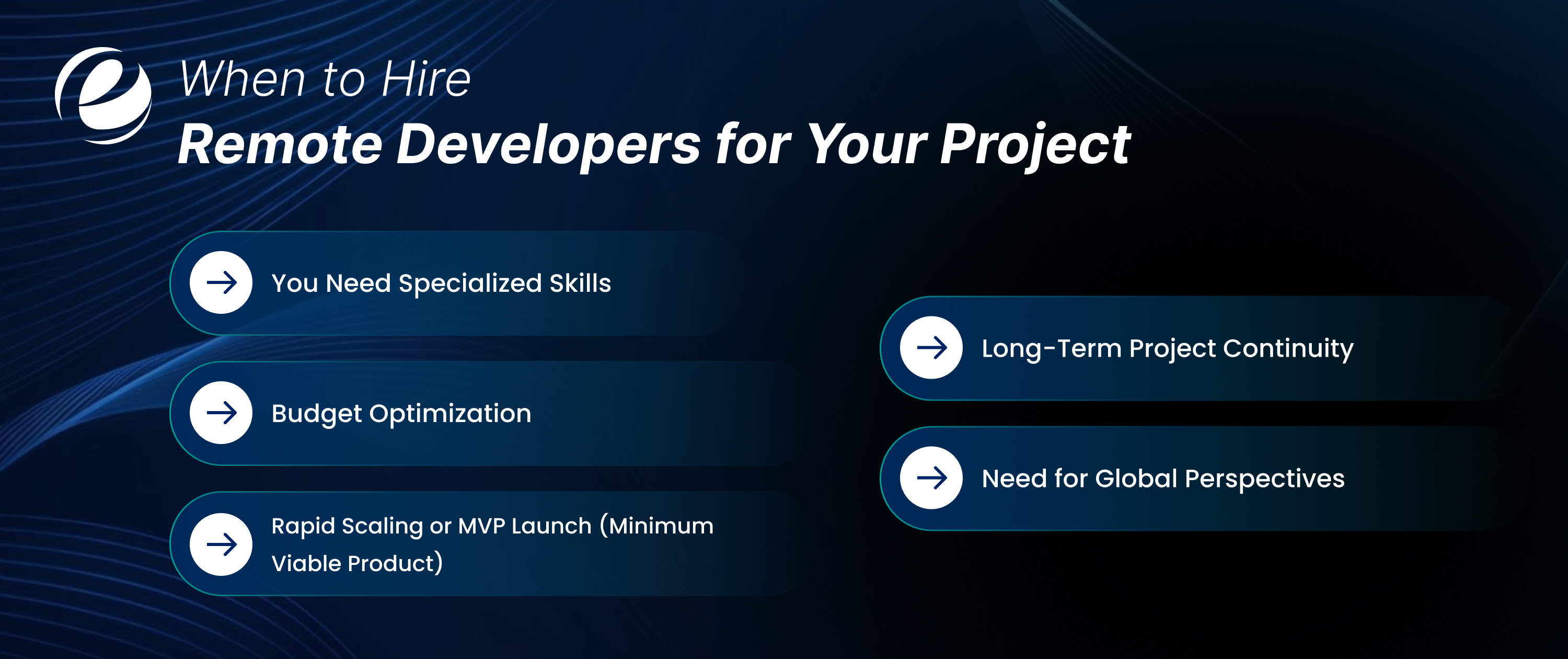
Knowing when to hire remote developers is essential in order to match the resources and timing with the needs of the project. Let’s take a look at some of the options.
- You Need Specialized Skills: If you have a project that requires specific skill sets that are either unavailable locally or come at a very high cost.
- Budget Optimization: Ideal when the goal is to reduce overhead costs related to office infrastructure, equipment, and higher local salary structures.
- Rapid Scaling or MVP Launch (Minimum Viable Product): Suitable when you need to quickly build a capable team to launch an MVP and accelerate time-to-market.
- Long-Term Project Stability: Best when hiring dedicated professionals who can seamlessly integrate into existing workflows for ongoing development, rather than relying on short-term freelancers.
- Access to Global Perspectives: Valuable when you want to foster innovation by leveraging diverse skills, experiences, and viewpoints from international talent pools.
In-House vs Remote Mobile App Developers: Key Differences
In today’s digital world, mobile apps are the driving force behind the growth of businesses. Therefore, the right choice between in-house and remote developers is vital because each option has its own advantages and disadvantages that can impact the success of the project. Here’s a comparison between in-house vs remote mobile app developers:
| Feature | In-House Developers | Remote Developers |
| Cost | High Costs, Salaries, Employment Benefits, Office Space, Hardware | No Overhead Cost, Lower Rate, No Equipment/Supply Cost |
| Talent Pool | Limited to the Local Geographical Limits of the Vicinity | Global Access to Niche-Specialized Skills |
| Communication | Synchronous – Via a Direct, Face-to-Face, Real-Time Mechanism | Asynchronous – Depending on the Mechanism Used To Communicate With Others |
| Control | Immediate Report, High One-to-One with Each Employee | Less Significant Reports, Managed Based Upon Results |
| Onboarding | Slow: Time Frames for the Hiring Process, Employee Development & Training and Time to Set Up for the Work | Quicker: More Immediate Orientation, More Immediate and Enhanced Initial Focus |
| Flexibility | Low Long-Term Commitment, Hard to Add Workers | Easier to Scale Workers Up or Down in Relationship to the Requirements of the Project |
| Culture | High Alignment with Company Objectives & Values | Low Alignment with Company Values, External Focus on Completion of Tasks |
| Security | In-House Capabilities, Controlled Environment | Need for Strict Controls (E.G. Use of a VPN, NDA) |
Final Thoughts
The decision of choosing between the remote dedicated developers and the in-house developers depends on the needs and requirements of the business. Working with in-house developers can indeed offer control and collaboration. It is also true that working with remote developers can offer flexibility and cost savings. With the information and knowledge obtained in this guide, businesses can be confident in their decision of choosing between the in-house and the remote mobile app developers and can even hire mobile app developers to enhance their team.
FAQ’s
Are Remote Developers Suitable for Startups with Limited Budgets?
Yes, Remote developers are suitable for a startup with a limited budget since they help the business cut down on costs.
How Can I Ensure Project Security with Remote Developers?
One can ensure project security by making sure that the remote developers have signed a contract and that they have the necessary tools to ensure project security.
Which Option is Better for Scaling a Development Team Quickly?
The remote option would be better since it allows the business to scale the development team quickly, since it’s not limited by location.
How Do Communication Challenges Differ Between In-House and Remote Teams?
The remote teams have the challenge of structured updates and video calls, while the in-house teams have the advantage of face-to-face interactions.



 +1 (989) 535-9295
 info@emizentech.com
 emizentech


