
 Add us as a preferred source on Google
 You decide to build a polo game app, list out features, and visualize the design. Ultimately, you know what it takes to create an ‘amazing’ equestrian gaming solution. But what sets it apart from a high-performance app? Backend is the answer.
Often overlooked behind the scenes, a scalable polo app backend is responsible for managing every aspect of how a user interacts with the platform. First, polo has already lagged in digitization. Players, clubs, and fans mostly use manual calculations or disconnected tools to catch up on stats and scores. Then, there’s a loud and clear demand for platforms offering speed, precision, and data flow. You can address the challenge and meet the market expectations with a solid backend architecture.
Please continue reading to understand what building a polo app architecture looks like, how it can be a game-changer, and most importantly, how to create one.
Importance of a Smart Backend for Polo Clubs and Players

Here’s the must-know thing about modern backends: They make apps perform great. More than just coding, the backend for a sports app is the engine that pushes your idea of a successful project to scale and do amazing things.
Here is a roundup of the benefits of a robust backend infrastructure for everyone concerned:
Access to Real-Time Insights
Performance data is the key to an efficient development strategy for every player. Thus, the accuracy of insights is a non-negotiable offering of the polo game app. A strong backend setup enables transparent access to previous performances, fouls, horses, and more. As a result, players can know exactly where they are lacking in the game, how they can improve their performance, and avoid penalties.
Fast and Accurate Updates
Like any sport, horse sports apps thrive on speed and must be reliable. Whether a seasoned gamer or just a curious first-timer, everyone who navigates the app expects things to be in order. This includes scores and post-match content, player lineups, and more, without lag. The backend, powered by efficient data pipelines and WebSocket-driven updates, can provide all the fans with all the information, up to the second.
Centralized Control Point
Polo clubs manage multiple aspects of the game. From coaches to horses to players to every single match, it is all data. The objective of building a robust backend for a sports app is to facilitate a centralized dashboard where these details (meaning schedules, performance, team structures, etc.) appear neatly. It’s an effective alternative to spreadsheets and disintegrated tools. Every time a stakeholder has to check up on numbers, they can access the app and find all the information in one place, saving time and energy.
Efficiency and Performance
A well-developed backend automates the polo game app. From triggering alerts for horse training schedules to auto-generating player performance reports, it helps streamline everything. This feature is no less than a blessing for polo clubs and stakeholders looking to manage and plan things efficiently.
Smart Player and Horse Management
The Polo game app is all about horses; every horse has its history, health record, and preparedness for matches. With backend development for a horse sports app, you ensure complete monitoring of different metrics, including performance and health. This enables polo clubs and organizers to assign horses to a game accordingly. That’s not all; the backend ensures that admins can seamlessly keep track of player injuries, substitutions, and more.

The Case of Game Control + WebSockets/ Firebase
The polo game app operates on speed, which is what the game is about. So, it is obvious to implement a tech stack that can keep up with that pace. That makes real-time access a core component of this app, meaning seamless performance tracking, updating the scoreboard across all devices, recording a foul, and so on. Enter tools like Firebase Database and WebSockets.
Traditional REST APIs will work as long as you talk about static data. But they are not enough to ensure high-urgency, high-frequency scenarios. It is WebSockets, which facilitate updates by enabling consistent communication between the client and the server.
Here’s why the backend is essential for functionality:
- Instant broadcasting: From fouls and goals to injury timeouts and substitutions, fans get up-to-the-second details about everything.
- Fewer errors: You can reduce the headache of manual data entry repeatedly during the game. All you need to do is ensure that the event triggers are linked to backend logic.
- Live scoreboards: From web to mobile apps, rest assured about score buzz with automatic updates across devices.
- Broadcast and commentary sync: With capabilities, commentators can receive live data feeds. As a result, the narration and gameplay remain in sync.
Now, the big question: how should you implement this?
If you are developing a Node.js backend and aim to gain complete control over custom logic and events, go for Socket.io. Need something for low-setup, cloud-native performance? Choose Firebase, which is ideal for club-level polo game apps.
Data Modeling for Polo App Backend
A strong data model is the lifeblood for a robust backend, which powers uninterrupted communication between the various areas of the same. Polo game app development is more than just about players; Horses, clubs, matches, performance updates, and well, more aspects of this sport need interactions.
Database schema helps tie them all together on a single platform, maintaining feature scalability, reporting, and querying. Now let’s take a glimpse of a sample schema, with core entities and attributes:
| Entity | Attributes | Description |
| Player | PlayerID, Name, Avatar, TeamID, InjuryStatus, Position | Store team link and current status, along with player profiles |
| Horse | HorseID, Name, OwnerID, Age, HealthStatus, MatchHistory[] | Monitors the health and assignment of each horse |
| Team | TeamID, ClubID, Name, CoachName, PlayerList[] | A team of players in a club, associated with matches |
| Match | MatchID, StartTime, EndTime, Team1ID, Team2ID, FinalScore, HorsesUsed[], Status | Stores participating teams, horses, and live match data |
| Club | ClubID, Name, Location, Owner, TeamList[] | Represents the central entity managing multiple teams |
| Stats | StatID, MatchID, PlayerID, Goals, Fouls, MinutesPlayed | Performance records for individual matches |
| Relationship | Type |
| Club → Teams | One-to-Many |
| Team → Players | One-to-Many |
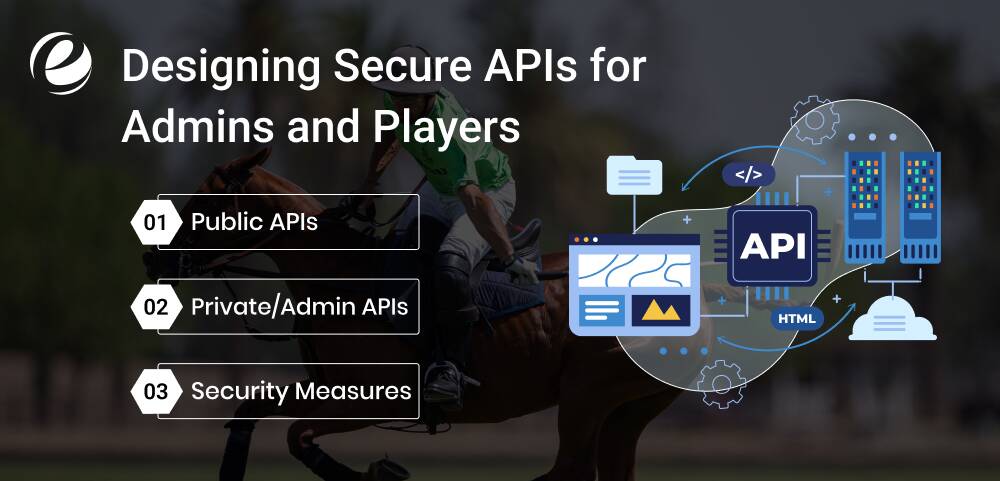
Designing Secure APIs for Admins and Players
The backend API facilitates the communication between the app and the database. So, it has to be both highly secure and easily accessible. Here is the segmentation for the same:
Public APIs
These open-access endpoints do not require logins or authentication steps. The Public APIs are designed for third-party apps and fans to fetch non-sensitive information, like live scores, match status, match schedules with place and time, team rosters, and player bios.
Private/Admin APIs
These endpoints are limited to verified users (coaches, clubs, and admins). They enable key internal operations, like:
- Upload match data and media (photos, reports, and videos)
- Edit, add, or delete players, horses, etc.
- Prepare and publish post-match stats
Security Measures
When data is highly sensitive, it is not a choice but a necessity to ensure robust security protocols. Here are the strategies to implement strong security:
- OAuth for Dashboards: Admins can log in with a Microsoft or Google SSO ID to avoid reused passwords and minimize risks.
- JWT-based authentication: JSON Web Tokens validate every request, ensuring that only verified users with defined roles can access secure endpoints.
- Rate Limiting and Abuse Protection: Suspicious request patterns are detected and throttled to block credential stuffing and API spamming.
Tips for Efficient Media Management
Photos, videos, highlights, and match replays are the elements of a polo game app that keep fans engaged and make them come back to the platform. From a quick foul clip to helmet cam footage, these are the details that need a robust and well-optimized backend. Let’s briefly discuss the key strategies to ensure a strong backend for the sports app to manage media efficiently:
Ensure Media Storage Scalability
Store and retrieve massive volumes of media files (like highlights, footage, etc.) with ease, using cloud-based storage, like Google Cloud Storage or AWS S3. This not only ensures reliability but also makes the app media scalable. Moreover:
- You can enable lifecycle rules, regional replication, and automatic backups to manage historical content without obstructing performance.
- Link important metadata to each file (like timestamp or match ID) and store it in the backend database. This speeds up filtering and searching content on the frontend.
Use CDN Integration
Using CDNs like AWS CloudFront or Cloudflare helps present images and videos from geographically distributed edge servers. This ensures smooth playback and speeds up load times on devices.
Implement Streaming and Clipping Tools
To facilitate seamless engagement, compile post-match highlight reels. Also, enable selective playback within dashboards and apps for deeper insights. You can leverage tools to clip key events from the match based on data automatically.
The Backend Architecture: A Snapshot
Now, let’s get to the main part: How do things exactly work and what it takes to create a seamless backend architecture.
-
Tech Stack
Below is the table presenting the core technologies used for architecture building.
| Layer | Tech Stack |
| Backend | Node.js (Express.js/NestJS) |
| DB | MongoDB or PostgreSQL |
| Real-Time | Socket.io / Firebase |
| Media | AWS S3 + CDN |
| Caching | Redis |
| Auth | JWT + OAuth |
| Queueing | BullMQ / RabbitMQ |
| Monitoring | Prometheus + Grafana |
-
Architecture Flow
csharpCopyEdit[Client App] | ↓ REST/WebSocket[API Gateway] | ↓ (Auth Check – JWT)[Backend Server – Node.js] | ├── Real-time Updates via Socket.io ├── Match Engine / Game Logic ├── Player & Horse Manager ├── Admin Panel Services | ↓[Database Layer – MongoDB/PostgreSQL] ↓[Redis Cache Layer] ↓[Media Service – AWS S3 + CDN] ↓[Notification System – Email/SMS via SendGrid/Twilio]
-
Key Backend Modules
Here are the key modular backend services to power up the platform’s operations:
- Match Engine: To start/stop matches and manage sync of events.
- Player Management: To track player stats, injuries, and full CRUD operations.
- Horse Life Cycle Tracker: To assign horses to players and log medical histories.
- Admin Reporting: To export insights as PDFs/CSVs and display visual analytics in dashboards.
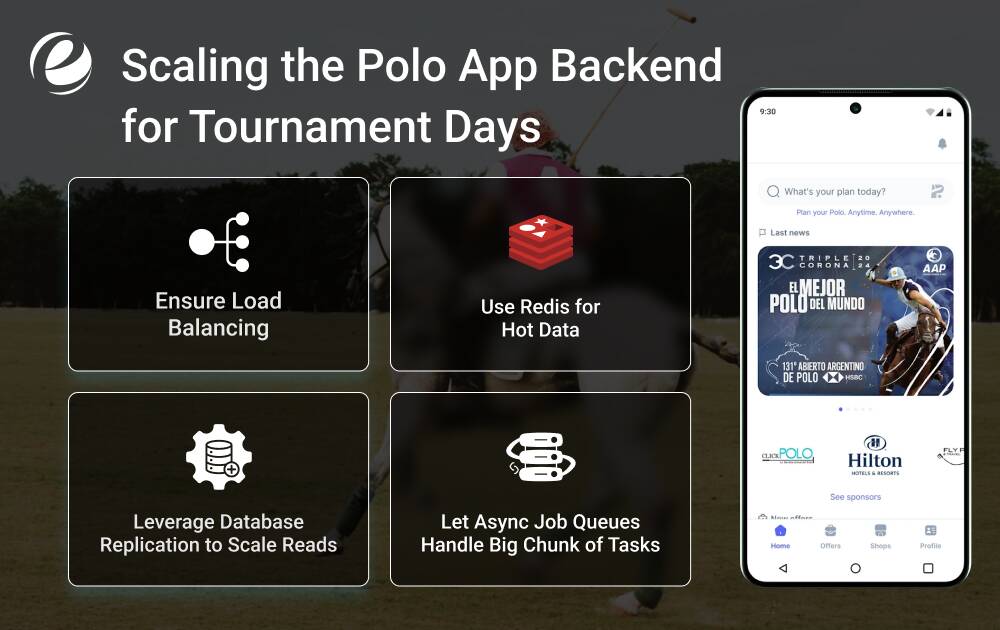
Scaling the Polo App Backend for Tournament Days
Plan to make your app enjoyable for hundreds of polo fans, media, players, and more? Here’s what you need to do to ensure that the platform is ready to perform seamlessly:
Ensure Load Balancing
Tournaments attract a spike in traffic and must be handled smartly. To approach such surges seamlessly, leverage NGINX for load balancing. It keeps the server from turning into a challenge by distributing traffic across different backend instances. As a result, latency remains minimal to zero, and interactions continue to be fluid.
Use Redis for Hot Data
Tournaments are all about fast-changing data. Be it timeouts, scores, or fouls, everything needs to be stored without a hassle. That’s when Redis enters the scene. Live stats are written to this in-memory store for minute-level accessibility. This minimizes the dependency on traditional database reads to a significant extent, beating latency.
Leverage Database Replication to Scale Reads
While writes move to the primary database, read replicas can be used to show public data (like team stats, player profiles, etc.). This approach helps make sure that the main database remains free to focus on live match writes as fans flood the polo game app to check other details.
Let Async Job Queues Handle Big Chunk of Tasks
Not every function needs to work instantly, definitely not at the cost of the main events getting blocked. These functions could be notification, email triggers, or post-match stats crunching. The key is to implement BullMQ with worker threads to ensure these tasks run in the background, so no delay takes place on the front.
Keeping Up with the Frontend
A strong backend for a sports app is not just about handling massive volumes of data. It should also be capable of accommodating the frontend demands, like ensuring compatibility with different devices, checking up on different network areas, etc. Here are some of the checkpoints to ensure a seamless frontend:
Mobile-First API Design
Focus on keeping the payload relevant and lightweight. Prioritize above-the-fold data, paginate wherever feasible, and do not forget to lazy-load everything else when a user clicks or scrolls.
WebSocket Fallbacks
Not every region can accommodate a solid network. So, you cannot rely on WebSockets alone. That said, switch to REST-based polling in case the socket drops. Use auto-reconnect logic to make sure that there is no (or minimal) disruption. This eliminates the hassle of users refreshing the app manually.
GraphQL
Avoid approaching multiple endpoints, use GraphQL to get exactly what you need instead. In the backend for sports apps, this simply means fetching player stats, chat history, scoreline, and more, all in one go with one smart query.
Final Thoughts
Polo has just started picking up the pace in digitization and has a long way to go. So, if you want to offer a feature-rich polo game app to the fans, clubs, and players, it has an open ground to bring a unique experience for all. A powerful backend for sports apps helps you turn that idea into magical gameplay.
As we discussed, developing a solid backend architecture is more than just about understanding and implementing the right technologies. It should be focused on creating an ecosystem where everyone, from players to clubs to horses to the audience, can engage without any disruptions. Once you have cracked the roadmap to that, you are already halfway through preparing a fault-tolerant, scalable, and engaging equestrian sports app.

FAQs
Why is the backend necessary for sports apps?
Backend powers several capabilities of sports apps like real-time updates, match data syncing, user accounts, and more. It ensures that everything runs seamlessly on the user’s side of the app.
How do you get started with scalable polo app backend development?
Scalable backend development begins with clarity on core features of the app, like live tracking and user management. Moreover, choosing scalable technologies like Node.js is also essential for ensuring robust performance. Consider opting for modular architecture to facilitate seamless app updates in the future.
Can I integrate third-party services into the Polo app backend?
Yes, payment gateways, ad networks, analytics, and more such third-party services can be integrated using APIs.



 +1 (989) 535-9295
 info@emizentech.com
 emizentech


