 Add us as a preferred source on Google
 When you go through the questions to ask before hiring an eCommerce developer, are you sure you’re hiring a person who can help you achieve your business objectives and develop an eCommerce site that performs well? Hiring the right eCommerce developer can make or break your eCommerce business.
A well-built eCommerce site not only looks professional but also performs well, converts visitors to customers, and scales as your business grows. The need for hiring the right eCommerce developer cannot be overstated more than it is today, especially in today’s growing digital landscape.
In fact, eCommerce sales are expected to contribute 21.1% of total retail sales in 2026 and are likely to reach 22.5% by 2028, thus emphasizing the significance of a strong online presence in a highly competitive market. This guide covers the most important questions to ask before hiring an eCommerce developer.
12 Essential Questions to Ask Before Hiring an eCommerce Developer
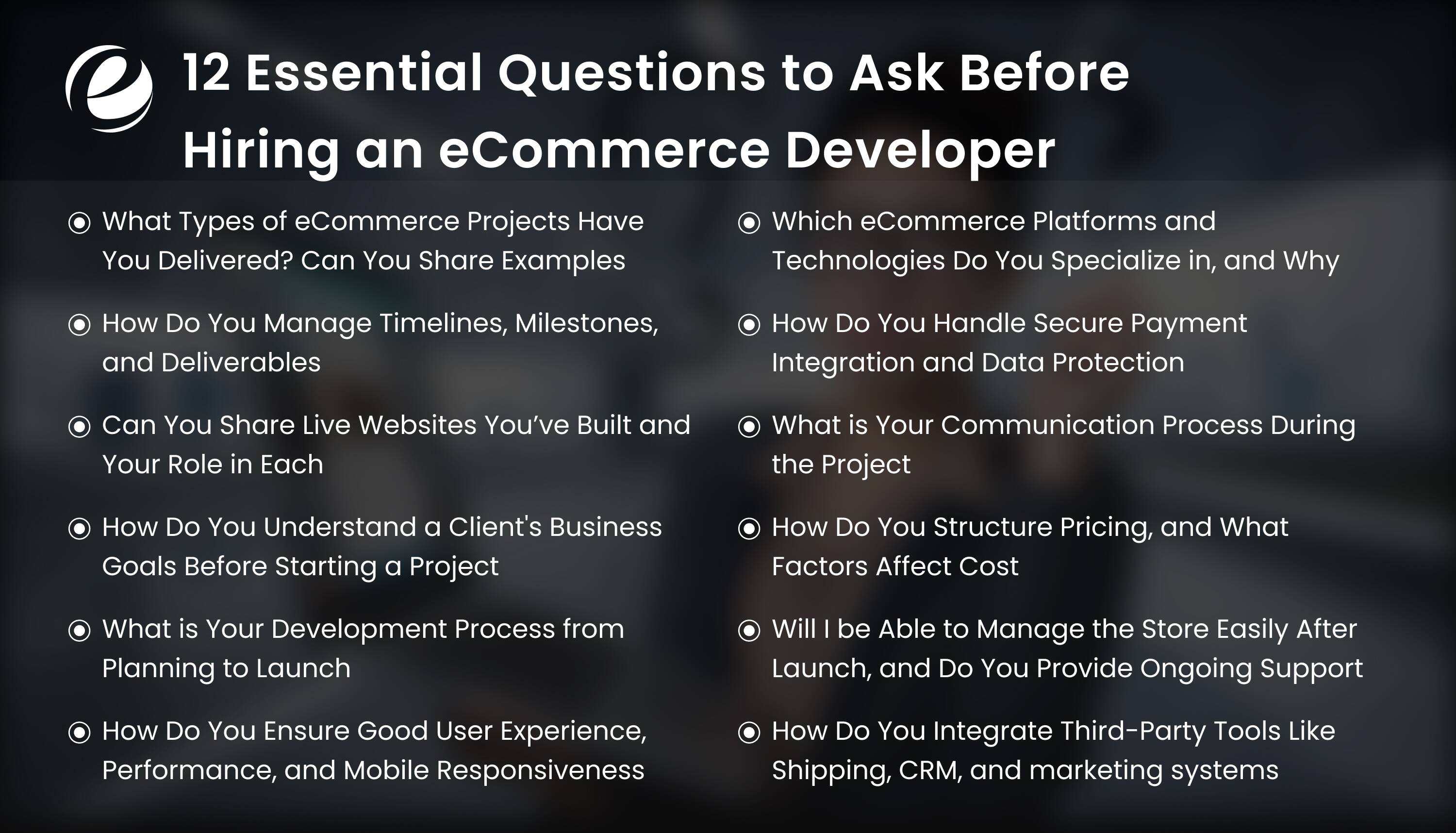
Questions can serve as a guideline for identifying and assessing the best candidates to successfully deliver your project, regardless of whether you’re retaining an independent developer or you’re looking to partner with an eCommerce development company. Here are some crucial questions to ask before hiring an eCommerce developer:
What Types of eCommerce Projects Have You Delivered? Can You Share Examples?
It’s worth asking what kind of stores they’ve actually built for simple products, catalogs, or even marketplaces for multiple sellers. Real evidence is more compelling than claims. When you look at their past work, you’re getting a sense of how they handle things like performance and scaling. For companies that plan to hire eCommerce developer for a similar project, it is important to review their portfolios to ensure they have both relevant experience and the necessary skills.
How Do You Manage Timelines, Milestones, and Deliverables?
Every project runs more smoothly when there’s a clear plan. A good developer usually breaks work into stages like planning, design, development, testing, and launch. Ask how they track progress and stay on schedule. The answer should feel organized, not vague, with some method for keeping both sides aligned throughout the process. Many companies prefer to hire web developers who have developed structured workflows and have demonstrated their ability to deliver on time.
Can You Share Live Websites You’ve Built and Your Role in Each?
Live sites tell you far more than a portfolio screenshot ever will. Ask them to take you through some of their projects. Sometimes, you may have multiple people working on the same project, so it’s good to know if they worked on the whole project or if they worked on parts of it, such as frontend, backend, etc.
How Do You Understand a Client’s Business Goals Before Starting a Project?
This is where experience really shows. A good developer will not simply start coding. Instead, they will ask you questions about your products, your audience, your competitors, and what you are trying to accomplish. The goal is to shape the store around your business, not force your business to fit a generic template.
What is Your Development Process from Planning to Launch?
A typical project moves through a few key steps: gathering requirements, sketching layouts, designing the interface, building the site, testing everything, and finally going live. What matters is whether they follow a clear sequence and check quality at each stage, instead of rushing straight to development.
How Do You Ensure Good User Experience, Performance, and Mobile Responsiveness?
People leave quickly if a site feels slow or confusing. Inquire about the developer’s approach to speed, navigation, and mobile-friendly layouts. Good developers will create user-friendly websites, optimize images and code, and ensure that the e-commerce store is functioning properly on mobile devices, since this is likely where the majority of visitors come from.
Which eCommerce Platforms and Technologies Do You Specialize in, and Why?
There are various tools available so that all developers do not have to use the same software to create e-commerce sites. Developers often specialise in diverse platforms. Some of them focus on Shopify, others on WooCommerce or Magento, while some build eCommerce websites with the help of custom code. What you want to hear is not just what they use but why they recommend it for your specific situation: budget, flexibility, and long-term plans all matter here.
How Do You Handle Secure Payment Integration and Data Protection?
Security isn’t optional in eCommerce. Ask how payments are processed and how customer data is protected. A capable developer will rely on trusted payment gateways, SSL encryption, and safe data handling practices. They should also be aware of common risks and how to reduce them without overcomplicating things.
What is Your Communication Process During the Project?
Unclear communication leads to project drift. To prevent this, determine the frequency of your project updates and the tools that will be used for those updates and how feedback will be provided. Some teams rely on regular check-ins, while others use dashboards to track progress. The most important factor is consistency, with no gap in time between communications, so that you are never wondering what is or isn’t happening.
How Do You Structure Pricing and Determine Project Costs?
The cost of a project is usually measured depending on the complexity, such as features, custom design requirements, and timelines. Based on this, developers may have different approaches to charging for a project, such as a flat rate for the entire project or an hourly rate, among others. Understanding the cost structure is crucial since a detailed cost breakdown helps you make sense of the cost and know exactly what you are getting into.
Will I be Able to Manage the Store Easily After Launch, and Do You Provide Ongoing Support?
Once your site is live, you shouldn’t need to rely on a developer for every little change. It is a good idea to check if you’ll be able to manage products, orders, and content yourself. It is also good to check if they offer training and support once the site is launched, in case things go wrong or need updating.
How Do You Integrate Third-Party Tools Like Shipping, CRM, and Marketing Systems?
Most stores rely on extra tools to run smoothly, such as shipping providers, email marketing platforms, analytics, and CRMs. Ask how they connect these systems and whether the integrations are stable. Good integration work saves time later and helps everything from orders to customer data flow without manual effort.
Final Thoughts
Hiring an eCommerce developer involves more than just evaluating their technical skills. When you explore questions to ask before hiring an eCommerce developer, you want someone who will take the time to understand your business, who communicates well, and whose development process is well-structured. The right developer will help you build an eCommerce store that is secure, scales effectively, and performs at a high level. In case you plan to scale beyond just a website, it is great to invest in a dedicated eCommerce app development solution to improve customer engagement. When interviewing or consulting with developers or other eCommerce professionals, use the questions from this guide as a checklist.
FAQs
What Should I Look for When Hiring an eCommerce Developer?
Search for experienced developers with proven work history, a solid portfolio, experience working on your platform, great communication skills, and the ability to meet deadlines with an understanding of your business goals.
How Long Does it Take to Develop an eCommerce Website?
The time required to develop an eCommerce website can vary depending on several factors, such as the number of features, overall complexity, integration needs, and the level of customization required.
How Much Does it Cost to Hire an eCommerce Developer?
Prices also vary greatly. The difference is mainly due to scope, platform design specification, and required expertise level; generally, they span from budget to luxury prices.
Which eCommerce platform is best for my business: Shopify, WooCommerce, or custom development?
Shopify is ideal for a quick and easy store setup, WooCommerce offers greater flexibility for WordPress users, while custom development is best suited for businesses with complex or highly specific requirements.




 +1 (989) 535-9295
 info@emizentech.com
 emizentech


