
 Add us as a preferred source on Google
The online marketplace has quickly evolved to keep up with ever-changing customer demands. Today’s consumers want fast service, and their shopping experience is shaped by how quickly they can get what they need. In the eCommerce world, businesses must keep up with changes in supply and demand. After the pandemic, people now value efficiency and convenience more than ever. To meet these expectations, quick commerce and on-demand app development has emerged as an efficient solution.
E-commerce has already changed the way we shop online, offering a wide variety of products and different delivery options. However, quick commerce takes it a step further. It’s revolutionizing the shopping experience with ultra-fast delivery of everyday items. Quick commerce focuses on fast, on-demand delivery, meaning most orders are delivered within an hour of being placed.
While eCommerce and quick commerce are similar, the key difference lies in the delivery speed. In quick commerce, delivery happens within minutes, not days. It relies on local fulfillment centers and a strong logistics network for quick deliveries. In contrast, traditional e-commerce may take several days to fulfill orders, covering a larger geographic area.
If you’re curious about quick commerce, keep reading! In this blog, we’ll explore quick commerce and its business model in detail.
What Is Quick Commerce?
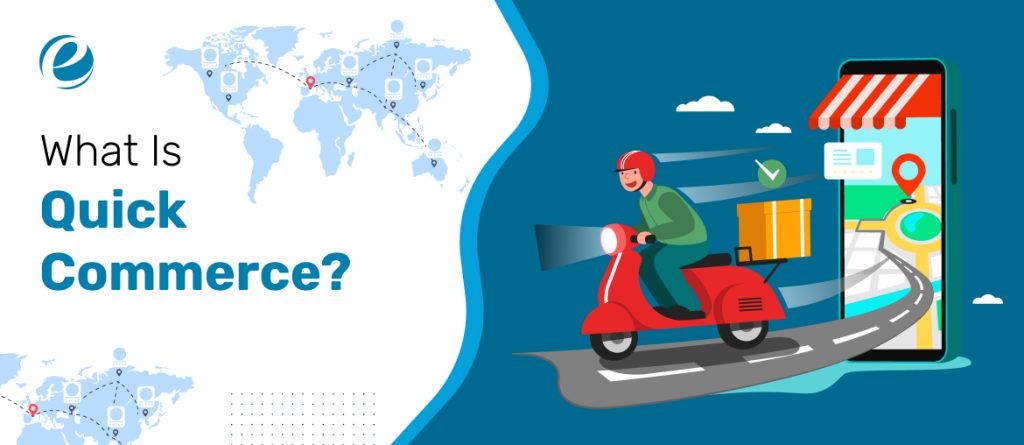
Quick commerce, also known as Q-commerce, is often considered the next generation of online shopping. It is a unique business model that focuses on providing fast delivery for small orders. In simple terms, Q-commerce ensures that customers receive their purchased items within hours or even minutes after placing an order. The delivery time, which used to take several days, has now been reduced to just 10-30 minutes.
Quick commerce covers a wide range of products, from small food orders to groceries, stationery, and pharmacy items. Many businesses have embraced this idea to bring a fresh and efficient solution to the online marketplace.
Q-commerce relies on local warehouses and fulfillment centers, which are typically found in most cities. These local hubs help ensure fast delivery by using a decentralized business model and working closely with local courier companies. As customers seek more convenience in their shopping experience, Q-commerce is becoming an essential part of today’s market.
How Does Q-Commerce Work?
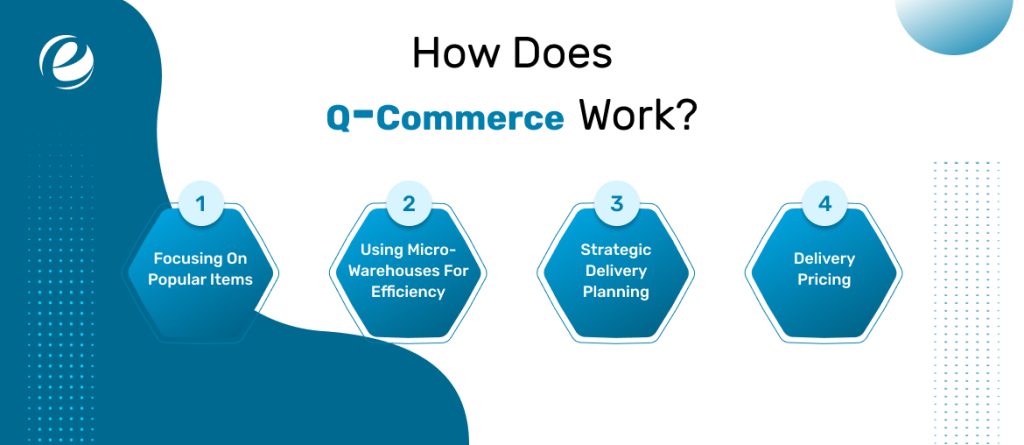
In this section, we will discuss how Q-commerce operates:
1. Focusing On Popular Items
Instead of keeping a wide range of products in stock, Q-commerce focuses on listing popular items that customers often buy, like essential groceries and everyday products. This helps reduce storage and warehouse costs because businesses can rent smaller spaces in the city instead of large warehouses on the outskirts.
2. Using Micro-Warehouses For Efficiency
Q-commerce companies use a strategy called “micro-warehouses.” These are small fulfillment centers, sometimes called “cloud stores” or “dark stores,” located in central neighborhoods. The goal is to make it easier for delivery partners to pick up and deliver items quickly. These micro-warehouses save time and travel costs compared to larger warehouses located outside the city. This setup helps Q-commerce businesses cut costs and reduce the time spent traveling long distances to fulfill orders.
3. Strategic Delivery Planning
Q-commerce companies plan their deliveries carefully. They hire delivery drivers for specific routes, such as morning or evening shifts, and divide cities into delivery zones. For example, one zone may require 50 deliveries a day, while another needs 100. The more deliveries a zone has, the more challenging and demanding the job becomes.
To ensure smooth operations, the right number of delivery drivers are assigned to each zone based on the expected delivery volume. GPS technology is used to track delivery partners, and they receive incentives for completing deliveries efficiently. Multiple orders are grouped together based on location to avoid unnecessary travel and save time.
4. Delivery Pricing
Q-commerce’s business model is more expensive than traditional e-commerce because the last-mile delivery service adds extra costs. To manage this, most Q-commerce startups charge a small delivery fee to customers. This cost can vary depending on the price of the items and the distance from the micro-warehouse.
Understanding The Quick Commerce Business Model
Below is a brief overview of the Quick Commerce business model:
1. Online Ordering
Q-commerce companies rely on customers placing orders through online or mobile apps. These apps let customers browse products, select items, and make payments. Delivery apps also allow users to track their orders and schedule deliveries for a later time.
2. Inventory Management
Q-Commerce mobile apps help businesses manage inventory and process orders efficiently. Real-time inventory tracking ensures that products are available for delivery and reduces the chances of cancellations due to out-of-stock items.
3. Order Processing
Q-commerce businesses process orders using their vendor or retailer apps. This typically includes validating payments and notifying the store or fulfillment center to prepare for dispatch. Many Q-commerce platforms now use AI-driven algorithms and automated systems to speed up order processing, which helps reduce delivery times.
4. Last-Mile Delivery
The final step in the Q-commerce model is delivering the products to the customers’ doorsteps. To make this process faster, Q-commerce companies use various techniques, such as specific pickup locations. By employing technology like route optimization and delivery algorithms, these businesses can reduce delivery times, often delivering groceries in as little as 10 minutes.
5. Customer Support
Customer support is vital for the success of any Q-commerce company. Customers may need help placing orders or receiving items, so having a reliable support system is essential for addressing concerns quickly. Q-commerce businesses offer support through live chat, email, and help with order returns or product inquiries, ensuring a smooth experience for their customers.
Benefits Of Quick Commerce

Super speedy quick commerce in on-demand delivery service is rapidly becoming popular in major cities where customers are delighted with speed and convenience. In this section, let’s have a look at key benefits of quick commerce.
1. Outstanding Customer Service
For Q-commerce, the main priorities are efficient delivery, fast service, and customer satisfaction. Customers benefit from the speed and convenience of having products delivered straight to their doors, saving them time and money. With deliveries made in just a few minutes, customer satisfaction is greatly improved.
2. High Growth Potential
Q-commerce presents a significant opportunity for market expansion. By establishing cloud-based stores in different cities or countries, businesses can grow quickly. Startups can also broaden their product range and offer limited quantities, allowing them to scale faster than traditional e-commerce businesses. Outsourcing delivery services further helps them expand efficiently.
3. Unique Selling Propositions
Q-commerce has introduced a new market by offering affordable last-mile delivery services. By providing customers with more convenience and lower prices compared to competitors, Q-commerce can now compete with both online retailers and local stores. Its fast delivery system has helped build a strong, recognizable brand in the marketplace.
4. Opportunity For Delivery Partners
Q-commerce businesses offer job opportunities to last-mile delivery providers. Many operate under an aggregator model, allowing them to work according to their schedules and earn extra income. This creates job opportunities for individuals who were previously unemployed or lacked a steady income.
5. Expanded Accessibility
Q-commerce ensures that customers’ needs are met quickly, offering a wide range of products, from everyday essentials to high-end items. As Q-commerce platforms continue to expand their inventory, they cater to the demands of consumers, small businesses, and offices that need fast replenishment, increasing accessibility for everyone.
6. Many Delivery Options
Q-commerce businesses provide various flexible delivery options, employing numerous last-mile delivery workers. These delivery partners often work on their own terms, allowing them to earn extra income. This model opens up job opportunities for individuals who were previously jobless or lacked a consistent source of earnings.
Q-Commerce Disadvantages
Q-commerce also has some disadvantages, which we are going to discuss in this section:
1. High Startup Operational Costs
Q-commerce delivery services have a cost of initial setup and incur on-demand app development cost because these businesses must set up the infrastructure and services required to make last-mile deliveries. This involves creating a warehousing facility that stores their merchandise, hiring delivery partners, and delivering items to customers as quickly as possible. The high costs of such delivery services make it hard for new Q-commerce companies to succeed in low-margin marketplaces.
2. Risks To Existing Local Economy
The delivery method of Q-commerce lets companies eliminate or reduce the need for local stores. This could be harmful to local companies because customers may prefer to shop for their necessities by shopping online rather than going to the market in their area.
3. Limited Product Range
Compared to traditional e-Commerce websites, Q-Commerce platforms offer only a limited selection of products, mostly daily-use products. This might not appeal to those who want to browse a larger selection of goods.
Key Elements Of Quick Commerce Business Model
Quick commerce is all about getting products to customers as fast as possible, often in just a few minutes. The main elements of Quick commerce are:
1. The Product/Service
This section focuses on product purchasing and selection. In addition, it analyzes the product, information regarding the number of sales and the amount of time spent on websites for the product, the purchasing process, etc.
2. The Customer
Q-commerce companies are primarily focused on customer service, and therefore, customer satisfaction is their top priority. Understanding customers’ behavior and buying habits is necessary to offer a great customer experience.
3. The Technology
Businesses that operate on Q-commerce platform are completely online. So technology has a huge influence on these stores. It’s crucial to stay updated with the latest technology for your Q-commerce business. Offer coupons, product suggestions searching, warehouse systems, and purchasing tracking systems are important to operate efficiently for offering smooth services to users.
4. The Marketing
The marketing department is accountable for both offline and online marketing strategies. This includes the use of digital media, social media advertising, TV marketing, and many more. Marketing strategies used by Q-commerce companies include personalizing websites, email marketing, and push notifications. In addition, they also focus on warehouse optimization.
5. The Sales
The sales department is accountable for outbound and inbound sales procedures. Inbound sales occur when a prospective customer or lead calls your company to inquire about a product or service. Outbound sales are when sales representatives contact a prospective client who has yet to inquire about an item or service the business offers. Sales departments must analyze sales statistics and keep track of them with a sales management software.
6. The Support
The Support department is comprised of the technical support as well as the customer service department.
- Technical support is required when a customer has issues with the mobile or website application. Problems with technical support can result from problems with payment or inventory information.
- The Customer Service department handles customer concerns and communicates with customers. They can use various methods to reach out to their clients, but the crucial aspect is being fast and quick to contact.
- Live chat is among the most widely utilized customer support systems. Companies can send automated messaging to clients in similar situations, and when the problem becomes more complex, customer support staff can handle issues independently.
- The most frequently used communication system for Customer Support is the smartphone. It allows customers to communicate with the support team in person and have their issues solved in a moment. The presence of a support team that can answer calls is crucial to boosting the level of customer satisfaction.
- The use of social media is widespread, and many individuals attempt to connect with businesses through social media to gain acknowledgment. Social media’s marketing strategy is crucial. However, it is essential to constantly be present in posts, messages to direct customers, and tweets that are mentioned to fix any issues swiftly.
Q-Commerce vs E-Commerce
At first, the Q-commerce business model may appear much like businesses that use e-commerce. However, a few differences in a Q-commerce structure make it unique from traditional eCommerce. The most obvious is delivery times. Q-commerce businesses are able to deliver immediately to their customers.
When e-commerce measures the shipping period in days, Q-commerce ensures that the item be delivered to the buyer in a matter of moments. The central warehouses used by e-commerce are generally located in the outskirts of towns or cities where prices are much lower. In addition, as the speed of delivery in Q-commerce is typically high, it is essential to locate warehouses close to where the customer segment resides. These are normally warehouses in urban centers or residential neighborhoods. E-commerce and Q-commerce have different approaches to logistics.
While e-commerce products are generally shipped by delivery vehicles or commercial parcel delivery services, Q-commerce companies are likely to use smaller, less manoeuvrable vehicles like motorbikes. Changes in the method of transport allow Q-commerce delivery providers to access locations for delivery and warehouses quickly, even when roads are jammed with traffic.
How Can You Implement Q-commerce?
Quick commerce is becoming increasingly important for companies that serve professionals, seniors, and large consumer audiences. It is especially beneficial for consumer packaged goods (CPG) and businesses looking to reach a wide customer base. As fast delivery becomes the norm, all consumers will expect quicker service.
1. Create Local Hubs
To deliver products within an hour, you need to be close to your customers. This is why Q-commerce depends on local warehouses located near residential areas. Most quick delivery businesses operating in metropolitan cities have local drivers ready to deliver goods.
Two-wheeled vehicles for deliveries are ideal and do not require large parking spaces. Businesses can also seek assistance from local service providers or third-party services. Various rapid commerce hubs can provide services in less than 30 minutes. Still, they offer additional omnichannel solutions, including collection points and in-store scans that can be integrated with online payments.
2. Be Sure To Select The Right Stock For Your Q-commerce
Currently, quick commerce is particularly effective for specific products and markets. On-demand delivery is ideal for everyday essentials like cosmetics, food, and other consumer packaged goods (CPG). Medicine and gifts also work well for quick commerce delivery. Additionally, with more people working from home, electronic devices and office supplies are becoming popular choices.
Q-commerce companies tend to stock local stores with the frequently purchased items, especially those favored by Gen Z and millennial consumers, who are more likely to seek out fast deliveries. It’s also important to have high-demand items available for older customers who prefer shopping from home. The success of your offerings depends on the target audience you are focusing on.
3. Ensure You Are Using The Appropriate Software
For Q-commerce businesses to run smoothly, it’s crucial to have an inventory management system in place. These tools help improve efficiency and speed while keeping your online stock data accurate. They also prevent stock-outs, which can affect sales, and minimize deadstock, which can increase storage costs, especially in expensive urban warehouses.
Inventory and pricing monitoring tools provide real-time visibility of stock levels for all retailers, ensuring that products can be reordered or redistributed without delays. Logistics teams can track which products are performing best in your rapid distribution networks, helping retailers optimize their offerings and improve their product selection.
4. Alternative Solutions
Many brands, such as Walmart and Amazon, offer fast delivery to their customers. However, if you’re not ready to build your own delivery system, there are plenty of third-party (3P) delivery services that can help. These services specialize in connecting stores to local customers with quick delivery options. Examples include DoorDash which is widely used in cities around the world. These services make it possible for almost any business to offer fast delivery to their customers, without the need to manage their own logistics.
Top Quick Commerce Trends For 2025
As consumer expectations evolve, Q-commerce is adopting new trends to stay ahead of the competition and cater to modern demands. Here are some key Q-commerce development trends that will shape the future of the industry:
1. Impulse and Seasonal Purchases
Quick commerce is an excellent way to capitalize on impulse buying, particularly around festive seasons or special occasions. By offering holiday-themed products or limited-time offers to users, businesses can create excitement, prompting consumers to make unplanned purchases.
In the future, Q-commerce will expand to include high-value items like electronics, cosmetics, and even gold, catering to customers seeking luxury and premium products with quick delivery. This will open up new customer segments, especially wealthy shoppers, and increase the average order value.
2. Rise of Distributor-Powered Quick Commerce Marketplaces
In coming years, local distributors will play an increasingly vital role in powering Q-commerce platforms. By leveraging existing distribution networks, companies can ensure faster delivery times, improve inventory control, and provide more flexibility in meeting regional demand.
Local distribution hubs will enable businesses to tap into new markets quickly and efficiently, offering more responsive and scalable delivery systems. This trend will transform how businesses manage their logistics and distribution, bringing products to customers in less time.
3. AI-Driven Personalization for Instant Gratification
Artificial intelligence is set to revolutionize Q-commerce by offering highly personalized shopping experiences. AI can analyze customer browsing patterns, purchase history, and preferences to provide tailored product suggestions and localized deals.
This personalization can be extended through multilingual interfaces, ensuring customers get the best shopping experience. By predicting customers’ needs and presenting relevant products immediately, AI will increase customer engagement, boost conversion rates, and enhance the overall shopping experience.
4. Subscription-Based Models For Essentials
Subscription-based models will become a core element of Q-commerce businesses, particularly for essential items like groceries, pet food, and personal care products. These models provide convenience and predictability for customers, ensuring that they never run out of stock.
Subscription services can also create loyal, long-term customers, offering personalized plans and discounted rates for repeat customers. This model will help Q-commerce platforms build stable, recurring revenue streams and improve customer retention.
5. Personalized Discounts To Boost Sales
To further enhance customer loyalty and engagement, Q-commerce businesses will increasingly offer personalized discounts based on individual shopping habits and preferences. By analyzing customer data, businesses can offer targeted promotions that are more likely to convert, reducing shopping cart abandonment rates. Personalized discounts not only incentivize purchases but also improve customer satisfaction by ensuring that deals are tailored to each shopper’s needs.
6. Enhanced Real-Time Inventory and Stock Visibility
As Q-commerce continues to thrive, real-time inventory management will become more critical. Clear visibility into stock levels will help prevent out-of-stock scenarios, reducing customer frustration and cart abandonment.
A modern inventory tracking system ensures that products are available when needed and shipped promptly. Real-time stock visibility will also improve supply chain management by reducing excess stock and enhancing the customer experience with timely deliveries.
Why Choose EmizenTech For On-Demand App Development Services?

Looking to develop a quick commerce app for your business? Our on-demand app development services are here to help you tap into the growing demand for Q-commerce. With a team of experts who specialize in crafting user-friendly, responsive, and robust applications, we ensure your app meets the needs of today’s fast-paced market.
At EmizenTech, we understand the importance of speed, efficiency, and seamless real-time connectivity in the Q-commerce industry. Our experienced developers work closely with you to create a tailored quick commerce development solution that enhances user experience and drives business growth. From initial design to final delivery, we provide comprehensive support and ongoing maintenance to ensure your app stays ahead of the competition. Choose us to create a scalable, high-performance app that helps your business thrive in the world of quick commerce.
Final Thoughts
Q-commerce is a new trend that is creating many opportunities in the world of shopping and e-commerce. It is quickly changing the way we buy things by offering fast delivery of everyday products. This shift aligns with our need for convenience and speed. Unlike traditional e-commerce, where delivery can take several days, Q-commerce allows customers to order a wide range of products and have them delivered in just minutes or hours. It focuses on providing daily-use items that are in high demand, right when people need them.
Companies in the Q-commerce industry are working on expanding their delivery areas and improving how they use technology. They are also investing in developing on-demand apps and working on sustainability efforts. These changes are shaping the future of Q-commerce, setting the stage for its growth and innovation in the years to come. As technology advances and consumers continue to expect faster delivery, Q-commerce will become even more important in the future of business. It is clear that Q-commerce will play a major role in meeting the increasing demand for fast and efficient delivery services.
FAQs
What is the difference between Q-commerce and E-commerce?
At first, Q-commerce and e-commerce might seem similar. However, the key difference is in the delivery time. E-commerce emphasizes the convenience of online shopping and delivery, while Q-commerce takes it a step further by prioritizing faster delivery times and user-friendliness.
What are the advantages of Q-commerce for the consumer?
Q-commerce changes the online shopping experience by offering incredible convenience with fast delivery, often within hours or even minutes. It provides a wide range of products, from groceries to electronics, and uses AI technology to create a more personalized shopping experience.
What is the importance of on-demand delivery in Q-commerce?
On-demand delivery is the backbone of Q-commerce. It allows customers to order products at any time and receive them quickly, often in minutes. With Q-commerce, there’s no need to wait for days or weeks for your purchase to arrive. The speed of delivery is one of the most important factors in the success of Q-commerce.
How can small businesses benefit from Q-commerce?
Small businesses can take advantage of Q-commerce by partnering with delivery platforms or creating their own delivery system. Key to success in Q-commerce is having a solid inventory control system and reliable delivery partners, ensuring that businesses can fulfill customer orders quickly.


 +1 (989) 535-9295
 info@emizentech.com
 emizentech


