
 Add us as a preferred source on Google
 Building a successful Shopify store takes more than just adding a product and launching a theme. With the increase in competition and the rise in customer expectations, a business will need to have very clear strategies, technical skills, and an ongoing optimization to be able to make a profit. This is where a Shopify consultant comes in to help the brand and even make it smarter. The technology is not the only thing that needs improving; the consultant can also take the brand through the planning of long-term growth. Right guidance in these aspects can impact your store’s performance and revenue.
The ultimate guide is designed to help you understand every aspect of Shopify eCommerce Consultant, their work, and how to select the right one for your business. You will know how the consultants approach store optimization, how to evaluate hiring possibilities from the angle of a Shopify consultant vs. an agency, and what costs, processes, and outcomes you can expect. Whether you are launching a new store or refining an existing one, you will gain practical insights to hire wisely, compare effectively, and grow your Shopify store with clarity and confidence.
What is a Shopify eCommerce Consultant?

A Shopify eCommerce Consultant is a specialized expert who has a lot of experience and helps companies to create and develop online stores on the Shopify platform that are not only successful but also scalable. A consultant does not merely take up development tasks but a strategic view of the business, aligning technology, design, and business goals to create an online store that operates excellently and changes visitors into customers.
The consultants guide brands at every stage of their e-commerce journey, from launching a new store to improving an existing one, and often work closely with the teams that are involved in Shopify store development to make sure the store is built for long-term success. There are mainly three types of consultants: freelancers, agencies, and Shopify partners. Brands can choose between them depending on the project, budget, and growth plans. The article further explains a fair comparison between them.
These consultants have good hands-on experience with Shopify and also have a very strong understanding of user behavior, sales funnels, and operational efficiency. They partner with business owners every day to facilitate site performance, improve customer experience, and unleash growth-oriented solutions that are practical. Their main concern is not how the store looks but how well it supports business objectives.
A Shopify eCommerce Consultant usually assists with:
- Store strategy and setup: Advising on the structure, themes, and apps based on business goals.
- User-experience optimization: Improve conversion rates (CRO), UX, and mobile responsiveness.
- Marketing and conversion support: Sales boosts, recommendations for SEO, and checkout optimization.
- Operational efficiency: Making inventory management, payments, and integrations smoother.
- Scalability planning: Preparing the store for handling growth, traffic surges, and future expansion.
Why Your Shopify Store Might Need a Consultant?
A Shopify store’s handling is easy to witness, yet the hidden problems may start silently as the business starts to expand, affecting performance, sales, and customer experience. The Shopify Consultant service is the one that takes care of the matters by not only fixing the issues but also by identifying the gaps that the store owners miss and turning them into opportunities for growth.
Common Challenges Faced by Shopify Store Owners
Nearly all Shopify stores go through similar problems in different phases of their growth. The main issues include:
- Low conversion rates despite decent traffic: Quite a number of stores attract visitors but then lose them to the poor products, lack of clear CTAs, or complicated checkout processes.
- Store performance slows down and technical issues occur: Too many apps, themes and integrations that are not optimized for speed, or outdated ones, can lead to the store being slow, which results in higher bounce rates and ultimately, loss of sales.
- User experience is poor and navigation is problematic: Users can easily become confused by the memos that are hard to figure out, layouts that are cluttered or by the simple fact that a website is not mobile-optimized, and thus their session lasts very little.
- SEO is ineffective and organic visibility is limited: If your store does not get indexed due to the lack of on-page optimization, product structuring, and content strategy, it will struggle to appear in search results.
- Scaling difficulties as the company gets bigger: Tactics for the small store may backfire as a brand grows. Without a clear strategy, scaling often leads to operational inefficiencies.
How Do Consultants Solve These Challenges?
A professional consultant will give you a clearer view, a wider experience, and verified techniques. Some of the benefits are explained below:
- Store audits associated with data-driven insights: The consultants study the customer flow, the conversion paths and the different metrics set to measure the store’s performance to point out the sources of the store’s conditions.
- Conversion-oriented alterations: A Shopify CRO expert will certainly make sure that every single step of the buyer journey supports the conversion of the visitors into buyers through optimizing product pages and improving the checkout process.
- Performance and app enhancement: The store will be made fast and stable by the deletion of unnecessary apps, dealing with integration performance in a more efficient way, and streamlining the whole store’s operations.
- Strategic growth planning: Instead of making decisions through trial and error, consultants correspond with the business goals, budget, and audience.
- Technical support is available on the spot when needed: Many businesses also prefer working with the development team to consult specialists, as they have the option to hire dedicated Shopify developer which helps in getting quicker undertakings and long-lasting scalability.
The Step-By-Step Process a Shopify eCommerce Consultant Follows
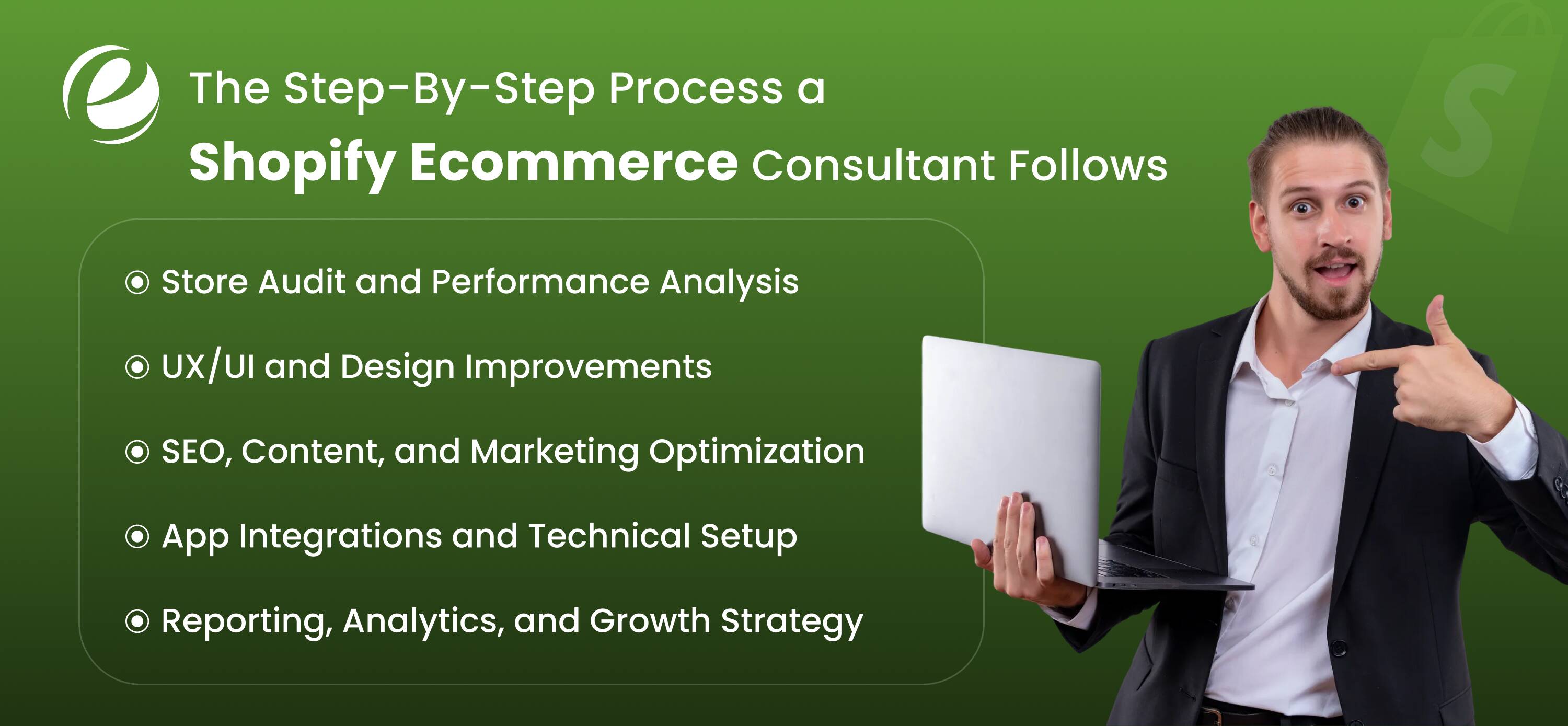
A Shopify eCommerce Consultant systematically leads the client through the entire process and ensures that each step results in measurable business value. The consultant uses insights, data, and long-term goals to allow the project to grow and this is what clearly distinguishes the professional from the trial-and-error approaches that are commonly discussed in the Shopify consultant vs agency dispute.
Stage 1: Store Audit and Performance Analysis
The first thing that occurs is a detailed store audit. This will help in determining where the growth is being blocked and what is doing well. The consultant will perform a technical review of site speed, mobile compatibility, conversion funnels, SEO, and user behavior data.
The target is to uncover the hidden points of friction that discourage sales; for example, long loading pages, high cart abandonment rates, or badly designed product pages. This diagnostic phase not only prepares the ground for good decision-making but also positions the consultant as an actual expert in Shopify store optimization rather than just someone carrying out what they have been told.
Step 2: UX/UI and Design Improvements
The process starts by focusing on the customer experience. The store is made conversion-friendly through refining navigation, layout, product presentation, and mobile usability. There is an emphasis on customer journeys, making sure that the visitors can easily discover the products, trust the brand, and complete purchases. This step is often carried out alongside the work of a Shopify CRO expert and data-driven usability and conversion goals.
Step 3: SEO, Content, and Marketing Optimization
Consultants work on visibility and engagement through SEO and content optimization. Site structure improvement, product description optimization, metadata refining, and content alignment with buyer intent are some major changes offered. All marketing elements such as landing pages, email flows, and promotions are also optimized to ensure a sustainable Shopify growth strategy that will attract and convert qualified traffic.
Step 4: App Integrations and Technical Setup
To enable the advanced functionality, consultants have the apps and integrations that come with performance, but without slowing the store down. This could be payment systems, analytics tools, inventory solutions, or marketing automation. Professional Shopify expert services usually rely on seamless backend connections, as businesses invest in reliable integration services to ensure scalability and operational efficiency. You can further investigate your options via trusted Shopify integration services.
Step 5: Reporting, Analytics, and Growth Strategy
This step focuses on tracking results and planning. Consultants set up dashboards, monitor KPIs, and analyze performance trends to understand the driving growth. Based on data, they recommend ongoing improvements, experiments, and expansion opportunities. This ensures the store doesn’t just perform well, but continues to evolve with market demands and customer behavior.
How to Hire the Right Shopify Consultant?
Choosing the right consultant can positively impact the performance of your Shopify store in terms of measurable metrics. A competent Shopify E-commerce Consultant not only carries out the tasks but also makes sure that the technology, design, and strategy are working with your business objectives. For store owners who prefer sincerity over jargon, here’s a practical, step-by-step guide:
Define Your Goals Clearly
Be specific about your desired outcome before turning to any expert for help. Detailed goals not only help you find the right consultant but also helps to avoid hiring.
Put the following questions to yourself:
- Is it a new store or an existing one that you are working on?
- What do you consider to be the key areas of improvement: design, performance, or conversions?
- Is your focus on SEO, speed, or sales growth?
Prepare a Detailed Project Brief
A well-prepared brief eliminates misunderstandings and clarifies expectations. It must contain:
- Business goals (e.g., increase conversion rates or decrease cart abandonment)
- Engaged audience and geographical areas
- Essential functionalities (multi-currency, advanced filtering, CRM or payment gateway integrations)
- Clothing style as well as brand and logo specifications
- Performance standards (like load time or conversion rate goals)
Shortlist Based on Relevant Experience
Not all professionals are appropriate for every company. Concentrate on:
- Relevance of portfolio for your industry
- Verified customer reviews and ratings
- The clarity and style of communication
Interview Strategically
Interviews can be utilized for the purpose of informing the consultant’s thought process:
- How does the consultant matter in relation to performance or conversions?
- Which are the tools that the consultant prefers for audits, testing, and optimization?
- What methods or techniques does the consultant follow for controlling the timelines and reporting?
Review Proposals Carefully
An ideal proposal should provide a clear picture of:
- Timeline and milestones
- Specific deliverables
- Transparent pricing
Start with a Small Test Project
Instead of getting into a long-term commitment from the beginning, start with a small project like:
- Optimization of a product page
- Speed audit
- Redesign of a landing page
Finalize Contracts and Support Terms
Be sure that the contract covers:
- Nature of the work
- Payment schedules and modes
- Rights of ownership
- Support and maintenance after launch
How Much Does Hiring a Shopify Consultant Cost?
Consulting a Shopify partner is a wise move for those enterprises that want to develop, enhance, or enlarge their e-commerce site. To build a store, Shopify is simple, but professional support makes sure that users are getting maximum benefit from the features, which will save them time, increase efficiency, and eventually lead to higher sales.
The table below summarizes the approximate expenses of hiring a consultant:
| Pricing Model | Best For | Typical Range (USA) |
| Hourly | Small or undefined tasks | $25–$250/hour |
| Project-Based | Store setup or app integration | $500–$10,000+ |
| Retainer | Marketing & Ongoing growth and optimization | $500-$5,000+/month |
Comparing Freelancers, Agencies, and Shopify Partners
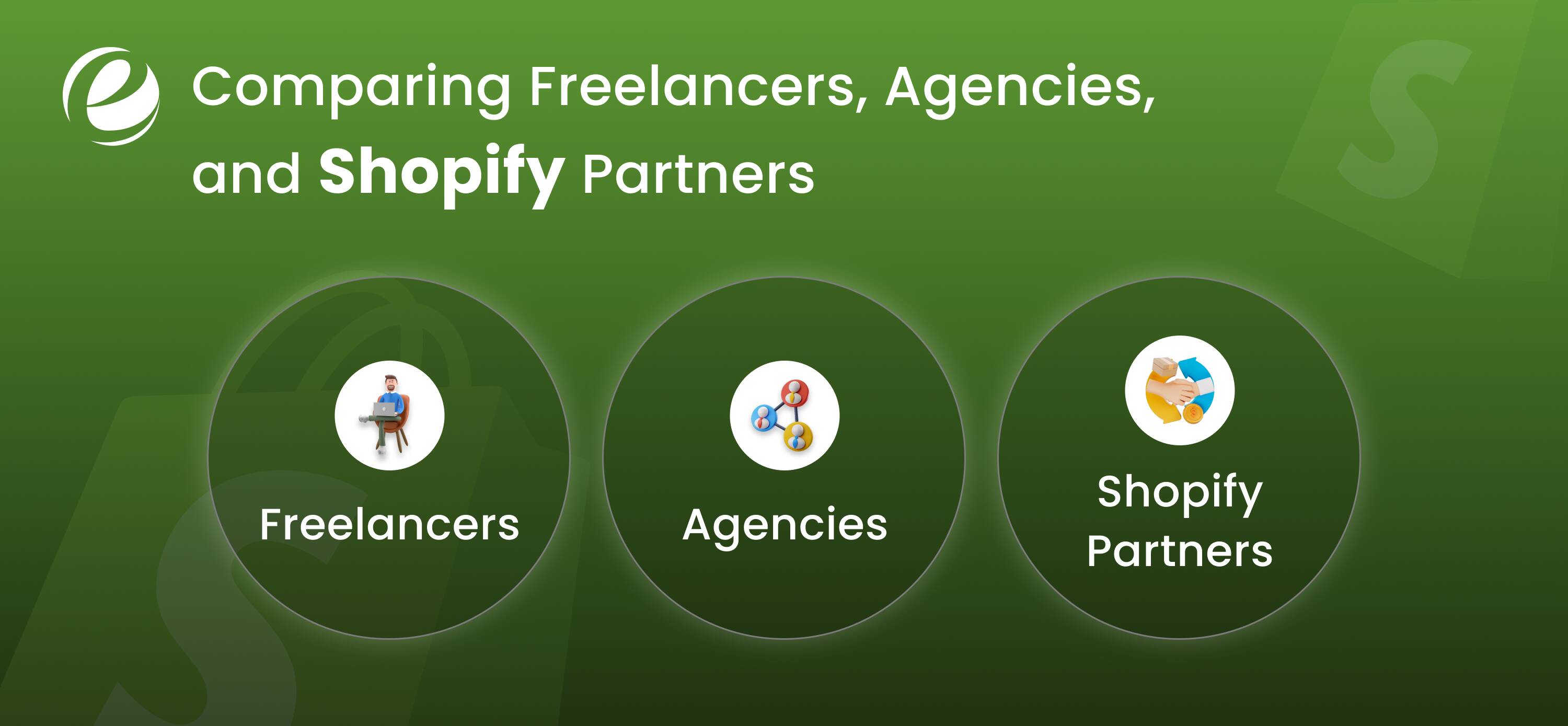
Freelancers, agencies, and Shopify Partners offer distinct paths for Shopify development, each balancing cost, expertise, and scalability differently. Choosing depends on the project, budget, and growth plans.
Freelancers
Freelancers deliver on-demand skills at lower rates, ideal for targeted tasks.
- Pros: Cost-effective with rates often 30-50% below agencies; quick turnaround for one-off jobs; specialized in niches like theme tweaks and modifications or app installation.
- Cons: Risk of availability issues during peak times and potential for communication without structured oversight.
Best for: Startups or specific projects needing flexibility, such as initial store setups or bug fixes.
Agencies provide full-team support with end-to-end processes for bigger builds.
- Pros: Comprehensive services covering design, development, and maintenance; reliable scalability via dedicated project managers.
Cons: Premium pricing due to overhead; sometimes a less tailored feel compared to development. Best for: Large-scale projects or ongoing partnerships, like enterprise migrations or custom software applications.
Shopify Partners are certified professionals or collaborators with platform expertise and a strong focus on business outcomes, not just development.
- Pros: Official partner ensures Shopify-specific expertise; access to perks like beta tools and priority support; often hybrid models for cost control.
- Cons: Variable quality despite certification; may prioritize high-volume clients over small tasks.
Best for: Mid-sized stores chasing optimization, such as Shopify store optimization consultant work or Shopify CRO expert audits alongside core development.
A Quick Comparison
| Factor | Freelancers | Agencies | Shopify Partners |
| Cost | Lower, project-based | Highest, full-service | Balanced, certified value |
| Expertise Scope | Narrow, specialist skills | Broad team capabilities | Platform-tuned, scalable |
| Flexibilty | High for short tasks | Medium, process-driven | High with partner resources |
| Best Scenario | Quick fixes, startups | Complex launches | Growth-focused optimization |
From Startup to Global Brand: Shopify Success Stories That Inspire
Gymshark: From Garage Startup to Global Fitness Brand
One of Shopify’s most incredible and inspirational story began in a garage in 2012 when a 19-year-old Ben Francis took to making and selling fitness clothes through his Shopify store with his sewing machine. While everyone started using influencer marketing, Gymshark had already been counting on it, sending free outfits to fitness YouTubers and micro-influencers to generate real knowledge and social proof that made them viral.
With the help of Shopify’s infrastructure, Gymshark handled the increased traffic without crashes, allowing it to grow effortlessly into a $ 1 billion market worth, as the demand in the market grows. The brand story is proof of the power of strategic promotion, building communities, and the right platform in turning a small idea into a worldwide, powerful business.
Key Takeaways:
- Invest in community-centric marketing to create organic buzz.
- E-commerce tools that can scale should be used to manage rapid growth.
Fashion Nova: Social Engagement Turned Into Explosive Growth
A small fashion retailer, at first, became one of the fastest-growing fashion brands in the US and got there very quickly through aggressive social media usage. Fashion Nova not only collaborated with influencers and celebrities but also used their presence to generate millions of followers and even turned every Instagram post into a shoppable experience.
Shopify has allowed the brand to deal with gigantic traffic and also to have a fine-tuned mobile experience, which was critical for the new age of social shoppers. This case is vivid proof that when storytelling, trend-led products, and an e-commerce platform come together, the outcome can be a rapid rise to the top of the category.
Key Takeaways:
- Marketing that puts social media first is the driver of modern eCommerce growth.
- A mobile and performance-optimized platform scales with demand.
Niche and Localized Shopify Consultants
Shopify consulting professionals are experts in various industries like fashion, electronics, health, beauty, lifestyle, and many more. These professionals will not apply a one-size-fits-all approach but rather use the methods that have been proven in the specific industry, thus preventing the brands from making the same mistakes as others and helping them to grow more quickly.
The impact of the role of industry-specific consultants:
- Fashion & Apparel: Consultants work on the improvement of the entire process, including size charts, heavy catalogues, and visual merchandising, which makes the flow of returns and seasonal promotions, thus improving modifications and reducing conflict.
- Electronics & Gadgets: They will deal with complex product specifications, warranties, and comparisons and also perform optimization for high-traffic product pages.
- Health, Wellness & Beauty: These consultants will take care of compliance, subscription setup, trust signals, and user-friendly interfaces that attract customer trust and repeat purchases.
- Other Niches (B2B, Home, Subscription Brands): The specialists will suggest pricing, bulk ordering, gated content, or recurring billing models, closing in on your business needs.
Reasons Why Industry Experience is Important?
Consultants with niche expertise will know the buyer’s intentions and industry regulations and also understand the competitive benchmark, thus enabling them to make quick, data-driven decisions that are in line with the market.
What Would You Consider the Localized Shopify Consultants?
Localized consultants are those who only work in specific regions or countries. Their job is to make sure that the Shopify stores in those regions have the local language, currency, payment methods, tax rules, and customer expectations.
Advantages of Local Consulting Services
- Understanding of the customers in that region and their buying habits.
- Mastery of local tax laws and shipping rules, as well as compliance requirements.
- Providing support in the native language for content, support pages, and checkout.
- Knowledge of the local payment gateways and logistics partners is preferable.
- Faster response during times like campaigns, launches, or urgent fixes.
Pre-Hiring Checklist and Consultant Toolkit

The decision of selecting the appropriate Shopify consultant is very important, as it affects your store’s performance, scalability, and success in the long run. A comprehensive pre-hiring checklist, along with a well-outlined Shopify Consultant Toolkit, enables companies to make informed decisions and at the same time, ensures proper execution post-onboarding. The combination of these factors minimizes risks, enhances transparency, and ultimately lays the groundwork for growth that can be measured.
Pre-Hiring Checklist: What to Evaluate Before You Hire
Before hiring a consultant, it is necessary to look at the ability and the fit both ways. Refer to this checklist so as not to make mistakes:
- Relevant Shopify Experience: Search for a consultant who has worked directly with already existing stores that are similar in terms of size, industry, or complexity.
- Proven Results: Requests for presentations, analytical data, or even instances of improved modifications.
- Technical & Strategic Balance: The consultant who is right for you should be aware of both Shopify programming and business strategy.
- Clear Communication Process: It is recommended that the consultant be able to put the problem and solution in a very simple and practical way.
- Transparent Pricing & Scope: Specify the deliverables, the schedule, and the price clearly.
- Post-Launch Support: Ask if they assist with improvement, maintenance, and growth support.
Shopify Consultant Toolkit: How Experts Deliver Results
Upon hiring an effective consultant, a structured toolkit is relied on to execute the strategies efficiently and consistently; thus, the consultant’s performance will be improved.
- Store Audit & Performance Analysis: Tools and frameworks to evaluate the speed, UX, SEO, conversion rates, and the checkout flow.
- UX/UI & Conversion Optimization Playbooks: Proven methods to improve a user’s experience, product pages, and customer journey.
- SEO, Content & Market Frameworks: Resources for content planning, keyword optimization, and organic traffic growth.
- App & Integration Checklist: Curated tools and workflows to integrate payments, analytics, CRM, and automation without performance loss.
- Reporting & Growth Strategy Templates: KPIs and dashboards to track ROI, long-term growth, and user behavior.
DIY Tips While Working With a Consultant
Here are quick tips to help you prepare as you consult and work with a Shopify partner.
Prepare Your Store Before Consultation
Before you engage with a consultant, ensure that your Shopify store is working properly. Update product details, assess performance, and identify issues to ensure the discussions stay focused and productive.
Define Clear Goals and Expectations
Explain what you want to get, e.g., more sales, a new place, or better speed. The more specific and clear the goals, the more capable the consultant will be to design the right strategies.
Share the Right Data and Access
Allow access to the most important tools such as Shopify Analytics, Google Analytics, and other marketing platforms. With valid data, you will be able to make the right decisions quickly without any interruptions.
Communicate Consistently and Clearly
Establish regular communication and share feedback without restrictions. Good communication leads to understanding, eliminates confusion, and makes the project more efficient in terms of time.
Stay Involved Without Micromanaging
Rely on the consultant’s knowledge and experience, but stay updated at the same time. If you are always there for approvals and feedback, that will be the right way to keep pace with the project without slowing it down.
Track Results and Measure Success
Identify the key performance indicators together, such as increased website traffic, sales conversion rates, or revenue. You can constantly review the results and get the assurance that the cooperation has been valuable for your business.
Conclusion
Hiring a Shopify eCommerce Consultant can be a turning point for companies that want to extend their online presence. The guide explains that consultants offer strategic clarity, technical proficiency, and data-driven decisions that facilitate conversions, user experience, and scalability improvements. The right support, from identifying performance gaps and opting for the right hiring model to applying proven optimization frameworks, minimizes risk and speeds up results. Collaboration with a freelancer, agency, or partner is a key to success with clear goals and ongoing communication.
For eCommerce stores aiming for high-end features in their Shopify apps, opting for custom Shopify app development services keeps your store competitive, flexible, and prepared to scale in a rapidly changing e-commerce area.
FAQs
What is the cost of a Shopify consultant?
Prices depend on the level of experience and the amount of work involved, but a comprehensive guide on Shopify development costs provides a clear explanation of the various pricing models, hourly rates, and project fees.
Which issues can a Shopify consultant resolve?
A consultant can tackle low sales, slow performance, poor user experience, SEO gaps, scaling issues, and ineffective store workflows.
Which is the better option, a Shopify consultant or an agency?
Consultants provide adaptable expertise, while agencies are more suitable for large and complicated projects that require a full team to execute.
How long before I can see results?
The initial improvements could be noticeable in a matter of weeks, but the growth that can be measured will usually take one to three months.
Is it possible for a Shopify consultant to work on app integrations and custom features?
Absolutely, Shopify consultants take care of everything, from picking the right apps to integrating them and custom development, so you get great features and smooth store operations.




 +1 (989) 535-9295
 info@emizentech.com
 emizentech


