
 Add us as a preferred source on Google
CPQ = Configure, Price, and Quote
Configuration
Configuration refers to the customization of services or products to satisfy the unique needs of end-customers by selecting features and combinations based on trial-and-error or manual calculations.
Pricing
Pricing refers to the process of deciding the right pricing of the configured product, considering present or future discounts, taxes, mark-ups, and other pricing rules, while ensuring profitability and fairness.
Get Quote
Get Quote refers to generating a formatted and professional proposal document that presents to a customer the configured product and price for consideration.
CPQ stands for Configure, Price, and Quote. Set up the product, generate pricing, and prepare the quote using CPQ software. As such, it helps companies issue quick and accurate custom quotes. Through CPQ, deal closure can be sped up with fewer errors, facilitating a better customer experience and further efficiency and effectiveness in sales.
Just like in website development, where every feature must align with user needs, CPQ ensures accurate configuration for business success.
According to Globe News Wire, the global CPQ market is projected to be in the area of $3.91 billion by 2030, growing at 14.19% during 2025-2030.
What is CPQ in Sales?
For those who are confused and would like an explanation of what CPQ is, here is the answer: CPQ, or Configure, Price, Quote, is a system for helping salespeople accurately configure product combinations, price these combinations, and allow quick generation of professional quotes.
So, if you are wondering what CPQ is, think of it as a clever sales assistant that reduces manual mistakes, speeds up the whole process of proposing, and allows prospects a view of customized options.” What CPQ does in sales is reduce deal time, improve accuracy, and customer satisfaction by acting as the sales assistant.Through Salesforce Development, CPQ integrates seamlessly into sales pipelines.”
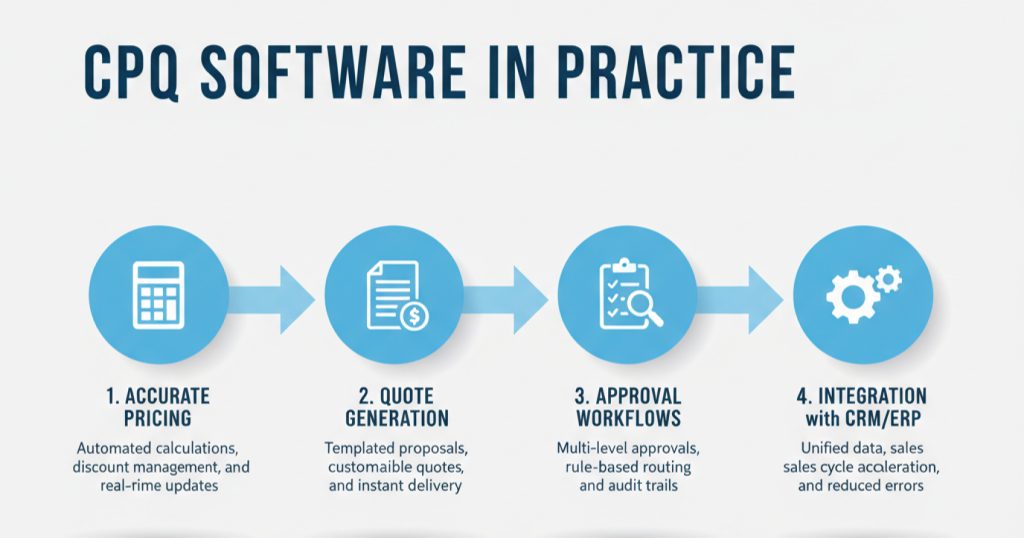
A quick breakdown of how CPQ software is being used in practice:
- Accurate Pricing: The software must choose the right pricing rules, discounts, and promo offers automatically to maintain consistency and profit.
- Quote Generation: Once configuration and pricing are done, CPQ is expected to churn out nicely formatted proposals that are professional and without errors within minutes.
- Approval Workflows: The built-in approvals ensure discounts or special terms do not pass through corporate policies, or else it would create a delay and cause errors.
- Integration with CRM/ERP: Since CPQ tools integrate with CRM and ERP, the data flows across customer interactions, pricing, and inventories seamlessly.
Why Do Companies Use CPQ?
“Why should CPQ be used in the first place?” The answer is a bunch of amazing business advantages that CPQ offers. Companies implement CPQ partly for streamlining internal processes and partly for offering their buyers consistent, dependable, and personalized experiences.
- Faster Sales Cycles: As far as deals go, the more displacement and back-and-forth between reps and customers in quote generation, the quicker the deals. CPQ automates the generation of quotes.
- Accurate Quotes: Using preset pricing rules and applying them with discounts and product logic, CPQ maintains customer discounts so that precise figures are always given and never due to human miscalculations.
- Fewer Errors: Usually, manual quotes insert human error; CPQ simply removes this error by automating all calculations and configuration processes to be compliant with company standards.
- Improved Customer Experience: Since customers value accurate, understandable, and timely proposals, the whole buying procedure generates the sales trust and satisfaction of the customer.
- Scalability for Complex Products: Having a vast catalog, complex configurations are done by a CPQ without compromising speed in selling, thus making it extremely scalable.
- Higher Sales Productivity
Salespersons sell more as they waste much less time correcting errors or waiting for their approvals. The result is, thus, increased team efficiencies and revenue growth.
Key Features of CPQ Software
If a company intends to implement and accelerate the sales cycle, then these are the CPQ Software features that will offer companies a way of working. The best CPQ tools have all the bells and whistles to help sales teams create precise quotes, have fewer errors, and allow them to work efficiently. With the rise of AI, many businesses consult an AI development company to enhance CPQ automation. From guided selling to powerful integrations, a modern CPQ offers the sales team the ability to deliver to a willing customer the right product at the right price!
1. Guided Selling
The feature helps sales agents with decision-making by suggesting the most suitable product options for their customers’ needs. Contracts are customized, accurate, and tailored, with no need for any specific product knowledge.
2. Product Configuration
Use product configuration to make the management of even complex product mixes simple. This ensures that sales reps build accurate combinations, empty of technical errors, where customers would only get valid and compatible products.
3. Dynamic Pricing
The really important CPQ software features are dynamic pricing because it lets businesses adjust prices automatically, based on rules, discounts, or regional factors. This way, they assure profitability and transparency to the customers.
4. Quote Automation
Wasting time on manual quote creation should be a thing of the past, as CPQ allows automation to generate proposals in minutes, which are professional and error-free, thus speeding up sales.
5. CRM/ERP Integration
Integration is among the great CPQ features. This integration connects the CRM and ERP systems, ensuring smooth data flow through sales, finance, and inventory, which enhances accuracy and efficiency.
CPQ vs Traditional Quoting Process
Many businesses still rely on spreadsheets and emails for quotations, but this is an old-fashioned manual system that is associated with delays and costly errors. When we consider the CPQ vs traditional quoting comparison, the difference stands out clearly: CPQ-assisted processes are completely automated, faster, more accurate, and consistent, while traditional methods are still time-consuming and error-prone. This creates a key consideration in the CPQ vs traditional quotations debate for companies wishing to remain competitive in modern selling.
Manual Quoting Challenges
- High chances of pricing errors because of manual calculations.
- Approval times slow down response time.
- Difficult to manage complex configurations of products.
- Inconsistent quotes given by different sales representatives.
CPQ Automation Advantages
- Automates pricing, discounts, and approvals for accuracy.
- Provides mistake-free quotes within minutes compared to hours.
- It guides selling and validates products.
- It integrates with CRM/ERP for seamless workflows.
Side-by-Side Comparison Table
| Aspect | Traditional Quoting (Manual) | CPQ Quoting (Automated) |
| Speed | Slow, takes hours/days | Fast, completed in minutes |
| Accuracy | Prone to human error | Highly accurate, rule-based |
| Product Configuration | Limited, complex to manage | Easy, guided configuration |
| Approvals | Manual, time-consuming | Automated, streamlined |
| Customer Experience | Inconsistent proposals | Professional, tailored quotes |
Industries That Benefit Most from CPQ
Use cases prove that CPQ is implemented across industries. Whether for manufacturing or SaaS and beyond, CPQs help configure, determine the right prices, and assist salespeople in quicker deal closures. Tech sectors, including mobile app development, rely on CPQ to handle diverse product offerings.
1. Manufacturing
Manufacturing companies with highly customizable products and components rely on CPQ to ensure that product bundles are correctly configured and priced accurately without errors.
As per Mordor Intelligence, the Asia-Pacific market is likely to have the highest growth rate at a CAGR of approximately 19.5%, due to digital transformation and increased manufacturing.
2. Telecom
Telecom has to juggle service packages, upgrades, and bundles. CPQ makes certain that the quotes are accurate, compliant, and customized to customer needs.
3. Healthcare
Pricing of healthcare products and services generally is subject to very rigid standards of compliance. CPQ contributes towards ensuring quotes are generated accurately and compliant with regulatory requirements, and in an efficient manner.
4. Financial Services
CPQ is used by banks and insurance companies for streamlined customization of offerings, for compliance, and to reduce the chances of error in complex pricing models.
5. SaaS/Technology
From the technological realm, you might have complex product tiers, add-ons, and subscription models. They allow CPQ for SaaS companies to handle these to produce clear and transparent proposals.
According to Research & Markets, Cloud is the leader in growth here, with the SaaS model of CPQ growing castle-high in cloud standards with a CAGR of 17.6% for 2025-2030 during this survey period.
6. Retail & E-commerce
The CPQ system complements the sales process with clear configurations and instant and guaranteed pricing when dealing with customized products from the Internet.
7. Energy & Utilities
CPQ helps utilities rapidly generate accurate, scalable quotes when the pricing models and contracts vary from one individual customer to another.
CPQ vs CRM: What’s the Difference
Many businesses get confused between CPQ and CRM since both are sales tools. They simply serve different purposes, generally speaking, on a sales line. The CRM is concerned with customer relationships and keeping the vital address details.
On the other hand, CPQ develops and automates price quoting. In short, “CPQ vs CRM: What’s the difference?” enables a firm to determine what exactly it needs, and how to combine these two tools for better sales performance.
| Feature / Purpose | CRM (Customer Relationship Management) | CPQ (Configure, Price, Quote) |
| Primary Function | Stores customer data, tracks leads & interactions | Automates configuration, pricing, and quote creation |
| Focus Area | Relationship management & customer history | Sales proposal accuracy & deal pricing |
| Sales Team Benefit | Better customer insights and communication | Faster deal closures and fewer quoting errors |
| Integration Use | Works with marketing, service, and sales teams | Integrates with CRM/ERP to complete sales workflow |
| Efficiency Boost | Improves follow-ups and customer engagement | Speeds up quoting and reduces manual effort |
Common CPQ Implementation Challenges
Businesses face many challenges during the implementation stage of CPQ solutions are less often the bane of efficiency and accuracy in sales. These CPQ challenges can hamper adoption and further reduce an organization’s return on investment if not paid due attention at the right time. Being aware of the most common CPQ implementation issues aids organizations in better preparing themselves to prevent a delay in reaching success.
1. Data Migration Issues
One of the major issues during CPQ implementations arises when trying to transfer product, pricing, and customer data from legacy systems. Incomplete and inaccurate data lead to errors when the system configures and quotes.
2. Complex Pricing Rules
Many industries have pricing structures that involve layers of discounts, promotions, and region-specific policies. Accurate rule definition inside the CPQ tools for business such complex pricing scenarios can become difficult and requires much thought.
3. User Adoption & Training Gaps
Even the most perfect CPQ system will fail in the case of a lack of user adoption. Sales teams may resist change if not properly trained or if they cannot discern the value of the system.
4. Integration Difficulties
CPQ must integrate smoothly into CRM, ERP, and billing systems. Poor integration would result in the division of information and cause rigid inefficiency.
5. Customization Needs
Companies want CPQ to align with differing sales workflows. However, heavy customizations make it hard to maintain and slow performance.
6. Change Management
The change in culture is from manual quoting to automation. If it is not well communicated and Leadership does not get on board, it would be very hard for the teams to embrace it.
7. System Scalability
As the company grows, the CPQ must support a large product catalog, along with complex rules. A lack of scalability will give the first trouble to sustained effectiveness.
Best CPQ Software Available Now
This is the most important choice to be made for any company that wants to attain efficiency in the sales process and accuracy. Multiple major players available today offer powerful features tailored to specific industries and to businesses of different sizes.
Being aware of what differentiates Salesforce CPQ vs Oracle CPQ, along with an examination of the SAP and independent CPQ solutions, shall define and shape the best choices for companies according to their particular needs.
1. Salesforce CPQ
It is best known for integration with Salesforce CRM to enhance sales workflows by automating quoting and approving inside the CRM environment, thereby increasing productivity and accuracy.
2. Oracle CPQ
Oracle CPQ holds great strength in the configuration of products and pricing flexibility for an enterprise with complicated sales cycles and international operations needing multi-currency and localization support.
3. SAP CPQ
SAP CPQ offers interactive guided selling and dynamic pricing. It is very well-known in the manufacturing and industrial sectors where complex product configurations are required.
4. Independent CPQ Tools
Besides the major vendors, there are a few independent CPQ tools like Conga that provide customizable solutions fit for smaller-scale businesses or industries with specific needs, offering flexibility and quick deployment.
5. Others Worth Mentioning
Such specialized capabilities for industries like manufacturing and telecommunications are also provided by PROS CPQ and Configure One, which further indicates the mounting innovation in CPQ software.
How Much Does CPQ Software Cost?
Understanding the CPQ software cost is crucial for businesses before investing in a solution. The CPQ price varies depending on the type of licenses to be purchased, the level of integration built into the setup, and the training requirements.
Also, depending on the type of cloud-based and on-premise deployments, each has different advantages. All of these aspects must be carefully weighed down by an organization to select the CPQ solution most suitable and cost-effective for their sales procedure.
1. License Fees
With most vendors, CPQ software is sold on a user or transaction basis. The number of sales reps and type of features will affect the overall costs of licensing for the software.
2. Integration Costs
There may be further expenses involved when integrating CPQ into already-existing CRM, ERP, or billing systems, depending upon the complexity level.
3. Training and Support
Suitable onboarding processes plus ongoing training ensure smooth adoption, but may possibly add to upfront or recurring fees.
4. Cloud vs On-Premise Deployment
Upon deployment, cloud offerings typically will price much below an on-premise offer that initially remains higher and offers control.
CPQ Software Cost Comparison
| Cost Factor | Cloud-Based CPQ | On-Premise CPQ |
| Upfront Cost | $5,000 – $20,000 (initial setup) | $50,000 – $150,000+ (software + hardware) |
| Licensing Model | $50 – $150 per user/month | $5,000 – $15,000 per user (one-time) |
| Integration Expenses | $10,000 – $30,000 depending on complexity | $20,000 – $50,000+ depending on customization |
| Maintenance & Updates | Included in subscription | 15%-20% of license cost annually |
| Training & Support | $2,000 – $10,000 (optional or bundled) | $5,000 – $20,000+ (may require contracts) |
Steps to Implement CPQ Successfully
The implementation of a CPQ can be smooth and successful if done in a staggered manner. Moreover, following CPQ best practices will allow a business to avoid many pitfalls and earn quicker ROI. Here are the steps to implement CPQ successfully:
1. Requirement Gathering
Understand sales process challenges, product complexity, and pricing rules to determine what functionalities and integrations must be offered by the CPQ system.
2. Vendor Selection
CPQ tools must be considered according to your business requirements, budget constraints, scalability, and integration with existing systems like CRM and ERP.
3. Customization
Configure CPQ software to fit your custom product configurations, pricing models, and approval workflows, but do not over-complicate it.
4. Testing & Rollout
Before going for full rollout, stiff testing should be initiated with real sales cases to primarily find configuration errors and ensure that it functions.
5. Training & Adoption
Major training sessions should be set for sales and support teams, wins for the CPQ must be shared with them, and afterward, the CPQ should be pushed for adoption with continuous support.
ROI of CPQ – How It Impacts Sales
Understanding the CPQ ROI explains how CPQ continues to be in full demand, with more businesses putting money into CPQ software every year. CPQ systems shorten the sales cycle by automatically configuring and pricing, enabling the reps to finalize the deals faster-Cycle times of closing sales have been noted to be reduced by up to 28% on average.
Accelerating the quoting process causes the generation of more revenues while also improving the forecasting accuracy due to the availability of constant and reliable sales data. Industry data reveals that companies using CPQ report a $6 return for every $1 spent, which vividly illuminates the huge benefits gained by sales teams through productivity and profit growth.
- Reduced Sales Cycle Times: From automating the entire quote and approval process, sales reps are more sales-oriented and less engaged in paperwork, which speeds up the rate at which deals are being closed.
- Increased Revenue: The CPQ tools complement upselling or cross-selling activities by proposing the best product bundle and price to apply to any transaction, thus increasing average deal value and total revenue.
- Better Forecasting: With quoting data that is neither decentralized nor inaccurate anymore, sales managers develop a clear understanding of the health of the pipeline and revenue projections to make better decisions.
- Reduced Sales Cycle Time: Automated quoting and approval procedures allow sales personnel to expend less time in administrative tasks; therefore, they can close more sales.
- Increased Revenue: CPQ helps sales representatives to recommend the ideal product bundles and pricing to help develop upsell and cross-sale opportunities, in turn enlarging deal size and total dollar value.
- Better Forecasting: Sales directors steer more productive management choices given accurate quoting data centrally stored, as they now have greater sales visibility and required transparency to forecast revenue accurately, along with keeping pipeline health.
- Higher Win Rates: Guided selling and error-free quotations build customer trust, directly meaning the proposals are more likely to win signatures for deals.
- Improved Sales Productivity: Automations take away the repetitiveness in daily activities for sales reps; hence, they get more time to scout for sales opportunities and connect with customers.

Mistakes to Avoid in CPQ Adoption
Adopting CPQ software can transform sales; meanwhile, CPQ errors cause several delays and lower returns. Knowing how to avoid errors while implementing CPQ would ensure better transitions and smooth implementations. Such pitfalls mainly include choosing an unsuitable vendor, poor integration planning, and neglecting the training process, an important aspect for real success and better adoption.
1. Wrong Vendor Choice
A vendor without going through the thought process of alignment with business needs may result in a mismatched solution that is expensive and difficult to change. Proper vendor vetting prevents unexpected limits.
2. Lack of Integration Planning
Not making sure that CPQ will interconnect with CRM, ERP, and other systems results in data silos and inefficient processes that may altogether discourage a CPQ from reaching its optimum potential.
3. Ignoring User Training
Ignoring sales management training programs will likely be met with resistance from sales teams, putting further returns on investments under pressure.
4. Overcomplicating Product Configuration
Confusing configurations unassisted by an easy-to-follow user interface may muddle the users and further escalate errors, thus weakening the payoff of an automation tool.
5. Insufficient Data Cleanup
What usually happens is that inaccurate or inconsistent product and pricing data get migrated, resulting in quotation errors and customer dissatisfaction.
Emerging Innovations Shaping CPQ’s Future
Innovative technologies and intelligent integrations are to shape CPQ 2025. CPQ trends 2025 thus account for a greater force of AI-driven pricing, predictive analytics, and CRM/ERP deeper integrations as business demand for more accurate and faster sales preliminary growth. These will enable sales teams to create the most personalized quotes, optimize pricing strategies, and deliver completely seamless customer experiences efficiently.
1. AI-Driven Pricing
Artificial intelligence will be used in determining pricing automatically after studying market trends, customer behavior, and historical data, so prices can be set dynamically and competitively in real-time.
2. Predictive Analytics
CPQ systems will use predictive analytics to reveal customer needs, maximizing the opportunities for cross-sell and upsell, and making smarter sales recommendations, thereby increasing win rates.
3. Deeper CRM/ERP Integrations
In the future, CPQ will provide even more major integration with CRM and ERP so that data flows across systems across the sales and fulfillment life cycles, enhancing accuracy and faster closing of deals.
Final Verdict
CPQ software delivers several advantages, such as faster sales cycles, correct quoting, fewer errors, and higher customer experience, which in turn means higher revenue and better sales teams.
Therefore, CPQ is definitely worth serious consideration for those companies that involve complex products with varying pricing processes and long sales cycles in order to streamline their quoting and sales processes.
Other words include quoting errors, deal closures, and sales productivity. So, CPQ is a strategic move for your company. If you wish to get help in the selection of the right CPQ, tailoring, and implementation, experts will secure the smooth running of the entire process from start to finish!
FAQ’s
How does CPQ software improve sales?
CPQ software automates quoting and pricing to speed up the quote process, gets deals closed more quickly for sales reps, and reduces errors.
What are the benefits of CPQ software for sales teams?
Errors from the proposal are reduced, time is saved, complex quotes have been made easy, and a better customer experience of fast and professional proposals is established.
How to implement CPQ in a business?
Begin with needs so that you can select the right software; then customize, thoroughly test, and train for a smooth implementation.
Can CPQ software integrate with CRM systems?
Absolutely! Some CPQ products will typically sync with CRM product suites to improve sales efficiency and data synchronization for customers and pricing.



 +1 (989) 535-9295
 info@emizentech.com
 emizentech


