Angola’s First B2B Marketplace, Rebuilt So It Could Actually Scale
Buitanda -connecting 100+ vendors to multiple warehouses on Magento, with payment rails built for how Angola actually pays
Overview
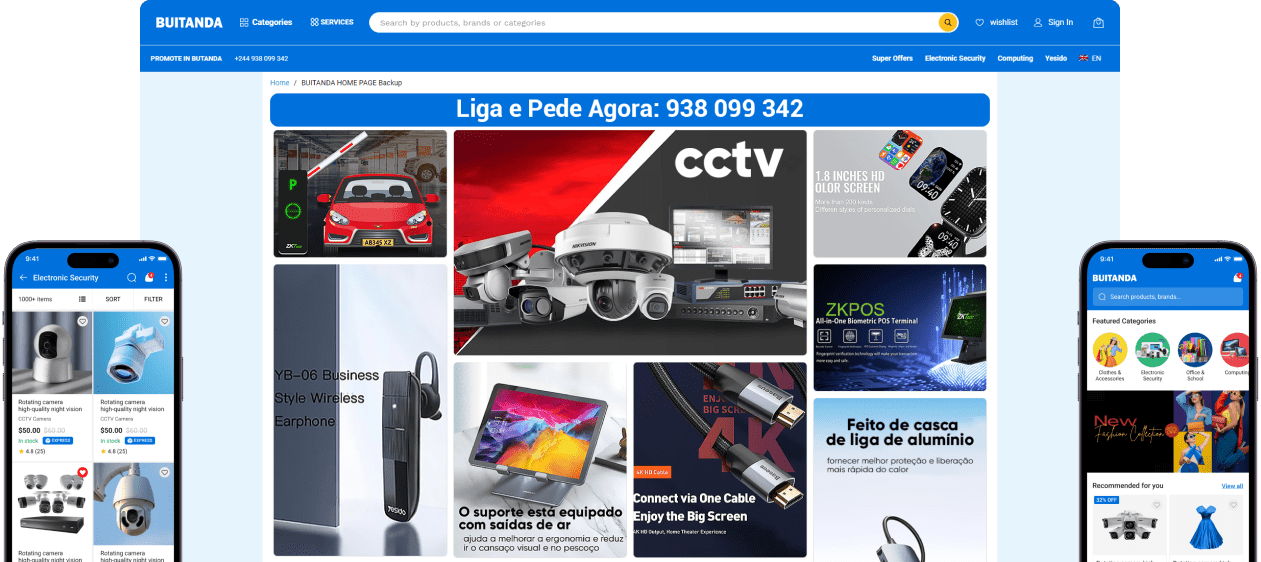
Buitanda is a digital B2B marketplace based in Luanda, and as far as anyone can tell it was the first of its kind in Angola. Wholesale buyers get trade pricing in one place instead of working the phones with a dozen suppliers. Sellers get a storefront without building one.
The catalog is deliberately broad -electronics, construction material, food, household goods, office supplies -and sitting alongside it is a services layer covering cleaning, home maintenance, repairs, real estate, graphic design and event planning. Buy a pallet of tiles and book someone to lay them, same account.
The brief looked like a maintenance job at first glance. It wasn’t. The platform existed and was trading, but the parts holding it together had been built for a marketplace maybe a tenth the size. Vendors were growing. Warehouses were multiplying. And the system underneath had no real concept of which stock sat where.
The Challenge
Discovery turned up four problems that mattered and one that everyone had stopped noticing because they’d worked around it for so long.
Vendors and warehouses weren’t connected
A vendor could list a product, but nothing told the platform which warehouse held it or how many were there. Stock counts drifted. Orders got promised against inventory that had already shipped. The ops team reconciled it by hand, which works at ten vendors and falls apart at a hundred.
Checkout was failing quietly
Payment integrations were unreliable, and the methods on offer didn’t match how Angolan businesses actually pay. Every abandoned cart was being read as a conversion problem when most of them were plumbing.
The mobile apps were buggy
Buitanda’s buyers skew heavily mobile. Crashes and broken flows in the Android and iOS apps were costing real orders, and app and web kept disagreeing about stock and order status because they weren’t reading from the same place.
The site was slow
Uncached pages, unoptimised images, category listings doing far too much work per request. On the connection speeds common across the region, slow isn’t an annoyance -it’s a bounce.
Returns ran on WhatsApp and memory
There was no returns workflow. Requests came in through messages, got approved verbally, and stock came back to whichever warehouse was closest to whoever handled it. Disputes had no paper trail.
Our Approach
The first decision was the one that shaped everything else: don’t rebuild the platform behind a curtain. Buitanda was live and taking orders, and a six-month blackout would have killed the vendor relationships they’d spent years building. So we split the work in two and shipped the first half fast.
Platform choice was already made -Magento -and honestly it was the right call for this. Multi-Source Inventory ships natively, which was exactly the problem we needed to solve, and the customisation ceiling is high enough that we weren’t fighting the framework when Buitanda’s requirements went off-script. Our Magento development team led the platform work, with separate Android and iOS developers on the apps and a QA lead running regression across all three surfaces.
Buitanda decided to hire dedicated developers from us on a long-term engagement rather than commission a fixed-scope build, and that turned out to matter more than anyone expected at kickoff. The MSI work threw up requirements nobody could have written into a spec upfront -the order-splitting logic in particular took two attempts before it behaved. Under a fixed scope that would have meant a change request every fortnight and a lot of awkward conversations about what was and wasn’t in the original estimate.
The skill requirement was specific too. Multi-vendor and multi-warehouse architecture has its own failure modes, and they’re not the sort of thing you learn on a live marketplace with a hundred sellers depending on it. Buitanda wanted to hire ecommerce developers who’d already broken and fixed this exact class of problem somewhere else first.
One thing we got right by accident: Buitanda’s team knew the Angolan payment landscape far better than we did, and we listened. Several design decisions in checkout came straight from them.
Delivery in Two Phases
Phase one -stop the bleeding.
App bug fixes, checkout stabilisation, working payment integrations including COD, and a first pass of Magento 2 performance optimization to get load times down to something usable. Roughly six weeks. The goal wasn’t elegance, it was giving Buitanda a platform that worked while we rebuilt underneath it.
Phase two -the architecture
Multi-Source Inventory, warehouse mapping, the vendor dashboard, returns and refunds, POS, logistics integration and the reporting layer. This is where most of the engineering went, and it’s the part that changed how the business runs rather than how it looks.
Solution Delivered
Multi-Source Inventory was the centre of it. Every vendor is now linked to one or more physical sources -warehouses, depots, storerooms -and stock is tracked per source rather than as one pooled number. When an order arrives the system checks availability across the relevant sources and assigns fulfillment based on stock and location, so nothing gets routed across Luanda when the same item sits ten minutes away. Reservations hold against source-level quantity, which is what actually killed the overselling.
Orders containing products from more than one vendor or warehouse split into separate shipments while staying a single order from the buyer’s side. Sounds simple written down. It was the hardest part of the project.
The vendor dashboard was rebuilt from nothing. Sales analytics by product, inventory across every linked warehouse, order management, restock signals, a returns queue and a payout view. We designed it for a vendor checking their phone between other jobs, not for someone with a dedicated ecommerce desk -and the first version was too dense, so we simplified it after vendor feedback. Adoption was the real test and it passed; vendors log in without being chased.
Payments got three methods matched to the market. GD Online Payment for cards and online banking, Multicaixa Express because that’s what most Angolan buyers reach for by default, and cash on delivery -which, let’s be honest, was probably the highest-impact change on the whole project. Trust in online payment was still being built. Letting people pay on receipt removed the last objection for a lot of first-time buyers, and plenty of them came back and paid online later.
The rest was the unglamorous half: a returns workflow with reason codes, authorisation, stock restored to the correct source and refunds through the original method, all timestamped. POS integration so counter sales draw down the same inventory the marketplace sees. Logistics wired into the order flow with tracking pushed back automatically. And WhatsApp notifications for order, dispatch, delivery and return status -email open rates in the market are low, WhatsApp is where people actually are. It measurably cut “where is my order” messages.
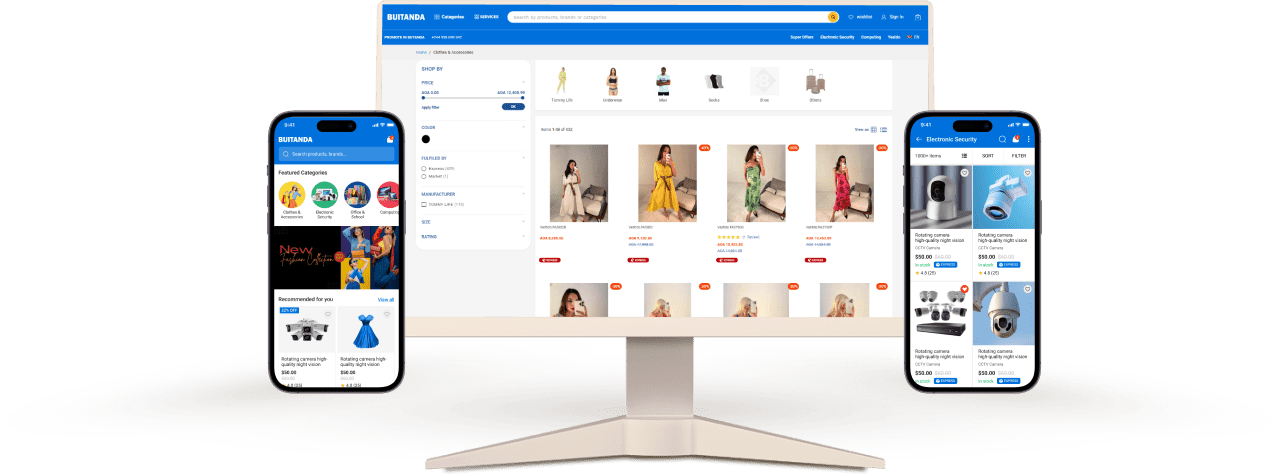
Glimpses of Buitanda
Key Features
The features that changed how the marketplace runs, rather than how it photographs.

Multi-Source Inventory
Stock tracked per warehouse, orders routed to the nearest source with availability. No more overselling.

Vendor dashboard with sales analytics
Which products move, which don’t, what’s in stock where, what’s owed -one screen, works on a phone.

Split order fulfilment
One order, multiple vendors or warehouses, separate shipments. Buyer sees a single order throughout.

Multicaixa Express, GOP and COD
Three payment methods matched to how Angola actually pays. COD did the heavy lifting on trust.

Returns and refunds workflow
Reason codes, authorisation, stock restored to the right source, refund through the original method. All logged.

Point of Sale integration
Counter sales draw down the same inventory the marketplace sees. Nobody updates stock twice.
WhatsApp push notifications
Order, dispatch, delivery and return updates where buyers and vendors already are.
Android and iOS apps on one API
Kotlin and Swift builds reading the same data layer as the web platform. No more disagreeing about stock.
Results and Outcomes
Figures from the engagement to date. Where we don’t have clean before/after data we’ve said so rather than invent it.
+ 50% users
User growth after the speed work, app fixes and new payment options -and still climbing.
100+ vendors connected
Operating across multiple warehouses from a single dashboard, with source-level stock accuracy.
Manual reconciliation eliminated
The weekly stock-matching exercise the ops team used to run is simply gone.
COD unlocked first-time buyers
Pay-on-delivery brought in a segment that wasn’t going to hand card details to a new platform.
Returns tracked end to end
Refund cycle logged with actor and timestamp, stock restored to the correct source automatically.
Technology Stack
Bigger stack than we’d normally like, but a marketplace with this many moving parts earns it.

Magento (Adobe Commerce)
The platform everything runs on. Native Multi-Source Inventory was the deciding factor, and the customisation ceiling handled the rest. Built by our Adobe Commerce development team.


PHP / MySQL / MariaDB
Server-side logic plus the custom modules for vendor management, source assignment and returns. Relational store for catalog, inventory, orders and payouts.

Elasticsearch
Catalog search and layered navigation. With this many vendors and this broad a catalog, native Magento search wasn’t going to hold.

RabbitMQ
Queuing for bulk inventory syncs, report generation and notification dispatch, so heavy jobs don’t block a page request.


Redis + Varnish
Sessions and block cache in Redis, full-page cache in Varnish. Between them they did most of the work on load times.


Kotlin / Swift
Native Android and iOS builds from our mobile app development team. React Native and Xamarin components carried over from the platform’s earlier life and maintained.

Knockout.js
Magento’s native front-end framework, used for the dynamic parts of the storefront and checkout.

NitroPack
Front-end delivery layer sitting on top of the Magento caching stack.

GD Online Payment, Multicaixa Express, COD
Three gateways with proper failure handling, retry logic and reconciliation so finance can match transactions without exporting to a spreadsheet.
Business Benefits of Choosing Emizentech for App/web development
Buitanda chose us, and here are some reasons why you should too.
One Stop Solution
Emizentech provides a vast range of services, making it a convenient one-stop solution for all your app/web development needs. We offer all the solutions, from concept and design to development, testing, and deployment. Thus making the development process seamless and efficient.
Unique Project Methodology
Our team of experts follows a unique project methodology emphasizing collaboration and transparency. We involve our clients in every stage of the development process, taking care of their feedback and inputs to develop customized solutions that meet the specific requirements of the clients. Thus making the process more effective and reducing the development time, ensuring the final product aligns with the client’s vision.
Uncompromised Quality
We maintain high-quality coding standards in app/web development. As well as our team also follows industry best practices, implements rigorous testing methodologies, and has a strict quality assurance process. We deliver stable, secure, and high-performing applications that provide an outstanding user experience by maintaining high-quality standards.
In-House Team of Experts
We have a team of experienced and qualified experts in multiple domains. Expert developers, designers, testers, and project managers work together to offer the best solutions. The presence of an in-house team provides greater coordination, more effective communication, and faster turnaround times.
Conclusion
Marketplaces are deceptively hard. The storefront is the easy part -it’s the inventory logic, the payout maths and the question of which warehouse ships what that quietly decides whether the thing works at a hundred vendors or falls over at thirty.
What we liked about this project: Buitanda let us fix the foundations rather than asking for features on top of a cracked base. That’s a harder sell internally than it sounds, because foundations don’t demo well. The payoff showed up in the numbers anyway.
There’s a threshold every marketplace hits where the back office stops keeping up with the storefront. Vendor counts climb, warehouses multiply, and the spreadsheets that held it together stop surviving contact with reality. That’s usually the point where ERP software development goes from a nice idea to the thing blocking growth.
Buitanda hit that threshold and dealt with it. If you’re somewhere near it yourself, our ecommerce development services work covers the whole stack rather than one layer of it.
Planning a Multi-Vendor Marketplace?
Get a team that has already shipped one. You can hire Magento developers with multi-vendor experience or talk through the scope first.
Schedule a Free Consultation


 Let’s build success Together