An Eye Hospital That Patients Can Book From Istanbul, Berlin or Their Sofa
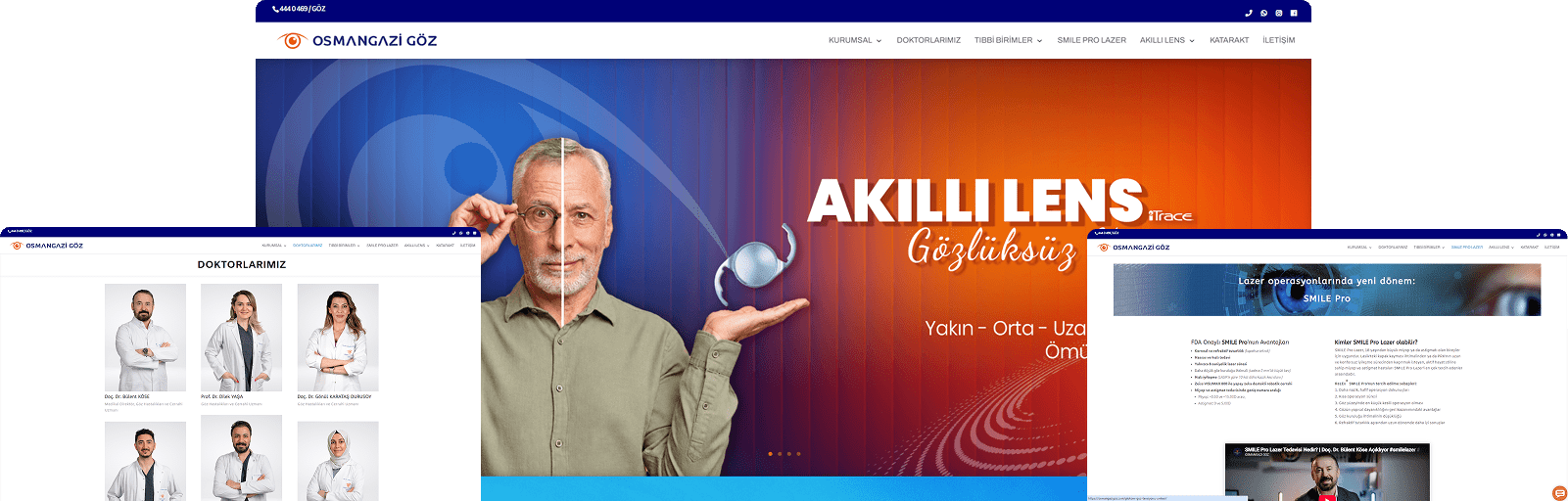
Osmangazi Göz: a bilingual website, iOS and Android patient apps, and a scheduling backend for a multi-specialty eye hospital in Bursa, Turkey, delivered end to end by our healthcare app development services. Patients now go from first question to confirmed appointment without a single phone call.
Overview
Osmangazi Göz is a specialist eye clinic operating inside Osmangazi Hospital in Bursa, led by Assoc. Prof. Dr. Bülent Köse. The clinical side was never the problem. They run cataract surgery with premium and trifocal lenses, ReLEx SMILE Pro laser vision correction, ICL implants, glaucoma and retina care, keratoconus crosslinking and a paediatric strabismus unit. OCT, corneal topography, the lot.
The digital side was a different story. Patients were finding them in two very different ways. Local patients searched in Turkish for a cataract surgeon or an eye doctor in Bursa. International patients, mostly from Germany, the UK and the Gulf, searched in English for laser eye surgery in Turkey and then spent days on WhatsApp asking the same twelve questions. Price, recovery time, whether someone picks them up from the airport, how long they need to stay.
Both groups ended up in the same place: a phone line and a busy front desk. Bookings got lost between WhatsApp, email and a paper diary. There was no single patient record, no view of the acquisition funnel, and post-op patients who flew home more or less disappeared from view. For a clinic whose outcomes depend on follow-up, that’s a care continuity problem, not just an admin one.
Osmangazi Göz was looking for a tech partner with real healthcare IT experience to fix that end to end. We designed and built a bilingual Turkish/English website, iOS and Android patient apps, and the admin and scheduling backend that ties both to the clinic’s clinical workflows. Honestly, the website and apps were the visible part. The real job was rebuilding how a patient moves from “I think I need surgery” to “I’m three months post-op and my vision is fine.”
The Challenge
Four problems, and every design decision after kickoff traced back to one of them.
Two audiences, two languages, one brand
A 68-year-old in Bursa researching cataract surgery and a 29-year-old in Munich comparing SMILE Pro prices do not want the same website. Different questions, different trust signals, different reading patience. But it had to be one site, one brand, and one booking system underneath, not two half-maintained versions drifting apart.
Eye surgery is a decision, not a purchase
Nobody books laser eye surgery on impulse. People read, compare, ask, go quiet for two weeks, then come back. The old setup treated every enquiry as a phone call waiting to happen. There was no patient intake process, no lead nurturing and no way to see where someone sat in the acquisition funnel, so follow-up was guesswork and plenty of warm leads simply went cold.
The front desk was the bottleneck
Appointments came in from the phone, WhatsApp, email and walk-ins. Five doctors, several clinical units (cataract, retina, glaucoma, refraction, paediatrics), and diagnostic equipment (OCT, biometry, corneal topography), each with its own time slots. Patient scheduling and resource scheduling lived in different places. Double bookings happened. So did empty slots that nobody knew were empty.
Patient data is not optional to get right
This is protected health information (PHI): diagnoses, test results, surgical notes, ID scans for international patients. Turkey’s KVKK applies, GDPR applies the moment a German patient fills in a form, and the clinic wanted HIPAA-grade safeguards so the platform could serve US patients later without a rework. App store reviewers also look hard at health apps. Security and compliance couldn’t be a phase-two item.
Our Approach
We started with the patient journey, not the homepage. Our lead business analyst spent the discovery phase on site, a week with the front desk and the international patient coordinator, mapping every route a patient actually takes. Turned out there were seven, not two. A local cataract referral from a GP behaves nothing like a self-referred SMILE Pro enquiry from abroad, and a parent booking a strabismus check for a child is a third thing again. Each route got its own entry point, its own content and its own path to booking, all written up in a software requirements specification the clinic signed off before development started.
We split the project into two-week iterations over 14 weeks. Discovery, solution architecture and journey mapping first. Then UI/UX design in Figma for the website, both apps and the admin panel, with clickable prototypes tested on real patients in the clinic’s waiting room (a surprisingly good usability lab, since people have time and opinions). Then the backend and scheduling engine, the website, the apps, and finally hardening, user acceptance testing and launch.
We assembled a dedicated project team of eight: a project manager, a lead business analyst, a UI/UX designer, two senior Laravel engineers, two senior Flutter developers for the iOS and Android apps, and a QA engineer, with front-end work on the website shared across the team. That was deliberate. A dedicated team is still around when the first real patients find the edge cases, and in healthcare, they always do.
Two early architecture calls shaped everything. One scheduling engine for every channel, so the website, the apps and the front desk can’t disagree about a slot. And one patient record per person, so the person who asked a question on Tuesday and booked on Friday is the same patient in the system – which is also what makes a future EMR or HIS integration straightforward instead of messy.
Solution Delivered

A website built around treatments, not departments
Patients don’t search for “Refraction Unit.” They search for “cataract surgery cost” or “am I a candidate for SMILE laser.” So every treatment (cataract, SMILE Pro, trifocal and smart lenses, ICL, glaucoma, retina, keratoconus, paediatric eye care) got its own page with the same backbone: who it’s for, how it works, recovery, the doctor who does it, and a booking button that already knows which treatment you came from. Our web development team built it fast on purpose; older patients on older Android phones were a big chunk of the audience, and a slow page loses them.

Turkish and English, properly.
Not machine-translated mirrors. Separate content tracks, so the English SMILE Pro page talks about flights, airport pickup and how many days to stay, while the Turkish one talks about insurance and parking. Shared structure, separate voice. hreflang tags and per-language URLs handle the search engine side.

A digital patient intake survey that does the front desk’s first job.
patients, a short initial survey – age, prescription range, previous surgery, dry eye history – sorts people into “likely candidate, book an exam”, “worth a consultation,” or “talk to us first,” and routes them to the specialist best suited to their case. It doesn’t diagnose anything, and says so plainly. What it does is stop the clinic spending an hour on the phone with someone who was never a candidate.

Appointment scheduling that understands how an eye clinic actually runs.
The resource-based scheduling engine knows doctors, units and diagnostic equipment. A cataract pre-op needs biometry and a doctor slot back to back; a SMILE Pro assessment needs topography first. The system books the chain, not just the appointment. Patients can filter specialists by treatment, see each doctor’s profile and qualifications, and pick a slot. Website, apps, WhatsApp handoff and the front desk all read and write the same calendar, so double bookings basically stopped.

A medical tourism module for international patients.
Treatment selection, secure upload of previous prescriptions and scans, a quote request, an in-app payment gateway for the booking deposit, travel dates, airport pickup and a dedicated coordinator. It borrows a lot from what we’ve learned in travel app development – itineraries, reminders, time zones – because medical tourism is half healthcare and half trip planning.

iOS and Android patient apps for the part after surgery.
The website gets people in the door. The apps keep them. Built in Flutter on one shared codebase, with native modules where it mattered (iOS push handling, Android background reminders). In effect it’s a mobile patient portal: upcoming appointments, secure patient-doctor messaging, access to their own test results and prescriptions, and medication adherence reminders on the exact post-op schedule their surgeon set. For a cataract patient on four different drops at four different frequencies, that reminder schedule alone is worth installing the app for.

An admin panel the clinic runs without us
Treatment pages, doctor profiles, prices, FAQs and blog posts are all editable through a custom CMS in both languages. Staff manage calendars, confirm international bookings, see every enquiry in one inbox, and track where each patient is in their journey.

PHI protection built in from sprint one.
Role-based access control (doctor, coordinator, front desk, admin). End-to-end PHI encryption in transit and at rest. Multi-factor authentication for staff and OTP login for patients. Medical documents kept in a separate encrypted store with signed, expiring links. Digital e-consent captured and versioned per KVKK and GDPR, with safeguards mapped to HIPAA requirements. Full audit trails on who opened which patient record and when. Not glamorous. Absolutely necessary.
Three Modules That Never Make the Demo
The unglamorous parts that decide whether a clinic can actually run on the system.
A WhatsApp handoff that doesn’t lose people
International patients live on WhatsApp, and pretending otherwise is a losing fight. So we didn’t. A WhatsApp Business integration logs every conversation against the patient record, lets coordinators send booking links straight from the chat, and flags anyone who’s gone quiet for five days. The chat stays where patients like it. The data lands where the clinic needs it.
No-show and reschedule logic
Automatic reminders at 72 hours, 24 hours and 2 hours, by SMS, push and email depending on what the patient chose. One-tap reschedule from the reminder itself. Freed-up slots go back into the calendar instantly instead of sitting empty until someone notices. It’s a small feature. It quietly fills a lot of chairs.
A post-op check-in schedule
Day 1, week 1, month 1, month 3. At each point the app collects a few patient-reported outcome measures (PROMs): any pain, redness, blurred vision getting worse. Anything off is flagged to the coordinator for a call. It’s lightweight remote follow-up, not full remote patient monitoring, but for patients who flew home to Frankfurt three days after surgery it’s the difference between “we’ll hear about it eventually” and “we heard on day four.”
Key Features

Treatment-led pages
One page per procedure, each with its own booking entry point.

Bilingual content
Turkish and English tracks with hreflang, not auto-translation.

Candidacy self-check
Short quiz for SMILE Pro, ICL and smart lens enquiries.

Chained booking
Books diagnostics + doctor slot together, by unit and device.

International patient flow
Quote request, document upload, travel dates, airport pickup.

Eye-drop reminders
Post-op medication schedule pushed to the patient’s phone.

Results in the app
Patients view their own reports and prescriptions securely.

WhatsApp Business sync
Chats logged to the patient record, booking links from chat.

Smart reminders
72h / 24h / 2h nudges with one-tap reschedule.

Role-based admin
Doctor, coordinator, front desk and admin permissions.

Encrypted document vault
Scans and ID files with signed, expiring links.

Patient journey tracking
Every enquiry tagged by stage, from first question to follow-up.
Results & Outcomes
Measured over the first six months after launch, against the six months before it.
14 weeks
Discovery to launch of the website and both apps.
64%
Of appointments now booked online or in-app instead of by phone.
37% fewer
No-shows since automated reminders and one-tap rescheduling went live.
2.1x
More international enquiries converting to a confirmed treatment date.
The clinic received a fully functional website and two production-ready apps within 14 weeks. Behind those numbers: critical paths (scheduling, payments, patient records, document access) covered by automated tests through our software testing and QA practice; penetration testing against the OWASP Top 10 with no critical findings at launch; all UAT issues closed before go-live; both apps approved on the App Store and Google Play on first submission; and Core Web Vitals in the green on mobile. We also handed over detailed technical documentation and ran knowledge transfer sessions with the clinic’s staff, followed by three months of post-launch support and maintenance.
Technology Stack


Mobile apps
Flutter (iOS + Android), native modules for push and reminders


Website front end
Next.js, server-side rendered, Tailwind CSS


Backend
Laravel (PHP 8), REST API


Database
MySQL, Redis for caching and queues
CMS / admin
Custom Laravel admin with bilingual content and roles

Interoperability
FHIR-ready API layer for future HIS/EMR integration

Payments
In-app payment gateway for international booking deposits


Notifications
Firebase Cloud Messaging, Twilio SMS, transactional email


Messaging
WhatsApp Business Platform API, WebSocket in-app chat


Storage
Encrypted object storage with signed URLs for medical files


Auth & security
JWT with refresh tokens, MFA for staff, OTP for patients, RBAC


Testing / CI
PHPUnit, Flutter integration tests, GitHub Actions


Monitoring
Sentry, uptime alerting

Hosting
Dockerised deployment on cloud servers in the EU region
The Part People Underestimate: A Clinic Website Is a Patient Relationship System
Worth saying plainly, because it’s where a lot of healthcare projects go sideways.
Osmangazi Göz looks like a website-and-app project. It isn’t, mostly. Take away the treatment pages and what you’re left with is a patient database, a booking engine, a messaging inbox, a follow-up schedule and a set of reports on who enquired, who booked and who drifted off. That’s a CRM. Just one shaped around eyes instead of sales deals.
That difference matters. A standard CRM models a contact and a pipeline. An eye clinic models a patient with two eyes, a prescription that changes, a surgery date, a drop schedule and a follow-up calendar. Off-the-shelf tools fight that shape every step of the way, which is why software built around the clinic’s own data model usually ends up cheaper than bending a generic tool into place for three years.
Get that data model right first, and everything else (reporting, integrations, AI) becomes a much easier conversation later.
What’s Next on the Roadmap
The platform shipped with room left in it on purpose.
Next up: a telemedicine module with WebRTC video consultations, so international patients can meet their surgeon before booking flights. An AI assistant on the website and in the app that answers common pre-surgery questions in both languages, built through our chatbot development practice and handing off to a human coordinator the moment a question gets clinical. HIS and EMR integration over HL7 FHIR, so test results flow into the patient portal without anyone uploading them. Arabic and German content tracks. And deeper data analytics on which treatment pages, campaigns and countries actually bring in surgeries, not just clicks.
None of it needs a rebuild. That was the point of the sprint-one decisions.
Conclusion
Osmangazi Göz already had the hard part sorted: experienced surgeons and serious equipment. What they needed was for the digital side to stop being the weakest link between a patient and that care.
Fourteen weeks, one dedicated team, and a website plus two mobile apps that now handle what the phone line used to. If we had to name what made it work: mapping real patient journeys before designing anything, building one booking engine for every channel, and treating post-op follow-up as a product feature rather than an afterthought.
If you run a clinic, hospital or specialist practice and your patients still have to call to book, that’s worth fixing. Our healthcare app development team builds exactly this kind of system. And you can hire dedicated developers from us the way Osmangazi Göz did: one squad that stays with the build from discovery through launch and post-launch support.
Patients still booking by phone?
Let’s talk about what a proper patient journey looks like for your clinic.
Schedule a Free Consultation Let’s build success Together