
The Wrong ECU Doesn’t Plug In. That’s the Hardest Part of Selling Car Parts Online.
Motorsport Electronics is a British engine management manufacturer selling wire-in and plug-in ECUs, harness kits, throttle body systems and dash displays. Order the wrong variant and you get a part that physically won’t plug in, so we built the entire store around fitment.
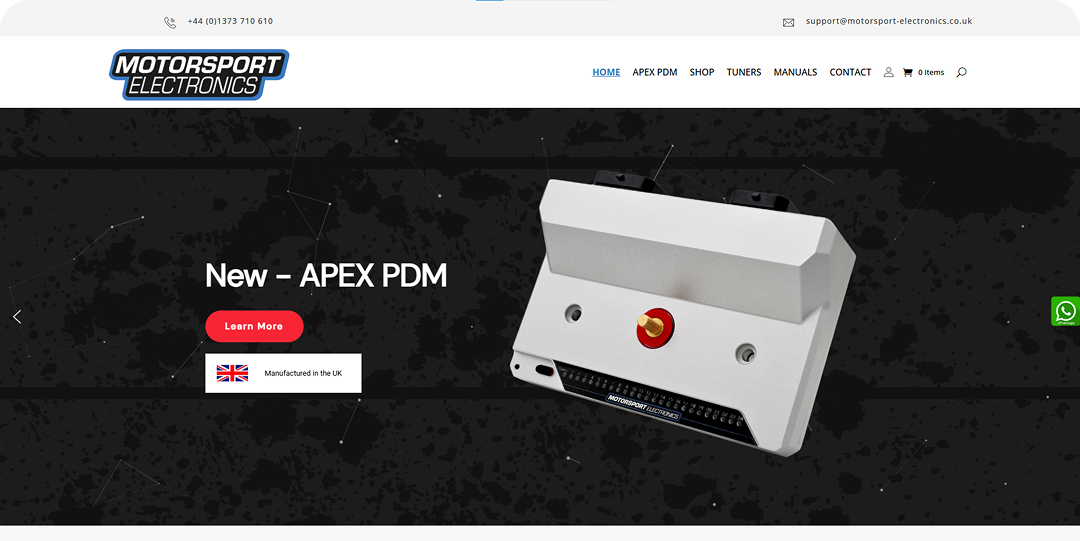
Overview
Motorsport Electronics designs and builds ECUs in the UK for the fast-road and race market. The ME221, ME360 and ME100 are their own hardware, and around them sits everything a build actually needs -engine harness kits, expansion harnesses, connectors, sensors, coils and igniters, trigger wheel kits, PDMs, dash displays, throttle body packages, MX-5 turbo kits, tuning cables. Mapping and calibration services too, sold as products in their own right.
The buyer is not browsing. They’re mid-build with the loom half out of the car, or they’re a workshop ordering for a customer’s Zetec. They know what a TPS is and they know what they want. What they often can’t be certain of is whether this specific plug-in ECU matches their specific car, because an MX-5 NA shipped with a two-plug loom and a three-plug loom and those are two different products.
Get that wrong online and you’ve earned a return, a refund, a stalled build, and a customer who tells the forum about it.
That constraint shapes everything, and it’s specific to this sector. Across our automotive eCommerce work, fitment is nearly always the first thing to design around and the last thing anyone budgets for. So that’s what we built the store around, before anything else got designed.
The Challenge
Fitment is the whole business, and it isn’t simple
Wire-in ECUs go on nearly anything. Plug-in ECUs go on one thing. Harness kits are organised by engine -Ford Zetec, Duratec, ST170, Honda K20, F20c, Vauxhall C20, VW ABF, MX-5 NB 1.8 VVT -while plug-in ECUs are organised by vehicle and generation. Same catalogue, two different mental models, and customers show up with either one. A normal category tree can’t serve both without duplicating products all over the place.
Kits with dependent options, not simple products
Take a direct-to-head throttle body package. The buyer picks anodising colour, TPS mounting side, fuel rail fittings, ram pipe length, linkage position, TPS type, extension length. Then it ships with or without an ECU, with or without a terminated harness. That’s a configurator. Build it as WooCommerce variations and you’ll end up with a few hundred combinations and an admin screen nobody can use.
Anything off the compatibility list still needed a route
Plenty of engines aren’t on the list. Those customers were emailing, and the emails were genuinely good leads -custom harness work, bespoke specs, decent order values. But they landed in an inbox with no structure, no record, no pricing path.
Documentation is part of the product
An ECU is a paperweight without firmware, software, a base map, a wiring diagram and a manual. People need those before buying, to check they can actually do the job, and after buying to do it. Scattering PDFs around the site doesn’t work. Neither does asking someone to email for a base map at 11pm the night before a track day.
Selling out of the UK after Brexit
Motorsport is international. UK-built electronics going into the EU now means VAT handling, HS codes, customs paperwork, and a decision about who absorbs the duty. Customers hate a surprise charge at the door far more than they hate a higher price up front.
WordPress running a genuinely technical catalogue
Spec tables, large product images, forty-plus categories, layered filtering across all of it. WooCommerce copes, but not on its own, and not if a page builder gets anywhere near the product templates.
Our Approach
We spent the opening stretch on the data model rather than the design. For a parts store that’s where the project is won or lost. Products got structured attributes -make, model, generation, year range, engine code, loom variant, cylinder count -because once that exists, everything downstream comes out of it: filters, the fitment tool, related products, the compatibility blocks on every page.
Get that structure wrong and you don’t find out for six months, at which point fixing it means touching every product in the catalogue. Worth the slow start.
WooCommerce was the right platform and we’d pick it again. The client wanted to run the shop themselves, publish technical content, and not pay a licence fee that scales with revenue. Our WooCommerce development services covered the build, with the custom logic written as proper plugins rather than buried in theme functions -so a future redesign doesn’t take the fitment system down with it. If you’re weighing that decision yourself, we’ve written up how the major platforms compare for a technical catalogue.
Two-week sprints, call every Monday, with their engineers in the room. When a merchandising question turned into “no, that loom won’t work on a late NB,” we found out during a sprint review instead of after launch.
Solution Delivered

Fitment, both ways round
Customers can find parts by vehicle or engine code, with compatibility clearly shown on product pages. The cart re-checks fitment before checkout, while the selected vehicle persists throughout browsing. A “Can’t find your engine?” route captures engine details, intended use, and setup, then sends a structured enquiry to the technical team—turning an unmanaged inbox into an organized lead queue.

A configurator, not four hundred variations
Throttle body and ECU packages are configurable products with conditional options -pick a mounting side and irrelevant extensions vanish, add an ECU and matching harness options appear, price updates live. Where a spec falls outside the standard set, the same form drops into a quote request with the configuration attached, so sales aren’t reconstructing it from a paragraph of prose.

Documentation tied to the product
Firmware, tuning software, maps, wiring diagrams, and manuals are linked directly to products. Public, pre-purchase documentation builds confidence by answering installation questions upfront. Version control ensures updates reach every unit owner. It also reduces support workload, as customers can access needed documents directly from product pages instead of emailing the technical team for files.

Shipping and duties, stated honestly
Zone-based rules for UK, EU and rest of world. Weight and dimension data on every product so cart quotes are accurate rather than optimistic. HS codes and country of origin in the product data for customs paperwork. Duty expectations shown before payment, not discovered on the doorstep.

Trade and dealer accounts
Workshops order differently from privateers. Own account tier, tiered pricing, faster reordering on the parts they move constantly.

Performance and QA
Product templates hand-built rather than page-built. Image weight cut hard. Filtering queries optimised, because layered navigation across forty-plus categories will flatten a WooCommerce site otherwise -the techniques are much the same as the ones in our guide to speeding up a WooCommerce store. Checkout regression tested across configurator permutations, shipping zones and trade pricing under our software testing & QA practice.
Key Features
Every tool here was chosen for a reason- not because it was fashionable, but because it solved a specific problem the platform actually had. Here’s what we used and why it earned its place.

Two-way fitment search
By vehicle or by engine code, loom variant handled explicitly.

Compatibility validation at cart
Catches a mismatch before payment, not after delivery.

Kit configurator
onditional options for throttle body, harness and ECU packages, live pricing, quote fallback for custom specs.

“Can’t find your engine?” enquiry flow
Structured capture for off-list builds, straight into the sales queue.

Product-linked documentation
Firmware, base maps, manuals and wiring diagrams, versioned against the unit they belong to.

Zone-based international shipping
Accurate quotes, HS codes, duty stated up front.

Trade accounts
Tiered pricing and quick reorder for workshops and dealers.
Results and Outcomes
Indicative outcomes from the build. Replace with the client’s measured figures before publishing.
Fewer wrong-part returns
Compatibility checked at browse and again at cart
40+ categories
Deep technical catalogue, filterable without the usual slowdown
Custom builds captured
Off-list engines routed as structured enquiries instead of loose email
Lower support load
Firmware, maps and diagrams self-served from the product page
Technology Stack


WordPress + WooCommerce
Store platform, catalogue and content

Custom plugins (PHP)
Fitment engine, compatibility validation, configurator logic

Structured product attributes
Make, model, generation, engine code, loom variant


Layered navigation + optimised queries
Filtering across a deep category tree without the usual slowdown.

Document management layer
Firmware, maps and manuals tied to products, versioned


Product schema + controlled indexation
Structured data, canonicals, crawl management


Payment + shipping integrations
Multi-currency, zone rules, customs data


Caching, CDN, image optimization
Page weight under control on spec-heavy pages
Engagement Model: A Dedicated Team on Retainer
Launch isn’t the finish line for a store like this. ECU revisions ship. Firmware needs publishing. New engine platforms join the compatibility list. Plug-in variants appear for cars that weren’t supported last year. WordPress and WooCommerce both update on their own schedule, whether you’re ready or not.
So Motorsport Electronics chose to hire dedicated developers from our team rather than take a handover and hope. Same people who wrote the fitment engine still maintain it, which matters more than it sounds -compatibility logic is full of exceptions that live in people’s heads as much as in code.
It scales with what’s happening -a quiet quarter might need a couple of developers and a QA resource part-time, while a new ECU platform launch calls for a bigger pod. It’s why most retailers hire eCommerce developers on a flexible model rather than fixed headcount.
New platform support

adding vehicles, engines and loom variants to the fitment data
Product and firmware releases

new SKUs, documentation, version pushes
Feature work

configurator changes, trade account features, campaign pages
Maintenance

WordPress and WooCommerce core, plugin versions, security patching
Performance

Core Web Vitals and query optimisation as the catalogue grows- Priority
support

a defined response window on anything touching checkout or stock
Conclusion
Automotive parts retail carries a problem most ecommerce categories don’t: the product either fits or it doesn’t, and the customer can’t always tell which. No amount of good photography solves that. You solve it in the data -structured fitment attributes, validation at the right moments, and an honest route for the cases that fall outside the list.
Do that properly and the rest gets easier. The same attribute structure that stops wrong-part returns is what makes the configurator possible, what keeps forty categories navigable, and what lets the team add a new engine platform in an afternoon rather than a fortnight.
It’s the approach we take to ecommerce development services generally, though it bites hardest in categories where a product either fits or it doesn’t.
If your parts store is drowning in wrong-fitment returns, that’s rarely a design problem. It’s the data underneath, and it’s fixable.


