From Overseas Application to First UK Shift, Without the Email Chains
NurseGate is an international healthcare recruitment platform that brings overseas trained nurses, doctors and care workers into UK healthcare roles. We built its iOS and Android apps in Flutter, along with the employer web portal, as part of our healthcare app development practice.
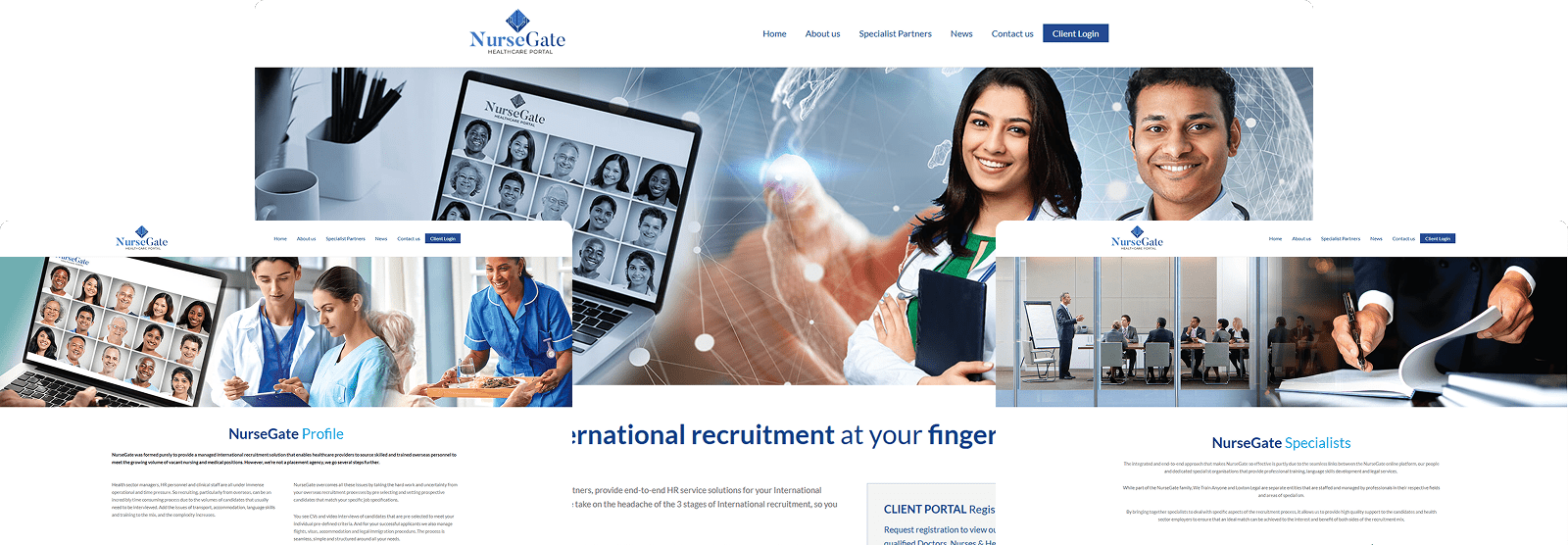
Overview
The UK has a nursing gap that isn’t closing on its own. NHS trusts and care homes have leaned on international nurse recruitment for years now, and bringing even one nurse over from Kerala, Manila or Lagos is a long road. NMC registration. An English test. The CBT. A Certificate of Sponsorship, a Health and Care Worker visa, and then the OSCE after landing. Somewhere in between, that person also needs a flat, a bank account and someone to explain how a UK ward actually runs.
NurseGate’s model covers all three stages of that journey (they describe it as register, retain, place) and works with specialist partners for immigration law, clinical training and accommodation. The service was good. The tooling behind it wasn’t. Candidate files were spread across shared drives, WhatsApp threads and a WordPress client portal that could list profiles and not much else. Every recruiter was, in practice, a full-time document chaser.
They came to us wanting one platform: a mobile app candidates would genuinely use from abroad, a portal where employers could see progress instead of asking for it, and a back office that kept the whole operation compliant. The first release went live in 18 weeks.
The Challenge
Four problems that set the direction for everything that followed.
The candidates are on mid-range Android phones, on patchy data
Most applicants were applying from India, the Philippines, Nigeria, Kenya and Zimbabwe, many of them between shifts. A heavy app or a desktop-only form loses these people fast. Try uploading a 9MB scanned passport over weak 3G and watch it fail at 95%. That happens once, and the candidate usually doesn’t come back.
Fourteen compliance steps, and any of them can expire
A nurse’s file isn’t a CV. It’s an IELTS or OET score with a two-year shelf life, a CBT result, an NMC application status, police clearance from the home country, a DBS check later on, a CoS reference, visa dates and right-to-work evidence. Miss one expiry and a placement can slip by months. Before this project, all of it was tracked in spreadsheets, updated by hand, whenever someone remembered.
Ethical recruitment rules aren’t optional
The Department of Health and Social Care’s Code of Practice for international recruitment restricts active recruitment from countries on the WHO health workforce support and safeguards list. NurseGate takes this seriously; the code is published on their own site. But a rule that lives in a policy PDF rather than in the software depends on every recruiter getting it right, every time.
Employers wanted visibility, not more emails
Care home managers and NHS workforce teams kept asking the same question: where is my nurse? Each answer took a recruiter 10 to 15 minutes to pull together. Across a few hundred active candidates, that’s a team spending a big chunk of its week writing status updates.
Our Approach
We mapped the candidate journey before designing a single screen. Two workshops with NurseGate’s recruiters, plus one with their partner immigration adviser, turned the “three stages” into 14 concrete milestones. Each one got an owner, a list of required documents and a note on what usually goes wrong. That map became the data model. Honestly, it was the most useful week of the whole project.
Flutter was an easy decision. One Dart codebase gave us native-feeling iOS and Android apps and, through Flutter Web, the employer and admin portals as well. For a client that needed three surfaces on a sensible budget, maintaining separate Swift and Kotlin apps would have meant paying for duplication instead of features. Our Flutter app development team has shipped enough of these to know where Flutter Web needs extra care (large data tables, mostly), so we planned around it from day one.
Delivery ran as nine two-week sprints. Discovery and UI/UX design in Figma came first, tested over video calls with 12 nurses from NurseGate’s existing pool. Then the candidate app, then the compliance engine and admin console, then the employer portal, integrations, security hardening and launch.
NurseGate worked with a dedicated eight-person squad rather than a fixed-scope contract: a project manager, a business analyst, a designer, three Flutter developers , a Node.js developer on the backend and a QA engineer, with DevOps support as needed. That setup paid off mid-build, when the Home Office changed salary thresholds for the visa route and the matching rules had to change with them. No change request, no renegotiation. We just picked it up in the next sprint.
Solution Delivered

A candidate app built for the phone people actually own
We set a hard budget: under 30MB installed, smooth on a 2GB RAM Android device, and every core screen usable offline. Documents are compressed on the device before upload and sent in resumable chunks, so a dropped connection picks up where it stopped instead of starting over. A typical nurse finishes onboarding in about 11 minutes, and the profile can be completed across several sittings.

A compliance tracker that does the remembering
Each candidate gets a live timeline of all 14 milestones, from English test through NMC decision, CBT, CoS, visa, arrival, OSCE and PIN. Every document carries an expiry date. The system sends reminders at 90, 60 and 30 days before anything lapses, to both the candidate and their recruiter, and marks the file amber or red on the dashboard. Nobody keeps a spreadsheet anymore.

Document checks that catch problems early
Passports, degree certificates and test reports go through OCR on upload. The app reads names and dates, compares them against the profile and flags mismatches. A surname spelled two different ways is surprisingly common, and surprisingly expensive once it reaches the NMC. A recruiter still verifies every document by hand. The OCR just means they start from a pre-filled check instead of a blank one.

Ethical recruitment rules written into the code
Country of training and residence are checked against the current WHO safeguards list. Candidates from red-list countries can still apply directly, which the Code permits, but the platform stops recruiters from actively sourcing them and logs every exception with a reason. When a client asks how NurseGate stays compliant, there’s an audit report to hand over rather than a verbal assurance.
An employer portal that answers “where’s my nurse?” on its own
Care homes and NHS trusts log in to review shortlisted candidates, run video interviews in the browser, make offers and follow each hire through the same milestone view the recruiter sees. Interview slots sync with the employer’s calendar, and status updates go out automatically when a milestone closes. People still ask the question. Just far less often.
Matching that respects the boring constraints
Employers post roles by band, specialism, location and sponsorship status. The matching engine filters on what’s legally possible first (sponsor licence, salary threshold for the visa route, the candidate’s registration stage) and only then ranks on experience and preferences. A care home in Coventry without a sponsor licence never sees a candidate who needs sponsorship. Sounds obvious. It wasn’t happening before.
Partner services inside the same flow
Legal advice, additional training and accommodation used to mean three separate phone calls. Now they’re bookable from the app. Candidates can request a consultation with NurseGate’s immigration law partner, enrol in OSCE preparation and UK clinical practice modules (built on the same patterns we use in education app development), and browse accommodation near their placement before they fly. Partners get a slim portal of their own for managing requests.
Security that fits sensitive personal data
Everything is hosted in AWS’s London region. Documents are encrypted at rest with KMS-managed keys and served through short-lived signed URLs. Role-based access means an employer only sees what a candidate has agreed to share. Staff accounts use two-factor login, every action is logged, and a retention policy aligned with UK GDPR purges candidate files on schedule, not whenever someone gets round to it.
Three Modules Nobody Puts in the Pitch Deck
The parts that never make the demo but decide whether NurseGate can run the platform without calling us every week.
A content manager for the help centre
Visa guidance, NMC explainers and “your first week in the UK” articles are editable from the admin console, with version history, using the same approach as our CMS development work. Immigration rules change several times a year. A help centre that needs a developer for every update is a help centre that goes stale.
A support inbox with an actual workflow
Candidates raise issues from the app (document rejected, visa query, accommodation problem) and admins route each one to recruitment, legal or the accommodation partner, with status and history kept. For someone thousands of miles away and nervous about a life-changing move, getting a reply in hours rather than days is most of the experience.
Notifications in the candidate’s own time zone
Push, SMS, WhatsApp templates and email, all scheduled against the candidate’s local time. A reminder to book a CBT slot that lands at 3am in Manila doesn’t get read. This took an afternoon to build and probably did more for completion rates than anything else on this page.
Key Features

Low-data candidate app
Under 30MB, offline-ready, resumable uploads for weak connections.

14-milestone compliance tracker
English test to NMC PIN, with owners and live status for every step.

Expiry alerts at 90/60/30 days
Automatic reminders to candidates and recruiters before documents lapse.

OCR document verification
Names and dates read on upload and checked against the profile.

Code of Practice red-list checks
Active sourcing blocked for safeguarded countries, exceptions logged.

Sponsorship-aware job matching
Filters on sponsor licence, salary threshold and registration stage first.

In-browser video interviews
Employers interview candidates without installing anything.

Partner service booking
Legal advice, OSCE training and accommodation requests in one place.

Five-role access control
Candidate, Recruiter, Employer, Partner and Super Admin, with consent-based data sharing.

Recruitment analytics
Time-to-placement, drop-off by milestone and pipeline by employer.
Results & Outcomes
Measured over the first six months after launch, compared with the six months before.
18 weeks
Discovery to App Store and Google Play launch, across nine sprints.
41% faster
Average time from job offer to UK arrival dropped from 27 weeks to 16.
3,800+
Candidate profiles created in the first six months, 71% of them completed on mobile.
62% fewer
Recruiter hours spent on document chasing and manual status updates.
Alongside that: expired-document incidents fell from 46 in the previous six months to 3. Employer emails asking for status updates dropped by roughly 70%. The apps hold a 4.7 rating on the App Store and 4.6 on Google Play, with a 99.6% crash-free session rate in Crashlytics. Critical flows (registration, document upload, offer acceptance) run with full automated test coverage through our software testing and QA practice, and the platform cleared an external penetration test with zero high or critical findings before go-live. Three months of hypercare shipped with the handover.
Technology Stack


Mobile apps
Flutter 3 (Dart), BLoC state management, iOS and Android from one codebase

Web portals
Flutter Web for employer, partner and admin consoles


Backend
Node.js with NestJS, modular REST APIs


Database
PostgreSQL with Prisma ORM, Redis for caching and job queues


Cloud
AWS London region: ECS, RDS, S3, CloudFront, KMS

Document OCR
AWS Textract with custom validation rules

Video interviews
Agora SDK, in-app and in-browser


Notifications
Firebase Cloud Messaging, Twilio (SMS and WhatsApp), SendGrid


Calendar sync
Google Calendar API and Microsoft Graph

Auth
JWT with refresh token rotation, two-factor login for staff


Testing / CI
Flutter integration tests, Jest, Codemagic and GitHub Actions


Monitoring
Firebase Crashlytics, Sentry, CloudWatch
The Part People Underestimate: This Is a Compliance System
Worth saying plainly, because it’s where a lot of healthcare staffing app development goes sideways.
NurseGate looks like a job board. It isn’t, or not mainly. Take away the job listings and what’s left is a regulated document store, a set of legal deadlines, a consent model and an audit trail. Recruitment is the visible part. Compliance is the part that decides whether a nurse actually lands in the UK on time, and whether NurseGate can show a regulator or an NHS procurement team exactly how it got there.
That changes how you build. The core object here isn’t a job or an applicant. It’s a person with a regulatory clock attached: test scores ticking towards expiry, a visa route with salary rules that shift, an NMC application that can stall over one mismatched date. Generic applicant tracking systems don’t hold that shape well, which is why custom software development made more sense here than configuring an off-the-shelf ATS and bolting spreadsheets onto the side.
It also means the reporting has to be real. Drop-off by milestone, average days per stage, which source countries convert best, which employers move slowest on offers. We built these on a proper data analytics layer from the start, so NurseGate can spot a bottleneck in the CBT stage before it turns into a missed intake.
What’s Queued Next
The platform shipped with room deliberately left in it. On NurseGate’s roadmap:
AI-assisted CV parsing and candidate matching through AI and ML , so recruiters start from a ranked shortlist rather than a raw pool. A multilingual chatbot for common visa and NMC questions, available at 2am Manila time when no recruiter is. A retention module with check-ins at 3, 6 and 12 months after arrival, because the “retain” stage deserves as much software as “register” and “place”. Integration with NHS Jobs and the larger trusts’ e-rostering systems. And, further out, support for Ireland’s NMBI and Australia’s AHPRA pathways as NurseGate looks beyond the UK.
None of it needs a rebuild. That was the point of spending the first sprint on the data model.
Conclusion
NurseGate already knew how to recruit overseas nurses ethically and look after them once they arrived. What it needed was software that could keep up with the paperwork, the deadlines and the employers, without adding headcount every time the pipeline grew.
Eighteen weeks, one dedicated squad, and a healthcare recruitment app that candidates use from their phones abroad and employers check instead of sending emails. If we had to point at why it worked: we designed around a nurse on a cheap Android phone rather than the admin dashboard, we put the compliance rules in the code instead of a policy folder, and we treated the 14-step milestone map as the product, not as a feature.
If you’re building something with a similar shape (regulated workforce, long onboarding journeys, documents that expire, employers waiting on the other end) you can hire dedicated developers from us the way NurseGate did: a full squad that stays with the build from discovery through launch and hypercare.
Recruiting healthcare staff from overseas?
Let’s talk about what the software behind it actually needs to do.
Schedule a Free Consultation Let’s build success Together