
A B2B Conservation Brand Goes Properly Online
Vivara Pro — building a multilingual WordPress storefront for nesting solutions used by garden centres and conservation pros across Europe
Overview
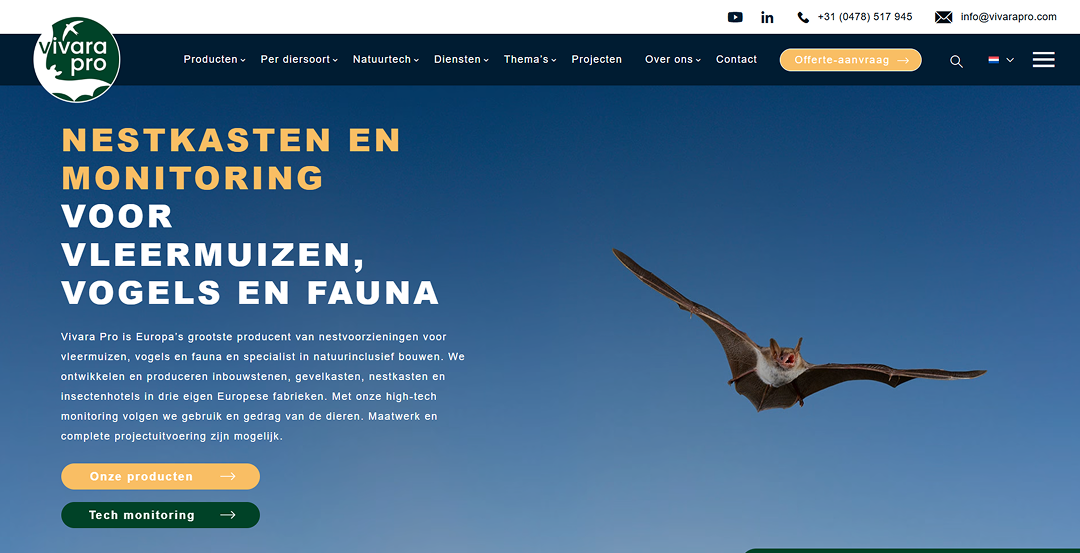
Vivara Pro is the professional arm of CJ Wildbird Foods — a European specialist in nesting solutions for bats, birds and insects. Their range covers built-in nesting bricks, bee bricks, wall-mounted boxes, pole-mounted boxes, full nest boxes and insect hotels. Most products are FSC-certified and developed alongside conservation organisations.
The buyers, however, aren’t end consumers. They’re garden centres, building merchants, retail chains, ecologists and architects spec’ing biodiversity into new builds. The old site treated them all the same. The new vivarapro.nl had to fix that — and do it in Dutch and English at minimum, ideally with room for more.
The Challenge
When we first reviewed the live site, the issue wasn’t catastrophic — it was just stuck. Product photography looked nice. Copy was OK. But the experience felt the same whether you were a one-shop garden centre owner in Maastricht or a procurement officer placing a 200-unit order for a council biodiversity project.
One-size-fits-all UX
Same flow for retail buyers, ecologists and trade accounts. No tier pricing, no quote requests, no minimum order logic.
Catalog without intent
Products were grouped by type (boxes, bricks, hotels). Buyers actually search by species — ‘house sparrow’, ‘common swift’, ‘solitary bee’. The site couldn’t lead them there.
Thin language coverage
Dutch was first-class. English was patchy. German and French — important markets for conservation buyers — weren’t there at all.
No content to support trust
Conservation buyers want to know how a product was tested, where it’s made, which org certified it. That story was missing.
Slow on mobile
Heavy hero images and unoptimised galleries dragged LCP well above 4 seconds in the field.
Our Approach
We did interviews with three buyer groups: a garden-centre owner, a council ecologist, and a building merchant. Different vocabulary, different constraints, mostly the same products. That meant the site couldn’t pick a single audience — it had to route each of them quickly.
WordPress with WooCommerce was already in the stack and we kept it, but rebuilt it from the ground up. Our WordPress development services team led discovery, IA, and the new product taxonomy. The big architectural call: build the catalog dual-axis — by product type AND by target species — so a buyer could land on a ‘common swift’ page and see every product designed for that species, regardless of whether it’s a brick, box or pole-mount.
On localisation, WPML went in early so the content team could expand into German and French without another rebuild. Pricing logic was wrapped in a custom layer so trade accounts see their own contract pricing, while public visitors see RRP.
Solution Delivered
The new site has three main entry points off the homepage: by product type, by species, and by buyer (garden centre, conservation pro, architect/builder). Each path leads somewhere useful — none of them dead-end into a generic catalog.
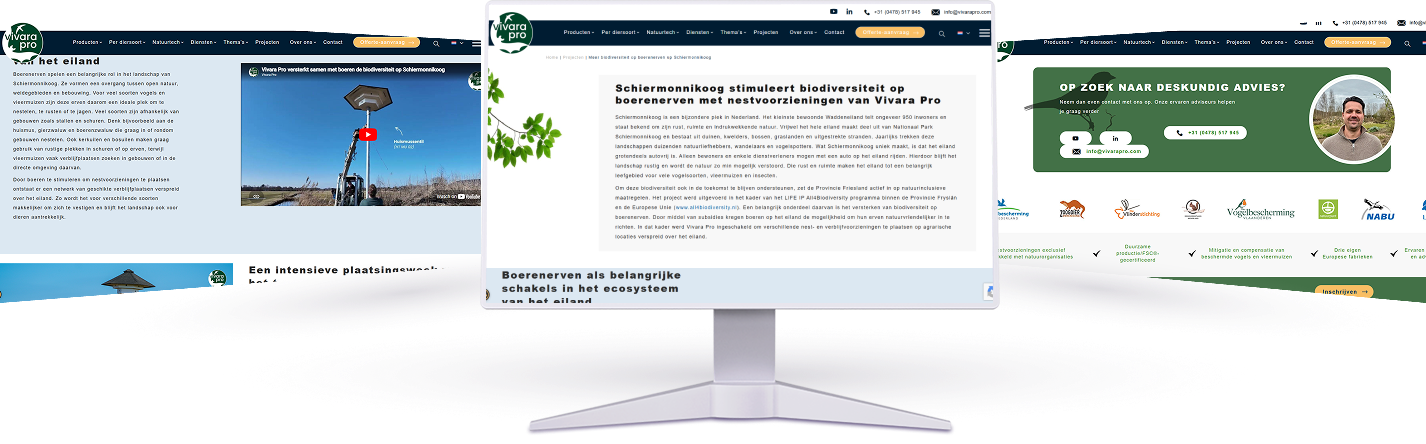
Product pages were rebuilt with proper context. Every product shows the target species, the certifying organisation, the materials, the FSC source where applicable, and a small ‘used in’ block that links to projects where the product is installed. That last piece took some legwork — we worked with the team to pull case references from existing project files — but it’s what conservation buyers care about.
For trade accounts, we built a separate ordering experience: tier pricing, MOQs per SKU, bulk-pack options, and quote-cart functionality so a buyer can build a list and request a formal quote rather than placing an instant order. The team can approve and convert quotes into orders inside the WP admin.
A content hub sits alongside the catalog — articles on biodiversity-net-gain regulation, species-specific installation guides, and partner-org case studies. That’s now a meaningful traffic source for the brand, not just decoration.
Glimpses of Vivara Pro
Key Features

Dual-axis catalog
Browse by product type or by target species. Same products, two paths to find them.

Trade account portal
Tier pricing, MOQs, quote-carts and order history for B2B buyers.

Multilingual (NL + EN, more coming)
WPML setup ready for DE and FR rollouts.

Project references on product pages
‘Used in’ blocks linking to real installations.

Certification badges
FSC, BTO, partner-org marks displayed where they matter.

Species-led landing pages
House sparrow, common swift, solitary bee, pipistrelle bat — each a proper page.

Knowledge hub
Articles, installation guides, downloads — built on a custom WP post type.

Bulk-order quote tool
Build a multi-product quote, request via the admin, get a formal PDF back.
Results and Outcomes
Tracked across the first 9 months post-launch.
+ 124% organic sessions
Mostly driven by species-led pages and the new content hub.
+ 71% trade account sign-ups
Garden centres and councils registering for a tier-priced login.
– 55% mobile LCP
From ~4.4s down to under 2s on the homepage and category pages.
+ 2.4× quote requests
B2B buyers using the quote-cart instead of going to email.
DE/FR expansion ready
Full language framework in place; no architectural rework needed for the next two markets.
Technology Stack


WordPress + WooCommerce
Catalog and commerce.

WPML
Multilingual content management.

B2BKing (heavily customised)
Trade accounts, tier pricing, MOQs, quote-cart workflow.

Custom species taxonomy
WP custom taxonomy linking products to target wildlife.


PHP 8.2 / MariaDB
Server-side stack, performance-tuned.


ImageMagick + WebP pipeline
ImageMagick + WebP pipeline Auto-optimised product photography for fast mobile delivery.

Algolia search
Fast, faceted search across products, species and content.


Mailchimp + ActiveCampaign
Mailchimp + ActiveCampaign Newsletter and trade-buyer nurture sequences.
Conclusion
Vivara Pro had a strong product range and a strong story. The site just wasn’t carrying either. The rebuild gives different buyer groups different routes, makes the conservation credentials visible without shouting, and sets the brand up for cleaner expansion into Germany and France.
B2B sites with multiple buyer types are tricky — get the routing wrong and everyone bounces. If you’re working on something similar, hire WordPress developers who’ll spend time on the buyer journey before they touch the design.


