
 Add us as a preferred source on Google
 Do you think of the situation when you get a little more access to a website and are still not able to read the text, click the buttons, or even navigate through the page simply because you are a disabled person with a disability? Isn’t it frustrating? Unfortunately, this is what millions of people are going through regularly when no effort is made to make the web, apps, and digital content accessible to them. Accessibility of resources through the Americans with Disabilities Act is the core of the issue. This is the main idea of the law, which is that all attempts are to provide citizens with disabilities with a wide range of resources that they can use digitally.
Anyone who is not yet ADA compliant is not merely a person unwilling to be just and fair but unsustainable if seen as a business. In line with the total capability and usability of market research that is projected to triple within the next five years is the global value of accessibility testing, which leads to $606 million by 2027 at a CAGR of 5.3%. Statistics show that the US alone has more than 61 million people who have developed some disabilities. With more ADA compliance accessible products, companies not only introduce themselves to new potential customers but also provide a competitive advantage.
Our blog contains everything about ADA compliance (Usability Act), what is ADA compliance?, its regulations, the advantages it offers for your company, the potential risks of breaching it, and how your company can utilize our capabilities to be the first. Step by step, let’s proceed to make online spaces more inclusive and better for all generations.
What is ADA Compliance?
ADA compliance refers to the steps that are taken to follow the rules of the Americans with Disabilities Act (ADA) to ensure that the products, services, and any other official matters of the organization are accessible- and user-friendly for people with disabilities in the offline as well as in the online world.
In addition to the physical dimension of the Act, such as building ramps for the physically handicapped, creating accessible restrooms, and, in this way, service counters, the ADA Act has achieved a new dimension that includes helping disabled people with ADA website compliance, phone apps, and digital information. This means, for example, whatever the needs are for people who use a screen reader, people who are unable to do anything with a mouse, or those who have hearing or vision disabilities, the website should work for them equally well as it does for all others.
Let’s take ADA compliance examples:
- Text that is spoken by text-to-speech applications
- Video subtitles
- Fonts that are very simple to read and distinguishable different visual elements
- Mouseless keyboard navigation (for people who cannot use a mouse).
ADA compliance means your website or app is usable by all people, no matter their ability. It’s not just the right thing to do—it’s also the law.
What Happens If You’re Not ADA Compliant?
When your website or online store is not ADA-compliant, it indicates that persons with disabilities cannot fully access your ADA compliance services. Consequently, it could bring some serious issues—both financially and legally.
This is how you can be affected:
1. Lawsuit
For the reason that they did not have accessible websites, some of the business owners have become defendants in the courts. In fact, ADA related litigation continues to grow annually and particularly the majority of cases are filed against websites which are not designed for disabled people. These lawsuits can result in the payment of large sums of money in legal fees and settlements.
2. Customer Structure Damage
If your web platform is not user-friendly, then your potential customers will simply flee to rivals with a more pleasant experience. This in turn means that you will not only lose sales but your business reputation will also be severely damaged.
3. Fines and Penalties
The government is authorized to impose fines in the event that you are found to be not in ADA compliance regulations. These fines mount up very fast, more so for huge companies.
4. Negative Publicity
No one wants to be the brand of discrimination or inaccessibility. If not compliant, it can result in bad word-of-mouth, which is damaging to your brand image and trust level.
Basically, if the website is not ADA-compliant, it will have an impact on your finances, customers, and reputation. However, the good news is that it is possible to solve the problem no matter how late it is, thereby increasing the satisfaction levels of the customers through a more inclusive website for all.
What Are The Key Benefits of ADA Compliance?
Ensuring your website or business is ADA-compliant is not just about fulfilling the ADA compliance requirements- it’s about making the experience for all. It’s like you make your ADA website compliance accessible, and then, suddenly, there are millions of people who might have been there for the first time without your digital presence, the ones you now can invite into your space to browse your catalogue of products and services, and many more who can become your new loyal customers.
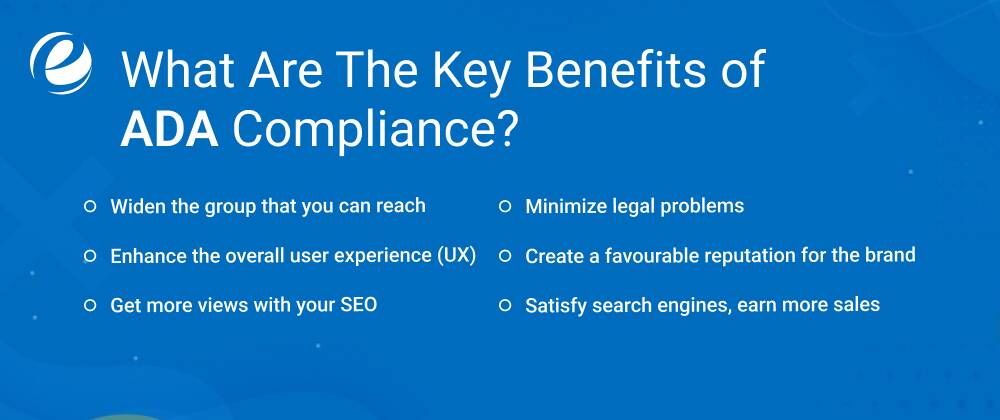
Furthermore, it can have different benefits for your brand, your customers, and your profit. The following are some of the ADA compliance advantages:
1. Widen the group that you can reach
More than 61 million Americans have some form of disability. As such, it can be said that being ADA compliant can help you connect with this significant and yet often neglected group of potential customers.
2. Enhance the overall user experience (UX)
ADA compliance for websites are more user-friendly for all kinds of people, not just those who have a disability, because a neat site, a clear flow, and content that people can not only read but read thoroughly benefit all users.
3. Get more views with your SEO
Most of the features for accessibility that you add to your web page can also be found in different kinds of search engine optimization techniques, such as an alt attribute, h1/h2 tags, and video transcripts, which in some way can make your content more competitive compared to the others and this can help in raising your searches.
4. Minimize legal problems
ADA compliance not only saves you from heavy fines but also keeps you on the good side of the law. It is a very effective way to protect yourself and move forward.
5. Create a favourable reputation for the brand
Demonstrating that your brand recognizes inclusion and accessibility will strengthen the bond between your brand and the customers, and customers will come back to you again and again. It shows that your brand cares for your customers and not a part of them.
6. Satisfy search engines, earn more sales
When more users can move seamlessly through your ADA website compliance, the chances are they are more likely to return, interact and purchase; hence, conversions will be on the rise, drama-free and without any walls to obstruct.

What Are the ADA Compliance Laws?
The Americans with Disabilities Act (ADA) is a federal law in the United States that guarantees people with disabilities have the same opportunities and rights as others. First, it affected only tangible spaces, but now, it also includes the digital world such as websites, mobile applications, and digital content.
Here is the summary of the ADA compliance regulations that must be known to you:
1. ADA Title I – Employment
Notifies employers with 15 or more workers to treat persons with disabilities equally in job hiring processes.
Changes like screen readers or flexible workspaces must be made by the employer.
2. ADA Title II – Public Services
Refers to public entities like schools, courts, and public transportation.
In addition to the physical world, they are required to make ADA compliance services and information also ADA compliance accessible on their websites.
3. ADA Title III – Public Accommodations
Refers to the private sector, i.e., private businesses like restaurants, hotels, stores, and websites.
They are obliged to provide facilities and electronic platforms that are accessible to persons with disabilities.
4. Web Content Accessibility Guidelines (WCAG)
There is no such law, but those are the most commonly adopted technological standards.
It includes alt text for images, readable fonts, and a keyboard for navigation.
5. Department of Justice (DOJ) Guidance
According to the DOJ’s view, ADA compliance for websites also belongs to public accommodations under ADA Title III.
This means that if your ADA site compliance is not accessible, it can become grounds for a lawsuit.
If you have a company that is part of an organization or manages government services, your digital content must be accessible to every single user as per ADA compliance laws, irrespective of their ability.
ADA Compliance Examples in Websites & Apps
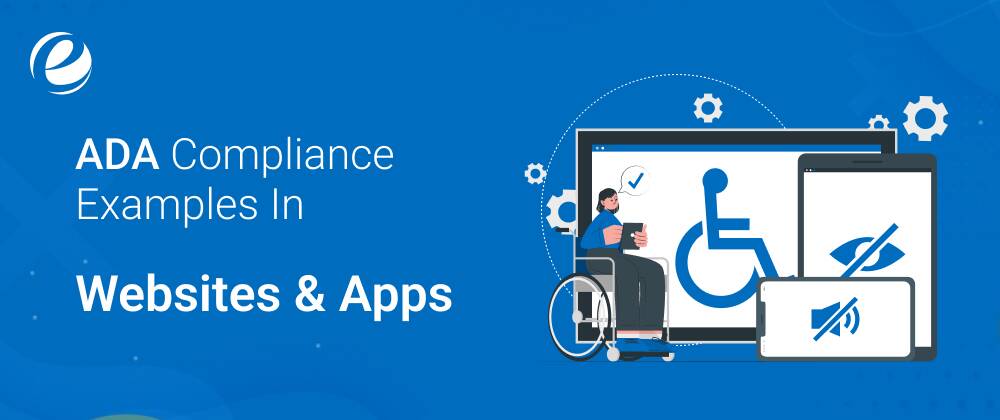
To better understand how top brands implement accessibility, we’ve divided the ADA compliance examples into two sections. The first highlights websites that follow ADA standards, and the second displays mobile apps designed with accessibility in mind.
Example of ADA Compliance s in Websites
Many of the biggest companies in the world make a positive impact on society by ensuring their websites are accessible to all individuals, including those with disabilities. These global brands recognize that ADA compliance is not only a way to stay legal but, most of all, a means of making their customers’ online experiences more engaging and inclusive.
Listed here are some of the most visited websites that have made the most significant changes to be fully accessible channels.
| Website | Launched Year | Platform Types | Monthly Visits (Approx.) | Global Rank | Accessibility Rating (1-5) |
| M.Gemi | 2015 | Web, Mobile Web | 300K+ | 160,000+ | 4 |
| Apple | 1996 | Web, iOS, Mobile Web | 1B+ | Top 50 | 5 |
| Walmart | 2000 | Web, Mobile Web, App | 450M+ | Top 100 | 4 |
| BBC | 1997 | Web, Mobile Web, App | 1B+ | Top 100 | 5 |
| Netflix | 1997 | Web, Mobile Web, Smart TVs, App | 250M+ | Top 200 | 4 |
ADA Compliance in Mobile Apps
Smartphones are essential in our modern age of technology, and mobile phones are very inclusive of everyone, even the disabled. The situation has improved significantly with app developers who now prefer to design ADA-compliant applications as a way of reaching out to more users and meeting their needs.
Below are some inspiring instances of apps that prioritize accessibility, be it those built with such attributes or those that modify and enhance the features to accommodate different users with disabilities.
| App Name | Launched Year | App Size | App Rating | Platforms | Downloads |
| Be My Eyes | 2015 | ~110MB | 4.7/5 | iOS, Android | 5M+ |
| Voice Dream Reader | 2011 (iOS only) | ~200MB | 4.8/5 | iOS | 500K+ (paid app) |
| Uber | 2010 | ~200MB | 4.5/5 | iOS, Android | 1B+ |
| Google Maps | 2005 | ~100MB | 4.6/5 | iOS, Android | 10B+ |
| Seeing AI | 2017 | ~250MB | 4.8/5 | iOS | 1M+ |
How We Can Help You Achieve ADA Compliance
Building ADA website compliance could be daunting, but we are here to help you make this process simple and stress-free.
1. Website Accessibility Audit
We kick off the process by scanning through your website or app in order to identify what parts are inaccessible. This may include such things as color contrast, alt text, navigation, and more.
2. Fixes and Remediation
After we identify the issues, our experts will start fixing them to make sure your site, design, and code adhere to the ADA and WCAG standards.
3. Detailed Reporting
We try to provide an extensive report on what we have already done, along with the ways in which your platform now complies with the ADA compliance requirements. This will not only make you feel at ease but also allow you to possess a record of your activities.
4. Ongoing Monitoring & Maintenance
Being ADA compliant does not mean that you become ADA fully for a lifetime. We can help you check for regular updates to ensure that your ADA compliance website remains accessible, even if there are any amendments or new content added.
5. Training & Support
Our team is ready to educate yours so that they can produce and look after the required content in the future — not just for now. So that you will be free of the mind for a long time.
6. Personalized Support
There’s no one-size-fits-all in business, and so we take that into consideration; we customize the ADA compliance services so that they can adapt to your business, whether it’s a small business, e-commerce or an enterprise.
Not only is making your digital space accessible ethical, but it’s also beneficial. Our collaboration will ensure that your company’s brand is inclusive to all people.
Which Are The Best Practices for ADA Compliance?
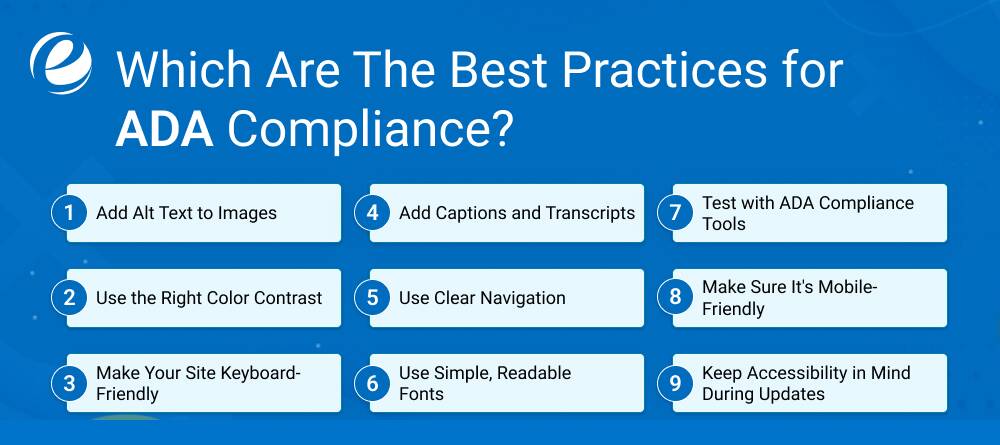
Practising ADA compliance the right way is one of the best ways to make your website or app accessible to people with all sorts of disabilities. The list of things that you may do to start things off is as straightforward as it can get:
1. Add Alt Text to Images
Alt text explains the meaning of images to people who are using screen readers. Ensure that every image is explained briefly and unambiguously.
2. Use the Right Color Contrast
Content should be easily visible in the background. Use large contrast-scale colour pairs to make your text and background — for instance, black text on white — readable.
3. Make Your Site Keyboard-Friendly
Do not forget that there are people who are better off using a keyboard only when they need to perform operations like clicking or pointing with the Tab key. Make sure that every button, link, and menu will be ADA compliance accessible in this way.
4. Add Captions and Transcripts
When producing a video, ensure that it has captions so that those with hearing impairments can follow the content. If it is a podcast or webinar, transcription will be beneficial for people who need it, or they can simply use it to follow the audio content.
5. Use Clear Navigation
See to it that your menus and links are in very accessible places and are easy to use. A table of contents is a great way to group items together and present them in labels that are clear and understandable.
6. Use Simple, Readable Fonts
Choose fonts that are not hard on the eyes (like Arial or Verdana), and do not be very small. The sentence should be short, and the language you are using should be simple.
7. Test with ADA Compliance Tools
Software applications such as screen readers, contrast checkers, and accessibility checkers (WAVE, Axe, etc.) may be used to make sure whether or not the website is working as expected with the use of a display to an audience that includes users with disabilities.
8. Make Sure It’s Mobile-Friendly
A successful ADA compliance website is one that is well-suited to mobile phones and touchpads. Nowadays, a lot of people depend on gadgets that have built-in accessibility features.
9. Keep Accessibility in Mind During Updates
If you decide to update your website or add some new information, always check if it is accessible. ADA is something that needs to be performed continuously, not just once.

Why Choose EmizenTech for ADA Compliance?
At EmizenTech, we aim not only to make websites ADA-compliant but also to make websites that bring digital advantages to everyone, i.e., inclusive, user-friendly, and future-ready. Check the following points to understand why businesses trust us in regard to their accessibility journey:
1. Expertise You Can Rely On
We are a team that has extensive and deep-rooted knowledge in auditing, remediation, and mobile app development of things related to accessibility, so we have the skills to check if the user journey is going to be completely ADA compliance accessible.
2. Custom Solutions for Your Business
Because every business is unique, we offer ADA compliance services that are appropriate for your site, audience, and objectives, whether you are a small business or a big enterprise.
3. Comprehensive Accessibility Audit
We do not start by giving you a self-checking mark. Our audit is very detailed, and it identifies the exact gaps where your website and app are not accessible. We then provide you with a list of very concrete and feasible actions to undertake in order to bridge these gaps.
4. Ongoing Support & Monitoring
It’s not a one-time check, ADA compliance. We continuously support you on your accessibility journey, enabling you to keep your digital assets accessible and ensuring that your content or technology changes will still make your website compliant.
5. Transparent Reporting
We will send you regular reports that are written in clear language without much technical terminology. The reports show the progress that has been made and the current ADA compliance status of your site.
6. Cross-Industry Experience
We have served a lot of different clients in various industries such as eCommerce, finance, healthcare, education, etc., so we have learned how to achieve ADA compliance without having to hinder your workflows in any way.
7. Faster Turnaround, Long-Term Value
We don’t compromise quality. Our team works fast without sacrificing the quality of the results, thus enabling the client to enjoy accessibility for a long duration of time.
Choosing EmizenTech means choosing a partner who genuinely cares about your ADA compliance requirements, expectations, users and your brand. Let us help you build a digital reach that’s open, ADA compliance accessible, and welcoming to everyone.
Nutshell
It is no longer unnecessary to add ADA compliance because now it is crucial. Apart from the legal requirement, the idea of the digital-first world has brought non-optional to manifest a genuine interest in your users, brand, and business. From derisking the business to enhancing the user experience and expanding the target audience, big benefits can be gained from accessibility performance.
EmizenTech is one of the companies that can help you achieve easy and productive ADA compliance. It does not matter if you are taking your first steps or need to do the redevelopment of the platform or require web development; we are here to help you and guide you through the process.
Now, we are ready to create a world free of digital barriers for all people because inaccessibility is not a word of regulation; it is a concept of participation.
FAQs
What is the ADA Compliance?
To be ADA compliant means that your website or your digital content should be available to everyone, including individuals with disabilities, thus following the Americans with Disabilities Act guidelines.
Why is ADA Compliance important?
It makes sure that everyone, including people with disabilities, can get to (access) your website and also use it (without any difficulty). Apart from this, you will be out of the risk of legal issues, and you will have a better reputation for your brand.
Who Needs to Be ADA-Compliant?
Any business or organization with their website, app, or digital content have to be ADA compliant; this is more important for those either in the public service sector or those that sell goods online.
What Are the Advantages of ADA Compliance?
The advantages are that you can reach a wider audience, provide more user-friendly service, reduce legal risks, and improve your brand's image.
What Will Happen If My Website Is Not ADA-Compliant?
A refusal to adhere to ADA standards might bring lawsuits, fines, and a negative change in your public image. Furthermore, without the website, you might miss the opportunity to appeal to potential clients who are unable to use it.
How Can EmizenTech Assist with ADA Compliance?
To guarantee complete ADA compliance and accessibility to all users, we provide website audits, remediation ADA compliance services, ongoing support, and training.
How Do I Know If My Website Is ADA-Compliant?
An accessibility audit or ADA compliance tools can be used to detect or identify issues. EmizenTech can help you with a thorough evaluation and fix any issues.
Is ADA Compliance a One-Time Task?
No. The process of maintaining and updating the website for ADA compliance requires constant effort, particularly when the ADA site compliance is modified or the new content is added.



 +1 (989) 535-9295
 info@emizentech.com
 emizentech


