 Add us as a preferred source on Google
Mobile applications have become one of the primary ways for businesses to connect with customers in today’s digital-first world. In 2026, customers are expected to download 143 billion mobile apps from the Google Play Store. This represents an almost 30% increase from the 111 billion app downloads in 2021.
Making an app successful is based on a lot more than just a pretty interface. It first starts with a solid mobile app architecture. A well-designed application architecture ensures optimal performance, a better user experience and long-term scalability.
This blog will walk you through the basic layers and architectural patterns, as well as a comparison of the three different types of app architectures (monolithic, microservices, and serverless).
What is Mobile App Architecture?
The term “Mobile app architecture” stands for the framework of a mobile application, which consists of its components and interfaces. It describes the app’s components and the way they connect with each other and with the system environment. Simply put, it is considered a blueprint that enables developers to design apps that are reliable, scalable, and easy to maintain.
However, if you are wondering how to bring your app vision to life, our mobile app development services can help you get started on your next digital innovation.
Why Mobile Apps Fail Without the Right Architecture?
A well-organized architecture of a mobile app is vital for its performance & scalability. In this section, we will examine the common reasons apps fail when their structure is not designed properly.
- Scalability Issues: Without a modular architecture, applications cannot expand, which results in overloaded servers & crashes during peak traffic times.
- Poor User Experience and Performance: 53% of users will abandon an app if the loading time is longer than three to four seconds due to inefficient architecture, which causes the app to load slowly and behave sporadically.
- Unmanageable Technical Debt: Tight coupling creates a huge amount of technical debt; therefore, it becomes very difficult to update the application or make changes to fix bugs in the software.
- UI/UX Fragmentation: Without a uniform architecture, there are inconsistencies between the behavior of Android & iOS, which often lead to a fragmented brand experience.
- Resource Management Failures: Poorly designed apps lead to excessive resource consumption, resulting in OOM (Out Of Memory) errors, which cause the operating system to shut down their app.
The Three Core Layers of Modern Mobile App Architecture
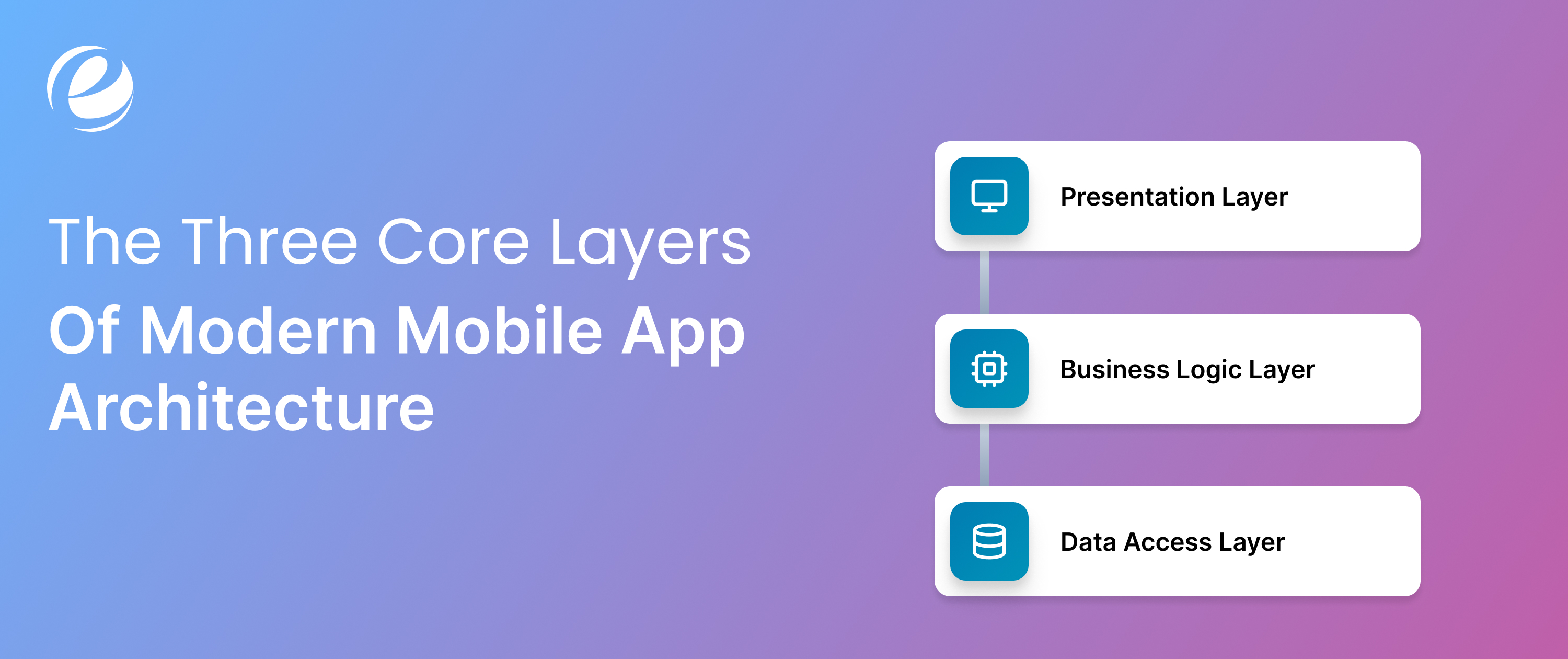
The architecture of mobile app is generally divided into three layers. Each layer has its own role, which enables you to keep the app organized and easy to maintain. Let’s investigate them in this section:
Presentation Layer
The presentation layer is what front-end users interact with, including the screen, controls, visualizations, and navigation. The main role of this layer is to capture user inputs and display outputs from the lower layer clearly and attractively. For instance, chat screens and menus in apps like WhatsApp.
Business Logic Layer
The business logic layer is also referred to as the application layer. It handles an app’s core functionality. It processes user inputs, applies rules, and handles tasks like notifications or analytics. Thus, it behaves as the bridge between UI and data. In messaging apps, it handles sending messages, spam detection, encryption, & notifications.
Data Access Layer
The data access layer takes care of all the connections to databases, external APIs, and storage systems. It takes care of getting, storing, and organizing data while hiding the mechanics of how it is stored. It gets and saves messages, answers user questions, and caches data and concurrency in apps like WhatsApp.
Comparing Monolithic, Microservices & Serverless Architectures
Selecting the right software architecture directly affects scalability, performance, long-term costs, and development speed. Here is a comparison of monolithic, microservices, and serverless architecture to enable you to determine which model is best for your app in 2026.
| Feature | Monolithic Architecture | Microservices Architecture | Serverless Architecture |
| Definition | Built as one complete app that runs as a single system | Split into smaller, and independent services that work together | Application built with cloud-managed function services |
| Codebase Structure | Single codebase | Multiple smaller codebases | Event-driven code units and function-based |
| Deployment | Deploy the complete app at once | Deploy services independently. | Deploy individual functions |
| Scalability | Scale the entire application | Scale individual services | Auto-scales per request |
| Development Speed | Fast | Moderate | Fast for small features |
| Complexity | Highly complex | Distributed system complexity | Managed infrastructure but event complexity |
| Technology Flexibility | Single tech stack | Each service can use distinct tech stack | Limited by cloud provider ecosystem |
| Fault Isolation | Low as one failure can affect the entire app | High as failures isolated per service | Very high as failure isolated per function |
| Cost Model | Fixed server cost | Server plus orchestration cost | Pay-per-execution |
| Best For | Ideal for small to medium apps, MVPs | For large, complex, and evolving systems | Best for event-driven apps and unpredictable workloads |
| Latency | Low (in-memory) | Higher (network-based) | Variable (cold starts) |
| Vendor Lock-in Risk | Low | Low-Medium | High (Depends on cloud provider) |
Top Mobile App Architecture Patterns
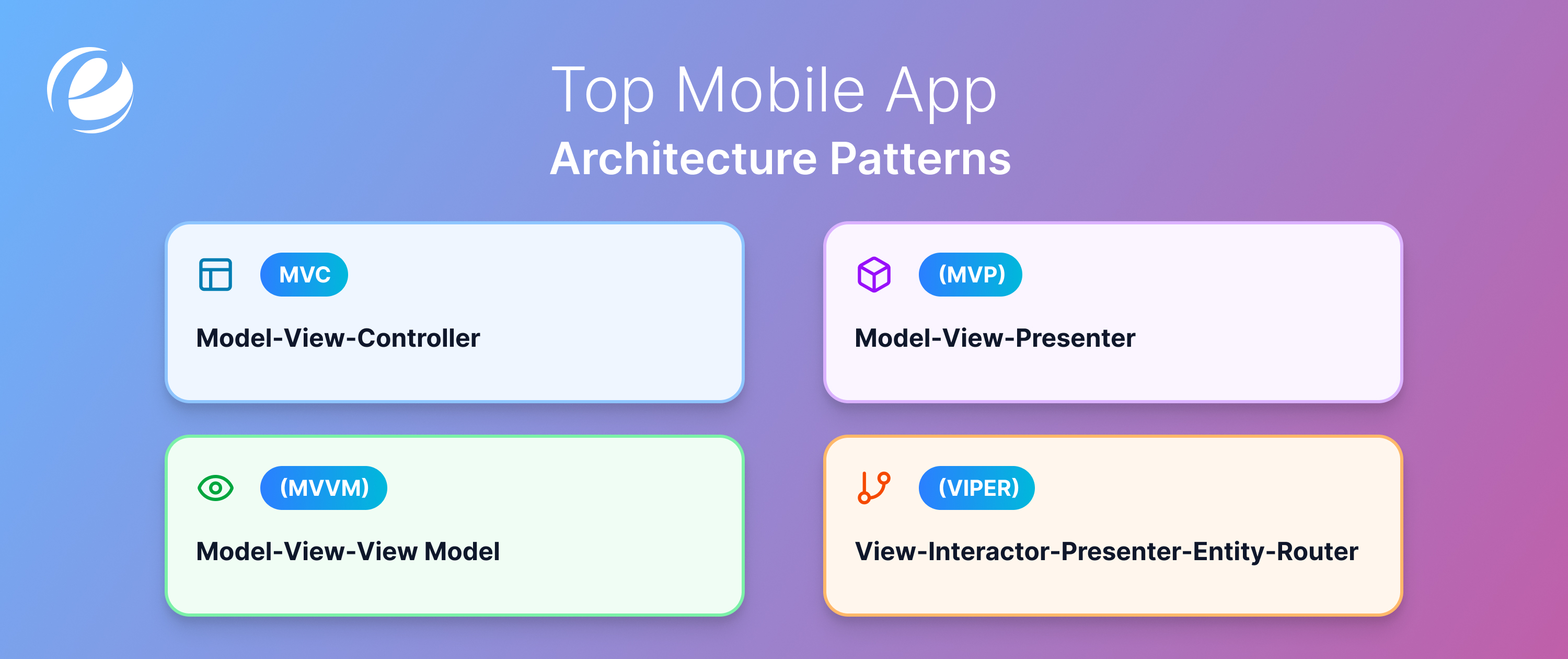
Mobile app architecture stands as a blueprint that describes the structure, behavior, and interaction of diverse components within an application. It consists of four main patterns. Let’s investigate them below.
Model-View-Controller (MVC)
The MVC design pattern is frequently used with simpler applications than with any of the other design patterns. A model is responsible for handling data and some of the application logic. The view displays the UI, while the controller manages user input and user interactions.
The downside to MVC is that it runs the risk of creating large view controllers and tight coupling between components, which make it difficult to maintain large applications.
Model-View-Presenter (MVP)
MVP fixes MVC’s testability and separation issues. In MVP, the views display data and capture inputs, while presenters connect to the Model, which manages interactions and logic. This lets you test presenters without interference from Android or UI components.
It helps with cleaner code, fewer layer dependencies, and better upkeep.
Plus, it’s ideal for rapid development and iterative cycles, which ensures a clear separation of concerns.
Model-View-View Model (MVVM)
MVVM was introduced by Microsoft and is commonly used in Android mobile app architecture. It adds components like ViewModel and LiveData to better organize the app’s structure. ViewModels help connect your UI and the various data sources you access from within your application.
If you want to create a complex Android app that implements the MVVM pattern, you can hire Android app developers. They can help you implement the architecture correctly and build your application for high performance and scalability.
View-Interactor-Presenter-Entity-Router (VIPER)
VIPER boosts modularity, scalability, and testability in iOS apps via five layers: View, Interactor, Presenter, Entity, and Router. Each layer handles a specific responsibility, such as the Interactor managing business logic, the Presenter handling presentation logic, and the Router controlling navigation. VIPER ensures that strong boundaries exist between components to reduce coupling and to more easily replace modules.
It is particularly suitable for intricate iOS projects that prioritize scalability and maintenance. If you want to successfully implement VIPER in your iOS application, you can hire iPhone app developers who understand modular architecture and Apple’s ecosystem requirements.
How Cloud and APIs Shape Modern App Architecture?
Cloud and APIs together form the backbone of modern cloud-native architecture. Let’s discuss it below.
Microservices Communication
Microservices in a cloud-native configuration use APIs to talk to each other. This lets teams build, deploy, and scale each service on its own without affecting the others.
API-Enabled Cloud Management
APIs automate the provisioning and management of cloud resources (servers, storage), which is important for DevOps and seamless CI/CD workflows.
Decoupled Architecture and Flexibilit
APIs separate frontend interfaces from backend services, which allows easy updates, replacements, or scaling of components without disrupting the system.
Performance and Scalability
Cloud environments with API gateways handle caching and load balancing, which ensures high availability and smooth management of traffic spikes.
Security and Layered Abstraction
API gateways provide authentication, authorization, and rate limiting, which secures backend services and cloud resources while streamlining system management.
Designing Secure Architecture to Prevent Data Breaches
To protect sensitive data, it is vital to build secure architectures. Now, let’s explore key strategies for designing secure architectures that protect data, prevent breaches, and strengthen overall system security.
- Zero Trust & Identity: Never assume any user or service is trustworthy. Require strict identity verification for every request, including service-to-service communication.
- Principle of Least Privilege (PoLP): Give users and system components only the minimum access needed to perform their roles safely and effectively.
- Encryption as a Baseline: Use encryption to protect data both while it is being transmitted and while at rest using secure protocols such as TLS.
- Micro-Segmentation: Segment the network into smaller networks to minimize the risk of an attacker breaching, as well as to limit lateral movement between systems.
How to Choose the Right Mobile App Architecture?
Selecting the appropriate mobile app architecture is an extremely important aspect of app success. Each type of architecture has a direct impact on how the app performs, how scalable the app is, how secure the app is, and what the app’s overall user experience is.
Understand App’s Requirements
Before you proceed with the selection process, you must comprehend every aspect of the application, including the user types, features, performance, and security, which will help guide its architecture, technology stack, and scalability.
Platform Compatibility
Decide between native, hybrid, or cross-platform development. Native ensures performance and device integration, while hybrid/cross-platform reduces costs and allows a single codebase across multiple platforms.
Complexity of Features
Use frameworks like MVVM or MVP to make it easier to test and separate concerns for apps that need complex features like real-time updates, animations, or extensive backend integrations.
Team Expertise
Choose an architecture your development team already understands to ensure faster development and better results.
Future Scalability
Plan for the app’s growth and its long-term aims. You may add features and handle additional users without any hassles if you use an architecture that makes scaling easy.
Security
Make sure the architecture of your app incorporates security from the very beginning. Include encryption, authentication, access controls, and secure data storage to protect user data and handle regulatory compliance.
Expected User Growth
Create your architecture to manage expected user growth. Plan for scalability, efficient load balancing, and resource optimization to maintain performance as user numbers increase over time.
Architecture Checklist Before You Start Development
Consider the following key areas that are important before starting to develop your project:
- Select frameworks, languages, and tools that are best for your project’s needs and team’s skills.
- Integrate smoothly with third-party APIs, services, and backends for reliable performance.
- Use caching, smart database setups, and network optimizations to deliver quick, responsive apps.
- Match architecture with key regulations like GDPR, HIPAA, or PCI DSS.
Future Trends in Mobile App Architecture
This section explores key trends that shape the future of architecture for mobile app development:
- AI Integration: More applications will combine ML and AI, which requires architectures that support complex calculations and real-time data processing.
- 5G Optimization: It helps create faster 5G networks that allow more processing to shift to cloud servers, which reduces reliance on intensive local computations.
- Modular Development: Microservices and micro-frontends will become more common, which helps create adaptable, maintainable, and scalable mobile applications.
- Low-Code Integration: Low-code platforms simplify app development, which helps in faster prototyping and deployment while reducing the need for extensive manual coding.
- Edge Computing Integration: Edge computing processes data closer to devices. Thus, it reduces latency and reduces its dependency on centralized cloud servers.
Why Businesses Choose EmizenTech for Scalable App Architecture?
Companies often struggle with apps that cannot manage growth, performance demands, or the evolving requirements of users. These factors have contributed to poor user experiences and additional costs for maintaining this solution. In addition to offering scalable mobile app architecture, our team develops highly scalable mobile applications (modular) that increase speed, reliability, and flexibility.
However, if you want seamless app scalability, improved performance, and innovative solutions customized to your business goals, then you can hire hybrid developers to make it happen.
Conclusion
A robust mobile app architecture is the core to build scalable, efficient, & user-friendly apps. Selecting the right approach, whether monolithic, microservice, or layered patterns, makes sure that your app grows, adapts, and stays easy to maintain over time. Integrating security, cloud services and APIs ensures reliability and helps transform ideas into scalable mobile applications.
FAQs
Why is Mobile Apps Architecture Vital for App Development?
Mobile app architecture provides the foundation for scalability, maintainability and efficient development.
How Does Mobile App Architecture Influence User Experience?
Mobile application architecture plays an important role in the end-user experience by enabling smooth performance, consistent functionality, and user-friendly navigation.
How Does Mobile App Architecture Affect App Performance?
Mobile application architecture directly affects app performance, including resource management, load time, and responsiveness for users.
Which Architecture is Best for Scalable Mobile App Development?
Microservices architecture and serverless architecture are the most commonly used types of scalable architectures; they allow for the independent deployment of an application and provide increased performance compared to monolithic architecture.
How Do You Select the Right Architecture For Your App?
It depends on app complexity, platform, scalability, and the resources available for development.



 +1 (989) 535-9295
 info@emizentech.com
 emizentech


