
 Add us as a preferred source on Google
Did you ever think about how you would introduce customer insight into eCommerce performance to drive more informed decisions? This becomes possible with the integration of Adobe Commerce with Adobe Analytics Intelligence. With the pairing of Adobe Analytics for eCommerce, companies have a greater, clearer understanding of the performance of an entire store.
With the integration, you canareable to combine your Adobe Commerce data with Adobe Analytics so that you can examine sales trends, customer behavior, and more. Merchants can connect their current Adobe Analytics account with Commerce Intelligence, select up to 25 of the most important metrics and dimensions from a single report suite, and mirror this data into the Data Warehouse. There, you can leverage the full potential of Commerce Intelligence to transform, combine, and report on this integrated data.
Throughout this blog, we will be guiding you with all the details about integrating Adobe Analytics with Adobe Commerce, from set up to practical applications.
What is Adobe Commerce?

Adobe Commerce, formerly Magento, is an open-source e-commerce solution for online stores. Incorporated today as part of the Adobe Experience Cloud, it enables companies to build one-to-one digital experiences on all devices and platforms.
With Adobe Commerce integration solutions, companies can quickly build and run B2C and B2B web stores. It has a set of robust features and customizability features, permitting merchants to design different and realistic buying experiences. This additionally integrates well with different Adobe tools consisting including Analytics, CDP, and Experience Manager, supplying deep analytics for greater informed decision-making and personalization.
The latest version of Adobe Commerce also leverages AI and next-gen data-sharing capabilities, permitting companies to offer consumers personalised buying experiences on an agile and extensible platform.
What is Adobe Analytics?
Adobe Analytics is a robust and loaded solution that is intended to help organizations gain a better understanding of customer actions, optimize marketing, and provide return on investment. Besides marketing metrics measurement, Adobe Analytics enables companies to analyze the complete customer experience. With tools such as Analysis Workspace, companies can access comprehensive analytics from the Adobe Experience Platform to inform better decisions.
For B2B companies, Adobe Analytics for eCommerce has campaign performance, lead generation, and web traffic against other companies.
Companies can optimize marketing campaigns, personalize email campaigns, and make informed decisions using Adobe Analytics for better results.
Why Integrate Adobe Analytics with Adobe Commerce?
By merging Adobe Analytics with Adobe Commerce, companies can achieve more and come to know more about their customers. Some of the most notable benefits this synergy offers are detailed below:
- Greater customer insights: By Adobe Commerce Analytics Integration, companies are given an end-to-end view of the interactions of their consumers. By this, they can gain knowledge about customer preference, behavior, and purchasing behavior.
- Better marketing measurement: By merging information from both sites, marketers are able to more precisely attribute sales and conversions to individual marketing campaigns. It aids companies in calculating return on investment (ROI) and optimizing marketing strategy.
- Personalization of customer experience: Integration enables companies to provide personalized experiences using customer information. This leads to more targeted product suggestions, customized promotions, and enhanced overall customer experience.
- Optimization for e-commerce success: Companies can determine where and how to optimize websites and customer experience with Adobe Analytics intelligence. This offers higher conversion rates, fewer abandoned carts, and overall improved online revenue performance.
- Data-driven decision-making: Businesses can now make decisions on marketing, sales, and product development with the assurance of making data-driven decisions supported by actual, actionable data through one customer journey view.
Adobe Analytics with Adobe Commerce, when combined, create a more evolved e-commerce platform that integrates data intelligence and personal experience to facilitate more customer engagement, sales, and business growth.
| Note: If you are looking for expert support to build or improve your eCommerce store? Connect with our Magento development experts for customized solutions that match your business goals. |
Key Benefits of Adobe Analytics + Adobe Commerce Integration
1. Unified Customer Data Across Channels
Integration of Adobe Analytics with Adobe Commerce for a single holistic view of the customer across different touches, i.e. web, mobile, in-store, etc. A seamless data flow means the brands understand how customers are interacting with their e-commerce store and all other channels. For instance, if the customer browses products on mobile and purchases on a desktop, then this journey is linked through integration, enabling marketers to create connected and personalized experiences.
2. Advanced Customer Segmentation
Adobe Analytics’s strong segmentation features tap into behavioural data from Adobe Commerce so that organizations can segment users based on behaviours such as historical purchase behaviour, cart abandonment, and product views. Demographic and psychographic information can then be leveraged by organizations to design highly targeted marketing campaigns, leading to immediate conversion and long-term customer retention through personalization.
3. Enhanced Personalization
The integration allows Adobe Analytics insights to drive product recommendations, promotions, and content within Adobe Commerce. From an understanding of customer preferences and behaviour, firms can impart personalized information to the shopping journey for each user. It reflects on customer engagement, session time, and average order value.
4. Deeper Insights into the Customer Journey
Since Adobe Analytics tracks data from Adobe Commerce, businesses will then be able to see the customer journey from first visit to last purchase with even greater detail. They will understand how drop-off through the funnel occurred, how long they stayed on a page, the navigation paths customers followed, as well as the drivers behind conversions. This information helps look into the bottlenecks, optimize user experience, and enhance sales performance.
5. Data-Driven Decision-Making
A rich and actionable set of data gives teams speed in making decisions. A/B test the checkout flow? How successful was that product launch? Those are exactly the questions where data from Adobe Analytics will come in handy as evidence to support decisions and effectiveness. It takes away the guesswork, therefore galvanizing marketing, merchandising, and development teams around a common objective.
6. Enhanced Return on Marketing Investment
Marketers can have the ability to know which areas of high revenue and traffic-producing areas they have obtained. After linking Adobe Commerce sales data to Adobe Analytics campaign performance, teams could optimize marketing spend by investing more in high-traffic channels. It shifts an organization toward real marketing attribution to revenue, thereby creating higher ROI.
7. Live Reporting and Alerts
Captures the dashboards that also support alerts, setting business teams fast on their feet whenever a flurry develops—for example, when there is a sudden increase in the demand for a particular product or even a drop in checkout completion rates. Viewing would create an agile business to mitigate the loss of potential revenue and enable the capture of emerging trends or opportunities.
8. Omnichannel Optimization
That is why, with Adobe Commerce expanding omnichannel selling and cross-device data collection via Adobe Analytics, businesses can analyze and optimize user experiences across platforms. Cross-channel performance issues, such as those between mobile and desktop sessions, will be clearer than ever before, as this solution gives a broad overview of performance across other devices and channels to fine-tune strategy for each touchpoint.
9. Integrating with Adobe Experience Cloud
Adobe Commerce and Adobe Analytics are two applications well within the Adobe Experience Cloud, hence the natural integration with other Adobe tools, such as Adobe Target for testing and personalization, Adobe Audience Manager for audience segmentation, and Adobe Campaign for email and campaign orchestration. Within this integration, a very strong interconnected ecosystem grows, which balances and enhances every little aspect of the customer experience.
10. Scalability and 100% Enterprise Grade Capabilities
Both Adobe Analytics and Adobe Commerce have been built for enterprise-scale operations. High traffic, global audiences, and complex product catalogues are just some of the things that can be handled by this excellent, integrated solution to its best while ensuring security, robustness, and reliability. As the business scales, so does the platform, without compromising the accuracy of the analytics or capabilities of commerce.
Implementation Overview: How the Integration Works
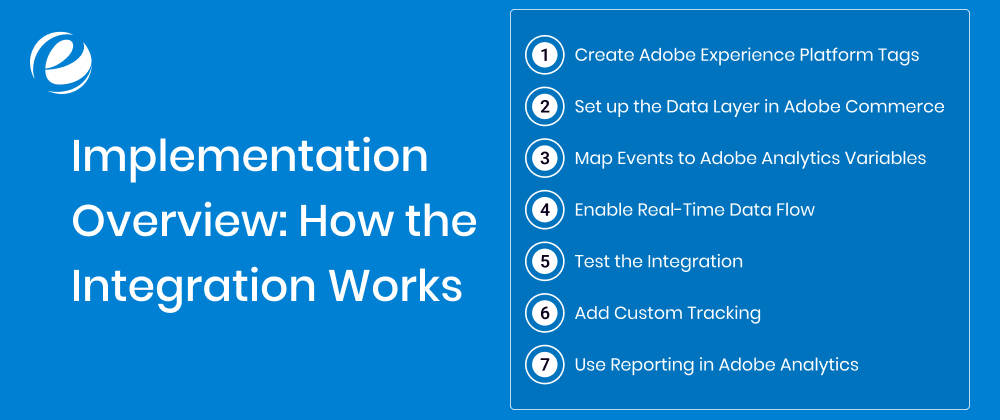
The integration process of Adobe Analytics with Adobe Commerce is systematic to carry out proper tracking, smooth data flow, and helpful insights. Below is the overall process for it:
1. Create Adobe Experience Platform Tags
The first is to deploy Adobe Experience Platform Tags (previously referred to as Launch), Adobe’s robust tag management platform. It offers a simple means of having marketers and developers deploy and update tracking codes without directly modifying the website code. The setup makes the integration easy and offers scalability for future enhancements or custom tags.
2. Set up the Data Layer in Adobe Commerce
Adobe Commerce needs a data layer that records all user interactions relevant to the storefront. This involves recording events like product page views, add-to-cart, checkout start, and completed orders. The data layer serves as an interface between the site and Adobe Analytics, normalizing information captured for uniform reporting.
3. Map Events to Adobe Analytics Variables
Third, the data layer events being tracked are being mapped to Adobe Analytics-specific variables—i.e., eVars (conversion variables), props (traffic-related variables), and custom events. These mappings create precise records of all significant actions that a user is performing so that one can effectively segment and analyze the performance.
4. Enable Data Flow
After event mapping is finished, the system is set up to pass user information into Adobe Analytics. It tracks everything – from browsing products to checkout – while it occurs. It allows businesses to track behavior and react to increasing trends or issues more actively.
5. Test the Integration
Before going live, there must be thorough testing and validation. With the help of tools such as Adobe Experience Platform Debugger and web browser developer consoles, teams check that the data layer is in good health and all variables are firing as expected. This helps catch errors early, and the reporting data is reliable.
6. Add Custom Tracking
Depending upon business requirements, custom tracking can be turned on to track additional insights like coupon redemption, wishlist usage, loyalty points redemptions, or even customer segments by location or device. Moving in this direction offers more depth in data for optimization and personalization.
7. Use Reporting in Adobe Analytics
Upon proper integration, Adobe Analytics dashboards can be utilized by teams to depict data gathered, identify user journeys, and measure marketing impact. With enhanced report and segmentation functionality, companies will have the ability to identify trends, monitor KPIs, and make data-driven decisions based on actual user behavior on their Adobe Commerce website.
Use Cases in eCommerce.
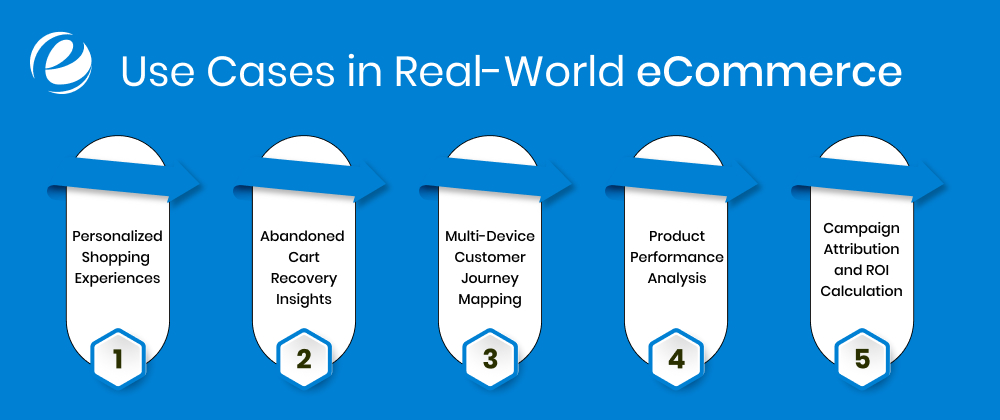
Now that we know what Adobe Commerce and Adobe Analytics are and how they work together, let’s look at some examples of how this integration can benefit e-commerce businesses.
1. Personalized Shopping Experiences
The type of shops that Amazon runs, they also monitor to determine customers’ preferences and suggest related items based on past searches, as well as sales. For instance, if previously, the customer has purchased shoes, they will offer them some corresponding accessories or fashion trends that they typically coordinate with as per their previous choice. That’s the degree of personalization, which helps maintain the interest of the customers as well as expandexpend more while promote sales, and hence the retail shopping experience itself.
2. Abandoned Cart Recovery Insights
Online retailers like ASOS use Adobe Analytics to identify when a shopper leaves a cart without purchasing. They can then quickly react, sending reminders or offers to known repeat buyers via targeted mail to finalize checkout. This action recovers lost sales that would otherwise be lost, boosting overall revenue and reducing cart abandonment rates.
3. Multi-Device Customer Journey Mapping
Shoppers today shop across devices, from phones to tablets to desktops. Companies such as Best Buy utilize Adobe Analytics to monitor and learn how customers transition across devices. By connecting all of these touchpoints, they can build a frictionless shopping experience. For instance, a consumer who begins shopping on his or her phone can continue where he or she left off on his or her desktop, enhancing the shopping experience and making it more convenient.
4. Product Performance Analysis
Walmart and other stores use Adobe Analytics to track how customers interact with products, such as what products are viewed repeatedly, added to the cart, or abandoned. It helps them make better inventory, pricing, and marketing decisions. For instance, suppose a product is getting a lot of exposure but hardly any buys, the store can lower the price or market it more aggressively to sell more.
5. Campaign Attribution and ROI Calculation
Businesses like Nike utilize Adobe Analytics for e-commerceeCommerce in a strategy to find out whichwhat advertising platforms are actually producing the most sales. They get to see literally where their conversions are happening – through their social campaign, email blast, or pay-per-click – to attempt to enhance their marketing spends. They get to buy the ones that convert the most and optimize their spend on advertising.
Why Use Adobe Commerce with Adobe Analytics Rather Than Other Platforms?
Integrating Adobe Commerce with Adobe Analytics gives a data-driven, end-to-end eCommerce development platform without peer in today’s competitive online marketplace. It is this integration that performs better than others:
1. Integrated Customer Journey Tracking
Adobe Commerce Analytics Integration provides an end-to-end understanding of the customer experience anywhere. It enables companies to track user behavior from first touch to last sale, with insights too often fragmented or lost in other systems.
2. Enhanced Personalization Capabilities
Based on Adobe’s AI-driven capabilities, businesses can deliver to customers with data-driven personalized shopping experiences. They are AI-powered product recommendations, specific offers, and AI-powered content, and more than the personalization capabilities of many other online stores.
3. Advanced Marketing Attribution
The integration enables accurate attribution of sales and conversions to the respective marketing activities. By merging Adobe Commerce and Adobe Analytics data, marketers can see campaign performance more intuitively and optimize ROI, levels of granularity that may be impossible with other systems.
4. Deep Data-Driven Decision Making
Having one dataset to tap into, businesses can make informed decisions about product positioning, pricing tactics, and customer engagement strategies. This complete data analysis is a huge advantage over platforms that require multiple tools to achieve the same insights.
5. Scalability and Flexibility
Adobe Commerce supports both B2B and B2C business models, with scalability that can match business expansion. It has a modular architecture that allows for customization and integration with other third-party applications, with flexibility that cannot be matched by other platforms.
6. Strong Ecosystem Integration
As part of the Adobe Experience Cloud, Adobe Commerce and Adobe Analytics are tightly integrated with other Adobe solutions such as Adobe Target and Adobe Experience Manager. Such an integrated platform enhances content management, testing, and personalization features beyond the capabilities of single-platform offerings.
7. Industry Recognition and Reliability
Adobe Commerce has been named an industry leader in digital commerce by analysts, demonstrating its dependability and performance. This is evidence of the platform’s potential to fulfill the advanced requirements of modern-day eCommerce companies.
When Adobe Commerce is integrated with by Adobe Analytics, companies gain a solid, combined platform that streamlines customer experiences, maximizes marketing performance, and creates business more effectively than most alternative solutions available.
Why Partner with Emizentech for Integration of Adobe Commerce with Adobe Analytics
With Adobe Commerce and Adobe Analytics integration, it is not merely a question of technical proficiency – it is a question of having a partner who understands e-commerce in and out. That is what Emizentech provides with certified Adobe Commerce experts who understand intimately how to unlock the full value potential of both platforms. Their strategy begins with learning about your business requirements, from how your customers buy to the exact numbers your marketing team works on. Instead of presenting a generic integration, they adjust the entire configuration to mesh with your business objectives.
What distinguishes Emizentech is their focus on data accuracy and workflow alignment. They ensure that all Adobe Commerce touch points are properly reported in Adobe Analytics, so you have actionable insights into customer behavior, conversion paths, and product performance. Integrations also natively merge with extended Adobe environments such as Adobe Target or Adobe Experience Manager, giving your business flexibility to deliver more relevant and personalized experiences to every touch point.
Supported by expertise and a record of successful implementation, Emizentech is now an industry go-to partner. Support does not end with implementation – the team continues to keep an eye out and out, and improve the integration as your business grows. Working with Emizentech is investing in a partner who is dedicated to performance, precision, and sustained growth.
Conclusion
Now that we’ve concluded, companies being able to have Adobe Commerce in conjunction with Adobe Analytics is an enormous differentiator in the realm of eCommerce. As is understood, achieving improved insights on customers’ actions, sales, and product performance is essential for making informed business decisions and pushing growth.
When you have Emizentech as your leading Adobe Commerce development partner, you get an easy and customized process that serves the needs of your company. They keep things simple for you and provide their support, and it gets easier for you to leverage your Adobe tools to their maximum and take your eCommerce business to an advanced level.
For companies wanting to optimize their online approach, enhance customer experience, and lead the pack in a challenging business environment, this integration is an investment that will yield returns in the long term.

FAQs
1. How do Adobe Analytics and Adobe Commerce collaborate?
It is easy to integrate Adobe Commerce in Adobe Analytics using the Adobe Experience Cloud. With this integration, you can monitor user visits and product performance. When you combine the two platforms, you learn more about customer experience, and hence the decision-making for your e-business improves.
2. Can the integration be used with B2B and B2C companies?
Yes, both B2B and B2C enterprises gain considerably from this integration. While B2C businesses have richer customer preferences and seasonal trend analysis, B2B enterprises can gain a better understanding of complex buying behavior and refine lead-nurturing processes.
3. Does custom development require integration?
While Adobe allows linking its solutions, seamless and personalized integration always entails customized development. A collaboration with experts like Emizentech allows you to have integration that fits your specific data format, KPIs, and workflow.
4. Is there monitoring of customer behavior through this integration?
Yes. Adobe Analytics provides collection and reporting, allowing you to see customers' behavior on your site—from product search and browse activity to cart abandonment and final transactions.
5. Will this integration slow down or impair website performance?
The integration will not have a negative effect on performance if it is implemented correctly. Actually, it can streamline things by collecting and consolidating data and eliminating manual reporting or the use of third-party tracking software.





 +1 (989) 535-9295
 info@emizentech.com
 emizentech


