 Add us as a preferred source on Google
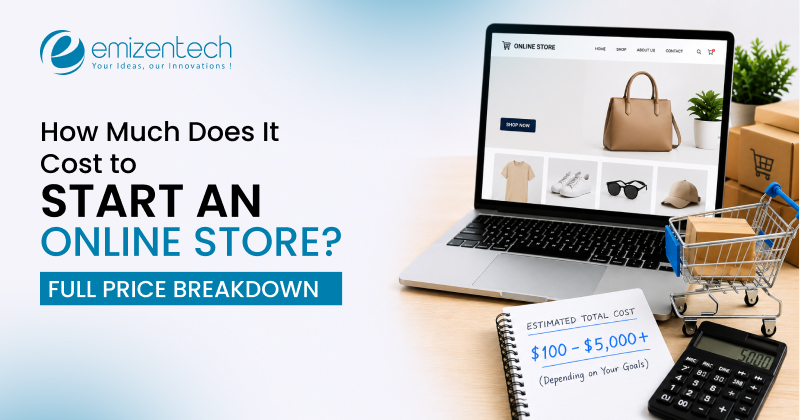
Ever wondered why some businesses thrive online, while others stall before they even land their first sale? A lot of the time, it comes down to getting a grip on the real cost to start an online store before you spend a single dollar. According to Mordor Intelligence, the global e-commerce market is expected to reach USD 36.21 trillion by 2026 and USD 77.58 trillion, and it’s growing at a CAGR of 16.46% from 2026 to 2031. For entrepreneurs mapping out their next move, understanding the e-commerce website developer cost, plus the platform choices, ahead of time, is critical. This guide walks through “How much does it cost to start an online store?” and the expenses so you can budget smarter and launch with real confidence.
How Much Does it Cost to Start an Online Store?
Before you go too far, here’s a quick, rough snapshot of what you might end up paying. Whether you’re comparing the cost to start a business with Shopify or you’re leaning toward a custom build, those early numbers can swing a lot depending on your objectives, required features, and the platform you pick. Well, the average cost ranges between ₹20,000 and ₹1,500,000.
Check the table below for a more orderly overview to help you plan your investment. If you want an extra deep dive, you can also explore our guide on the cost to build a website.
| Store Size | Platform/Approach | Estimated Cost Range | Best For |
| Basic Starter Store | Shopify/Wix | $29 – $500/month | Beginners & small sellers |
| Small Business Store | Shopify / WooCommerce | $500 – $5,000 | Growing SMBs |
| Mid-Size eCommerce | WooCommerce / Custom | $5,000 – $20,000 | Established brands |
| Enterprise Store | Magento / Custom Dev | $20,000 – $100,000+ | Large-scale operations |
| Mobile Commerce App | Custom / React Native | $15,000 – $80,000+ | Mobile-first brands |
Cost Breakdown of Online Store Development
A clear cost breakdown of online store development helps entrepreneurs make informed decisions. You want to see where the money goes, not just end up guessing after launch, so below is a component style breakdown of the main expense categories. When you understand the cost to develop an e-commerce website this granularly, it reduces the risk of those surprises. If you want to know the eCommerce website developer cost, then check our detailed guide.
| Cost Component | Budget Option | Mid-Range | Premium/Custom |
| Domain Name | $10–$20/year | $20–$50/year | $50–$500/year (premium) |
| Web Hosting | $3–$15/month | $30–$100/month | $200–$1,000+/month |
| Platform/CMS License | $0 (WooCommerce) | $29–$299/month (Shopify) | $22,000+/year (Magento) |
| Theme / UI Design | $0–$200 | $500–$3,000 | $5,000–$15,000+ |
| Payment Gateway Setup | $0–$200 | $200–$500 | $500–$2,000 |
| SSL Certificate | $4 – $70/year | $50–$200/year | $300–$1,500/year |
| Apps & Plugins | $0–$100/month | $100–$500/month | $500–$2,000+/month |
| SEO & Marketing Tools | $0–$100/month | $100–$500/month | $500–$5,000+/month |
| Ongoing Maintenance | $50–$200/month | $200–$1,000/month | $1,000–$5,000+/month |
Online Store Development Costs by Business Type
The cost to start an online store can differ a lot based on the type of business you run. A solo artisan selling handmade goods, for example, generally needs a very different setup than a B2B distributor with thousands of SKUs and more complex workflows. In the section below, we estimate development costs for each business type so you can compare and benchmark more realistically. You can also check on the cost to develop an e-commerce app, especially for mobile-first stores.
| Business Type | Typical Features Needed | Estimated Cost Range | Recommended Platform |
| Solopreneur / Freelancer | Simple catalog, basic cart, 1 payment method | $500 – $3,000 | Shopify Basic / Wix |
| Small Retail Business | Inventory management, discount codes, and email marketing | $3,000 – $10,000 | Shopify / WooCommerce |
| Mid-Size Brand | Multi-currency, loyalty program, CRM integration | $10,000 – $30,000 | WooCommerce / BigCommerce |
| Fashion / Apparel | Product variants, lookbooks, AR try-on | $15,000 – $50,000 | Shopify Plus / Custom |
| B2B Wholesale | Tiered pricing, bulk ordering, and custom invoicing | $20,000 – $70,000 | Magento / Custom |
| Marketplace / Multi-Vendor | Vendor dashboard, split payments, reviews | $30,000 – $150,000+ | Custom / Magento |
| Enterprise Retailer | Full ERP/CRM/WMS integration, advanced analytics | $80,000 – $500,000+ | Magento / Headless Commerce |
Cost of Starting an Online Store by Business Model
Beyond business size, your business model really is what drives how much you pay, like your cost structure. Subscription boxes, dropshippers, and sellers of digital goods all have different platform requirements and daily expenses. Use the comparison here to sort of see where you fit in. If you want a more platform-specific direction, take a look at the cost to build a website from scratch, and then adjust it to your situation, more or less.
| Business Model | Key Requirements | Monthly Running Costs | Initial Setup Cost |
| Dropshipping | Supplier integrations (DSers, Spocket), automation | $50 – $300/month | $500 – $3,000 |
| Print-on-Demand | Printful/Printify integration, design tools | $30 – $200/month | $300 – $2,000 |
| Private Label / Own Inventory | Inventory management, warehouse integration | $200 – $1,500/month | $5,000 – $30,000 |
| Digital Products | Secure download delivery, DRM, licensing | $50 – $300/month | $500 – $5,000 |
| Subscription Box | Recurring billing, subscription management | $100 – $500/month | $3,000 – $15,000 |
| Affiliate eCommerce | Content management, affiliate tracking software | $50 – $400/month | $1,000 – $8,000 |
| D2C Brand | Brand storytelling, loyalty program, analytics | $300 – $2,000/month | $10,000 – $50,000+ |
Key Factors That Determine Online Store Development Costs

There are a few moving parts that really decide, “How much does it cost to start an online store?” If you get what’s driving the price, you can plan the money better and also not overspend in the first place. Below are the five biggest cost drivers; more or less, they tend to show up every time.
Platform Selection
Your platform is basically the base. With SaaS tools like Shopify, you usually get clear, monthly spending. On the other hand, open-source options like WooCommerce may have lower initial costs, but then you spend more on hosting, upkeep, and some custom build work. Also, if you are looking at Magento, keep in mind it’s more enterprise style, so pricing and implementation needs usually look different.
Design & UX Complexity
A ready-made theme can be $0–$200. But a fully custom shopfront, with the full look and feel, might be $2,000–$10,000+, depending on how fancy it gets. Stuff like advanced UI/UX, interactive animation, custom product configurators, or AR previews usually push the budget higher. So always compare the visual upgrades to the actual return.
Feature Set & Integrations
Features like AI-powered search, loyalty schemes, multi-currency support, ERP or CRM integrations, and subscription billing can increase eCommerce website development costs. Every integration, even the “small” ones, adds hours of work, plus it means you keep managing API changes and maintenance over time.
Developer Location & Expertise
Hiring someone from North America or Western Europe often lands around $80–$200 per hour, while skilled teams in South and Southeast Asia typically charge $20–$60/hour. Offshore work can lower costs by 50–70%, but only if it’s managed well, with clear communication and proper oversight.
Ongoing Maintenance & Scaling
After launch, the real costs sometimes pop up. Hosting costs, plugin renewals, security patches, SEO improvements, and new feature requests add up faster than people expect. A common guideline is to budget 15–20% of your initial development cost each year for keeping an e-commerce app healthy and for ongoing maintenance.
Hidden Expenses Businesses Should Consider Before Launching
Many first-time store owners underestimate the total cost of ownership. Besides the obvious setup fees, there are also a bunch of hidden costs that can throw off your budget. When you notice these things early, your e-commerce development cost projections stay realistic, and you avoid post-launch financial stress.
Transaction Fees
Payment processor fees matter (Stripe/PayPal charge roughly ~2.9% + $0.30 per transaction), but then you have platform add-ons too. For example, Shopify may tack on extra transaction fees (usually 0.5-2%) unless you’re using Shopify Payments.
Premium App & Plugin Subscriptions
Most platforms offer a basic free tier, but advanced features often require paid apps and plugins. Think subscription billing, upsell funnels, abandoned cart recovery, advanced analytics, and more. Depending on what you choose, paid apps can add $200–$1,000+ per month to your running costs before you realize it.
Compliance & Legal Costs
GDPR for EU customers, CCPA for California, ADA accessibility, plus tax compliance software like TaxJar or Avalara can run you about $100–$2,000+ per year. If you ignore the consequences, it can be way more expensive than doing it properly from the start. This also often gets missed in the costs to develop e-commerce website budgets.
Returns & Logistics Infrastructure
Setting up a returns management system, plus the shipping software (ShipStation, EasyPost) and fulfillment integrations, often involves both initial setup costs and ongoing subscription fees. But returns by themselves can cost you like 20-30% of the value of the product when you factor in reverse logistics.
Customer Acquisition Costs (CAC)
Organic traffic doesn’t pop up overnight; it takes months to get momentum. If you’re going to be paid early, Google Shopping and Meta Ads for a new store can easily run $500–$5,000 per month, just to start pulling in enough visits to matter. Make sure you factor in CAC when you’re figuring out break-even, because it often turns out to be the biggest upfront spend after the build phase itself.
Smart Budgeting Strategies to Reduce Online Store Setup Costs
Strategic budgeting doesn’t mean you cut corners; it means you maximize the value of every dollar invested.
These five tried-and-tested strategies can help reduce the cost of starting an online store while maintaining quality, functionality, and long-term scalability.
Start with a SaaS Platform and Scale Later.
Launching on Shopify Basic ($29/month) or WooCommerce (hosting around ~$15/month) instead of custom development can save you $10,000–$50,000 upfront. When you cross $50K+ monthly revenue, then you can move to a stronger platform setup. This stepped approach is basically the most cautious, sensible way to manage costs to build a website in the early stages.
Use Premium Themes Instead of Custom Design
Choosing a high-quality premium theme ($50–$350) from ThemeForest or the Shopify Theme Store can look professional right away and often saves you $5,000–$15,000 compared to doing a custom UI/UX design from scratch. You can tweak colors, fonts, and page layout without hiring a developer full-time. Save the custom design budget for the point where your revenue actually justifies it.
Prioritize MVP Features Only
Launch with only the features that actually bring in revenue, such as product listings, checkout, and basic marketing. Try not to let feature creep; it usually does. An MVP store can be assembled for about $500–$5,000, rather than something like $30,000+ for a fully loaded version. Then, after you go live, add capabilities based on real buyer signals, not guesses—so you cut down wasted e-commerce website developer costs.
Leverage Offshore Development Teams
Working with skilled developers in India, Eastern Europe, or Southeast Asia often lowers hourly billing from roughly $150/hour in the US to around $25–$60/hour, without dropping the bar on quality. For a mid-size store, that can mean savings of about $15,000–$40,000. When you vet a partner, look for people with a solid e-commerce portfolio and also actual client feedback.
Negotiate Annual Subscriptions & Bundle Tools
Switch from monthly plans to annual subscriptions, because most SaaS tools charge 10–25% less that way. Also, bundle things like email marketing, CRM, and analytics into a single platform; examples are HubSpot or Klaviyo. This reduces subscription sprawl, which is a quiet budget leak. In the end, these micro-savings can stack up to $1,000–$5,000/year for a store that’s still growing.
Why Choose Emizentech for Online Store Development?
If you’re building a high-performance, scalable online store, Emizentech brings end-to-end know-how across major platforms and custom solutions. That’s why many businesses trust us with their e-commerce website development cost investment. Want clear context on Magento pricing? We can help you sort it out fast.
Full-Stack eCommerce Expertise
From Shopify and WooCommerce to Magento, plus fully custom headless commerce builds, Emizentech’s developers cover the whole scope of your store frontend, backend, integrations, and DevOps. We map each solution to your cost to develop an e-commerce website budget, even when requirements shift a bit.
Transparent, Milestone-Based Pricing
We share a full cost breakdown before any work starts, so there aren’t any hidden fees and no scope creep surprises later on. Our milestone-based billing keeps everything clear, and it gives you real financial control while the project moves through its lifecycle.
Mobile-First Development Approach
Every store we build is tuned for mobile performance, from the very first day. Our developers use PWA plus React Native to create app-like experiences in mobile browsers, and that usually cuts down the cost to develop an e-commerce app compared to building a separate native app entirely.
Post-Launch Support & Maintenance
The relationship doesn’t end at launch. Emizentech offers maintenance packages that are dedicated and ongoing, like a proper upkeep plan. We do performance monitoring, security updates, and also new feature additions, so your store keeps scaling in a profitable manner as your business grows.
Proven Track Record Across Industries
Across fashion, electronics, B2B wholesale, and digital products too, Emizentech has delivered 500+ e-commerce projects worldwide. You can check our case studies, which show clear ROI improvements, conversion rate uplifts, and smoother platform migrations as well.
Final Words
Figuring out “How much does it cost to start an online store?” is a key first move for a profitable digital venture. In general, costs can start around $500 for a basic setup, then go up to $500,000+ for enterprise platforms, depending on your business type, model, and feature requirements. Whether you’re checking the cost to build a website using a SaaS platform or you’re planning a fully custom build, smart budgeting and the right development partner make the difference. Emizentech supports businesses at every stage, planning, building, and scaling, with full transparency on cost to develop e-commerce website investments. Ready to launch? Let’s build something great together.
FAQs
What is the cheapest way to start an online store?
The cheapest way is usually going with Shopify’s Basic plan ($29/month) or using WooCommerce (it’s a free plugin + roughly $10/month for hosting). With either option, you can launch something usable for under $500, including the domain, hosting, and a basic theme. And dropshipping also helps because it removes the inventory problem entirely.
Can I launch an online store without inventory?
Yes, absolutely. Business models such as dropshipping, print-on-demand, and digital product sales don’t need physical inventory sitting around. You basically list items from suppliers, and they handle fulfillment straight to your customers. This kind of lowers startup capital needs a lot, plus it reduces operational mess, or at least the busywork.
Do online stores require ongoing maintenance costs?
Yes. Every online store requires ongoing costs for hosting, platform subscriptions, security updates, plugin renewals, and even performance optimizations. Many businesses allocate approximately 10–20% of their initial eCommerce website development cost annually to ensure the store remains secure, up to date, and operates smoothly.
What are the main costs of building an online store?
The primary costs usually include domain registration, web hosting, platform/CMS fees, design, custom development, and payment gateway setup, plus apps/plugins. Don’t forget ongoing maintenance either. In practice, the total cost to develop an e-commerce website can be $500 for basic setups, and it can jump to $100,000+ for enterprise-grade solutions.
Do I need to pay monthly for an online store?
Yes, most platforms charge monthly. Shopify starts at $29/month, while Magento tends to come with annual licensing fees. Even if you go with WooCommerce (which is free), you still pay for hosting, security, and sometimes plugin subscriptions. So plan for recurring costs before launch.
Which platform is best for starting an online store on a budget?
Shopify Basic ($29/month) and WooCommerce (free, plus low-cost hosting) are usually the go-to picks. Shopify is more straightforward, with solid guidance, and WooCommerce gives you the most room to tweak and shape things your way. Before you compare the real cost to start a business on Shopify vs. other options, first figure out your own technical comfort level first.
How long does it take to build an online store?
If you’re going with a simple Shopify or WooCommerce build, expect about 1–2 weeks. A mid-size custom order usually lands around 4–8 weeks. But if it’s an enterprise setup with heavy integrations, think roughly 3–6 months, sometimes more. The schedule really affects the total budget because longer timelines mean more developer hours and extra project management investment.


 +1 (989) 535-9295
 info@emizentech.com
 emizentech


