
 Add us as a preferred source on Google
 In the past few years, artificial intelligence has developed and changed very quickly; it has also given birth to many powerful technologies, such as generative AI, as well as much newer, agentic AI. While both (Agentic AI and GenAI) fall under the general classification of AI, both are generally different.
Agentic AI vs Generative AI, seeks to create content, texts, images, codes, music, and others by learning from preexisting data. Much publicized examples include ChatGPT, DALL·E, and Midjourney. These systems receive information and produce new human-like outputs that can be applied in different fields of marketing, design, writing, and even software development. With the growing exploration of use cases of generative AI across various industries, businesses are increasingly seeking custom generative AI application development to stay competitive.
On the other hand, Agentic AI refers to systems that go beyond content generation. These AI agents can independently make decisions, plan their actions, adapt to dynamic environments, and act purposefully toward the attainment of their goals. In other words, Agentic AI does not just react but rather responds proactively.
Market Outlook: Agentic AI and GenAI
In global markets for Agentic and Generative AI, industry adoption and technology evolution serve as growth drivers.
Agentic AI Market Forecasts
According to Grand View Research, Enterprise Agentic AI: Grows from $3.67 billion in 2025 to $24.5 billion by 2030, a 46.2% CAGR.
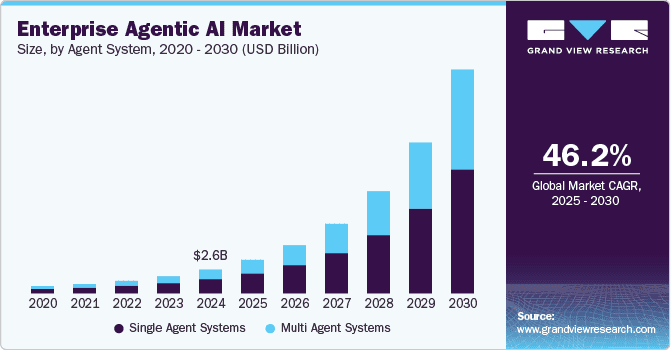
Agentic AI Tools: Rise from $6.67 billion in 2024 to $10.41 billion in 2025, a 56.1% CAGR – (Source –
Statista’s Forecast: The market will reach $47.1 billion by 2030-
Generative AI Market Forecasts
Long-Term View: Forecast to reach $1,005.07 billion in 2034, 44.2% CAGR from 2025 to 2034 – Precedence Research.
Morgan Stanley’s Estimation: Estimates revenue from Generative AI at $153 billion in 2025, which will consist of enterprise software and consumer platforms –
Key Trends Fuelling Growth
Transformation of the Consulting Industry: Leading companies like McKinsey and Deloitte are integrating AI agents into their consulting work to deliver increased efficiency and service –
Main Features of Agentic AI and GenAI
While both Agentic AI and Generative AI exist under the far-reaching support of artificial intelligence, they were created with very different goals and capabilities. With that in mind, here are the key features of each, explaining how they differ from each other.
Key Features of Generative AI
Generative AI refers to systems that create new content, mostly with human-like appearance and quality.
- Content Creation: Gen AI can produce text, images, audio, code, and others. Examples are articles written by AI, chatbot responses, and realistic images.
- Data-Driven Learning: It learns from a large dataset how patterns look and uses that data to create some new output.
- Prompt-Based Outputs: Most Gen AI models need to be prodded by users to generate responses or any content.
- No Goal Orientation: Gen AI does not have the intent or goals to respond to the user’s query reactively.
- High Customizability: With fine-tuning and prompt engineering opportunities, companies can adjust what kind of content they generate.
- Used for Automation: Although not fully autonomous, Gen AI is instrumental in automating tasks like writing emails, generating reports, or summarizing data.
These features for generative AI use cases are increasingly used by companies in marketing automation, eCommerce personalization, and product recommendations. More traction is being achieved in Generative AI app development for custom solutions.
Distinct Characteristics of Agentic AI
In contrast, Agentic AI is about making choices and achieving independence. It simulates agents that operate autonomously in dynamic environments.
- Aim-Directed Behavior: Agentic AI systems intend to achieve specific goals and are left to determine their own ways of doing so, step-wise.
- Autonomy and Agency: The AI agent can set its own plans, make decisions, and execute them without needing to wait for instructions.
- Context Awareness: They are well aware of their surroundings and modify behaviours based on real-time inputs and changes.
- Long-Term Planning: Agentic AI not only reacts but also foresees potential future outcomes and adapts its current behaviour to that forecast.
- Multi-tasking Capability: This means distinguishing and handling various interrelated activities in an intelligent way.
- Integration to Tools and APIs: Agentic AI should be able to use software tools, APIs, or digital systems to achieve complex workflows.
For example, an Agentic AI could autonomously manage a project timeline, alter task assignments in response to the realization that delays have occurred, or update records by interacting with a specified CRM system. Many organizations want such agent-based systems developed by the best AI-building companies.
Agentic AI vs Generative AI
| Feature | Generative AI (Gen AI) | Agentic AI |
| Primary Purpose | Content creation | Goal-driven autonomous behavior |
| Input Type | Prompt-based | Context and environment-aware |
| Output Type | Text, images, code, audio, etc. | Decisions, actions, task execution |
| Level of Autonomy | Low | High |
| Adaptability | Static unless re-prompted | Dynamic and adaptive |
| Common Use Cases | Marketing, design, chatbots, summarization | Digital workers, personal assistants |
Comprehension of these variations (Agentic AI vs Generative AI) becomes crucial for any business expecting to perceive AI and its applications fully. So, depending upon what the job entrusts you to, be it creativity or autonomous execution, an understanding of which of Agentic AI or Gen AI is, in actuality, stronger in explanation will enable one to make a choice upfront in an academically respectable manner.
Key Differences Between Agentic AI and Generative AI
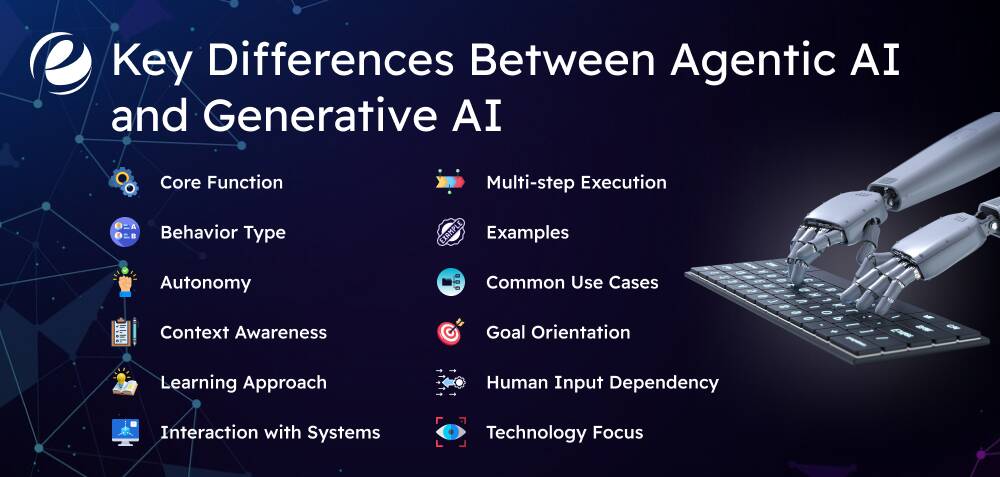
Agentic AI and GenAI are two powerful points in the round of artificial intelligence. Teaching others what separates these two technologies will guide you in choosing one over another in your business. Here, we will discuss some basics that serve to Agentic AI vs Generative AI, with their appropriate applications and the advantages thereof.
| Aspect | Agentic AI | Generative AI (Gen AI) |
| Core Function | Autonomous decision-making and action execution | Creating new content (text, images, code, etc.) |
| Behavior Type | Proactive and goal-driven | Reactive and prompt-based |
| Autonomy | High – acts independently | Low – requires human input to generate output |
| Context Awareness | Continuously adapts to environment and real-time data | Limited to input context |
| Learning Approach | Reinforcement learning, planning, agent architectures | Machine learning, deep learning, transformer models |
| Interaction with Systems | Can use tools, APIs, and software to complete tasks | Usually limited to content generation without action |
| Multi-step Execution | Capable of planning and executing complex sequences | Generates single-output per prompt |
| Examples | Autonomous assistants, workflow agents, robotic systems | ChatGPT, DALL·E, Bard, Copilot |
| Common Use Cases | Task automation, dynamic workflows, digital workers | Writing, coding, design, summarization |
| Goal Orientation | Acts based on long-term or short-term goals | Has no intrinsic goal or objective |
| Human Input Dependency | Minimal after setup – operates with autonomy | High – depends on user prompts |
| Technology Focus | Intelligent automation, agency, reasoning | Creative generation, pattern recognition |
How Businesses Can Use Agentic and Generative AI?
With AI moving industries, many companies appreciate this powerful amalgamation of Agentic AI with Generative AI. While Generative AI is the right tool for automating content creation and communications, agentic AI further refines it by carrying out a range of tasks autonomously and making decisions and actions aimed at goal fulfillment.
Below are some of the ways businesses stand to benefit from these technologies:
1. Customer Support Automation:
Generative AI answers questions from customers with the best possible responses through chatbots or emails with speed and scalability.
Agentic AI could be used to analyze the escalation of customer issues and updates of tickets or even make autonomous decisions to find resolutions such as compensation.
Together, Agentic and Generative AI can provide highly responsive and human-like dialogue joined with smart decision-making abilities.
2. Creativity in Marketing and Content Production:
Generative AI can come up with great marketing copy, blog articles, or social media content about products in seconds.
Even Agentic AI agents track the campaign performance, modify budgets accordingly, conduct A/B tests on content, and forecast strategies from real-time results.
Custom-built generative AI tools write and optimize marketing assets, while Agentic AI does what it does best – automate the strategy behind them.
3. Makes Business Operations Effortless
With background knowledge in Generative AI, reports, summaries, or predicting insights can be drawn from business data.
A practical example of an AI agent in HR could be writing job descriptions (Gen AI) while handling the hiring workflow (Agentic).
An AI will manage workflows by allocating tasks and/or sending reminders or rescheduling things depending on team performance and/or availability.
4. Personal User Experiences
Generative AI may suggest unique content or offers or best sales for a user.
Agentic AI design tracks users’ behaviour over time, predicting their preferences and fixing their experience automatically, which might differ from the evolving requirements.
Both will offer retail sellers personalized experiences across the board. Intelligent assistants & digital workers.
-
Intelligent Assistants and Digital Workers
The voice or text generation for intelligent assistants is powered by Gen AI.
Agentic AI will further convert those assistants into digital workers: this means scheduling meetings, drafting emails, analyzing calendars, and more—all without any user input.
This situation is annoying for an enterprise where time-consuming tasks have to be repeated. Advanced decision support: Generative AI can help me summarize lengthy documents, customer feedback, and financial reports.
-
Advanced Decision Support
An agentic AI can analyze the data, suggest decisions, and perhaps undertake certain actions such as sending out updates, reassigning resources, etc.
Best suited for managers and executives in search of intelligent insights and assistance.
7. Product Progression and Innovation
Gen AI assists in arriving at a product concept and rapidly generating design alternatives or coding components.
Agentic AI takes care of product roadmaps, task assignments to developers, and progress tracking. Together, they stimulate faster and smarter innovations for a company.
Understanding how to harness Agentic AI alongside GenAI will open avenues for automation, creativity, and efficiency. Whether you are developing a content tool using generative AI application development or building intelligent systems using an AI development company, having both types of AI will give your business an advantage.
Agentic AI and Generative AI Trends
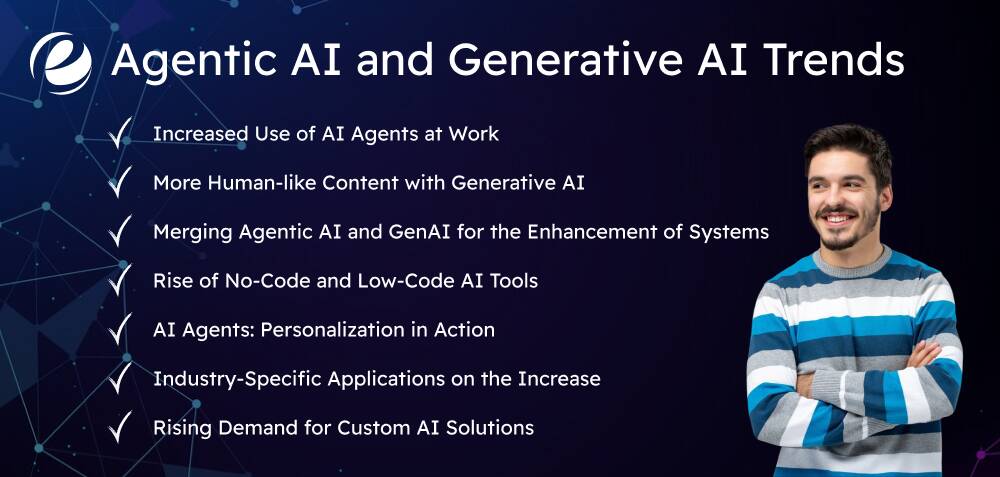
The process of AI evolution involves Agentic AI and GenAI, which pave the way for future technological and business applications, each walking its own world but occasionally coming together to form some interesting hybrids. Let’s take a dive into the major trends that rule their evolution.
1. Increased Use of AI Agents at Work
More and more Agentic AI is getting accepted in the corporate environment. Companies are building intelligent agents to perform tasks such as scheduling, following up on emails, or even managing entire workflows. They’re acting as digital employees, halting the need for human supervision.
2. More Human-like Content with Generative AI
Generative AI tools like ChatGPT and DALL·E are getting better at generating human-like content. They build emails, create marketing communications, design products, and much more. These trends are boosting creative avenues at the expense of time for companies.
3. Merging Agentic AI and GenAI for the Enhancement of Systems
Arguably one of the hottest trends is the convergence between Agentic AI and GenAI. Imagine an AI agent that not only determines what task needs to be done but also creates any content that is required with the aid of generative AI- for instance, a digital marketing assistant who writes posts and schedules them. This kind of synergy brings together the greatest level of utility from AI tools into something they can serve the real world with.
4. Rise of No-Code and Low-Code AI Tools
Because of that, we are seeing many no-code and low-code platforms that allow the teams to build custom AI tools using drag-and-drop. This includes Gen AI content-generating tools and Agentic AI decision-making capabilities.
5. AI Agents: Personalization in Action
In an agentic mode, AI has been increasingly used for its ability to bring user experiences to a personal level. For instance, the e-commerce domain now has AI agents to support the buyer journey through product searching and answering queries in real-time, creating offers based on user behavior, thus becoming personalized. Gen AI can generate instant responses, product descriptions, and so forth.
6. Industry-Specific Applications on the Increase
Despite their ability to work across multiple industries, Agentic AI and GenAI are now on the path toward becoming industry-specific solutions:
- In healthcare, Gen AI summarizes patient records; Agentic AI helps schedule follow-ups.
- In banking, Gen AI documents financial summaries, whereas Agentic AI helps check compliance.
- In retail, Gen AI creates the product content, and Agentic AI automatically makes inventory decisions.
7. Rising Demand for Custom AI Solutions
With this trend, more companies are looking for custom development solutions. There has been increasing demand for AI companies with specialization in development and real experience with generative AI and tools that serve precise business needs.
The future of AI is more than just creation. It’s going to be where the prowess of both Agentic AI and Gen AI conjoin to form intelligent, creative, yet autonomous systems that will redefine the working patterns of different businesses.

Pros and Cons of Agentic AI and Generative AI
Pros and Cons of Agentic AI
| Pros of Agentic AI | Cons of Agentic AI |
| Acts autonomously and reduces need for human intervention | Complex to design and implement |
| Can handle multi-step, goal-driven tasks | Requires strong context understanding and real-time data |
| Makes intelligent decisions in dynamic environments | Higher development and maintenance cost |
| Improves productivity through automation | Risk of unexpected behavior if not properly monitored |
| Ideal for digital workers and AI assistants | Limited awareness without integration with other systems |
Pros and Cons of Generative AI (Gen AI)
| Pros of Generative AI | Cons of Generative AI |
| Quickly generates human-like content (text, images, etc.) | Outputs can sometimes be inaccurate or biased |
| Boosts creativity and content production | Needs prompt input – lacks autonomy |
| Saves time in writing, coding, and design tasks | Can be misused to create misleading or harmful content |
| Easy to integrate with tools and platforms | Not suitable for decision-making or goal-setting |
| Customizable through fine-tuning or prompt engineering | Cannot adapt or act beyond the immediate task |
These tables help highlight the Agentic AI vs Generative AI conversation by showing where each excels and where they have limitations.
How Emizentech Implements Agentic AI and Generative AI in Real Projects?
Emizentech’s approach to AI is practical and futuristic as it integrates features of Agentic AI and GenAI for business-ready intelligent solutions rather than mere automation. Emizentech complements AI technologies to real-life needs through intelligent chatbots, workflow automation tools, or personalized recommendation engines.
According to Generative AI, Emizentech uses large models to create tools that generate human-sounding content, such as automated copywriting platforms, AI-powered design tools, and in-depth data summarization engines. Such solutions allow companies to drive the heights of creativity while being part of improved communication and saving time.
Emizentech also implements Agentic AI, but this time, it is developing intelligent AI agents that could actually manage themselves in making decisions, managing multi-step tasks, and using various software platforms. For example, in retail or eCommerce, such agents can update their inventories, send personalized offers, or manage customer support without human intervention.
Above all, these two wind technologies are used in Emizentech to create solutions where Generative AI takes care of content and Agentic AI of actions. Intelligent, goal-driven systems can think, create, and execute all in one workflow.
Why Choose Emizentech for Agentic and Generative AI?
- A specialist in both content generation tools and autonomous AI agents
- Demonstrable experience in building generative AI App across various industries
- Qualified generative AI developers and AI engineers
- Custom, scalable solutions tailor-made to suit your business goals
- Reliable AI development company with a global clientele success story
- Strong interest in collaboration, creativity, and intelligent automation
Final Thoughts
Businesses are figuring out new ways of working, creation, and growth through Agentic AI and GenAI. If we talk about separately, Generative AI is limited to content generation, it creates text, images, or code and whereas Agentic AI goes a considerable way forward by acting as a smart assistant, planning, making decisions, and executing tasks independently.
Understanding these differences is relevant when choosing the right solution for your requirements. Many companies have started unlocking the best of both worlds, creativity versus automation, by employing a combination of the two.
Your business will benefit from efficiency, innovation, and future readiness if you use the two techs for building intelligentworkflows or content tools.
Emizentech, an AI development company with a proven track record, can steer your shine in the right way when you feel like starting with the AI journey.
FAQs
Can you have Agentic AI work with Generative AI?
Indeed! They can be integrated; Generative AI generates the content, while Agentic AI uses its possible actions to complete a task with the content.
Which industries can use Agentic AI?
Adjacent to eCommerce, healthcare, finance, and customer service, Agentic AI proves applicable to such industries to automate tasks and streamline processes.
Give me some Generative AI examples.
Among its applications, generative AI includes content creation, product descriptions, email writing, design creation, and code assistance.
What does it cost to set up Agentic AI?
The price of Agentic AI implementation varies with the size of the task, complexity, and the degree of customization involved. While some basic automation can be inexpensive, more sophisticated, deliberate AI agents usually require a much greater investment in development and integration.
How long before Generative AI is ready?
Development time can run the gamut for Generative AI solutions; simple content generation models may take a few weeks to develop, while very distinctive tools, like specialized AI applications for a particular industry, may take several months for development and tuning.



 +1 (989) 535-9295
 info@emizentech.com
 emizentech


