
 Add us as a preferred source on Google
 The artificial intelligence (AI) in sports market has significantly evolved and grown in size, being the one factor that can be mentioned as the most important reason for the transition to online sports betting. Being worth USD 2.2 billion in the year 2022, the potential of the market reaching USD 29.7 billion by the year 2032 seems quite realistic, as a strong CAGR of 30.1% by 2032 is expected, according to Allied Market Research. All of this is happening because more and more of the sports industry is incorporating AI and its capabilities.
Advanced artificial intelligence methods such as computer vision, machine learning, and natural language processing are typically used now to provide insights that had been unachievable before analyzing data that volumes larger as compared to human acceptance. Consequently, AI has become completely inseparable from the sports world, playing its part in performance analysis, decision-making, and fan involvement; moreover, its input and impact are expected only to increase in the near future.
The continuous requirement of instant monitoring and tracking of player performance is associated with the rising usage of chatbots and digital assistants as a great interest for AI in sports market. Many organizations are adopting intelligent fan interaction tools, encouraging services like chatbot development services, to improve engagement and communication. Additionally, the increasing acceptance of real-time data analysis is another factor that is driving the market growth.
However, challenges such as the shortage of skilled professionals, high setup, and maintenance costs are in the way of market growth. Despite these limitations, the growing demand for AI-powered predictive insights is expected to create a great opportunity for AI in sports market through the forecast period.
What is AI in Sports?
Artificial Intelligence in sports refers to the use of advanced technologies that enable machines and software systems to analyze data, make predictions/decisions, and learn from patterns to improve various aspects of sports performance, management, and fan management.
What Does AI Do in Sports?
AI in sports systems can process a vast amount of data collected from:
- Wearable devices and sensors
- Video footage and motion tracking
- Player statistics and historical match data
- Fan behavior and engagement platform
Key Applications of AI in Sports
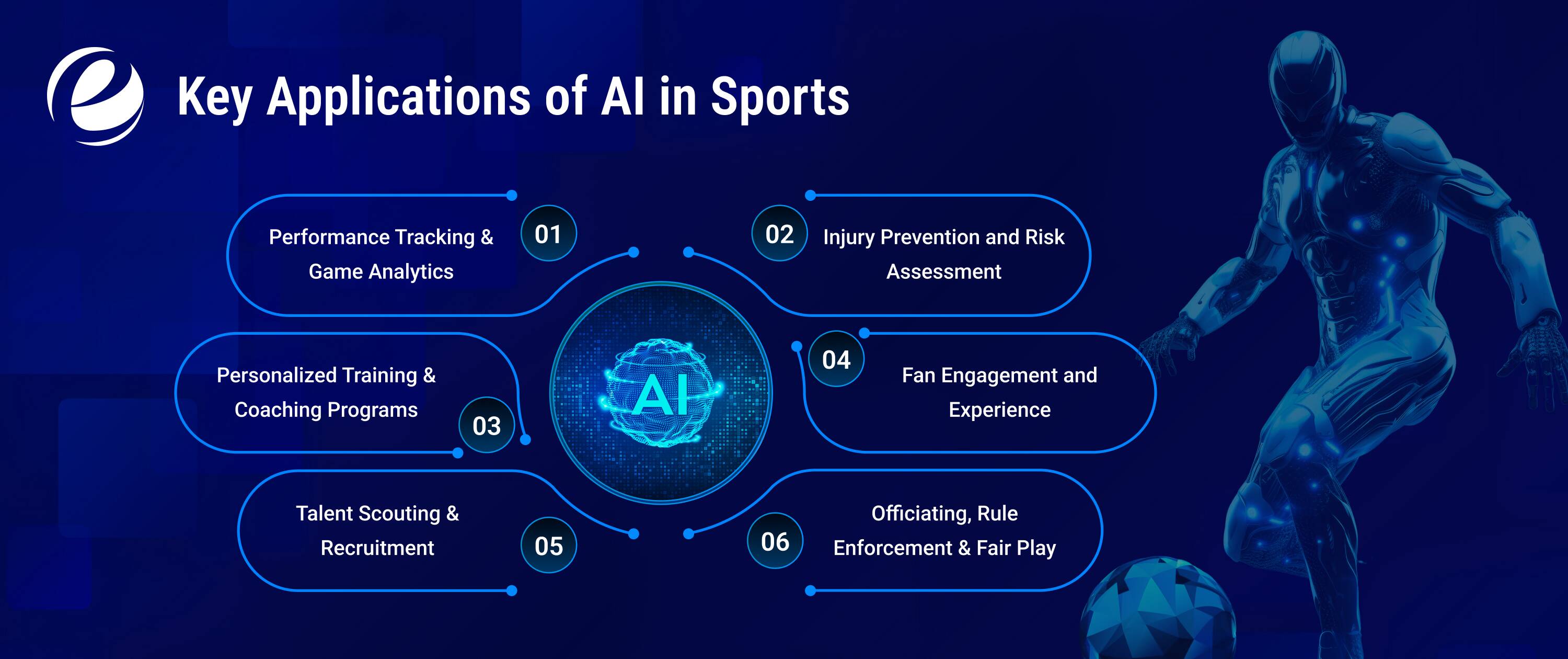
AI in sports has evolved simply from presenting scores and schedules. Today, its role is far more significant, allowing teams to develop smarter strategies, helping athletes to improve performance, and delivering more engaging and personalized experiences for fans.
Artificial intelligence in sports allows for processing the data of live matches together with years of historical data to deliver insights that are timely, relevant, and actionable. This transformation has led to a significant change in the training, competition, and fan interaction managed in the digital sports ecosystem.
The following are some of the use cases that depict the way AI is applied in sports app development:
Performance Tracking & Game Analytics
Real-time performance is the most important advantage that the newest sports provide. The application of advanced analytics tools allows tracking players’ movements, reactions, and their performances throughout a match or training session.
With the help of AI in sports analytics, the raw match data has been transformed into insights that are easily understandable and usable by coaches, analysts, and broadcasters.
The key features are:
- Live dashboards for teams and players: On-screen dashboards showcase real-time performance metrics like speed, stamina, possession, and accuracy, which facilitates quick decision-making.
- Real-time player and team comparisons: The sports technology compares sportsmen or teams immediately according to the live match data and past trends.
- On-the-fly tactical changes: With the help of real-time insights, coaches can change formations, substitutions, or playing styles during the game.
- Interactive statistics for fans and broadcasters: Access to visual statistics that restore understanding and excitement about the match is given to fans.
This use case describes one of the most practical benefits AI has brought to sports, turning complex data into a competitive advantage.
Injury Prevention and Risk Assessment
The main goal of the sports industry is to keep athletes healthy, and smart sports applications are slowly but surely taking over this area of prevention. The applications are able to inform coaches and medical staff about the danger of injuries in advance by taking into consideration patterns and intensity of workouts, as well as recovery time.
This method proactively prevents injury by AI as it allows the management of the teams to intervene and take corrective measures before the conditions that cause injuries become worse.
Some of the common applications include:
- Wearable integration for early detection: Applications to link with wearable devices that keep track of a person’s heart rate, movements, and strain on the muscles.
- Monitoring of fatigue and workload: Quality of sleep, levels of exertion, and time spent on recovery are monitored and analyzed to prevent overtraining.
- Risk prediction based on historical patterns: Previous injury data is of great help in predicting the areas and situations that might lead to future injuries.
- Individualized recovery planning: Timeframes for recovery and regime are set according to individual athletes.
Today, teams are relying on data-driven tools provided through wearable app development services to get the required support and guidance.
Personalized Training and Coaching Programs
Every athlete reacts in a unique way to training and this characteristic has started to reflect. Rather than giving standard workout plans, the AI in sports market provides personalized coaching that takes into account the individual’s performance data, fitness levels, and recovery patterns.
As a matter of fact, these resources are similar to an AI personal trainer, more or less, who will lead the athletes to safe and smart training routines. Many companies are now building such personalized training platforms using advanced fitness app development solutions.
The personalization process is structured in the following way:
- Movement correction based on motion analysis: The performance of athletes is analyzed and compared to optimal form, and delivers real-time and detailed feedback.
- Prompting over text and voice: The athletes receive live voice and text prompts on the smart systems, offering motivational support and training cues during the practice sessions.
- AI-based skill testing: Applications that measure progress across sessions will track improvement and consistency throughout the course of the training.
- Delivery of tailored content: Training content such as videos, guides, and articles are suggested based on individual performance trends and progress data.
When combined with an AI fitness app, this approach brings professional-level coaching within reach for athletes of all levels.
Fan Engagement and Experience
Fan expectations have significantly changed as sports apps have already offered immersive experiences, but AI takes things further. They are looking for relevant updates, personalized highlights, and timely notifications. Sports technology performs the task of analyzing fans’ viewing habits, favorite teams, and engagement patterns to bring content to the audience that they would love the most.
Here are some of the key features:
- Personalized AI content delivery: Artificial intelligence recommends news, offers, and highlights to the fans’ curiosities and watches the content that is of their interest.
- Push notifications based on behavior: AI enables and analyzes in-app interactions and triggers alerts that are sent out according to user activity and preferences.
- Interactive fan games: From match predictions to trivia and polls for the matches, they are dynamically generated to keep the fans rewarding and engaged.
- AI-assisted event reminders: The AI in sports analytics alerts the fans about the games that they would be most likely to watch based on their past performance and activities.
This personalized method has mainly increased the influence of AI in sports marketing, which allows the teams to establish strong connections with their audience.
Talent Scouting & Recruitment
Sports technology is getting involved more and more in the process of discovering and evaluating talent. By looking at the footage of matches, the statistics of performances, and the rate of growth, the app assists recruiters in detecting potential players sooner and more impartially.
Some of the features aimed at recruitment are:
- Skill assessment through video analysis: AI in sports helps assess gameplay footage to evaluate techniques, efficiency, and decision-making, which helps athletes to identify with standout potential.
- Predicted performance insights: The AI in sport gives an estimate of how the players might perform in a new team and in a competitive environment.
- Automated scouting reports: The detailed data-driven reports are automatically generated using in-game statistics, biometric data, and video highlights for every player.
- Virtual Reality & Augmented Reality: An immersive experience of VR/AR allows fans to tour the stadium, experience highlights, or even see the game from a different perspective, all of which highlight how AI is transforming the overall sports experience.
To support efficient and intelligent recruitment platforms, organizations often collaborate with an experienced AI app development company that understands sports-specific data and workflows.
Officiating, Rule Enforcement & Fair Play
Accurate decision-making plays a vital role in ensuring fair competition across sports. Advanced systems are now being used to assist the officials by reviewing plays, tracking the movement of the players and the violators with the rules of pinpoint accuracy.
Technology-driven is reshaping officiating through:
- Automatic detection of fouls and offside incidents
- Unbiased rulings due to uniform application of the rules
- Enhanced replay support for referees in critical choices
- Tracking of players to approve on-field decision accuracy
- Data-based analysis for complicated situations
Tools for human judgment are still very important, but they help in making competitions more consistent and transparent.
How to Implement AI in Sports Business?
The sports industry has been transformed by the incorporation of AI, as it has changed not only the operation of teams and the training of athletes but also the interaction of fans with the game. Through data-driven systems, sports organizations can not only obtain performance insights but also enhance their decision-making processes and, consequently, become more attractive to audiences.
The artificial intelligence in sports will be a great resource for organizations to depend on intuition, rather than relying on measurable insights. Here is a practical outlining how sports businesses and teams can blend AI successfully.
Define Clear Objectives
The initial step is to figure out your objectives. AI should not be characterized as a feature but rather supported by specific goals.
The most common objectives are:
- Athletes’ performance and recovery improvement
- Fan engagement and personalization enhancement
- Smarter coaching and tactical decision support
- Reducing injuries through AI injury prevention
- Optimizing digital experiences and operations
Clear goals make it easier to decide how AI is used in sports within your organization.
Collect and Organize Relevant Data
The main part of every intelligent sports system is data. To come up with significant results, the teams have to collect the most accurate and reliable data from different sources.
The sources of data that are most common include:
- Fitness trackers and wearables
- Match recordings and motion capture systems
- Performance history records and training logs
- Data on fan activities and engagement
Timely and accurate capturing of athlete metrics is what many institutions depend on through the use of solutions like wearable app development services.
Select the Right Tools and Platforms
After being clear about the objectives and data sources, the next step is to select the appropriate tools. The selection is made based on whether the main interest is in performance analysis, fan engagement, or business optimization.
Such tools may include:
- Motion tracking and video analysis systems
- Predictive tools for AI in sports analytics
- Visualization dashboards for coaches and analysts
Making the right choice of tools and technologies can guarantee that the sports technology ecosystem you are using will grow along with the needs of the future.
Build Custom Models Aligned with Goals
The use of generic solutions is avoided by sports organizations, benefiting from the models that are tailored to their specific needs. These setups will be able to analyze a game, forecast fatigue levels, or even facilitate training that is customized for the athlete.
In various situations, these tools appear to be like a AI personal trainer or supercharging the functionalities that are typically found in an AI fitness app, thereby giving personalized insights to both athletes and their coaches.
It is common for organizations to work together with professionals providing AI development services to ensure that the results are correct and the system is reliable over a long period of time.
Test, Measure, and Optimize
The solution of AI cannot be implemented across the organization without first testing it in controlled settings. Pilot testing allows one to determine the limitations in the system or solution, measure the accuracy of the results, and enhance the outputs.
This stage is all about:
- Checking the precision of predictions
- Making sure that the system is reliable during the entire live process
- Making it easier for coaches, staff, and fans to use the system
The continuous improvement during this process will help in getting the best out of AI in sports, while at the same time, risk will be kept to lowest level.
Scale and Integrate Across Workflows
When the AI solutions are authorized, they will be rolled out across the different teams and departments or over the internet. The integration should be seamless, blending naturally into the existing workflow without causing disruptions.
At the large scale, AI might be of assistance:
- To the coaching dashboards and the analytics tools
- To the audience-facing applications and the engagement platforms
- In the scouting, recruiting, and talent development
- To the revenue strategies within the expansion of AI in sports market
Most of the companies do the same by developing an end-to-end sports application to support these capabilities.
Advantages of AI in Sports

AI has turned out to be one of the most important assets in modern sports. The biggest achievement that AI has accomplished is converting huge amounts of user-friendly data and insights.
The advantages of AI in sports are:
Better performance analysis
AI gives coaches and players a clearer picture of the situation on the field by examining the movements, speeds, fatigues, and decision-making patterns. For example, Hawk-Eye in tennis, followed by more accurate feedback, gives better training results and determines the ball’s trajectory.
Less injury and better-than-safety
AI can bring attention to the potential of injuries at an early stage by analyzing the workload, biomechanics, and recovery data. The teams can change the players’ training schedules to prevent such issues from escalating, hence helping the players to stay in the game for a longer period.
Enhanced fan engagement
The fans are given content that is in line with their interests, such as personalized highlights, match reminders, and interactive features. Hence, it leads to a more engaging and immersive experience.
Operational efficiency for sports companies
AI takes over repetitive tasks, improves scheduling, prices the tickets, and aids marketing activities, thus time-saving and reduction of operational costs are the main advantages.
Challenges of AI in Sports
The need to take privacy and data security issues into account, biases in algorithms, and resistance to change are some of the challenges that basketball and other organizations have to go through and face carefully, even though AI-related problems are across all sports sectors.
Some of the challenges of AI in sports:
High implementation costs
The full cycle of AI system building, training, and maintenance requires massive investments in technology, infrastructure, and skilled people. The financial burden may be too heavy for smaller teams or organizations.
Privacy and data security issues
Athletes’ health data and biometric information fall in the category of the most sensitive data. The adoption of strict data protection measures and compliance with privacy regulations is a significant undertaking.
Discrimination in algorithms
When there are biases or limitations in training data, the AI systems may generate results that are unfair or inaccurate, particularly in recruiting talent or assessing performance.
Referral to change
Coaches, players, and staff may be slow to accept the new technologies, as AI might take away traditional methods or roles.
The Future of AI in Sports
The situation concerning AI’s involvement in sports is still changing, and its outlook is more and more integrated than disruptive. It will help people instead of taking their places.
What the future may look like:
More advanced injury prediction models
AI will progress from detecting risks to recommending prevention strategies and recovery plans for individual athletes.
Immersive fan experiences
Fans will be able to view matches from different angles, digitally engage with players, and participate in activities outside the stadium through virtual and augmented reality.
Growth in sports business innovation
AI will be more influential in the areas of sponsorship analysis, fan monetization, content creation, and market expansion.
Closer collaborations between Human and AI
The sports organizations that will achieve the most will be those that know how to balance technology with human expertise, employing AI as a support tool for the decision-making process rather than as a decision-maker.
How to Launch Scalable AI-Powered Applications?

The launch of an AI application nowadays is not solely a matter of technology; rather, it is a matter of developing a product that is capable of growing, adapting, and performing consistently under increased demand. At this point, Emizentech Imaginovation takes the lead, as it facilitates the transition from idea to scalable reality for businesses through a well-structured and practical approach.
Converting Ideas into Clear Use Cases
The first step in the launching of large-scale AI applications is to clearly define the problem. Whether the area of focus is AI in sports or fan engagement, we help businesses to identify the spot where artificial intelligence in sports can really make a difference.
Creating a Strong Data Infrastructure
The winning of AI is dependent on clean, orderly data. The data pipelines not only consist of athletes’ performance stats but also of insights on fan behavior, which are the basis for the most advanced sports technology solutions. Thus, this step is paramount in the case of applications like AI injury prevention, fitness apps, and performance analytics platforms, where accuracy and reliability directly impact outcomes.
Scalable Application Design
Scalability is built into the architecture from day one. By using cloud-ready frameworks and modular systems, the AI application can expand at the same rate as the demand for artificial intelligence in sports market. Such an approach applies to training platforms as well as providing solutions for instant sports streaming.
Custom-Made AI Models for Real-Life Situations
AI in the sport decision-making process, or personalization engines, custom development always guarantees long-lasting value. Businesses now have the option of analyzing the research more deeply through the AI development services.
Seamless Integration Across Platforms
The performance of AI solutions is greatly enhanced by smooth integration into the existing systems, and our AI engineers make it very easy to connect to fitness devices, analytics tools, and mobile apps, which are all necessary for AI personal trainer, AI sports marketing, and performance tracking apps. Their competence in wearable app development services plays a vital role in supporting this connection-making process.
Continuous Optimization and Growth
AI models become better and better through the constant use of real-time data and user feedback. This ensures that the AI performs effectively in sports analytics, fan interaction, sports betting, insights, and various use cases. For instance, FIFA using AI officiating has been known to assist referees in making faster and more accurate decisions using advanced semi-automated offside technology.
End-to-End Support Further Launch
The launch of the app isn’t the end but the beginning of the cooperation. This provides continuous monitoring, updates, and support in scaling to keep the performance and security up. This long-term support maximizes the advantages of AI in sports while letting the businesses eventually be replaced by the gradual replacement of AI in the sports domain.
A Partnership Built for Innovation
We have mentored businesses to launch the AI-powered sports application development from idea generation to securing operations that are reliable, scalable, and future-ready.
Conclusion
AI is no longer a futuristic vision in the sports world but is already a part of the industry that influences the way it operates, competes, and grows. From improving athletes’ performance and lowering injury risks to transforming fan interaction and administrative decisions, AI in sports has become a common practice and thereby a strategic advantage, apart from a luxury. As described in every section of this guide, AI in sports is a technique that allows teams and businesses to move from intuition-led choices to data-backed actions that deliver measurable results.
What truly stands out is how AI connects every layer of the sports: athletes, coaches, officials, fans, and business stakeholders, into a more intelligent and responsive system. When executed with clear goals, reliable data, and scalable technology, AI helps organizations stay competitive in digital sports.
Companies that want to have the best sports solutions in the future must invest in predictive capabilities, customer personalization, and process automation, among other offerings provided by AI technologies. The support of experts in the field, such as those providing generative AI development services, is essential to ensure that the organization’s AI projects are not only scalable but also safe and aligned with long-term growth goals
FAQs
How is AI used in sports training?
AI collects and evaluates data related to the player’s performance and accordingly customizes the training routine, improves their techniques, and monitors the progress more accurately.
Can AI prevent sports injuries?
Certainly, AI not only predicts but also reveals the hours when the players are most susceptible to injuries through continuous tracking of the physical demands, tiredness, and recuperation, and thus, eventually leading to the team's taking preventive action.
How are live streaming sports platforms supported by AI?
AI elevates streaming by offering individual recommendations, live stats, and intelligent content delivery, as evidenced by platforms like Sportsurge, which is detailed in this guide on sports streaming app development.
Which sports use AI the most?
Soccer, basketball, cricket, tennis, and motorsports widely use AI for their data analysis, training, officiating, and fan engagement.
What role does data analytics play in AI-powered sports solutions?
Advanced data analytics services support AI models by transforming performance data into actionable insights.



 +1 (989) 535-9295
 info@emizentech.com
 emizentech


