
 Add us as a preferred source on Google
 Do you want to know about AI chatbot development best practices? A conversational AI chatbot requires lots of training and input data to talk to the customer and tug him/her along the buying process.
Recent studies have shown that chatbots generate approximately 45% response rates in a conversation. If your chatbot is designed using advanced technologies, the response rate can rise to 80-90%.
According to MarketsandMarkets, the global Generative AI market size was estimated at USD 20.9 billion in 2024 and is projected to grow at a CAGR of 36.7% during the forecast period to USD 136.7 billion by 2030, backed by various converging factors.
Ever-changing AI technologies and advances in the association areas of natural language processing (NLP), computer vision, and generative adversarial networks (GANs) are paving the way for new frontiers in rendering high-quality human-like content in different fields.
Different AI technologies, such as AI, ML, NLP, and Sentiment Analysis, make it possible for AI chatbots to converse humanly. This blog gives a brief but thorough overview of the best AI chatbot development platforms and the best practices for chatbot development.
What Are AI Chatbots?
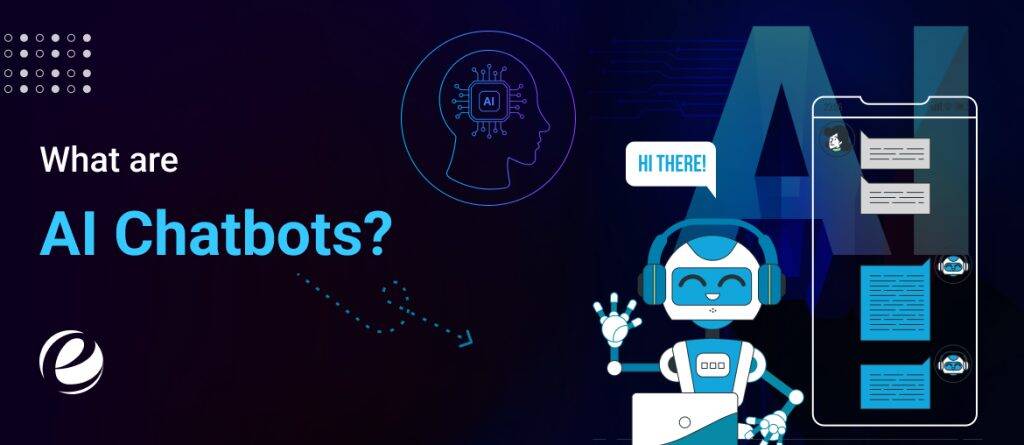
A chatbot is a computer program that has been designed to have a conversation with you—like a human would. Not every chatbot depends on advanced technology, though many modern and advanced ones are being run with the help of artificial intelligence. More advanced chatbots use techniques from natural language processing to understand the beginning. More advanced chatbots, however, have natural language processing capabilities that will enable the systems to understand what is being said to them and then respond accordingly.
Well, in simple terms, the chatbot is a program that allows you to talk with machines—be that by typing or speaking—just like you would with a person. Some chatbots are basic and can only give short, simple answers to your query. On the other hand, some chatbots are more advanced and can learn from your interactions over time, becoming better at understanding and responding in ways that feel more personal and helpful.
How Chatbots Help Businesses Grow?
Chatbots is now an integral part of business operations, and streamlines communication between customers and support teams. They are not question-answering machines but enhance efficiency, foster engagement, and drive business performance.
1. Seamless Presence Across Platforms
Chatbots are able to interact with customers through different touch points, such as web, apps, social media, SMS. This provides a smooth experience for the customer through all touch points and which format the customer makes it possible to start contact is convenient for them.
2. Quick and Accurate Responses
AI chatbots handle customer queries in real-time, reducing wait times and response accuracy. Because they can handle multiple languages, companies can reach a wider audience without being limited by language.
3. Round-the-Clock Support
Chatbots are time-free and operate 24/7, meaning customers get the help they need at any given moment. From answering FAQs to providing critical updates, they keep everything going smoothly without a hitch.
4. Better Customer Experience
By answering recurring tasks and routine questions in a real-time scenarios, chatbots enable human representatives to concentrate on intricate issues. Not only that, but the efficiency is improved, and most importantly, this results in customers having a much more satisfying experience.
5. Increased Lead Generation and Conversions
Chatbots not only help customers, but also aid in lead generation and sales driving. They are able to converse with prospective customers, provide information on their queries, and even make appointments, resulting in improved conversion rates and revenues.
6. Deeper Customer Engagement
Because chatbots learn from each conversation, they keep improving conversations by responding more precisely. This makes customers interact with the brand more, provide feedback, and even get emotionally attached, thus making customers more loyal.
How AI Chatbots Are Changing Different Industries
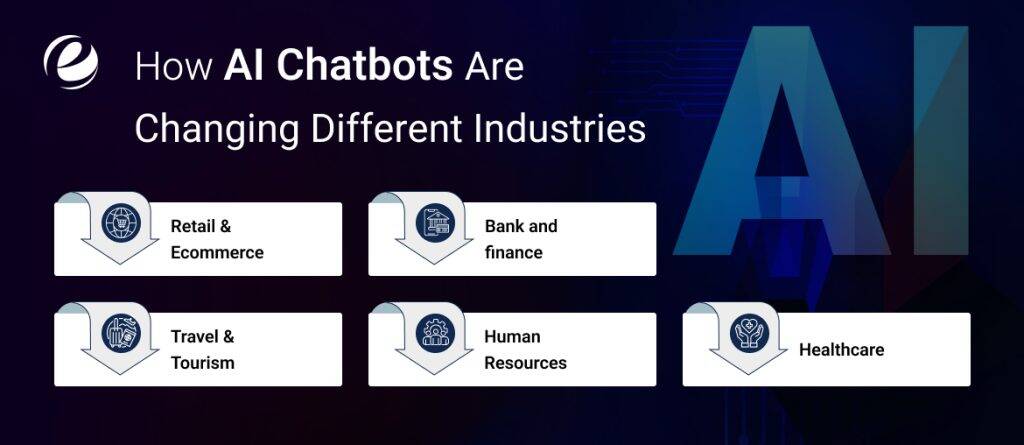
AI-driven chatbots are optimizing companies and enhancing customers’ experiences in various sectors.
1. Retail & Ecommerce
Ecommerce has expanded exponentially, particularly after COVID-19, and is likely to generate approximately $11 trillion in 2024. Since competition is fierce in a specific market, companies need to deliver great customer experience in a bid to retain customers.
Chatbots help companies by handling customer inquiries, helping consumers, and handling high-speed rates of requests at high speed. They also free human agents, hence making the operations efficient and enhancing sales.
2. Bank and finance
For banks, Chatbots simplifies the financial sector and the facilitation of banking services. The client no longer has to line up or check business hours to be served. A chatbot can respond right away at any moment.
Additionally, chatbots are important for the purpose of security since they inform the users of any suspicious activity on their account, thus preventing fraud and safeguarding them.
3. Travel & Tourism
For travel businesses, even simple chatbots can perform everyday tasks such as answering FAQs and giving general travel tips. Advanced chatbots go one step further by assisting customers with hotel bookings, local sightseeing, or verifying travel requirements.
Since they can be accessed 24/7, chatbots have the capacity to offer travelers assistance at the right time, irrespective of the geographical location or time zone.
4. Human Resources
With increasing popularity of remote work and competition in job markets, HR sections typically receive numerous applications. AI Chatbots helps to complete the procedure by conducting initial screening, answering the questions of the candidate and arranging interview agreements.
They can also help guide new employees through background checks, facilitate reminder messages and onboard paperwork—freeing HR professionals to work on more strategic initiatives.
5. Healthcare
Healthcare organizations handle most of the administrative tasks, such as scheduling visits and patient records. Chatbots streamline these functions to execute by performing everyday procedures such as reminders for appointments, test results notices, and patient questions.
This not only maximizes health care services but also enables physicians and medical personnel to devote more time to caring for patients.
Key Features of AI Chatbots in 2025
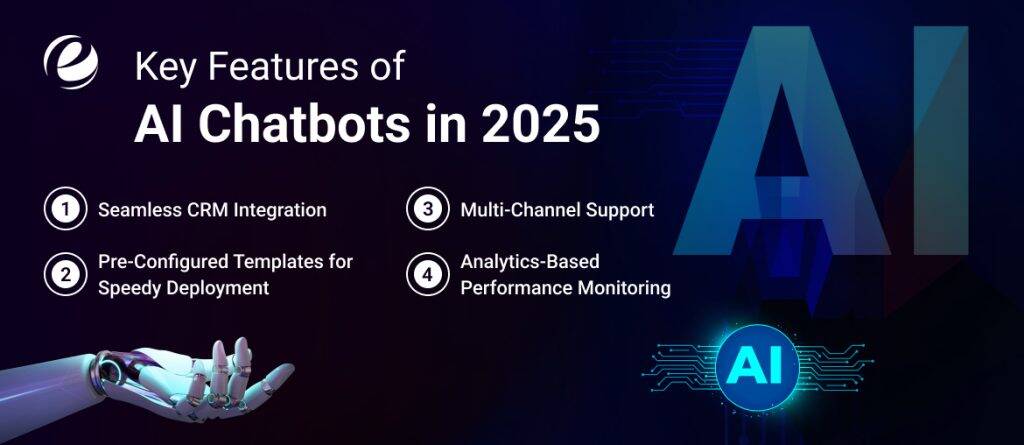
While choosing a customer support chatbot, you can look at the properties that improve efficiency and improve the customer experience. Some important ideas and how they can be used to help the service team enhance conversations are listed below.
1. Seamless CRM Integration:
A chatbot integrated into your CRM can accelerate response times, automate routine tasks, and provide personalized service. It also provides multilingual support and simple deployment through the utilization of existing customer data. With instant access to previous interactions, the bot can provide accurate solutions, minimizing waiting time and maximizing user satisfaction.
2. Pre-Configured Templates for Speedy Deployment:
Companies can quickly get bots implemented by choosing a chatbot with pre-configured templates. Such templates are best for generic and specific applications, allowing teams to implement chatbots in an efficient way without designing them from scratch. They also allow easy fine-tuning, which is a simple process of reconfiguring chatbot procedures as customer demands evolve.
3. Multi-Channel Support:
Consumers engage across many channels, and thus an omnichannel-capable chatbot is essential. Whether a live chat on a website, an app’s message or SMS, a bot needs to be where consumers require assistance. This ease makes it so that users are able to easily switch between channels without losing their context.
4. Analytics-Based Performance Monitoring:
It is important to know how well Chatbot is performing. With integrating analytics, companies can trace response time, customer satisfaction and cost reduction. By analyzing customer interaction and chatbot performance, companies can find areas that they need to improve and adapt to high commitment.
Types of AI Chatbot
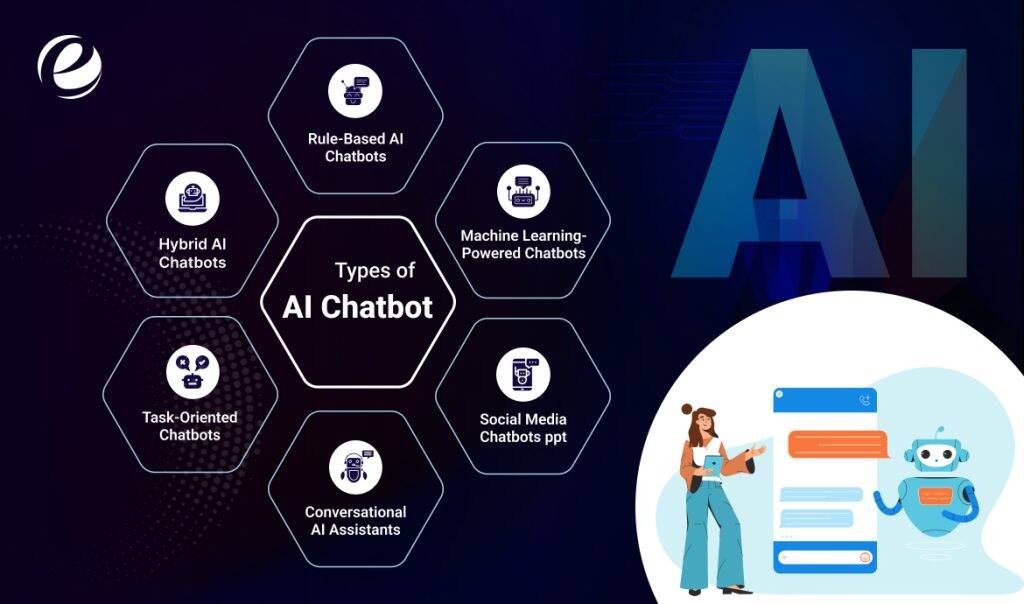
Well, many types of AI chatbots are now available in the market and right now we are talking about some important ones. So, look at these AI chatbots, which are categorized into several categories.:
1. Rule-Based AI Chatbots
Rule-based AI Chatbots work by following predefined rules; these types of chatbots respond based on keywords or phrases. They are good for simple tasks where the interactions are clear, fixed, and predictable.
2. Hybrid AI Chatbots
Hybrid AI chatbots combine rule-based systems and machine learning: these kinds of chatbots use rules where the tasks are structured and machine learning to adapt, bringing a balance to both predictable and dynamic scenarios.
3. Task-Oriented Chatbots
Task-oriented chatbots are designed to perform focused functions, like answering questions or helping with the completion of a task, such as making an appointment; these chatbots lead users through defined processes.
4. Conversational AI Assistants
Conversational AI assistants are advanced and mainly used for open-ended conversations. These types of chatbots easily understand user context, answer questions, and perform actions just like Siri or Google Assistant.
5. Machine Learning-Powered Chatbots
Machine learning-powered Chatbots learn from user interactions and can manage increasingly complex queries by analyzing and adapting different types of user behaviors, rendering them versatile for a variety of tasks.
6. Social Media Chatbots
Social media chatbots run inside messaging platforms like Facebook Messenger or WhatsApp. These chatbots usually help with customer service, marketing, and sales by rapidly firing off automated responses to users.
Technologies Powering AI Chatbots
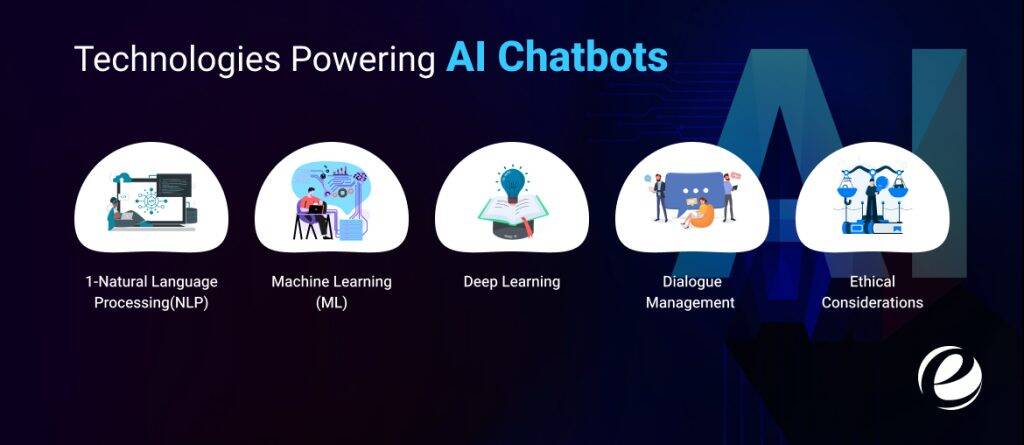
Artificial intelligence chatbots are also known as conversation bots that are powered by natural language processing (NLP), machine learning (ML), and, in some cases, deep learning techniques.
1. Natural Language Processing(NLP)
Chatbot uses natural language processing to understand human language. Human language, as distinct from the more formal language of computers, also requires proper analysis, interpretation, modeling, or some form of treatment by a computer. It can be introduced thus:
- Tokcuction: It divides very small UNITS, such as inscriptions, a word, or a sentence.
- Parsing: Grammar analysis of the text.
- Named Entity Recognition (NER): The recognition of basic things (beings), such as names, dates, and locations.
- Sentiment Analysis: Determining the emotional tone behind a series of words to understand their intended emotion.
2. Machine Learning (ML)
Machine learning algorithms enable chatbots to improve their responses based on prior interactions. In this process, some major aspects are:
- Training Data: The model is trained using large datasets of what a conversation in the text could look like.
- Supervised Learning: Training the model on labeled data where the correct output is made known.
- Reinforcement Learning: Making the model learn through reinforcement of correct responses and punishment of incorrect ones.
3. Deep Learning
Deep Learning mainly considers the use of neural networks that have multiple layers in order to gain insights from data. The important models are:
- Recurrent Neural Networks (RNN): These are good for sequential data in that they can cycle through their past output and keep context.
- Transformers: Models like GPT (Generative Pre-trained Transformer) that take in all words of a sequence at once, allowing for greater parallelization and better handling of long-range dependencies.
4. Dialogue Management
Dialogue management defines the conversation’s flow and oversees context and state to maintain coherent and relevant responses. It ensures that the chatbot can handle multi-turn conversations and can keep track of state to have meaningful interaction.
5. Ethical Considerations
Ethics in relation to chatbot use encompass issues such as:
- Bias and Fairness: Ensures the chatbot does not carry forward biases learned from the data set on which it had been trained.
- Privacy: Safeguarding user data and ensuring compliance with applicable privacy regulations.
- Transparency: Knowledge given to users that they are interacting with a bot and not a human being.
How to Build an AI Chatbot?
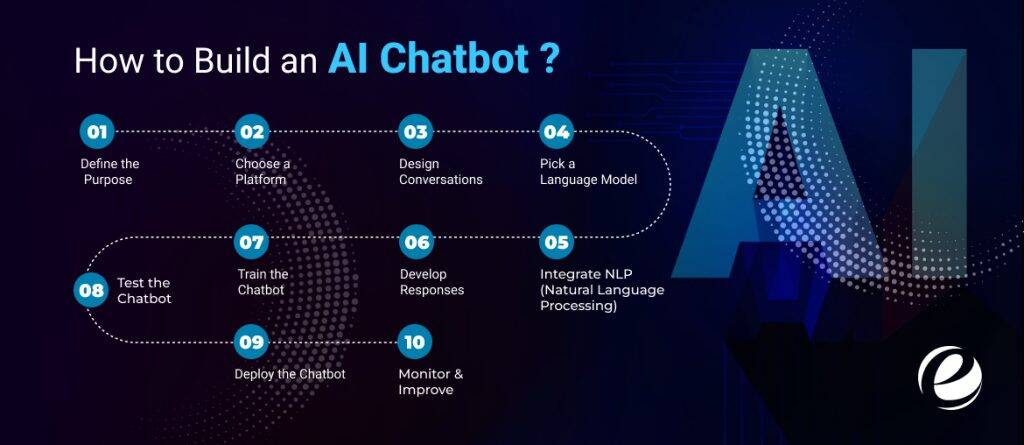
Sure! Here’s a simple, step-by-step process on how to build an AI chatbot. Look at this AI chatbot development process.
1. Define the Purpose
At the initial basis, you have to define the purpose to develop an AI chatbot like what, it is for entertainment, customer support, sales, or something else? So you need to define the purpose first.
2. Choose a Platform
After defining the purpose, you now have to select a chatbot development platform with your chosen AI chatbot development company like Dialog Flow, Rasa, or Microsoft Bot Framework. If you choose the platform, you get the chatbot development tools to make chatbot development easier.
3. Design Conversations
After choosing a platform, now it’s time to design conversations. Your hired development team will map out potential conversations your bot will handle. You also have to think about common questions and responses. This process is called “intents” (what users ask) and “entities” (specific details in a query).
4. Pick a Language Model
After designing conversations now it’s time to choose an AI model for your chatbot. Your hired developers will pre-trained models like GPT-3 or BERT are good for handling complex conversations. Then you can also train your own model if you need to prefer a specific language.
5. Integrate NLP (Natural Language Processing)
After picking up a language model, your team will now use NLP tools to help the bot understand and process human language. Also, you need to choose platforms like Dialogflow that have built-in NLP, but you can also use libraries like spaCy or NLTK.
6. Develop Responses
After integrating NLP, it’s time to create scripted responses based on common user inputs or use AI to generate dynamic responses. For more complex bots, you’ll need AI to generate context-aware replies.
7. Train the Chatbot
After developing responses, it’s time to feed the bot example questions and responses (known as training data). The more you train, the better it understands various ways users can ask for the same thing.
8. Test the Chatbot
Now, it’s time to test your bot with real users to see how well it handles different queries. You can adjust responses and improve the bot’s training data as needed.
9. Deploy the Chatbot
After testing the chatbots, once they work well, deploy or launch your chatbot on your website, app, or messaging platforms like Facebook Messenger, WhatsApp, or Slack.
10. Monitor & Improve
Lastly, you need to continuously monitor the chatbot’s performance. Collect user feedback and make improvements with your chatbots to keep the conversations smooth and natural.
Importance of AI Chatbot Development
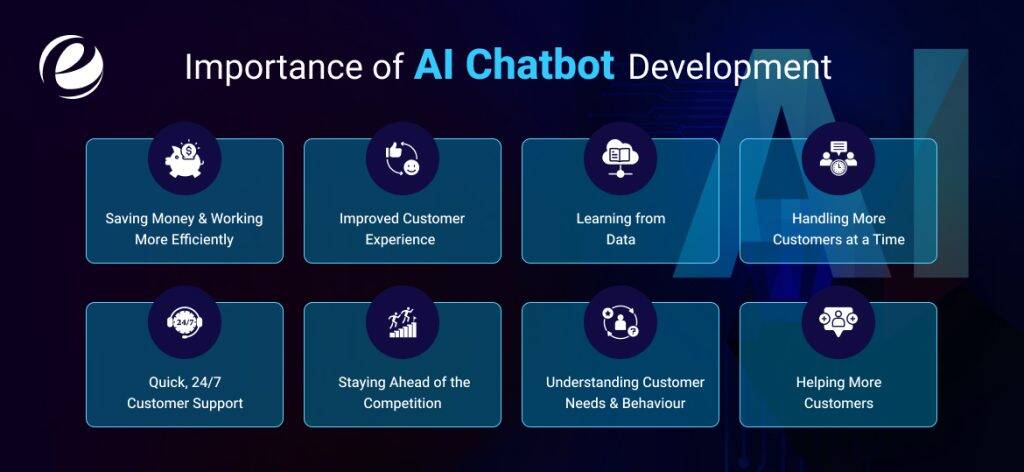
Well, you have a question: “What are the benefits of using AI chatbots, and what’s the importance of AI chatbots?” You are curious to know, right? Here, we cover the importance of AI chatbot development. Look at these points.
1. Saving Money & Working More Efficiently
Ai Chatbot when Customer’s questions are commonly worked, which means that there is no need to choose people for this specific query solved jobs. This helped to reduce spending and allowed customers to sleep day or night. For example, a large telephone communication system protects the customer by using an AI chatbot.
2. Improved Customer Experience
The smart Chatbots can give personal attention to answer what the customer asks and the Chatbot knows about past memorial activities. They can think of the past that the customers need to be weak and great helpers. This advancement is more interesting than customers and also helps to achieve more honesty.
3. Learning from Data
The Chatbot learns from the data meaning the customer is a useful data when he speaks to the distance. This data can affect much from many of the commercials that affect the customers and the causes of suffering. This research can be used to provide their products, commerce, and programs.
4. Handling More Customers at a Time
The AI chatbots are able to talk to many customers at the same time and cannot be a human act. Especially at a busy time, it is especially helpful when many customers need help at once.
5. Quick, 24/7 Customer Support
The customers are quick to want, even in a busy time. The Chatbot can take steps at the beginning of the conversation and immediately wait for help. Chatbots never sleep for an hour; they can be available for about an hour, although some customers are in the world or when they need their help.
6. Staying Ahead of the Competition
Vibrations, which begin with Ai Chat Bot, can be different and advanced from the crowd. The contestants can be given a great deal of benefits to good redemption service, personal experience, and special purposes.
7. Understanding Customer Needs & Behaviour
A detailed conversation shoes cannot answer the questions only: the institution of the customer can also be understood. For example, the consumer’s concerns, joys, or nets, can be attributed to the advertisers, and then is made to act in the same way. This can include the words on many related information, so they can insert them on their own behavior to increase things.
8. Helping More Customers
The customer teams can do a lot by using Chatbot. Because of the easy-to-be-worker Chatbot, human governments focus on the most difficult topics. The Chatbot can also be a responsibility to many consumers, as the chatbots help more customers than people.
Challenges in AI Chatbot Development
AI chatbots are evolving at a rapid rate with smarter and more efficient solutions. But yet, businesses have some fundamental concerns that must be resolved for seamless and ethical application of chatbots. Some of the challenges are as follows:
1. Ensuring Ethical AI
Since more is being outsourced to chatbots, their ethical behavior is important. They become biased and give unwarranted outputs without training—especially in the sensitive domains such as recruitment or customer support. Businesses thus need to use diverse training sets, regularly audit for bias, and have extremely high ethical standards to avoid this.
2. User Data Protection
Chatbots hold individual customer data for the most part, and security and privacy are of utmost importance. Commercials are disclosed by law such as GDPR and CCPA for storing, collecting, and processing information. There should be proper data encryption, data protection policies, and secure authentication procedures to provide protection of users’ privacy.
3. Compatibility with Existing Systems
Most of the firms have legacy technology with which they work, and that may not be compatible with AI chatbots. Integrating the chatbots with such legacy technologies is not a piece of cake. APIs or middleware products help create a bridge to integrate.
4. Optimizing Conversation Flow
AI is still far away from fully knowing human conversation. Chatbots lose context sometimes, handle unclear questions, or respond to out-of-the-blue inputs. Natural Language Processing (NLP) and improved dialogue management systems need further advancement to make chatbot interaction better.
5. Making AI Decisions Transparent
As chatbots get smarter, their reasoning can be mysterious. Users must know why a chatbot responds in a specific way. Transparent explanations and openness about AI processes establish user trust and comply with the law.
6. User Expectation Management
The more realistic chatbots are, the higher are the expectations from the users. If chatbots are too realistic but provide wrong answers, then the users are frustrated. Realistic expectations need to be had and users need to be informed about the capabilities and limitations of chatbots.
Top 10 AI Chatbot Development Tools and Frameworks
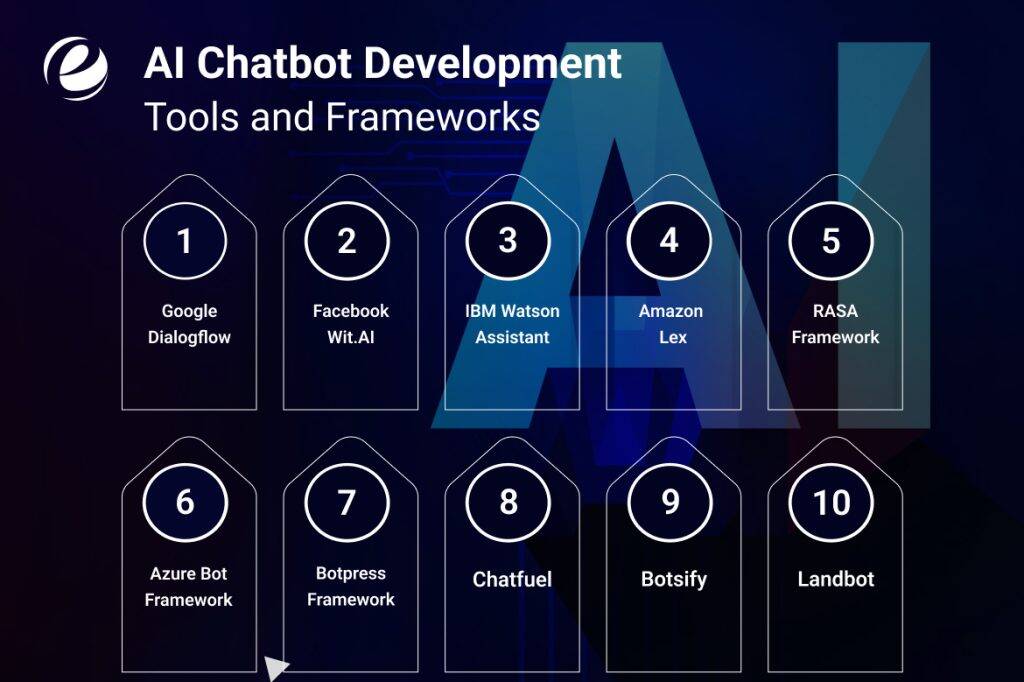
Chatbots AI are also a crucial element for companies that need customer interactions to be enabled and exchanges automated. Following is the overview of top AI chatbot development frameworks and tools along with their prices and best features.
| Tool/Framework | Define | Pricing |
| Google Dialogflow | Based on Google Cloud Natural Language, the platform offers an effortless method of developing intelligent chatbots with the ability to understand long language patterns. | Free for the basic version. Paid offering starts at $0.002 per text request, and phone call processing is up to $0.075 per minute. |
| Facebook Wit.AI | Open-source framework owned by Facebook that is strong in natural language processing (NLP) and hence a great option for Facebook Messenger bots. | Pricing depends on usage and business requirements on a custom basis. |
| IBM Watson Assistant | The platform utilizes AI and machine learning to enhance business automation. It also safely stores all the processed data within the system. | Three plans available – Lite (free), Plus, and Enterprise (price varies depending on features). |
| Amazon Lex | AWS has developed Amazon Lex and incorporated it into Amazon’s platform to deliver robust chatbot solutions with speech recognition and NLP. | Provides a free plan with 10,000 text requests and 5,000 speech requests monthly for one year. |
| RASA Framework | One of the other hot favorites amongst the development of smart AI assistants, RASA enables developers to customize chatbot policy. | Prices are dynamic based on features chosen and are tailor-made for companies. |
| Azure Bot Framework | Perfect for businesses already adopting Microsoft services, this tool offers seamless integration with Cortana, Microsoft Teams, Skype, and more. | 1,000 free messages per month, and pay-as-you-go in the paid plan. |
| Botpress Framework | A popular open-source chatbot platform used across industries such as finance, insurance, and government services. | Two plans are offered – an Open-Source package, which is free with fewer features, and an Enterprise package, which has more features. |
| Chatfuel | A low-code platform that allows individuals and businesses to build AI-powered chatbots without coding. | Free – $0/month Pro – $15/month |
| Botsify | A hosted chatbot platform providing omnichannel live chat automation, which helps businesses chat with ease across multiple platforms. | 14-day free trial Personal – $40/month Professional – $124/month Business – $415/month |
| Landbot | A no-code chatbot builder for conversational website interactions to increase engagement and conversions. | Sandbox – Free Starter – $30/month Professional – $80/month |
The Role of AI Chatbots in Different Industries
1. AI Chatbots Customer Retention
AI chatbots have a significant contribution to assisting organizations in building more and superior customer relationships. With personalized experience, proactive service, and instant support, chatbots build flawless experiences that drive loyalty among customers. Companies in numerous sectors were capable of enforce AI chatbots to improve engagement tiers, such that the customers get a direct response and provide personalized recommendations, thereby maximizing retention tiers.
Use Case: Online retail organizations along with Amazon employ AI-based totally chatbots that endorse merchandise with similarities, ship notifications for abandoned cart orders, and provide one-time offers to secure purchaser loyalty.
2. AI Chatbots in Personalization
AI chatbots examine user history, hobbies, and behaviour to construct custom-designed experiences. Chatbots use natural language processing (NLP) and machine-gaining knowledge to understand consumer rationale and advice while needed, making the experience engaging. Personalization generates client satisfaction and extended-term consumer-organization relationships.
Use Case: Internet sites for on-demand video viewing such as Netflix employ AI-powered chatbots in order to provide recommendations of films and television series to an individual based on his/her watch facts and ratings, providing a personal-designed viewing experience.
3. AI Chatbots for Lead Generation and Sales
Chatbots streamline the revenue pipeline by qualifying leads, answering customer questions, and leading prospects through to conversions. Integrated with customer relationship management (CRM) software, AI chatbots enable effortless lead management so that potential customers get the correct information at the right time. Chatbots have been tested to be beneficial equipment for each B2B and e-trade organization in maximizing sales performance and customer engagement.
Use Case: Real property corporations hire chatbots to speak to potential purchasers through digital property tours and respond to inquiries regarding listings, loan phrases, and availability in real time.
4. AI Chatbots in Crisis Management
At times of increased need in crisis, such as pandemics or natural catastrophes, AI chatbots effectively manage enormous volumes of inquiries, delivering real-time accurate information. Chatbots had been successfully used by agencies and authorities to control crisis conversation and make users at once available without overburdening client care groups. With actual news and automated guides, chatbots help agencies in staying in touch with citizens in the course of a catastrophe.
Use Case: WHO’s AI chatbot can provide actual-time COVID-19 information, protection hints, and solutions to common health questions, minimizing disinformation and selling public schooling.
5. AI Chatbots in Employee Engagement
AI chatbots not only enhance customer interaction but also workforce productivity by helping employees with daily tasks. Right from HR inquiries to training files and administrative workflows, chatbots simplify internal activities. Companies that integrate AI chatbots into business processes reap effectiveness and employee satisfaction as they permit teams to channel efforts to high-value actions.
Use Case: IBM utilizes AI-based HR chatbots to help staff with leave requests, payroll, and company policies, offloading the workload for HR.
6. AI Chatbots for Accessibility
Inclusivity of digital communication is a concern for companies, and AI chatbots play an important part in accessibility. Voice interplay for blind users, assistance for multiple languages, and adaptive verbal exchange styles enhance the accessibility of chatbots.
Use Case: Mobile banking apps, which include Bank of America’s Erica benefit, aid blind people with the useful resource of offering voice commands for transactions, invoice bills, and stability assessments.
7. AI Chatbots in Gaming Industry
AI chatbots are converting the gaming industry by providing real-time support, interactive stories, and custom tips. Game builders utilize chatbots to enhance customer service, force interactions, and construct deep experiences. Right from assisting gamers with in-game questions to delivering dynamic interactions, AI chatbots increase gaming interaction.
Use Case: Fortnite users are being offered recommendations, game reminders, and event notifications by AI chatbots to boost user engagement and experience.
8. AI Chatbots for Augmented Reality (AR)
Augmented reality (AR) with AI chatbots is giving way to new avenues of user interactions. Chatbots used in apps that involve AR are being adopted in companies more and more in a bid to improve interactive assistance that enables users to interact more with the virtual world.
Use Case: IKEA’s AR chatbot permits users to peer how furnishings might look in their own houses using AR whilst additionally suggesting arrangements and responding to product-related questions.
9. AI Chatbots in Blockchain Technology
Empowering AI chatbots with blockchain infuses security and transparency into e-transactions. Using blockchain’s decentralization, companies ensure secure chatbot and data exchanges.This symbiosis is very valuable to verticals such as health care and finance, in which guaranteed information sharing and integrity of data becomes essential.
Use Case: Healthcare companies using blockchain-powered chatbots for safe patient health records transfer and assured authenticity and confidentiality compliance.
10. AI Chatbots in Multicultural and Multilingual Markets
Globalization forces businesses to serve many consumers, and AI chatbots serve as a bridge of language. Multilingual chatbots enable on-the-spot translation and culturalization, which can enable tidy communique geographically. It becomes possible for companies to engage with more consumers and improve customer satisfaction globally.
Use Case: Emirates leases AI chatbots that help customers in diverse languages, imparting flight facts, reservation, and baggage regulations.
11. AI Chatbots in Emotional Intelligence
AI development companies have enabled chatbots to recognize emotions and respond empathetically. Through personal sentiment analysis with the aid of textual content or voice entry, emotionally sensible chatbots can reply to offer more advantageous purchaser revel. It is used pervasively throughout intellectual health manuals, customer service, and personalization guidance to create interactions nearly human and ubiquitous.
Use Case: Mental wellness packaged with Wysa deploy chatbots the application of artificial intelligence in the delivery of remedy exercise guidance and mood-driven emotional support.
12. AI Chatbots for Live Collaboration
In the business quarter, AI chatbots enhance teamwork by becoming a part of platforms such as Slack, Microsoft Teams, and Trello. AI chatbots work on tasks, send reminders automatically, and facilitate group conversation, promoting efficient workflows. Companies using AI chatbots for team collaboration within a company see productivity increases and smooth processes.
Use Case: Slack bots arrange meetings, send reminder notifications, and send automatic workflow updates, improving group efficiency.
13. AI Chatbots in Predictive Maintenance
Manufacturing, automotive, and IoT industries utilize predictive renovation to prevent device failure. AI chatbots help through monitoring systems, tracking usual overall performance parameters, and predicting viable faults before the state of affairs turns unmanageable. It prevents downtime, extends asset life, and decreases preservation charge, thereby allowing popular operational performance to progress.
Use Case: Tesla makes use of AI chatbots that show automobile diagnostics and alert drivers about viable maintenance faults.
14. AI Chatbots for Sustainability
Companies are employing AI chatbots in sustainability to encourage environmentally friendly behaviour. From teaching consumers how to save energy to maximizing the use of resources, chatbots bring the world to attention. AI chatbots also provide zero waste in the virtual world by taking advantage of automation for tasks that would otherwise be resource and time-consuming for humans.
Use Case: Smart home gadgets like Google Nest hire AI to provide electricity-saving suggestions and manipulate the use of devices to store electricity.
15. AI Chatbots for User Onboarding
AI chatbots optimize user onboarding by helping new users with product capabilities and functionality. Organizations that utilized chatbot-primarily based onboarding experienced more suitable adoption as users had been supplied with step-by using-step steerage applicable to their wishes. Chatbots optimize the engagement of the onboarding technique, minimizing frustration and maximizing person retention.
Use Case: SaaS corporations which include HubSpot utilize AI chatbots for personal walkthroughs of the platform functions, resolving FAQs, and providing customized setup tactics.
16. Gamification in AI Chatbots
AI app development company integrate gamification features like rewards, demanding situations, and leaderboards inject a laugh and interactivity into chatbot use. Gamified chatbots are employed with commercial enterprise firms in loyalty programs, schooling modules, and retention and engagement packages.
Use Case: The chatbot by way of Duolingo affords interactive quizzes, progress monitoring, and encouragement through gamified elements to beginners of languages.
17. AI Chatbots in Data Analytics
AI chatbots in data analytics assist businesses in processing huge amounts of data by detecting patterns and delivering useful insights. Chatbot analytics permit agencies to music client pastimes, campaign pastimes, and decision-making. Data visualization gear primarily based on AI offers extra business intelligence to the analytical procedure in the form of interactive real-time dashboards.
Use Case: Banks use AI chatbots to generate money reports, have a look at spending styles, and provide budgeting suggestions.
18. AI Chatbots in Cybersecurity
Cyber attacks keep emerging, and AI chatbots keep helping create even more secure digital security. AI chatbots enable real-time abnormality detection, prevent cyber attacks, and give security advice to users. Secure deployment needs to be implemented so that it will not become a zone of vulnerabilities such as data leaks or abuse.
Use Case: IBM Watson AI chatbot helps security officers interpret cyber attacks and suggest defence approaches.
19. AI Chatbots in the Metaverse
Metaverse innovation has driven use cases of AI chatbots within virtual worlds. Directing customer service in virtual department stores and chatbots elevates the metaverse experience. Businesses are looking for AI-pushed interaction to create engaging, customized digital worlds for customers.
Use Case: Decentraland employs AI chatbots to useful resource humans within the metaverse to shop for virtual assets and engage with digital worlds
20. AI Chatbots in User Feedback
Collecting remarks is important for organizations, and AI chatbots offer a conversational way of accumulating records. Live chats, polls, and chatbots are transforming the collection of comments and making it enjoyable. Organizations utilize these records to improve products, services, and customer experience.
Use Case: Online shopping websites utilize AI chatbots to ask about the customer’s shopping experience and make personalized additions.
21. AI Chatbots in Localization
To become more localized in international economies, companies make chatbots personalized based on cultural and linguistic differences. Localized AI chatbots are able to recognize local idioms, shopping expectations, and shopping norms for, and the speak more in a localized way. Brand value increases, and relationships with specific looking crowds are established.
Use Case: McDonald’s utilizes AI chatbots to enact totally definitely national cuisine-influenced personalized menu rules in most nations.
22. AI Chatbots in Compliance
AI chatbots have to abide by laws such as GDPR, HIPAA, and other data privacy acts so that AI can be utilized ethically. Organizations that utilize chatbots are very much concerned with secure handling of information, user authentication, and open AI-mediated interactions so that compliance issues can be avoided and trust can be generated.
Use Case: Banks employ AI chatbots to facilitate compliance data through transactional monitoring and alerts for regulatory compliance
Use Cases of AI Chatbots Development
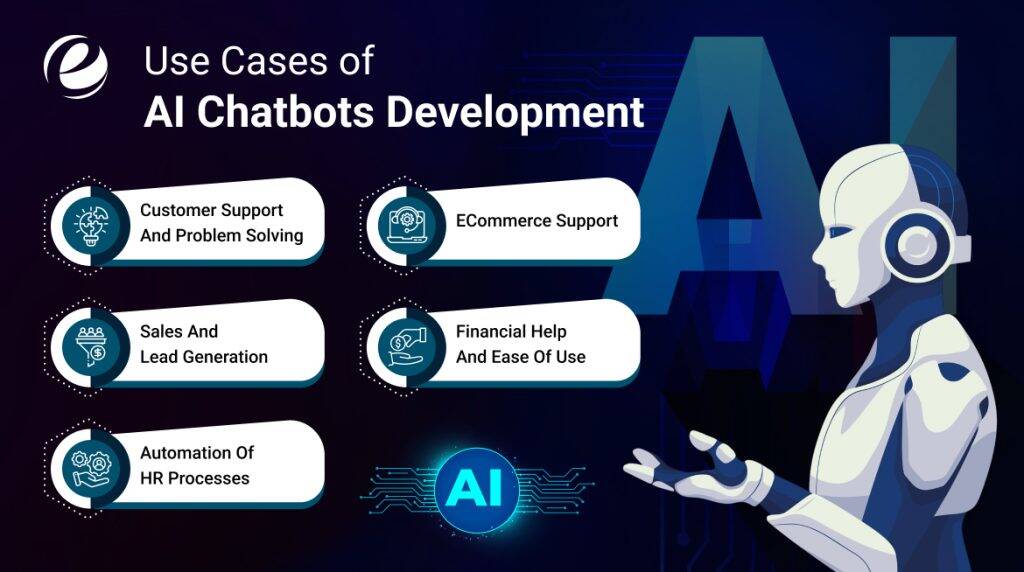
Regardless of whether it is retail, hospitality, finance, or any other industry, customer experience is all about getting it better. Chatbots are a basic business tool to make things better and improve interaction. According to thorough study and research, and supported by industry input, the best uses of chatbots to deliver outcomes are discussed below.
1. Customer Support and Problem Solving
One of the most common and effective uses of chatbots is customer support. Since modern customers prefer instant solutions, AI-powered chatbots help businesses provide fast, round-the-clock assistance.
Reports suggest that 67% of users have interacted with chatbots for query resolution, and this number has only grown over the years. Today, companies integrate chatbots across multiple platforms to enhance customer service.
Key Applications:
- Offering live support on business websites
- Providing in-app assistance for users
- Responding to social media questions
2. Sales and Lead Generation
Four times as many leads have been created by businesses through chatbot engagement than with conventional methods. As customers are receptive to interactive procedures, chatbots assist in lead nurturing, guiding them through the sales funnel, and generating revenue.
Primary Uses:
- Enhancing lead nurturing procedures
- Scheduling appointments automatically
- Facilitating direct order placement via chat
3. Automation of HR Processes
Human resource departments waste their time on routine tasks like shortlisting, fixing interviews, and answering employee queries. AI chatbots do all these tasks automatically, thus releasing the time of HR professionals to work on key projects.
Primary Uses:
- Automatically sourcing candidates through emails, websites, and word of mouth
- Reducing operating costs and up to 14% of HR time
- Serving as a direct point of contact for employees
- Increasing employee satisfaction and engagement
4. eCommerce Support
The eCommerce sector has high growth prospects, but few online stores make much money. To enhance customer experience and increase sales, businesses are leveraging AI chatbots for effective support.
Leading Use Cases:
- Providing real-time delivery and order tracking
- Handling return and exchange requests
- Allowing customers to order within a single message
- Providing personalized product recommendations to customers
- Collecting customer feedback and analyzing them
5. Financial Help and Ease of Use
Chatbots are offering the primary support to the finance industry by offering people money guidance and transaction easements. As they can browse through huge amounts of data, AI chatbots can offer consumers information that will help them use money more wisely.
Additional Valuable Applications:
- Offering secure and easy payments
- Monitoring expenditure for providing money tips
- Giving actionable money advice
Case Studies: Successful AI Chatbots
Case Study 1: Domino’s Pizzas Made Easy to Order Through a Chatbot
Part of its efforts to make and streamline pizza ordering, Domino’s rolled out a chatbot on Facebook Messenger. Not only is the bot easy to order from, but it also serves as a brand-building platform utilized to foster brand awareness. The customers can order the pizzas wherever they may be and even customize them, choosing their preferred toppings and crusts—all through the chat.
Case Study 2: Smart Travel Suggestions by Emirates Vacations
Emirates Airlines made its process of travel reservations smarter by pairing a chatbot with on-page display ads. This bot is smarter than other travel bots in that it also asks users questions about preferences when traveling and tracks activity on the website. It utilizes this to provide personalized travel suggestions and information about locations. During a 30-day trial, the chatbot ads interacted with 87% more than regular display ads, and the campaign was successful.
Case Study 3: Alexa – The Voice Assistant Building Booming Revenues
Amazon’s Alexa is the top-performing business chatbot with shipments forecast to 125 million units by 2025. Amazon’s backing of Alexa still holds as the company remains convinced about voice commerce popularity. Alexa boasted more than 80,000 skills in the US in 2021 through which consumers could shop, listen to music, switch home lights on and off, and even cast out polls—voice commands alone.
Case Study 4: Kian – A Chatbot That Boosted Kia’s Conversions
Kia’s bot, Kian, transformed the customer experience with the brand online. By providing quick and precise answers to complex automobile-related queries, it further improved the customer experience. Most significantly, it even improved the conversions on Kia’s website by 7% to 21%. Besides this, chatbots such as Kian also provide a consistent sales strategy across all digital platforms, thereby making the purchase process convenient for the users.
Cost to Build an AI Chatbot
The cost depends upon multiple factors, such as project complexity, technologies, expertise, the developer’s location, and the chatbot’s functionalities. You have to be careful when developing an AI chatbot; just ask your chosen AI chatbot development company.
Here’s a table which shows the Cost to Build an AI Chatbot, considering the different roles and stages involved in the AI chatbot development process.
| Role | Estimated Hourly Rate | Estimated Cost (Total) |
| Project Manager | $50 – $150/hour | $5,000 – $20,000 (depending on project size) |
| AI/ML Developer | $75 – $200/hour | $10,000 – $40,000 (depends on complexity) |
| Backend Developer | $60 – $150/hour | $8,000 – $30,000 |
| Frontend Developer | $50 – $120/hour | $6,000 – $25,000 |
| NLP Engineer | $80 – $180/hour | $8,000 – $35,000 |
| UI/UX Designer | $40 – $120/hour | $4,000 – $15,000 |
| Quality Assurance (QA) | $30 – $100/hour | $4,000 – $12,000 |
| DevOps Engineer | $60 – $150/hour | $5,000 – $18,000 |
| Content Writer | $25 – $80/hour | $2,000 – $8,000 |
| Marketing/Copywriting | $30 – $90/hour | $2,000 – $6,000 |
| Maintenance & Updates | $40 – $120/hour | $3,000 – $10,000/year (depending on frequency of updates) |
Total Estimated Cost:
- Small Project – $15,000 – $40,000 (Up to 3 months)
- Medium Project – $40,000 – $100,000 (3-6 months)
- Large Project – $100,000 – $250,000+ (6-12+ months)
Future Trends in AI Chatbot Development
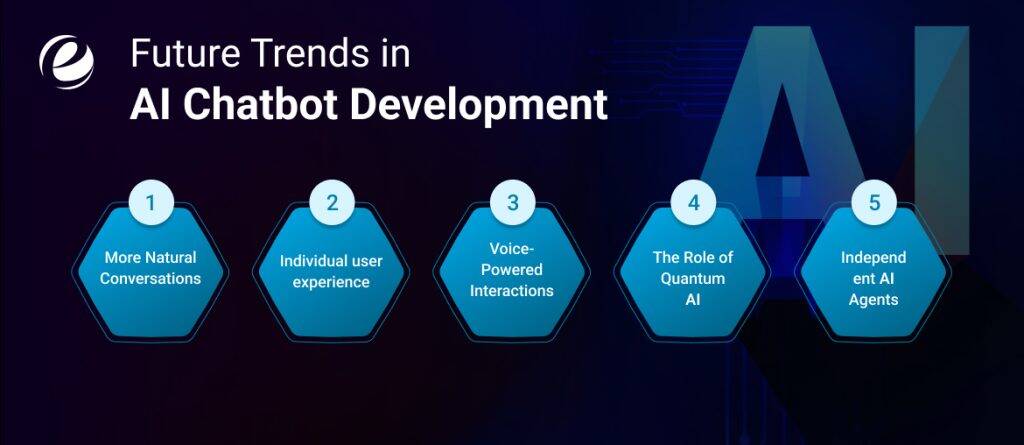
AI chatbots are also advancing quickly, growing more intelligent and efficient in various industries. Among the most compelling trends defining their future are:
1. More Natural Conversations
Chatbots are becoming more competent at handling human language, emotions, and context. Advances in Natural Language Processing (NLP) and machine learning are allowing chatbots to respond in a more human and natural way, making interaction more fluid and enjoyable.
2. Individual user experience
Artificial intelligence-powered chatbots are learning to provide more personal answers by understanding the user’s choices and previous conversation. From product suggestions to customer help, each user becomes smarter and more favorable to remember user preferences.
3. Voice-Powered Interactions
More and more, the voice capacity is added to chatbots so the user can talk, not write. It is most useful for hand -free applications, for example while driving or getting instructions while having services on smart devices.
4. The Role of Quantum AI
Quantum computing can also be employed to enhance AI chatbots. It can handle massive amounts of data within seconds, and this can result in innovation in fields like medicine, where AI can help develop new medicines at a pace higher than ever before.
5. Independent AI Agents
The age of autonomous AI implies that chatbots will be capable of doing sophisticated tasks independently in the future. Picture an AI assistant booking meetings, handling customer support, or even making business calls—all independently.
Choosing the Right AI Chatbot Development Service Provider
Here is a simple step-by-step guide to assist you in choosing the ideal service provider to build your chatbot. We will divide what you should think about before you make your choice.
Know What You Need
Before searching for a chatbot developer, it is essential to know what you need from the chatbot. Ask yourself these simple questions:
- What is the chatbot going to do? Determine if it’s customer support, answering questions, sales support, or otherwise.
- Where will it host? Consider where the chatbot will reside: on your site, app, or on Facebook or WhatsApp and other social platforms.
- How complex should it be? Do you want a simple bot that provides basic answers, or a very intelligent chatbot that’s intelligent enough to speak in a more human-like way?
Ask yourself these, and you will know how to look for a partner who will provide what you want.
Look For Experience and Expertise
Make sure you get someone who’s had experience with chatbots and your business as well. Look for this in them:
- Experience: Take a look at what they’ve worked on previously. Are the chatbots real time, and easy to interact with?
- Custom Solutions: Ensure they can make you a customized chatbot suitable to your exact business and don’t provide a stock one.
- Technical Skills: They should understand natural language processing (NLP), machine learning, and other technicalities which allow chatbots to be intelligent.
It also works if they have experience in your line of business. This way, they can easily grasp your requirements and deliver a better solution.
Think About Post-Launch Support
Once your chatbot is live, it’s crucial to ensure it continues to function well. Ensure your developer provides:
- Maintenance and regular updates: Regular updates keep the bot in top shape and up to date.
- Monitoring performance: Monitor the performance of the bot and adjust as necessary through user feedback.
- Training your staff: Train your staff so they can support and manage the bot when it is released.
A company that provides excellent support after release shows they care about your chatbot being around for the long haul.
Consider the Cost
While cost is a factor, it can never be the determining factor alone. Steer clear of businesses that offer what appears to be too good of a deal. Cheap is not cheaper and therefore lower quality or no service at all.
Make sure you are aware of what the business is actually selling, whether it’s a subscription fee, an hourly rate, or a flat rate. Make sure you are aware of what the fee is paying for—is there design included through to support ongoing?
By learning the ideal cost and quality blend, you will be able to make the most informed decision for your business.
Why Choose “EmizenTech” for Your AI Chatbot Development?
Alright, let’s talk about EmizenTech. Firstly, if you really want to develop an AI chatbot because of the many benefits of AI Chatbot Development, then EmizenTech is one of the best-trusted partners. All our developers have years of experience in advanced technologies, and they always learn new things to provide unique and extra development services to our clients. Here, our professionals can build customized AI chatbots at the most budgetary prices; you can compare our solutions and offerings to others.
- At EmizenTech, you get the most skilled AI chatbot development team with vast knowledge of NLP, ML, and many other technology solutions.
- Our developers have expertise to develop smart and user-friendly AI chatbot development services and they believe to deliver secure, high performance and scalable solutions.
- Our experts can develop AI chatbot as per your requirements and market demand at the most affordable prices. So feel free to contact us and share your requirements with us.
- We are 24*7 available for our clients to solve their issues and queries. We are just a call away so connect right now and hire AI chatbot developers.
Conclusion
So, have you made up your mind to develop an AI chatbot? Well if you really want to build an AI chatbot then hopefully this guide seems helpful for you because we covered everything in this guide to know. AI chatbot development is not an easy task but professional or expert developers can manage by using the right tools.
The best AI development company is EmizenTech which specializes in developing smart, scalable, and secure solutions tailored to your business needs. Our professionals are perfectly expert in combining advanced technology with industry specific to build AI chatbots that surely help users and provide them solutions to their queries.
FAQ’s
Which industries use AI chatbots most?
Many industries use AI chatbots in e-commerce, healthcare, banking, customer support, education, and more.
Is developing a chatbot difficult?
It depends. Basic chatbots are easy to build, but on the other hand the advanced AI chatbots need more skills and time.
How much does it cost to develop a chatbot?
Costs depend upon many factors. A simple chatbot can be free, while advanced chatbots may cost thousands of dollars.
Can chatbots replace human jobs completely?
Not entirely. Chatbots can handle basic tasks, but humans are needed for complex conversations and decision-making.


 +1 (989) 535-9295
 info@emizentech.com
 emizentech


