 Add us as a preferred source on Google
 The multilingual chatbot has become an essential tool for companies seeking to communicate with diverse audiences without difficulty in today’s interconnected and digitally dependent world. Businesses that employ these sophisticated chatbots will not only gain the ability to interact with their customers in their native languages but also enjoy the benefits of customer satisfaction, as the interaction will be immediate and native language-based, with the help of advanced AI.
According to Intel Market Research, the multilingual conversational AI platform market, which is expected to be worth USD 1.57 billion by 2025, is anticipated to be valued at USD 3.28 billion by 2034, thus marking a 13.1% CAGR growth rate. You can stay ahead of the competition if you adopt the best practices for multilingual support in AI chatbots, since the rise of e-commerce and globalization will make such practices a necessity.
What Is a Multilingual Chatbot?
A multilingual chatbot functions as a continuous AI communication facilitator, capable of identifying, managing, and responding to user input in various languages seamlessly. Natural language processing (NLP), machine learning, and translation technologies enable it to automatically identify languages and provide contextually appropriate replies, thereby eradicating global communication barriers.
The major types include Translation-Layer bots, which convert the user input into a base language first and then translate the response back to the user, and Native LLM bots that are based on large-language models that have been directly trained on multilingual datasets, thus having a better understanding of the nuances in the conversation.
| Aspect | Translation-Layer Bots | Native LLM Bots |
| Accuracy | Good for simple queries; prone to translation errors | Superior; handles idioms/slang natively |
| Speed | Faster initial setup; latency from translation | Slightly slower training; real-time fluency |
| Cost | Lower; uses existing monolingual models | Higher; requires diverse training data |
| Scalability | Limited to translation quality | Excellent for 100+ languages |
In the course of AI chatbot development and utilization, businesses mostly go for native LLM bots from chatbot solutions providers, especially due to outstanding performance in Chatbot Development Services.
Why Do Businesses Need Multilingual Chatbots?
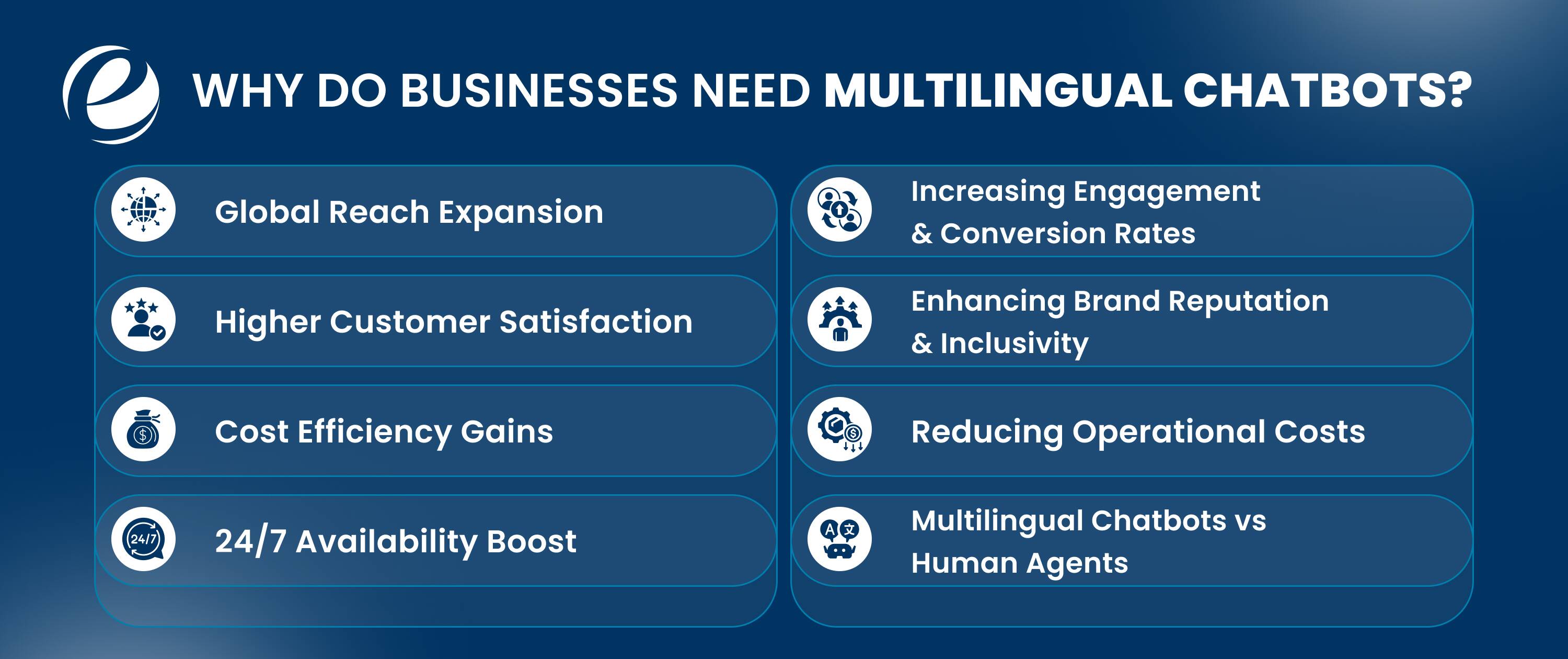
The necessities of a chatbot for businesses include being present in the international market, playing a big role in customer satisfaction, and minimizing support costs in the e-commerce sector due to the increase in demand. The top multilingual chatbot solutions providers are offering these chatbots, which play a huge role in giving businesses a competitive advantage through 24/7 communication in the native language.
Global Reach Expansion
The chatbots are helping reach more than 75% of global non-English internet users, thus opening up emerging markets through AI Development Services with uninterrupted language support.
Higher Customer Satisfaction
These chatbots replying in the customers’ language will not only cut down on their frustration but will also raise the customer’s satisfaction rate by 30–40% through conversations that are culturally attuned.
Cost Efficiency Gains
The usage of how to make multilingual chatbot strategies for automating 80% of queries across languages will result in a significant reduction of support costs, which will allow for the scaling of operations.
24/7 Availability Boost
Implementation of best practices for multilingual support in AI chatbots will guarantee that help will be available all the time, which is especially important for businesses that are global in nature and are involved in Chatbot Development.
Increasing Engagement & Conversion Rates
Chatbots using different languages for personalizing services raise the number of users clicking and buying by 25% since they provide instant, relevant replies to users in their native tongues.
Enhancing Brand Reputation & Inclusivity
The use of chatbots that are inclusive earns the brand loyalty from different cultures, thereby making the brand stand out as a global company that provides support through accessibility.
Reducing Operational Costs
A single chatbot manages the equivalent workload of 50 human agents, thereby reducing the organization’s staffing needs by 90% while keeping up with the quality of service.
Multilingual Chatbots vs Human Agents
These chatbots are very economical in scaling their operations: an AI agent can take care of the same work as 50 humans for regular queries, it is always there for the customers and takes care of them in their own languages, at very low cost, with seamless escalations in case of complex needs.
How Do Multilingual Chatbots Work?
The multilingual chatbots have the capability to communicate using more than one language, utilizing the most advanced and sophisticated NLP applications that are able to identify the user’s language, the intention behind the request and give a reply either through translation or a native model, depending on the case. AI chatbots’ multimedia interactions go smoothly if they follow the best practices and use the best tools for chatbots in their operations.
Natural Language Processing (NLP) & AI Basics
The main NLP engines perform basic operations of tokenization and intent classification on multilingual inputs, which help build machine learning-based multilingual chatbots for correct understanding across languages.
Integration with Existing Platforms
Easily integrates with various business systems such as Salesforce and Shopify, thereby allowing the flow of chatbot data in multiple languages through the existing business channels.
Handling Idioms, Slang, and Regional Dialects
The AI is trained on a variety of datasets, and it is able to detect informal language through contextual AI, and it is also able to change its responses according to the best practices for multilingual support in AI chatbots for natural conversations.
Language Detection
Input language is auto-detected by employing machine learning algorithms, thus the whole process is instant and user-friendly for over 100 languages.
Intent Recognition
NLP is applied to analyze the incoming queries and understand the meaning, even with different languages and slang, since the model is trained to handle these cases.
Response Generation
Replies are formulated in the user’s language and apply techniques like context retention and cultural adaptation that help to create chatbots.
Translation Processing
It passes through either APIs or native LLMs according to the best practices for multilingual support in AI chatbots, which guarantee high accuracy.
Building a Multilingual Chatbot Without Code
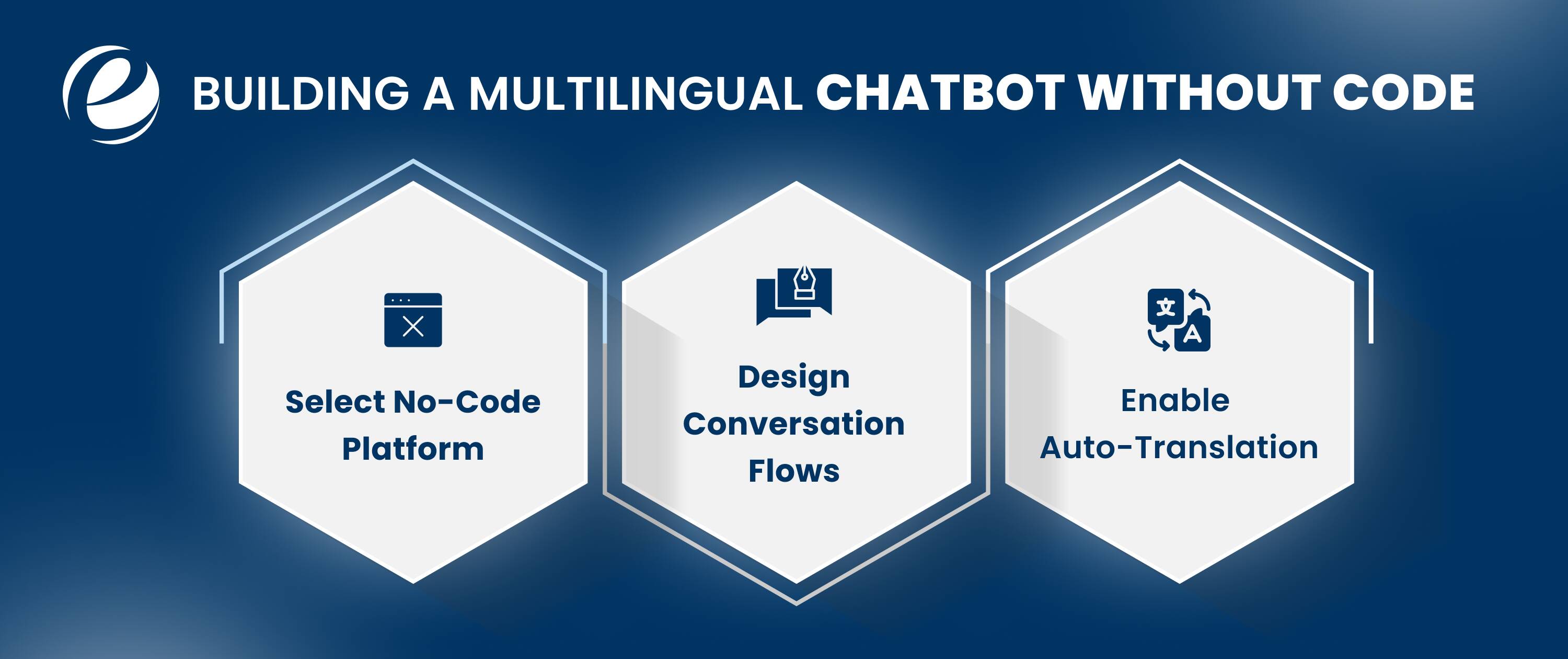
Create a no-code chatbot on user-friendly platforms of the chatbot solution providers, which will greatly speed up the whole process since it’s as simple as drag-and-drop, along with the use of pre-built NLP that is done for the chatbot solutions. Perfect for companies looking for an AI Chatbot to transform industries.
Steps to Create Quickly
Select No-Code Platform
Choose the best tools for multilingual chatbots
Design Conversation Flows
Use visual builders to outline intents and responses, which is how to make chatbot templates for multi-language branching to be integrated.
Enable Auto-Translation
Within the tool, activate APIs such as Google Translate, pushing for real-time fluency in adherence to maintaining best practices for multilingual support in AI chatbots.
Pros and Cons: No-Code vs Custom
| Aspect | No-Code Solutions | Custom Development |
| Speed | Deploy in days; rapid prototyping | Months for full builds |
| Cost | Low upfront; subscription-based | High; needs developers |
| Flexibility | Limited customization | Fully tailored to needs |
| Scalability | Good for SMBs | Enterprise-grade handling |
Testing Tips
Simulate User Scenarios
Native speakers will be used to check the accuracy and the cultural fit of multilingual chatbots in the mentioned cultures by testing the queries in the target languages.
A/B Language Testing
Operating across the different dialects in parallel and refining according to the best practices for multilingual support in AI chatbots will be the approach for new languages.
Monitor Edge Cases
Having the slang/idioms checked by tools will be the mainstay of robust how to make chatbot performance before live rollout.
Core Features of a High-Performing Multilingual Chatbot
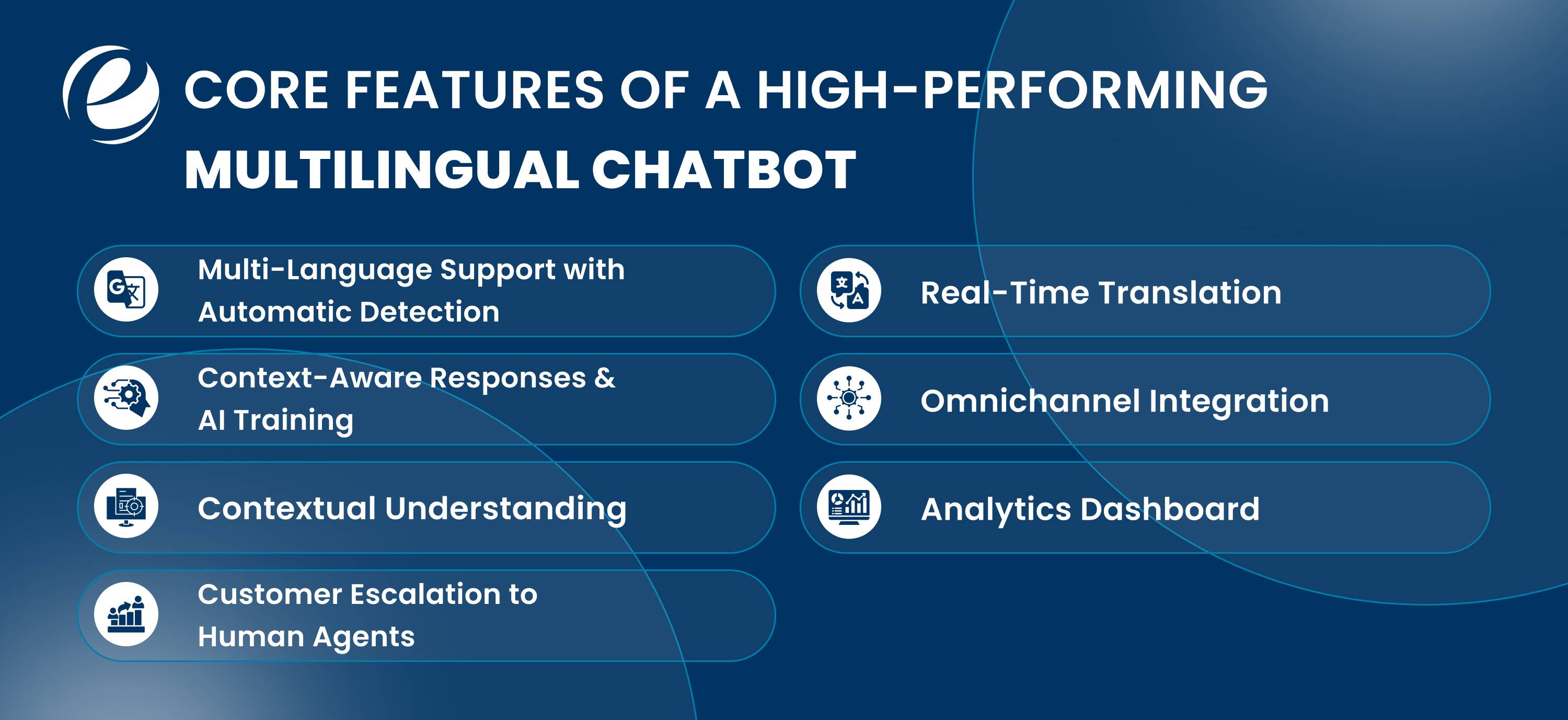
Auto-detection, contextual NLP, and seamless translation are the core features of a peak-performance multilingual chatbot. Explore the top tools that significantly enhance the features of the leading chatbots through the application of the most effective practices for multilingual support in AI chatbots.
Multi-Language Support with Automatic Detection
The feature can identify more than 100 languages at once and does it right from the first input, thus enabling the user to have non-stop communication in different languages without any prompts for user intervention, which in turn leads to a smoother chatbot experience all over the world.
Context-Aware Responses & AI Training
The system keeps track of the entire conversation history in different languages. It depends on the ongoing training on how to develop a chatbot to always provide personal, culturally appropriate, and, through the use of machine learning techniques, responses.
Contextual Understanding
Ability to recognize intent accurately for how to make a chatbot in different scenarios through the training of a native LLM on the conversation history across languages and the handling of nuances like slang and idioms.
Customer Escalation to Human Agents
The smart handoff recognizes the complicated queries and passes them on to the trained human staff while at the same time keeping the context for the efficient resolution of the multilingual chatbot support.
Real-Time Translation
Interfaces for two-way fluency are integrated, and the corresponding human-curated fallbacks are applied according to the best practices for multilingual support in AI chatbots, thus minimizing errors through the combination of machine accuracy and human-curated fallbacks.
Omnichannel Integration
The platforms of WhatsApp, websites, and apps are uniformly deployed, which allows AI Chatbot Development for global support without any platform silos.
Analytics Dashboard
The analytics dashboard tracks performance metrics such as resolution rates per language, enabling continuous improvement and refinement of the chatbots.
Best Practices for Multilingual Chatbot Success
Achieve customer support success with a chatbot by following the best practices for multilingual support in AI chatbots, which enhance the accuracy and cultural relevance of the chatbots. Exchange the word along with the chatbot solutions providers for the large-scale deployment.
Prioritizing Top Customer Languages First
With the help of the loquacity data, the company would focus on getting the maximum return on investment through the deployment of targeted multilingual chatbots first at places where the highest traffic languages like Spanish and Mandarin are spoken.
Maintaining Tone, Politeness, Cultural Nuances
AI chatbots will be trying to communicate in the most appropriate way for the particular market, direct for US users, honorifics for Japanese, while maintaining brand voice through the best practices for multilingual support in AI chatbots.
Continuous AI Training for New Phrases/Slang
Keep multilingual chatbots conversationally relevant by updating models quarterly with regional expressions as per how to make chatbot pipelines.
Prioritize Cultural Localization
Extend your chatbots beyond the mere translation area, adopt the use of regionally characteristic idioms, formalities, and visuals to win the trust and eliminate the communication barrier in different markets.
Implement Fallback Strategies
Use a combination of auto-detection and user prompts for the uncertain languages, while human beings take care of the intricate and complicated queries, and use the best tools for multilingual chatbots
Ensuring Security & GDPR Compliance
These chatbot deployments across regions will meet global standards by encrypting conversations, anonymizing PII, and conducting audits.
Using Fallback Mechanisms
When users hit a language barrier, the chatbots will support them per best practices for multilingual support in AI chatbots by routing unsupported languages to translation services or agents, thereby maintaining the reliability of the chatbots.
Train with Diverse Datasets
Let the models learn from native slang, dialects, and industry terms, current and constantly updated via how to make multilingual chatbot processes, regularly updating for evolving language patterns and accuracy.
Conduct Multilingual A/B Testing
Before the official launch, the various responses in different languages will be assessed and improved following the guidelines of a multilingual AI chatbot support that promotes best practices such as engagement and resolution rates.
Monitor and Iterate Continuously
Using analytics will help identify where customers lose interest in each language, which will then guide the selection of chatbot service providers that focus on maintaining performance through quick and proactive changes.
Multilingual Chatbots in Action: Real-World Success Stories
Multilingual chatbots go beyond the provision of global brands with language-support facilities by also being pioneers of the positive real-world scenario. Discover success stories that reveal the most effective tools and strategies for AI chatbot support, provided by the most proficient chatbot solution providers.
Global E-Commerce Giant
A leading retailer was using chatbots developed by Chatbot Development Services, which positively impacted their conversion rates, lifting them up by 35% in real-time translation and personalized recommendations through 15 different languages.
- Business Challenge: The high volume of support requests from international clients significantly affected the English-speaking markets and resulted in delays and unsatisfied non-English-speaking markets.
- Implementation Strategy & Platform: The multilingual chatbot creation with Dialogflow and utilizing no-code flows for quick scaling was the plan.
- Languages Supported & Customization: Over 15 languages were covered, along with local-specific greetings and product recommendations culturally.
- Results: Customer Satisfaction Score went up by 35%, response times were cut by 50%, and this had a 20% positive effect on revenue in fewer territories.
- Lessons Learned: Regular training on local slang interpretation through best practices for multilingual support in AI chatbots avoids misunderstanding.
Travel Platform Triumph
The company was making chatbot strategies on Dialogflow that helped in managing over a million queries a month in more than 20 languages while also cutting support tickets by 60% for international bookings.
- Business Challenge: The growth in booking queries was so significant that it became extremely hard for the agents to deal with during peak season and across global time zones.
- Implementation Strategy & Platform: The best chatbot tools, such as Yellow.ai were incorporated into the website and WhatsApp.
- Languages Supported & Customization: Support was moved to 20+ languages with real-time translation and itinerary personalization features.
- Results: 60% tickets occurred, which improved efficiency, and the first contact resolution worldwide was 92%.
- Lessons Learned: Feedback from user loops is very useful for getting the accuracy of chatbots for updating seasonal travel terminology.
Financial Services Win
The bank, using Yellow.ai and best tools for multilingual chatbots
- Business Challenge: The existence of compliance inquiries in various languages led to misinterpretations and regulatory issues all over the globe.
- Implementation Strategy & Platform: One of the providers for chatbot solutions, Rasa, was selected as the most suitable for secure and custom NLP training among the contenders.
- Languages Supported & Customization: 12 languages were professionally supervised with secure log-in and respective financial terms for different localities customized for each locality.
- Results: 95% of queries were taken care of, 40% efficiency increase, and building trust with native multilingual chatbot support were the main outcomes.
- Lessons Learned: Ongoing assessments ensure the conformity of AI chatbots’ multilingual support standards with those of the laws.
Healthcare Provider Case
The healthcare provider’s case represents the integration of chatbot solutions providers that facilitated 24/7 triage in different languages, hence 40% increase in patient satisfaction through AI Chatbot Transforming Industries interactions, which were culturally sensitive.
- Business Challenge: The multilingual questions from patients caused the staff to be inundated, and consequently, the worldwide triaging and appointments got postponed.
- Implementation Strategy & Platform: The adoption of chatbots through the best tools for multilingual chatbots, like the Microsoft Bot Framework, which was chosen for its HIPAA compliance.
- Languages Supported & Customization: Over 10 languages were handled in the project by means of the adaptation of medical terminology and localization of the symptom checker.
- Results: 40% satisfaction increase, 55% waiting time reduction, and thus, the chatbot triaging was done effectively and globally.
- Lessons Learned: AI chatbots’ best practices for multilingual support require that clinician validation for medical accuracy be performed.
Multilingual Chatbot Implementation Checklist
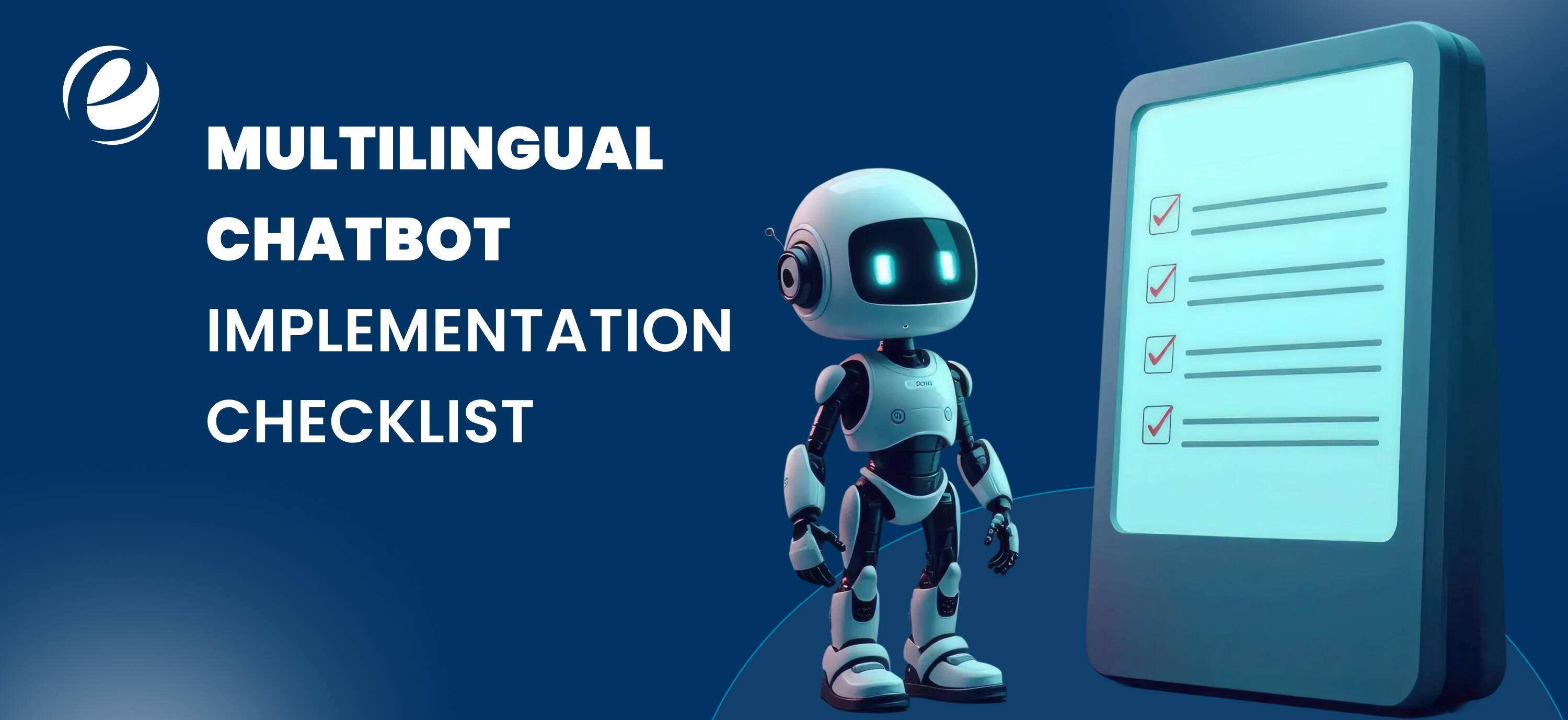
Utilize these chatbot implementation checklists to simplify the deployment process, thereby ensuring that the integration of chatbots takes place smoothly according to the best practices for support in AI chatbots. Collaborate with chatbot solutions providers for a perfect execution.
Define Objectives & Languages
By analyzing user data, the way to target markets will be uncovered, and then the selection of the most suitable 5-10 languages consistent with the chatbot goals for the future return on investment will be made.
Select Tools & Platforms
The identification of the best tools for multilingual chatbots
Build & Train Models
Designing intents and applying best practices with language datasets will enable multilingual AI chatbots to deftly handle dialects and cultural nuances.
Security & Privacy Checks
The chatbots must follow GDPR rules by using algorithms that include encryption, data anonymization, and audit logs to protect users’ information globally.
Integrate & Test Thoroughly
We will confirm the accuracy of multilingual chatbots through A/B testing in real-world scenarios before launching them across various channels.
Staff Trained for Escalations
The support staff will be trained for the transition process and the language-specific issues, thus ensuring that there is a smooth transfer from the chatbots to the human agents.
Launch, Monitor & Optimize
Continuous iterations through analytics for the consistent chatbot performance will be done by measuring KPIs like resolution rates for every language.
Conclusion
Multilingual chatbots represent a significant advancement in customer interaction worldwide, as they provide professional communication in customers’ native languages, which enhances customer satisfaction and drives business growth. The companies that make a choice to implement these ways through the best tools for chatbots
The chatbot, either through no-code platforms or through custom builds using how to make multilingual chatbot guides, really makes the company stand out in a world that is getting more and more interconnected. Chatbot Development for Businesses is where you can go to revamp your support strategy and make sure you don’t lose out on the competition.
FAQs
What is the best multilingual chatbot platform?
SiteGPT is the leading platform for chatbots with 95+ languages, a no-code setup, and automatic language detection. It is superior to its competitors in terms of coverage and price for the chatbot service.
How much does it cost to build a chatbot?
The cost to create a chatbot is between $20,000 and $60,000 for custom development or $39/month for a no-code solution like SiteGPT; plus $1,000-$3,000 per language for advanced features.
Can chatbots handle regional dialects?
Certainly, the sophisticated multilingual chatbots can manage regional dialects through the use of NLP, custom training, and feedback loops, thus adapting to the slang; however, fallback prompts assist in the handling of complex cases.
Does having a chatbot help my website's SEO?
The use of chatbots not only boosts the SEO but also contributes to the creation of more localized content, thus bringing in the international audience, enhancing their interaction, and improving the search ranking for the particular languages
How long does it take to deploy a multilingual chatbot?
No-code multilingual chatbots can be created in a few days with the help of tools like Language I/O; on the other hand, custom ones usually take around 6 to 10 weeks when following the best practices for multilingual support in AI chatbots.


 +1 (989) 535-9295
 info@emizentech.com
 emizentech


