
 Add us as a preferred source on Google
 Rapidly changing customers needs and preferences are coming together to create a world full of opportunities. Businesses are pressured to perform faster, more intelligently, and more effectively. With this in mind, traditional strategies and tools aren’t effective and advanced nowadays. Moreover, AI in business process automation is changing the way businesses operate. The business automation market is expected to increase up to $19.6 billion by 2026; it’s evident that AI powered automation is more than a trend; it’s the way of the future.
Artificial intelligence (AI) is fast-changing the way how businesses operate. AI-powered innovations such as chatbots provide continuous customer service, machine learning creates targeted marketing campaigns. On the other hand, sophisticated data analytics support better decision-making, and business process automation (BPA) capability to streamline data entry or document processing.
The time has come for businesses to use the two powerhouses, AI and BPA to meet their objectives of growth, increase productivity, and navigate an ever-changing market. Whether you’re a startup or a large enterprise, you’ll definitely get benefit from the AI business automation and improved decision-making capabilities.
This article will explain the basics of AI business process automation, including its benefits and how it’s used.
So, let’s get started.
Understanding AI in Business Process Automation
AI-powered business process automation (BPA) is changing how companies streamline their operations. Unlike the traditional system which is based on fixed rules and sequence generation, the AI BPA is based on real-time data learning. It brings a higher level of intelligence, flexibility, and also makes automation much more capable to meet changing business requirements. Unlike the old ways that are not only stagnant but also are always one-time solutions, its ability to grow and better itself makes it unique.
AI BPA helps automate customer support by using NLP. Unlike scripted traditional systems, AI understands and addresses queries naturally, creating more seamless and effective interactions. It is able to make better-tailored solutions to meet customers’ expectations by analyzing previous interactions with machine learning (ML) algorithms.
Benefits Of AI In Business Process Automation
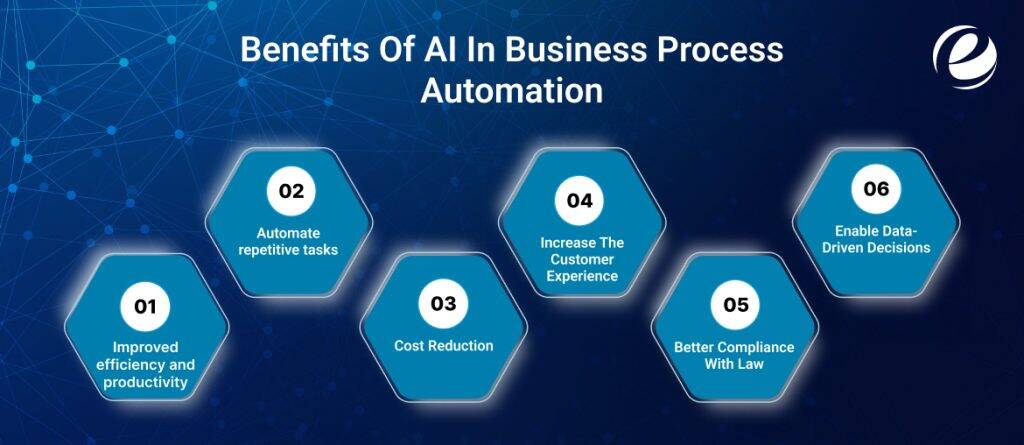
Below are a few of the most significant benefits of implementing custom artificial intelligence solutions for business process automation.
1. Improved efficiency and productivity
AI simply processes and analyzes data in order to do repetitive work more efficiently and at a higher speed than it can typically be done by human. In other words, functions can be executed at a quicker pace, and employees have time to focus on the task essential for business growth and success. Mistakes are common in data entry and calculations when done manually. AI automation eliminates much of this risk by reorganizing and handling the work with better precision.
2. Automate repetitive tasks
AI can handle routine tasks like answering customer questions, booking appointments, or managing invoices. This frees up your team to work on important projects that encourage creativity and innovation. This helps employees learn new skills that may provide new ideas and long-term competitive advantages for the business.
3. Cost Reduction
One of the greatest advantages of AI in business process automation is its potential for substantial cost savings. The system reduces the labor costs associated with manual processes and lowers the chance of errors. Automating invoice processing does not just speed up the workflow; it also lowers the chance of mistakes that can result in money loss.
4. Increase The Customer Experience
AI-powered chatbots and virtual assistants can handle high volume of customer requests, and provide tailored responses according to customer needs, more specifically for simple queries that support staff encounter regularly. This improves customer service and allows human service staff members to focus on more complicated customer support issues requiring expertise and training.
5. Better Compliance With Law
AI systems can continuously monitor business processes and transactions to ensure compliance with guidelines and internal policies. Automating the monitoring process means that any problems arising in compliance, such as misdeeds (e.g., unauthorized activities) or data breaches and violations, can be alerted in real time by AI. Moreover, AI can monitor employee financial transactions, data and operational workflows to ensure compliance without manual review, which is especially advantageous for businesses in heavily regulated industries.
6. Enable Data-Driven Decisions
AI is a very powerful tool that helps in data-driven decision-making. It uses complicated algorithms, machine learning, and data analysis to extract useful data in structured and unstructured formats from big data. With the application of AI, you can automate the processes which you can adopt to extract raw data from multiple sources including but not limited to, marketing reports, sales reports, operational data into one central repository.
Key Components Of AI Business Process Automation
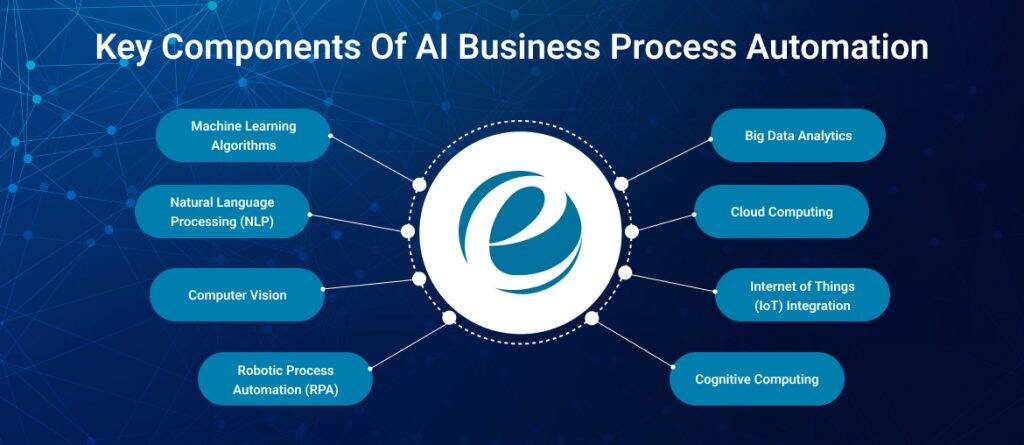
Using AI to improve business operations is more than just adding new software. It’s a big change in how a business works, involving important tools that help automate many tasks. This includes:
1. Machine Learning Algorithms
Machine learning (ML) is the backbone of business process automation. It can analyze data, make decisions, and tackle complex tasks without following a set routine. ML’s ability to adapt and learn on the go makes it a powerful tool for automating processes and solving problems efficiently such as fraud detection, personalized maintenance, and advertising.
2. Natural Language Processing (NLP)
Machines can understand the meaning, interpret and respond to the human voice. It is used extensively to automate customer service programs such as chatbots. NLP is utilized with robotic process automation (RPA) to streamline workflows requiring human interactions, including handling emails or responding to written inquiries.
3. Computer Vision
Computer vision can analyze images and recognize objects using machine learning. Therefore, it can be used to monitor surroundings and process data in real-time when combined with IoT devices. It also transmits visual data to big data platforms for subsequent analysis.
4. Robotic Process Automation (RPA)
Automating routine tasks using rules helps decrease time spent on boring and repetitive tasks, such as filing paperwork. It is used in conjunction with additional AI components, such as computer vision and NLP, to streamline more complicated processes.
5. Big Data Analytics
Big data analytics aids with analyzing massive datasets in order to extract useful information. This data is used for train AI. Big data analytics maintains precision and high quality, provides better analytics, predicts trends and supports better decision-making.
6. Cloud Computing
It allows you to deploy and control automated tools without investing in equipment on the premises. The cloud is a crucial part of AI automation because it can process vast amounts of data needed for training and deploying AI models that automate processes.
7. Internet of Things (IoT) Integration
IoT connects physical devices with the digital universe, which allows automation of control and equipment and processes monitoring. IoT devices generate data that is used by data analytics and ML algorithms to enhance their predictive abilities.
8. Cognitive Computing
Similar to human brain processes, cognitive computing helps you to solve problems, make decisions, and reasoning too. It assists in offering diagnoses in healthcare and is used for risk assessment in finance. Moreover, it leverages NLP to provide highly advanced reading interpretation and RPA capabilities to automate complex multi-step processes and workflows.
Optimizing Operations with Business Process Automation & AI Integration
AI and business process automation are changing how organizations run, bringing in a new era of efficiency. While BPA handles repetitive tasks, AI allows systems to learn, improve, and make decisions on their own. Together, they create Intelligent Process Automation, giving businesses more flexibility and speed.
1. Overlap Between BPA and AI
AI and BPA team up to make processes smarter and more flexible. BPA handles tasks, while AI helps systems learn and get better with time. By automating tasks that once required human input, AI makes software applications, like invoice processing, more efficient with features like trend detection and error recognition.
BPA platforms are mainly focused on rule-based logic, and AI brings in high-end features like computer vision, machine learning, and NLP. This cognitive component is what allows BPA to perform tasks with unstructured data. For example, a BPA can extract critical information from scanned documents of emails, pdf or any other emails.
AI development services integrated with BPA can turn the traditional automation process into a more intelligent, dynamic automation system that not only performs the assigned work accurately but also enhances performance over time. Thus, offering a great degree of agility and adaptability to the organization.
2. AI Enhances BPA
Processing and understanding the information out of vast amounts of non-structured data is enabled through AI. The most critical methods are NLP and machine learning. This allows businesses to streamline labor-intensive processes such as customers’ query resolution, sentiment analysis, and classification of content. Automation will increase efficiency and reach.
With process optimization, AI is able to identify inefficient use, bottlenecks, and inefficiencies by studying patterns and learning from past activities. AI-based systems generate information and provide real-time adjustment recommendations to increase the speed and effectiveness of the operation. This ensures that operations continue to improve in response to changing operational and data input.
Through the use of AI, BPA becomes more adept, efficient, and error-tolerant. This allows it to handle massive amounts of unstructured data, improve workflows quickly, and make precise decisions using facts.
Use Cases Of AI Business Process Automation Implementation
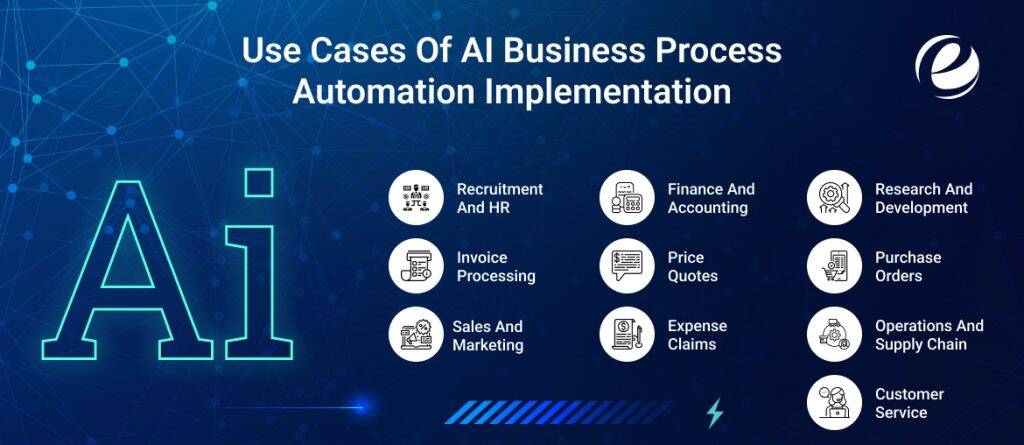
AI in business process automation helps different industries work more efficiently and get real results. Below are some use cases that show the effectiveness of AI in business process automation.
1. Research And Development
Artificial intelligence plays an important role in automating the R&D process in various industries. It will help in ideation and innovation by predicting trends, customer behaviour and competitiveness. Artificial intelligence will streamline project management processes like scheduling, resource allocation, and progress monitoring, so that teams are in sync. Also, AI automates the extraction of market data such as customer review and competitor information and this data is critical for R&D strategy with regards to market need.
2. Recruitment And HR
Automating business processes with AI will transform HR processes and streamline activities, including recruitment, onboarding, compliance checks, timesheet management, exit interviews, and performance management. It reduces time and allows HR personnel to concentrate on more important aspects such as employee training, culture improvement, and wellness programs.
AI is really helpful in HR. It can automate resume screening, make onboarding easier, predict when employees might leave, and help keep them around longer. With AI, HR can work better, faster, and create a better experience for employees.
3. Invoice Processing
AI in BPA automates invoice processing, which reduces the chance of errors and increases efficiency. BPA systems can gather relevant information from invoices and automate approval workflows. The system can extract relevant data from invoices, automatically route them for approval, and integrate seamlessly with ERP systems. It also performs three-way matching to verify that the purchase order, invoice, and receipt align, ensuring accuracy and avoiding discrepancies.
Automating invoice processing lets the accounting team focus on more important tasks while making finances run smoother. It speeds up approvals, cuts delays, and makes sure payments are on time and accurate. It also makes tracking invoices easier, reducing mistakes and missed payments, and helps keep finances in check.
4. Sales And Marketing
The software for business process automation offers significant advantages in marketing and sales by simplifying the process and maximizing the allocation of resources. For sales, automation allows fast and accurate price quotations and efficient approval processes, leading to quicker deal closings and improved customer satisfaction.
AI automates email promotions, lead scoring, and follow-ups in marketing. AI in BPA also simplifies requests for time-off, allowing employees to quickly enter a request and track its status. Ultimately, AI increases efficiency, enhances customer experience, and increases business performance as well.
5. Purchase Orders
AI powered business process automation software can significantly improve the procurement process by digitizing purchase orders as well as connecting them with databases. It eliminates the need for the manual entry of data, decreasing tedious tasks while increasing the speed and accuracy of the process.
The main benefits are automated information entry, live information on inventory levels, improved communication with suppliers, expense tracking and budget management. AI helps in building better relationships with suppliers eventually leading to savings as well as improved efficiency of the supply chain.
6. Finance And Accounting
AI technology has made business financial tasks more accurate and efficient. Tools like AI-powered expense management systems make it easier to submit, organize, and reimburse expenses, reducing mistakes and making sure the rules are followed.
AI in finance also helps process invoices faster. It gathers the right data, automates approval steps, and cuts down on manual work. AI can find mistakes in expense reports and unusual spending patterns, making sure financial records are correct. AI also helps businesses make better financial decisions. By looking at past data, market trends, and other factors, it provides accurate forecasts and insights that help businesses plan better.
7. Price Quotes
Automating business processes with the help of AI improves the price quoting process, which allows the rapid creation and automated sending of price quotations for management review. This enhances the speed of process, customer experience and offers real-time pricing for e-commerce stores.
It also allows customized estimates for services and tiered pricing on bulk orders. AI in BPA also simplifies the discount approval process to ensure it aligns with the firm’s pricing plan. In general, AI powered BPA software streamlines the quote process, increases customers’ satisfaction, and improves their chances of buying.
8. Expense Claims
AI in business process automation simplifies expense reporting and ensures compliance with organization policy. This also helps in getting the expenses filed and approved quickly. It ensures adherence to guidelines and enables real-time tracking and visibility.
Data analytics also helps prevent fraud. AI also streamlines the financial planning process and decreases manually generated workload. The features improve precision, speed and promote transparency in expense tracking.
9. Customer Service
AI is changing customer service by making interactions quicker and more personalized. Chatbots can answer common questions right away, while virtual assistants provide customized help. Automated systems quickly handle tickets, and sentiment analysis helps businesses understand how customers actually feel based on their feedback.
This technology doesn’t just improve customer interactions; it also makes customers happier by solving their problems quickly. It allows human agents to spend more time on tricky issues that need a personal touch, while AI takes care of all the routine tasks.
10. Operations And Supply Chain
AI is a key component of supply chain management. It plays a vital role in so many industries by increasing the ability to forecast demand, optimize inventory, and manage fleets. AI in business process automation improves retail sales by improving demand forecasting. It utilizes past data and other external influences to predict demand for goods precisely.
This allows retailers to enhance the amount of inventory they have and improve the customer experience. AI helps improve inventory management by analyzing manufacturing data and supplier lead times. This helps prevent overstocking and stockouts.
In transportation, AI-powered predictive maintenance looks at sensor data and past records to find problems with components. This helps fleets run more smoothly and cuts down on unexpected repair costs. AI’s impact on these industries leads to better decisions, cost savings, and improved operations overall.
How To Implement AI In Business Processes?
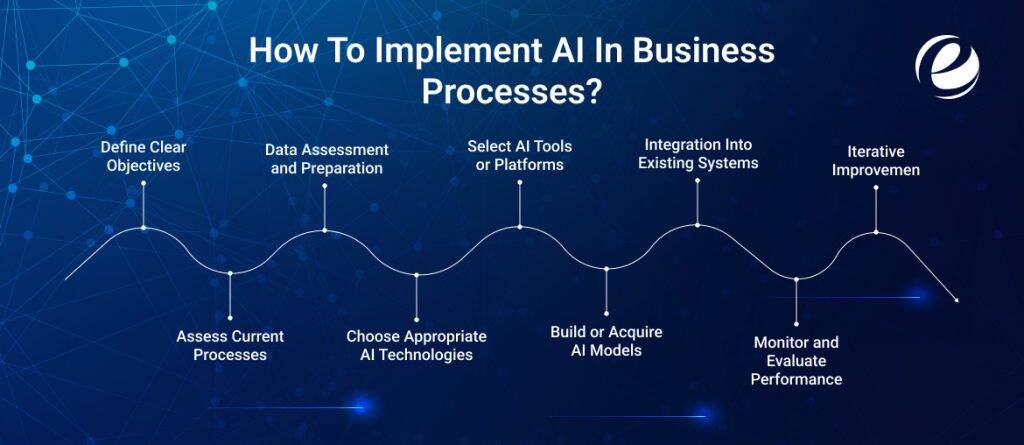
Using AI in business process automation requires a solid plan to get the most out of it and make sure it works well. Here’s a step-by-step guide to ensure successful AI integration:
1. Define Clear Objectives
It is important to clearly define the goals the company hopes to achieve through AI in order to improve efficiency, decrease expenses, improve customer service, or even gain an advantage in the market. Setting clear goals is important to make sure AI in business process automation matches the company’s overall strategy.
2. Assess Current Processes
Examine existing business processes to determine areas in which AI will contribute the most. Consider the repetitive processes, tasks that demand data, and places that have the potential to be optimized. Learning about the benefits of AI in business process automation will enable you to focus on the areas with the most significant impact.
3. Data Assessment and Preparation
AI is heavily dependent on data availability. Evaluate the quality and quantity of your data. Ensure your data is clean, well-organized, and reflects the process you wish to automate or improve. Establish data governance procedures to ensure data integrity.
4. Choose Appropriate AI Technologies
Choose the best AI techniques for your business process automation. This could be machine learning, NLP, computer vision, or a combination of them. The technology you pick should match your company’s goals and the purpose of your process.
5. Select AI Tools or Platforms
Based on your resources and needs, select AI software or platforms suitable for your company’s needs. These could include off-the shelf solutions or custom-developed ones. Cloud service providers offer AI solutions implemented into your existing infrastructure to provide the advantages of AI in business process automation.
6. Build or Acquire AI Models
If you decide to opt for some specific solutions, there is a chance that you will design AI models for your own business needs. This process involves training models with the right data to make predictions and classify information. To improve your business processes, you can also update existing models and adjust them to fit your company’s needs.
7. Integration Into Existing Systems
Make sure that AI has seamlessly integrated into your existing business systems. It could involve working with your IT department to link AI solutions to databases, apps, and other infrastructure components to enhance the efficiency of your business process.
8. Monitor and Evaluate Performance
Set up monitoring systems to monitor the effectiveness and performance of AI applications. Regularly evaluate the fulfilment of business needs and perform the respective updates over AI. This may be refining the model, refreshing the data, or changing algorithms based on the customer feedbacks and process automation examples.
9. Iterative Improvement
AI implementation is an ongoing procedure. Use user feedback and performance metrics to improve your AI applications. Keep track of the new AI development that can improve not only your process but also bring continual business automation scenarios that can help in the relentless improvement of the process.
Challenges Of Implementing AI In Business Process Automation
Despite so many benefits of AI in business process automation, businesses could face difficulties in implementing AI in business process automation. Below are some of the common hurdles:
1. High Cost Of Implementation
Implementing AI-powered technology comes with expensive upfront costs. From developing AI software to training employees, these costs could seem prohibitive for small-scale enterprises. However, as AI technology develops, the costs could come down. And will give ROI.
2. Data Security and privacy
AI systems depend heavily on data for their operation. However, it’s crucial to secure sensitive personal and company data. Businesses must put security first and comply with rules to avoid legal penalties.
3. Refusal Towards Changes
However, a few employees resist AI automation as they are afraid of losing their jobs or as they do not know about the technological advances. The answer to this problem is to build learning organizations, fostering a mindset in which AI is considered a tool to enhance human output, rather than replacing it.
4. Integration Of Existing Systems
One of the challenges of using AI technology is that it is often not embedded into pre-existing tech platforms and IT infrastructures. The new AI software needs to connect with the existing systems as AI automation integration is core to success.
Future Of AI In Business Process Automation
As AI revolutionizes the automation of business processes, the key trends are shaping its future. Innovations are being made in AI technology, such as machine learning, deep learning, and computer vision, which can improve communication, analysis, and the ability to make decisions.
Integrating AI with technology like the Internet of Things (IoT) can create smart devices and allow predictive maintenance. AI and Robotic Process Automation (RPA) can create sophisticated robots. AI-driven predictive analytics that AI drives will improve strategy-based decision-making and resource planning.
Autonomous decision-making systems use data to perform tasks and make choices on their own. As AI becomes more accessible, even small businesses can use advanced tools. Hyper automation doesn’t just automate single tasks. It can make whole systems run on their own, which makes things a lot more efficient. This trend will help industries work faster and make decisions easier. As more companies use this technology, AI could change how businesses automate their processes, bringing us closer to a smarter, fully automated future.
Conclusion
AI automating business processes is an exciting development for businesses. Technology is changing how businesses run by enhancing efficiency and lowering expenses. Automating repetitive tasks and enhancing workflows enables organizations to concentrate on growth and development. AI-powered tools can unlock the potential of new performance levels and customer satisfaction.
Intelligent process automation improves productivity; cuts costs; enhances decision-making; and guarantees compliance. Use case scenarios portray the benefits of AI automation within all domains. However, But, AI development company must tackle problems like integration into systems, data security, and employee adaptation.
Consequently, this allows enterprises to maximize the rewards of AI in business process automation. AI is ever-changing, and its potential is endless. Businesses implementing AI BPA will lead in the business growth, achieving operational excellence and long-term growth.
FAQs
What is AI business process automation?
AI business process automation is an application of AI technology to improve the efficiency of business processes. You can say a mixture of classical automation and AI methods. Using AI BPA, systems can perform more complex tasks than traditional BPAs and make data-driven decisions.
What are the benefits of AI in business process automation?
AI analyzes real-time information to increase efficiency, reduce operating costs, and improve decision-making. Additionally, it allows for the personalization of the customer experience. It can help businesses stay ahead always by adjusting quickly to changing market trends.
What is the difference between AI & conventional automation?
Traditional automation uses rules-based programming; AI can learn and adapt to new data and situations on its own and can make decisions independently. AI BPA can handle unstructured data, make predictions and optimize process without any human intervention.
How will AI in businesses affect the employee roles?
The roles of employees may leave behind routine tasks and move towards creative, strategic and higher value tasks, which may replace existing job roles that will be automated by AI. This may indeed lead to emergence of new work in the fields of supervising and optimizing AI.



 +1 (989) 535-9295
 info@emizentech.com
 emizentech


