 Add us as a preferred source on Google
 In 2026, AI chatbots and GPT technology have changed from experimental tools to calculated business elements with global corporations, which helps generative AI to simplify operations and uplift customer participation. With the increase in influence of AI chatbots and GPT technology, around 78% of organizations now use AI for at least one business function, and chatbot adoption continues to climb across sectors, which include e-commerce, finance, and healthcare. Business uses GPT powered tools to report up to a 40% boost in operational efficiency and faster go-to-market timelines. As these tools continue to advance, firms that understand and apply them properly are better placed to scale.
Businesses that don’t adopt AI run the risk of falling behind as the competition gets fiercer and clients’ expectations increase. This blog will walk you through how GPT technology and AI chatbots are transforming industries in 2026, and the difference between them. Additionally, it examines some future trends associated with these technologies.
How AI Chatbots and GPT Technology Are Transforming Businesses
AI chatbots and GPT technology play a vital role in transforming business models from manual performance to automated intelligence. This change is visible in three aspects: scalable efficiency, personalisation and data accessibility.
Scalable Efficiency
Businesses are moving beyond simple FAQ bots to AI agents, as these systems autonomously manage end-to-end workflows such as the refund process, scheduling logistics, or drafting legal contracts, which allows firms to scale operations without a symmetrical increase in headcount.
Hyper-Personalization
Companies can now use GPT capabilities to treat all of their customers as unique. AI provides personalized product suggestions and tailored email responses to each client, as well as analyzes massive volumes of data in real time. One-to-one marketing now offers significantly higher conversion rates and brand loyalty.
Democratized Insights
Perhaps the most intense change is in business intelligence. Rather than waiting for a data analyst to generate reports, managers can chat with their corporate data with natural language. This gives instant access to trends and forecasting, which turns raw data into a competitive benefit.
Top AI Chatbots and GPT Technology
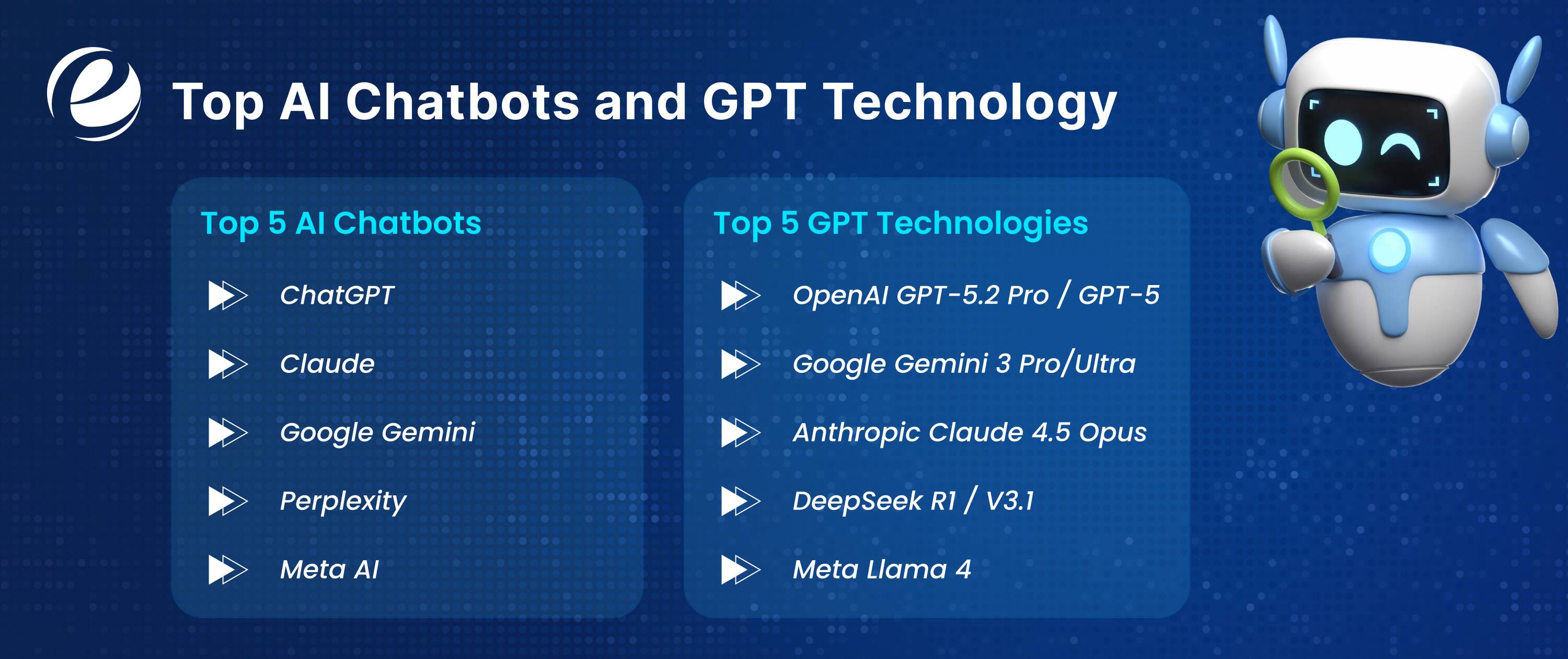
These technologies used to feel like science inventions, but in 2026, they’re a vital part of everyday business. Below we will discuss top AI chatbots and GPT technology:
Top 5 AI Chatbots
ChatGPT
ChatGPT is an extremely adaptable AI chatbot that has many potential applications, including generating creative content and facilitating collaboration between clients and professionals. It has influenced numerous other chatbot systems, as well as contributed to the Copilot functionalities of numerous programs.
Claude
Claude aims to use AI ethically with a security-focused approach. It is perfect for sensitive or tough conversations that need careful management, such as analysis or a calm customer service environment.
Google Gemini
Google Gemini stands for an AI chatbot that aims to enhance search capabilities and facilitate real-time content creation. Further, its close relationship with Google’s data infrastructure enables it to pull up-to-date data immediately.
Perplexity
Perplexity provides a chatbot that shines in delivering real-time, data-driven responses as it accesses the current web content, which is ideal for users who require the latest information alongside advanced conversational abilities.
Meta AI
Meta AI is an AI chatbot, which is developed by Meta. It’s integrated into Facebook, Instagram, and WhatsApp. As an instance of innovation from a leading AI app development company, Meta AI improves digital experiences for both users and businesses across various social platforms.
Top 5 GPT Technologies
OpenAI GPT-5.2 Pro / GPT-5
GPT-5.2 Pro refers to GPT technology that was released in late 2025 and early 2026. It is known for advanced reasoning, coding, and multitasking capabilities. Its step-by-step problem-solving makes it excellent for complex workflows, firm automation, and creative apps, which makes it a top choice for experts.
Google Gemini 3 Pro/Ultra
Google’s Gemini 3 Pro includes the “Deep Think” function and a huge 2-million-token context window. It is excellent for understanding text, images, audio, and video together. Hence, it is highly versatile for multimedia tasks and enterprise-level AI solutions.
Anthropic Claude 4.5 Opus
The Claude 4.5 Opus is demanded in enterprise environments for safety, precision, and redefined reasoning. It manages long, complex workflows efficiently and makes it perfect for professional tasks that require thoughtful and context-aware AI assistance.
DeepSeek R1 / V3.1
DeepSeek’s R1 and V3.1 models are effective in 2026. It offers modern reasoning and problem-solving. Users can effortlessly switch between logical thinking and modes. Thus, it is perfect for startups and developers on a budget.
Meta Llama 4
Llama 4, a leader in open-source AI, utilizes Scout and Maverick versions for on-premise, customizable, and secure enterprise deployments. It uses a mixture-of-experts architecture for high performance while being adaptable.
Difference b/w AI Chatbots and GPT Technology
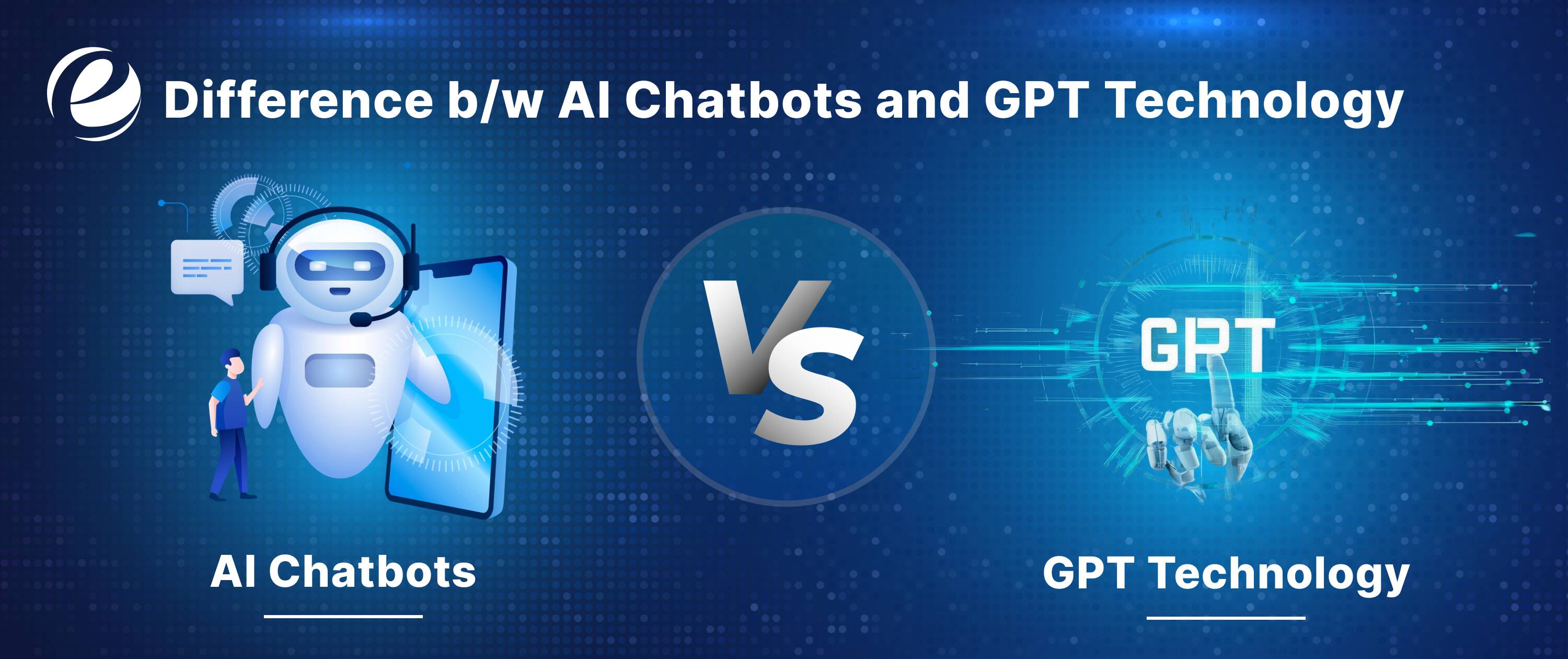
Chatbots adhere to pre-programmed rules, while GPT employs contemporary language models to enhance the versatility of conversations. In this section, we will look at how AI chatbots and GPT technology are different.
| Features | AI Chatbot | GPT Technology |
| Definition | An AI chatbot is a software app that communicates with users via text or voice. | A type of deep learning neural network model that is designed to comprehend and create text. |
| Role | The customer-facing communicative agent. | This agent act as the “brain” or engine that drives the conversation forward. |
| Scope | It is designed for certain tasks, for instance, support and booking. | It is adaptable and used for diverse tasks, which include writing and coding. |
| Training | Training can be either rule-based (without AI) or AI-powered (using LLMs). | Transformer architecture enables training on vast and diverse datasets. |
| Flexibility | It depends; some are rigid, whereas advanced ones are dynamic. | They are highly adaptable, generating fresh, context-sensitive solutions instantly. |
| Context | May find it difficult to handle long-term context | Do not struggle to manage context over long conversations |
| Integration | It seamlessly incorporates into websites, apps, and CRMs. | It is accessed via an API, which needs a wrapper application. |
| Pros | Quick, rule-based replies. | Context-aware conversations |
| Cons | Cannot handle complex queries | High computational cost |
| Examples | Zendesk Bot, Drift, and Intercom | GPT-5.2 Pro |
Future Trends of AI Chatbots and GPT Technology
AI chatbots and GPT technology are changing. They are not only the tools that respond to queries but also a smart digital assistant that can understand users. Now, it’s time to discuss some of the diverse future trends for AI chatbots & GPT technology:
Multimodal Capabilities
Future models will describe and create text, audio, images, and video without difficulty, which allows for natural user interaction.
Autonomous AI Agents
Instead of just responding to the questions, AI agents will do complex, multi-step workflows end-to-end, such as management of full sales cycles or complex administrative tasks.
Digital Twins and Proactive Assistance
AI will behave as a digital twin which makes decisions or suggestions based on the user’s unusual and upgraded digital footprint.
Human-like Voice and Conversational AI
With growing expectations for Artificial Intelligence (AI) to not only be conversational but also have a human-like voice, this will contribute to greater use of both voice-controlled technology and real-time AI agents by 2026.
Emotional Intelligence (EQ)
Chatbots will be capable of detecting users’ emotional states by means of written language, voice tone and pitch, and physical facial expressions; as a result, AI will modify the way they interact with users to be more empathetic
Niche and Specialized AI
With the introduction of advanced models that serve niche markets (i.e., law, medicine, and education), AI will be able to better serve unique individual needs by evolving from being general-purpose chatbots to filling an individual user’s unique needs.
Conclusion
As 2026 continues to evolve, the introduction of AI chatbot development is completely revolutionizing how businesses operate. Originally, these were solely used as a basic form of automation, but today, AI chatbots have developed into extremely sophisticated types of technology that aid businesses with better decision-making, improved customer service, and up-to-the-minute data and information that support enhanced decision-making. As businesses continue to implement AI into their day-to-day operations, they can now gain a competitive advantage over other businesses in their field due to the dynamic nature of markets.
FAQs
What Does an AI Chatbot Stand For?
An AI chatbot is considered a software application that is designed to conduct simulated conversations with human users through text or through voice using AI technology (machine learning) & natural language processing to interpret intent.
What Is the Best AI Chatbot in 2026?
While the choice of chatbot provider depends on specific business needs, the best in 2026 will be ChatGPT due to its flexibility, ability to integrate other applications (such as Zapier), and capability to create automated complex operations.
What Technology Powers Most AI Chatbots?
Natural Language Processing (NLP) is the primary technology powering modern AI chatbots. NLP is a core technology that allows computers to comprehend humans’ interactions with each other and computers using human language.
Why Should Businesses Use AI Chatbots?
By implementing AI chatbots in their business processes, businesses can increase excitement about their products or services, be more timely in addressing customer questions, support customers better and identify opportunities for improvement.



 +1 (989) 535-9295
 info@emizentech.com
 emizentech


