
 Add us as a preferred source on Google
 Buy-Now-Pay-Later apps like Afterpay have become quite popular in recent years, especially among Generation Z. The BNPL solutions have emerged to eliminate the complexity of the financing process and reduce the high fees associated with credit cards.
Research indicates that three in five people have used BNPL services, as they are constantly looking for convenient ways to manage their financial goals.
It goes without saying that Afterpay has revolutionized the BNPL app space and let users pay for their goods in four installments. Since all the major ecommerce platforms partner with this service, users prefer Afterpay-like apps over credit cards.
According to a recent report, the buy now, pay later market is projected to grow by $1014.82 billion in 2028, with a CAGR of 44.6%. The rapid growth has highlighted the popularity of BNPL services as accessible alternatives for individuals who may not qualify for traditional credit.
As a result, this segment has gained a lot of attention from startups and businesses alike who want to develop an app like Afterpay. If you aim the same, then you are in the right place.
In this blog, we will discuss everything that is essential for creating a successful app like Afterpay. So, without any delay, let’s dive in!
What is Afterpay, and how does it work?
Afterpay is a fintech company that offers a Buy-now, pay-later service. This service allows consumers to make purchases and pay for them in installments for over six weeks. It is particularly popular among online shoppers.
It was launched in 2015 and provides its services in countries like New Zealand, Australia, and the United States. Afterpay doesn’t charge shoppers any interest but charges late fees when payments are not made on time.
Afterpay is easy to use. First, users must create an Afterpay account and undergo a quick approval process, which typically involves a soft credit check.
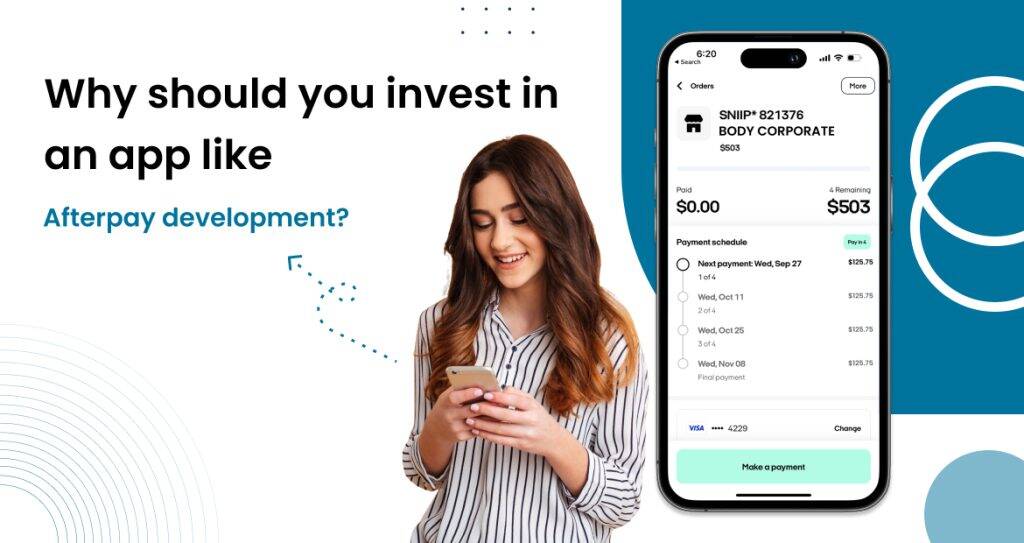
Customers can shop at participating retailers and select Afterpay as their payment method at checkout. The platform will split the total purchase cost into four equal payments, which are due every two weeks.
So, the first payment is made at the time of purchase, while the other three payments are automatically deducted from the customer’s linked debit or credit card every two weeks.
When it comes to late fees, it’s better to make payments on time. There are no interest charges, but late payments may incur fees.
Now, you might be wondering how this BNPL solution generates revenue. To learn more about that, let’s move to the next section.
How do BNPL apps like Afterpay make money?
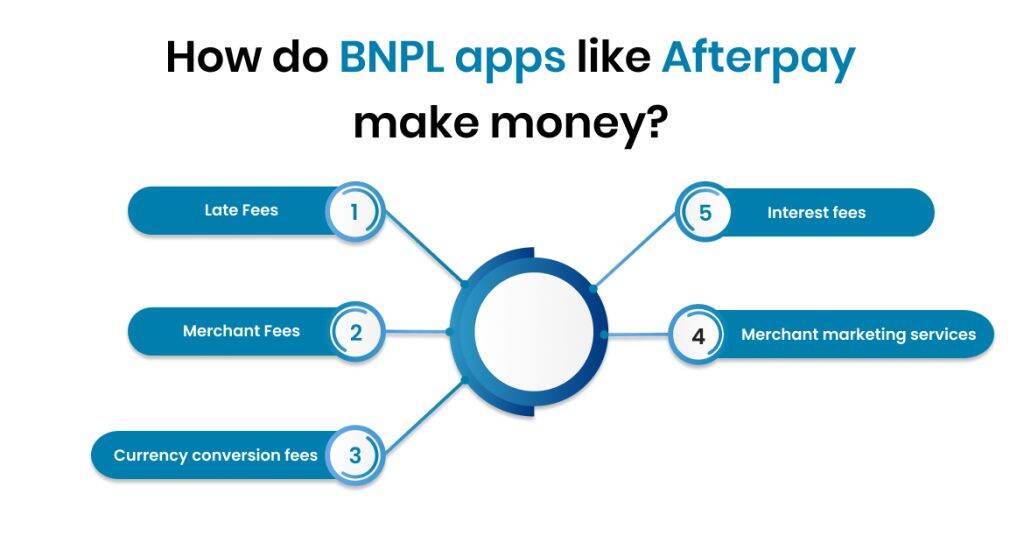
Like many other BNPL solutions, the Afterpay monetization strategies are quite simple.
1. Late Fees
Afterpay revenue source is late fees, which are charged when users don’t make timely payments. If a payment fails, users are notified of every technical glitch.
However, if the user fails to make a payment on time, a fee of $10 will be charged. If the payment is made within the next week, another $7 will be charged.
2. Merchant Fees
Merchants are charged a fee based on the merchant app agreement, ranging from 3% to 6% of the transaction value, for every successful transaction using the app’s platform.
3. Currency conversion fees
For international transactions, users may be charged with currency conversion or foreign transaction fees by the app.
4. Merchant marketing services
Businesses can take advantage of sponsored placements, customized advertising, and promotional campaigns through BNPL apps and websites.
5. Interest fees
The app does not charge interest on its installment plans, but if consumers choose long-term payment plans, it collaborates with lenders to provide financing solutions.
Now that you know how BNPL apps like Afterpay make money, it’s time to create an app similar to Afterpay. To start the process, you need to explore the top 10 alternatives of Afterpay and get inspired by them.
Why should you invest in an app like Afterpay development?
The buy now, pay later market is projected to grow significantly, with Afterpay leading the market. Let’s explore the market stats:
- The market is dominated by several BNPL companies, in which Afterpay is leading the market.
- With over 5,000 New Zealand merchants featuring Afterpay on their websites by February 2024.
- The BNPL market size was $232.23 billion in 2024 and is expected to grow to $1.01 trillion by 2028, with a CAGR of 48.3%.
- Another report from Statista, the global buy now, pay later market, stats projects to experience substantial growth, with transactions expected to increase by nearly $450 billion between 2021 and 2026.
- In Sweden and Germany, the BNPL market share in domestic e-commerce payments is ten times higher than its share in global ecommerce payments.
Afterpay has positioned itself as a leader in the BNPL space, appealing primarily to millennials and Gen Z consumers who prefer flexible payment options. By going through the market stats, you can gain insight into the market and Afterpay popularity. Now, you can move ahead with a clearer perspective. Let’s explore their features.
Key features for developing an app like Afterpay
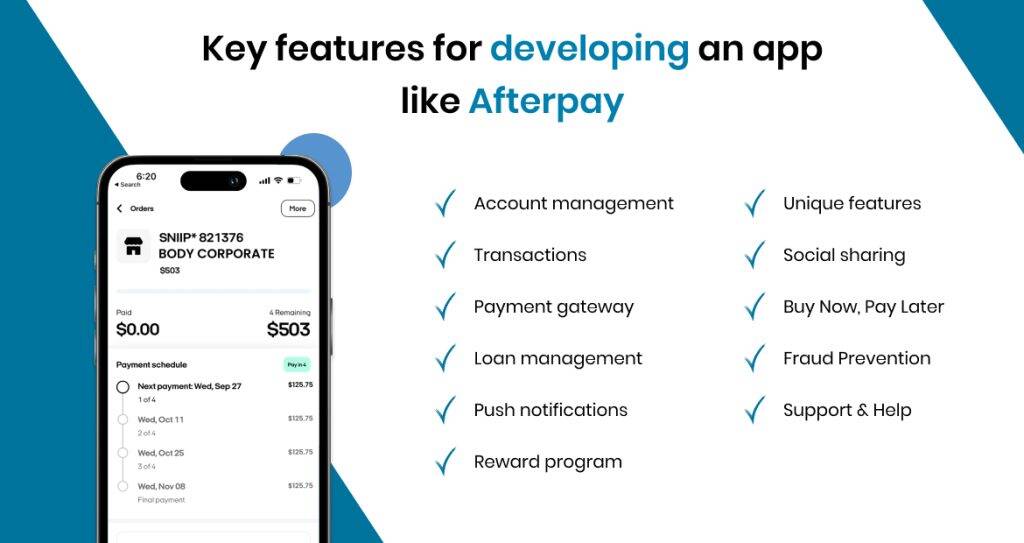
Features are the major components that make a mobile app useful. So, when you build an app like Afterpay, you need to include features that not only enhance user experience but also provide users with the best BNPL service compared to competitors.
We researched and created a list of essential features that you must include in your Afterpay alternative to stand out in the crowded market.
| Features | Admin Panel | User Panel |
| Account management | -User registration and login options -Assign user roles and permissions -User details and activity viewer -User roles and permission management | -User accounts Edit profile (name, email, contact information) -Banking links option -Change the password option -Payment methods |
| Transactions | -View detailed transactions -Search filter option ( By date, user, amount) -Manage refunds and dispute -Export transactions data | -View detailed transaction history -Download statement -Automate payments -Schedule upcoming payments |
| Payment gateway | – Configure payment gateways – Monitor transaction logs | – Multiple payment method support – Secure transactions |
| Loan management | – Define user-specific spending limits -Loan generate reports -Monitor loan performance – Adjust loan limits dynamically | – Personalized spending loan limits – Notifications when adjusting loan limits -Request early repayment -Manage automatic repayments |
| Push notifications | – Schedule notifications – Customize notification templates | – Alerts for payment due dates – Offers and updates |
| Reward program | – Create reward tiers – Monitor reward redemption rates | – Earn rewards for on-time payments – Redeem points for offers |
| Unique features | – Monitor QR code transactions – Generate QR usage analytics | – QR-based in-store purchases – Real-time purchase sync |
| Social sharing | – Enable/disable social sharing – Track referral program performance | – Share wishlist and purchases – Invite friends for bonuses |
| Buy Now, Pay Later | – Configure merchant partnerships – Manage buy-now-pay-later terms | – Flexible options for online and offline purchases |
| Fraud Prevention | – Advanced fraud detection – Generate fraud reports -User data encryption -Manage user controls and permissions | – Real-time identity verification – Secure transaction measures -Access to privacy policy and terms of service |
| Support & Help | – Access in-app chat support – Submit support tickets | – Manage support tickets – Update FAQs and help center content |
Advanced features of BNPL apps like Afterpay
Buy-Now-Pay-Later apps like Afterpay have evolved beyond simple payment solutions to offer a variety of advanced features that enhance user experience and financial management.
To create a successful Afterpay-like app, you need to integrate 10 advanced features that will keep your users engaged and promote responsible financial behavior.
1. AI-Driven Risk Assessment
These apps use machine learning to evaluate a user’s creditworthiness and spending habits quickly. By analyzing transaction history and behavior patterns, they can provide instant approvals or tailored payment plans, reducing the risk of defaults for both users and providers.
2. Gamify Responsible Spending
To encourage users to spend responsibly, some BNPL apps incorporate gamification elements such as points, badges, and rewards. Users can earn these rewards for staying within their budgets or making timely payments, making saving and responsible browsing fun.
3. AI-powered budgeting and insights
By leveraging AI, these apps can analyze users spending habits and provide personalized budgeting advice. This feature helps users identify areas where they can save money and make smart financial decisions.
4. Financial wellness tools
Several BNPL apps integrate tools such as budgeting calculators, spending trackers, and savings planners to help users manage their finances better. You can integrate these tools to help users improve their overall financial health.
5. Smart notifications
Integrate smart notifications to keep users informed and engaged. This will remind them of upcoming payments, special promotions, or new retailer partnerships.
6. Augmented Reality Try-ons
This feature will allow users to virtually try on products like clothes and accessories before making a purchase. This feature will enhance user’s online shopping experience and reduce the cart abandonment rate.
7. Green financing options
Sustainable practices are in huge demand, and so some BNPL apps offer green financing options. This feature, allows users to finance eco-friendly products or services, which promotes environmentally responsible purchasing behavior.
8. Currency and language support
You can cater to a global audience by offering localized currency options and language support. This will help users from different regions understand their transactions and feel comfortable using your app.
9. Marketplace expansion
Many BNPL providers are expanding their partnerships with various retailers, creating a broader marketplace for users. This expansion allows consumers to use BNPL services across more platforms, giving them greater flexibility in their shopping choices.
10. In-app Financial Education
This feature will empower users to include educational resources directly within the app. These resources can cover topics like budgeting, savings, and responsible spending.
A step-by-step process for developing an app like Afterpay
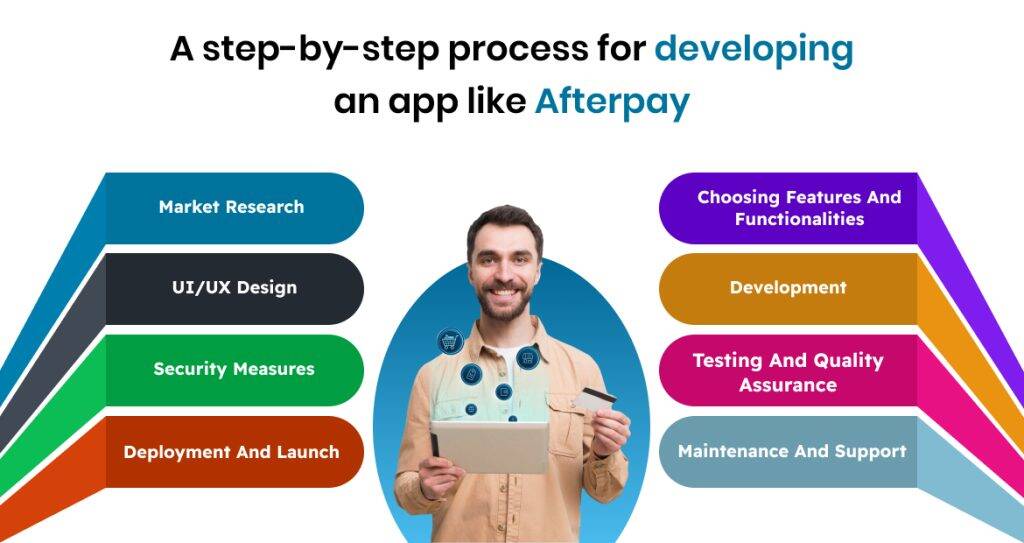
Developing an app like Afterpay is no easy feat. It takes a partnership with an experienced development partner that understands your project requirements. Here are some crucial steps to build a buy now pay later app like Afterpay.
1. Market research
Mobile app market research is the first step in the Afterpay app development process. Conduct thorough market research to understand your users’ needs and what is trending in the BNPL market.
Moreover, remember to research competitors, app characteristics, and possible challenges. Monitor consumer behavior and decide on marketing methods based on users’ purchasing habits.
2. Choosing features and functionalities
Now, choose features and functionalities based on market research, such as account administration history, payment processing, installment management, and user authentication.
You can also consider features like budgeting tools, social sharing capabilities, and reward programs that meet customers’ needs and differentiate your app from other competitors.
3. UI/UX design
UI/UX design is crucial to the success of your app. You need to design an intuitive, easy-to-navigate app. Ask your team of UI/UX designers to create wireframes and prototypes to determine the app’s usability, design, and flow.
To validate your design, test it with the intended audience to get their input and make improvements accordingly.
4. Development
Now, provide the functionality to the app frontend interface and create the backend system architecture and system integrations. Use appropriate frameworks that satisfy the app’s needs based on scalability, compatibility, and security.
Conduct routine code reviews and testing to ensure code quality. Additionally, continuous integration and deployment pipelines must be established throughout the development process to ensure stability and scalability.
5. Security measures
Implement strong security measures, such as data encryption and authentication techniques, and ensure timely security audits. To improve user security, a biometric system and two-factor authentication should be implemented.
6. Testing and Quality assurance
Now, conduct thorough testing to identify bugs, usability issues, and security vulnerabilities. The QA will perform various tests on the app’s functionality, usability, performance, and security and rectify any issues if they occur.
7. Deployment and launch
After testing, prepare your app for launch. You can launch on the Play Store and App Store. Also, KPIs’ user engagement, downloads, and retention rates can be monitored by using analytics tools to make data-driven decision-making.
8. Maintenance and support
Invest in app maintenance and support services to keep your app going. Provide continuous maintenance, upgrades, and support to keep up with the latest industry trends.
Top 10 Alternatives of Afterpay Recently Reviewed By EmizenTech
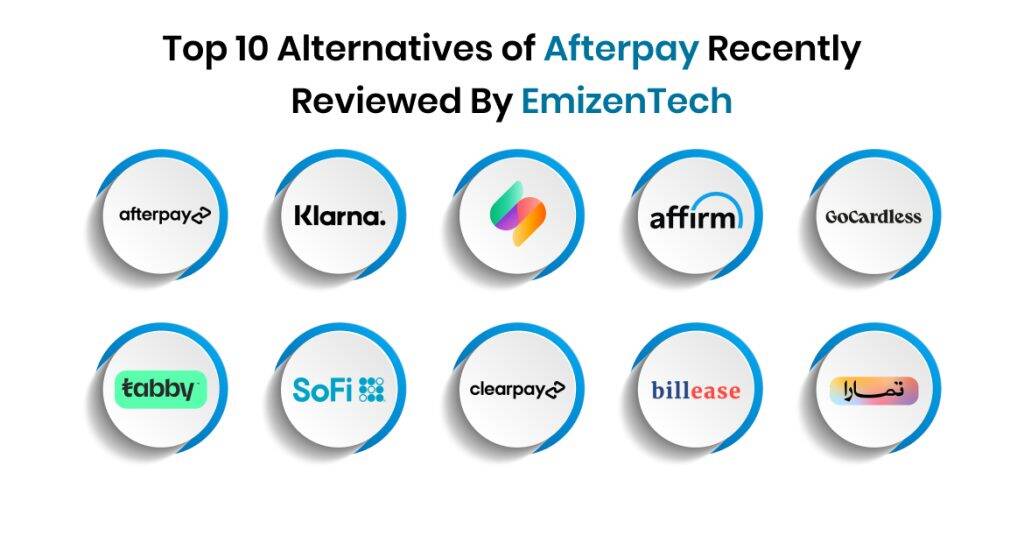
Here is a list of the top 10 Afterpay alternatives that are quite popular in the market. Let’s explore their crucial features and popularity.
| Category | Features |
| Afterpay |
Download: 10M+ |
| Klarna |
Download: 50M+ |
| Affirm |
Download: 10M+ |
| Sezzle |
Download: 1M+ |
| GoCardless |
Download: 10M+ |
| Tabby |
Download: 1M+ |
| Tamara |
Download: 1M+ |
| SoFi |
Download: 1M+ |
| BillEase |
Download: 5M+ |
| Clearpay |
Download: 1M+ |
Tech Stack to be used for building Afterpay-like apps
Creating a successful app requires the right set of tools and technologies to provide users with a seamless user experience. We have researched and created a table of tech stacks that are essential for creating apps like Afterpay and Klarna. Take a look.
| Category | Technology |
| Frontend |
|
| Backend |
|
| Database |
|
| Payment Processing |
|
| Authentication |
|
| Hosting |
|
| DevOps |
|
| Monitoring & Analytics |
|
| Security |
|
Cost to develop an app like Afterpay
The cost of developing an app like Afterpay ranges from $20,000 to $300,000 or more. The cost typically depends on various factors, such as the app’s complexity, chosen features and functionality, the team’s location, and more.
However, creating an app with minimal features will cost less than building an app with advanced features, such as advanced algorithms and chatbot integration.
Let’s explore the number of factors that influenced the cost of developing Afterpay alternatives.
Factors that affect the cost of developing an app like Afterpay
1. Chosen features
The chosen set of features that influence the cost include transaction history, account administration, and payment schedule. To enhance user experience, you need to integrate features such as real-time notifications, personalized offers, live chat support, and more. This will enhance the user experience while influencing the cost.
2. Design
Design is another crucial factor. A well-crafted user interface (UI) and user experience (UX) require skilled designers and extensive testing, which can add to expenses.
3. Chosen platform
The chosen development platform (iOS, Android, web) affects costs, as each has different requirements and complexities.
4. Integrating with external systems
Integrating with external systems such as payment gateways and customer service platforms further complicates development and can lead to higher costs.
5. Security requirements
stringent security requirements to protect user data and comply with regulations can increase the development effort and expenses.
6. Team’s location
the team’s location impacts labor costs; hiring developers in regions with higher living costs typically results in higher salaries, thus influencing the overall budget for the project.=
How can we help you create an app like Afterpay?

Today, users want flexible and reliable payment solutions like Afterpay. In the years to come, BNPL will redefine how consumers approach spending and financial management.
As a leading fintech development company, Emizentech builds flexible and reliable payment solutions like Afterpay. With over 11+ years of industry experience, we have created successful Fintech applications like SokoFund, eFunder, and more.
Hire EmizenTech, a top mobile app development company, for your BNPL or loan lending mobile app development and get user-centric BNPL apps that meet the growing demands of users and merchants alike.
So, if you are ready to dive into this venture, connect with us to learn how to create the next successful app like Afterpay.
Conclusion
The BNPL market is dynamic, and developing an app like Afterpay is a rewarding journey that requires careful planning, technical expertise, and a clear understanding of your target audience.
With this blog, you have gained the intricacies of this segment, which will help you craft a unique BNPL app like Afterpay. Just make sure to define your app’s core features and ensure seamless integration with payment systems to prioritize security and compliance. Every step matters when creating a trustworthy and user-friendly BNPL platform.
While the process can be complex, it is crucial to break it down into manageable stages and work with an experienced development partner who understands your project needs. Design your app to provide users with unique, user-friendly features and foster responsible financial practices.
At last, invest in continuous improvement to make your app successful in the long run. Listen to user feedback, stay updated with market trends, and be ready to adapt your app to meet evolving customer needs.
Partner with us and build your app with the right strategy and dedication. Be ready for your app to carve its own niche and thrive alongside giants like Afterpay.
FAQs
Is Afterpay legit?
Afterpay is a legitimate and quite popular buy now, pay later service that is used by millions of consumers partnered with numerous retailers, and is regulated and operated in several countries.
Is BNPL different from the credit card?
BNPL services like Afterpay allow users to pay for purchases in installments without interest if they are paid on time. Credit cards typically involve revolving credit, with interest charges on unpaid balances.
What are the benefits of using Afterpay?
Afterpay possesses several benefits for both consumers and app owners, such as:
Interest-free payments
Budgeting
Instant approval
Wide acceptance
How much does it cost to build an app like Afterpay?
The cost ranges from $20,000 to $300,000 or more, depending on several factors,, such as the app’s complexity, the the developer’s location,, and its features and functionality.
Are there any fees associated with using Afterpay?
While there are no fees for consumers who pay on time, Afterpay charges late fees if payments are missed, retailers also pay fees to Afterpay for each transaction processed.



 +1 (989) 535-9295
 info@emizentech.com
 emizentech


