

 Add us as a preferred source on Google
One of the fastest-growing industries worldwide is the financial sector. With the influx of new entrants and players in the market, the demand to keep customers satisfied with innovative services is growing every day. Did you know that mobile banking app are among the most-used apps in the UK, according to the most up-to-date figures? Mobile banking usage in the UK has risen between 2019 and 2024, with 73% of customers who have bank accounts managing their finances using smartphones.
NatWest, one of the largest banking institutions in the UK, is a prime example of a mobile banking app that combines simplicity with sophisticated capabilities. As digital banking continues to expand, numerous financial institutions and fintech companies are developing mobile banking apps to meet the quickly increasing demand for mobile banking solutions.
The development of a mobile banking app like NatWest requires a thorough understanding of the entire banking ecosystem, a solid technological stack, and an approach to security and user experience. A common question among business owners and entrepreneurs is: What does it cost to develop a mobile banking app similar to NatWest? The cost to build a banking application like NatWest ranges between £32,000 and £320,000 or more.
In this blog, we’ll delve into the development process of mobile banking apps and discuss the various aspects that impact the development cost of an app like NatWest.
What Is NatWest?

NatWest is one of the top leading banks in the UK, is the creator of a highly successful mobile banking app that blends simplicity, security, and a variety of unique features. It has revolutionized the way people interact with their money, making banking more convenient, transparent, and efficient. With more than 10 million downloads, the NatWest mobile banking app is an excellent example of what modern-day banking can look like.
The NatWest mobile banking app offers a comprehensive range of features which enables app users to do everything from checking balances and managing savings accounts to paying bills, transferring money, and applying for loans, all from their mobile phones. It serves as an all-in-one solution to manage personal and business finances, and its regular updates ensure that the app remains accessible and loaded with features.
Benefits of Mobile Banking App Development Like NatWest
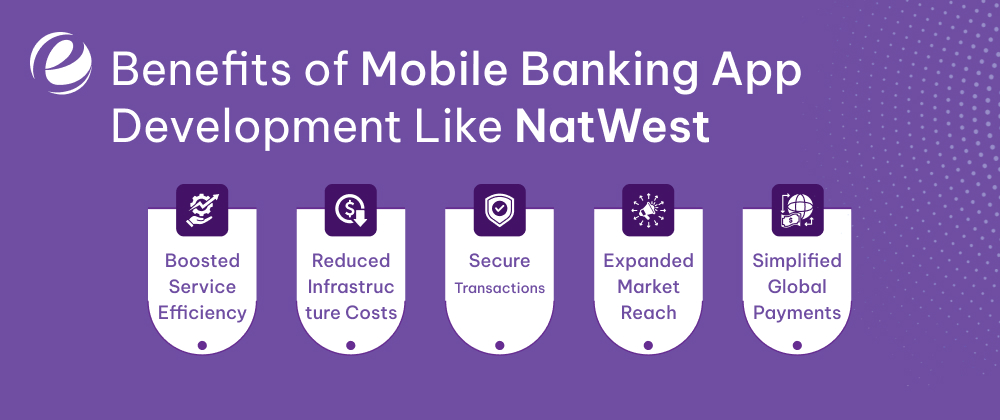
It’s clear how mobile banking solutions can impact the interaction between a bank and its customers. They are designed to make life more convenient for customers. This is why a mobile banking app seems to be something customers want from their banks. The question is: What are the benefits of developing a mobile banking app similar to NatWest for banks?
1. Boosted Service Efficiency
A mobile banking app like NatWest helps reduce the need for in-person banking services provided by bank employees. Customers can manage transactions without visiting a branch. As a result, branches are less busy, as many customers can easily handle their financial transactions without contacting customer support.
Additionally, data from mobile devices can be used to analyze and understand customer behavior. Understanding customer behavior within the app can lead to improved financial services and an enhanced user experience. This also helps identify problems and missing features, allowing customers to have greater control over their finances within the app.
2. Reduced Infrastructure Costs
With fewer people using branch locations, the need for physical branches, as well as maintenance and staffing costs, decreases. Users can manage financial transactions on their mobile devices instead of seeking assistance at an institution. This is why many banks are closing branches while keeping the most essential ones open.
Banks can also benefit from new technologies, such as cloud computing, to store data and manage mobile applications, thus reducing the need for on-site servers. Cloud-based solutions lower IT expenses compared to traditional IT infrastructure, as these solutions generally have lower initial costs and maintenance requirements.
3. Secure Transactions
A mobile banking app like NatWest is changing the rules by introducing additional security layers to banking services, as well as providing extra security features. Many apps utilize multifactor authentication (MFA), such as fingerprint recognition or numeric codes, to verify the client’s identity, especially when making transfers. There are various methods to create extra authentication layers using a smartphone, and banks are encouraged to implement these measures to protect their customers’ security and data.
Additionally, mobile banking apps like NatWest have the ability to encrypt sensitive data, including account numbers, account details, and passwords. Even if there is a data breach and the information is compromised, it remains protected from misuse. Customers are notified whenever a suspicious event occurs.
4. Expanded Market Reach
One of the primary reasons mobile banking apps are so popular is due to their ease of access. Customers can manage their banking accounts anytime and from anywhere. There is no need to visit a bank branch for assistance with financial concerns. This convenience allows banks to reach more customers, as they can bank on their own terms.
In addition, mobile banking apps can be excellent tools for targeted marketing. Banks can use push notifications, in-app messages, and other methods to present special offers to their clients. These campaigns can reach a large number of people quickly and efficiently.
5. Simplified Global Payments
Mobile banking facilitates the use of open banking services. By using APIs, banks can better connect with third-party payment service providers. Open banking allows access to international payment processors, making cross-border payments easier and more convenient for trading.
Mobile banking apps like NatWest enable immediate cross-border financial transactions and settlements. This allows the use of digital wallets, digital banking, and a variety of currencies in one account, along with other payment options accessible abroad in a specific currency, often with a favorable exchange rate.

How Much Does It Cost to Build a Mobile Banking App Like NatWest?
The development of a NatWest mobile banking app is a significant investment. The cost depends on a variety of factors like the complexity of features, the technology stack, the location of development teams, and security requirements. Below is a brief description of the potential costs:
Basic App: A standard mobile banking app that includes essential features (balance checking, money transfer, and account management) could cost anywhere from £32,000 to £69,000.
Medium Complexity Apps: For apps with moderate complexity, which include advanced features such as AI-powered applications, real-time payment systems, and financial planning software, costs could range from £69,000 to £161,000.
High-End App: For a highly advanced app with features like biometric security, multi-currency support, machine learning algorithms, and top-tier security, the price can range from £161,000 to £320,000+.
The final cost of creating a mobile banking app depends on the unique specifications of your application and the capabilities of your development team.
Factors That Affect the Cost of Building a Mobile Banking App Like NatWest
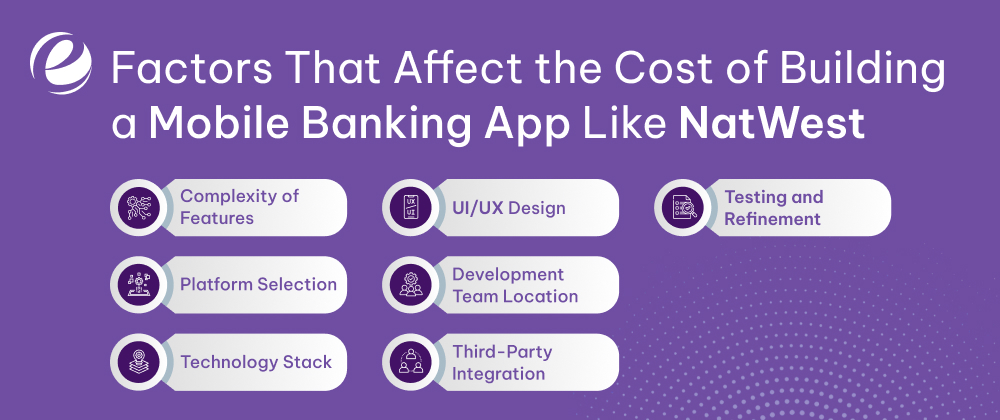
Estimating the overall cost of developing mobile banking apps can be really more difficult than it appears. It depends on several crucial elements, particularly those that are feature-rich and secure, like NatWest. In this section, we’ll examine the factors that affect the total cost of building a mobile banking app like NatWest.
1. Complexity of Features
The more intricate the features, the greater the App development costs. For example, adding AI-powered applications, real-time payment systems, or multi-currency support introduces more complexity, which increases the cost.
2. Platform Selection
The design and functionality of the mobile banking app, whether for iOS, Android, or both (cross-platform), significantly affect the cost of development. Creating separate applications for different platforms typically requires more resources, which drives up costs. However, cross-platform development can reduce expenses by using a single program that works efficiently across multiple platforms.
3. Technology Stack
The choice of technology stack plays a key role in determining the price of building a banking app similar to NatWest. Popular frameworks and languages, such as Swift for iOS, Kotlin for Android, or cross-platform frameworks like Flutter and React Native, affect both development time and cost. Additionally, the selection of backend technologies, such as Node.js, Python, or Java, can also impact the total price.
4. UI/UX Design
The design of the mobile banking app is crucial for improving the user experience and, consequently, its market growth. A clean, easy-to-use interface that focuses on accessibility and engagement can affect both the time and costs of development. The more user-friendly and customized the design, the higher the cost.
5. Development Team Location
The location of the development team plays an important role in the price of creating your app. Developers in North America and Western Europe generally have higher costs compared to those in Eastern Europe or Asia. The hourly rate for developers in the UK can range from £50 to £100 per hour, depending on the region.
6. Third-Party Integration
The development of mobile banking apps often involves third-party service providers to enhance functionality. These include identity verification software, financial data aggregators (Open Banking), payment gateway integrations, and additional security tools.
Each of these integrations requires more development time, which can increase the cost. Therefore, the cost of developing a mobile banking app varies based on the number of third-party service providers and the level of complexity involved in the integration.
7. Testing and Refinement
A static mobile app requires fewer tests, while a dynamic app with custom animations will need additional testing. A static mobile app is more affordable to create. However, when developing a dynamic app, you must consider compatibility with the interface, security, and lower-level resource requirements. When the NatWest app was first launched, it underwent several test phases, including beta and open testing, which added to the overall cost.
Hidden Mobile Banking App Development Costs In The UK
The cost factors for business mobile banking app development mentioned earlier are important to consider when evaluating banking app development expenses in the UK. You cannot ignore the additional costs that may arise during the development process. Ignoring these factors could lead to overspending. So, be sure to take the following into account in your financial plan.
1. Technical Complexity
Building a mobile banking app like NatWest involves addressing various complexities that can quietly drive up costs. For example, integrating third-party APIs, dealing with complex features, and ensuring compatibility and security issues. Failing to account for these in the initial assessment could result in unexpected costs later.
2. Iterative Development and Updates
Apps evolve, just like everything else. Once your mobile banking app is launched, user feedback and market demand may prompt periodic updates and improvements. Iterative development, similar to NatWest app development, can be costly, especially when your app needs regular updates to keep up with the rapidly changing UK market.
3. App Hosting Costs
A frequently overlooked but crucial expense in developing apps like NatWest is the cost of hosting. Once your app is developed and launched, it requires a location to operate and stay live. Hosting options vary, including dedicated servers, cloud hosting, and shared hosting, each with its own costs.
Hosting choices can significantly affect your monthly or annual expenses, so it’s essential to consider your app’s hosting needs and set a budget accordingly. Consider factors such as security, scalability, and uptime guarantees when making your decision to ensure that your mobile app runs smoothly without any unexpected price increases.
4. App Store Submission and Maintenance
Getting a mobile banking app similar to NatWest listed in popular app stores comes with costs. You may encounter one-time registration fees, annual developer account costs, and fees for future app updates. Be aware of the ongoing maintenance costs for your app, including bug fixes and compatibility updates. Each of these factors can impact your total spending.
5. Legal and Regulatory Compliance
Regulations and rules are everywhere! The development of a mobile banking app in the UK must comply with legal and regulatory requirements. The app you create and the information it collects may require assistance from a lawyer to ensure compliance with data protection laws, privacy guidelines, and other industry standards. Failing to adhere to these rules as well as regulations could result in penalties or result in your app being excluded from app stores.
Steps To Develop a Mobile Banking App Like Natwest
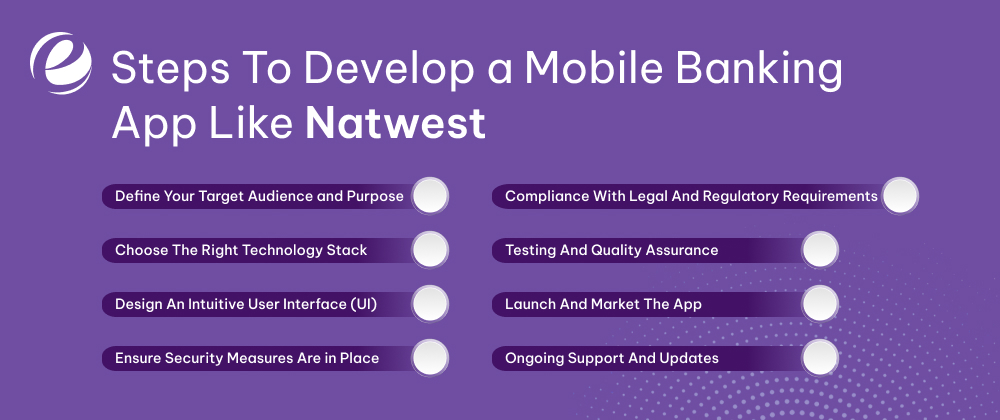
Once you have a solid understanding of the functions and features that make up a mobile banking app like NatWest, it’s time to begin the development process. Let’s look at the steps to bring your mobile banking application to life.
1. Define Your Target Audience and Purpose
Who is your ideal customer? Are you targeting everyday users, small-business owners, or maybe both? Defining your target audience will help shape the functions and capabilities of your app. Also, determine what problems your app will solve. Will you offer basic banking services, or will you provide specialized services such as investment tools and credit scoring?
2. Choose The Right Technology Stack
Selecting the right technology stack is very important for the app’s security, performance, and scalability. When developing a mobile banking app like NatWest, consider using technologies with strong backend support, fast data processing, and a seamless front-end user experience.
Popular technologies for mobile banking apps include React Native for cross-platform development, Swift for iOS, Kotlin for Android, and secure backend frameworks like Node.js and Django.
3. Design An Intuitive User Interface (UI)
User experience is very important when it comes to mobile banking apps. Your customers should feel comfortable using the app, regardless of their technological skills. To achieve this, focus on creating a clear, easy-to-use interface (UI).
It should have a simple yet functional design that allows users to complete tasks swiftly and efficiently. For example, the NatWest app features a minimal layout to provide a seamless and uninterrupted experience for customers.
4. Ensure Security Measures Are in Place
Security is one of the most crucial aspects of a mobile banking app. When launching your app, ensure that security protocols are in place to safeguard the customers’ personal and financial information. Do thorough penetration testing in order to identify and fix any vulnerabilities, and use two-factor authentication (2FA), encryption, and other fraud detection methods to secure user data.
5. Compliance With Legal And Regulatory Requirements
When developing a mobile banking app, especially in the UK, it’s crucial to follow regulations governing financial transactions, such as the Payment Services Directive as well as the Financial Conduct Authority guidelines. Your app must comply with these guidelines to ensure it meets all legal requirements regarding user protection, data privacy, and transaction processing.
6. Testing And Quality Assurance
Once your app has been developed, it’s time to conduct rigorous testing. This includes functional testing, security testing, performance testing, and usability testing to ensure that all functions are working as intended. Beta testing is conducted with a few selected group of app users to gather feedback and fix all the issues before releasing the app to the general public.
7. Launch And Market The App
Once you’ve confirmed that your app is safe and fully functional, it’s time to go live! Plan a marketing strategy that highlights the unique features and benefits it offers customers. Your marketing campaigns should target potential customers who could benefit from a mobile banking app similar to NatWest, such as tech-savvy users or small business owners. The power of word-of-mouth, online ads, and App Store Optimization (ASO) can help encourage customers to download the app.
8. Ongoing Support And Updates
The process of developing a mobile banking app doesn’t end when it launches. Ongoing support and updates are essential to make sure it remains efficient, secure as well as up-to-date with the latest technological advancements. Pay attention to user feedback and regularly release updates or new features to keep users happy and engaged.
Tips For Reducing Mobile Banking App Development Costs Like NatWest
Cost reduction doesn’t necessarily mean cutting corners or sacrificing quality. Here are some ways to reduce costs while maintaining the highest standards.
1. Prioritize Features and Phases
Start by identifying and prioritizing the most important features for your app. Focus on the core features that meet the needs of the users you intend to target. You might consider breaking the development process into stages, starting with a MVP that covers only the essential functions. This approach enables you to launch quickly, gather feedback, after that add more features based on user feedback and your budget.
2. Utilize Cross-Platform Development
Choosing platforms that support cross-platform development, such as React Native or Flutter, allows you to create one codebase that works easily on both iOS and Android devices. This eliminates the need for separate development teams and reduces the time and expense involved in maintaining multiple codebases.
3. Outsource To a Reputable Development Company
A trusted app development company can speed up the development process while reducing costs. By outsourcing, you can easily access the expertise of a team of developers proficient in a variety of technologies and fields, without the expense of hiring and managing internal staff. Experienced app developers can offer valuable advice and strategies to ensure your app meets industry standards and user expectations.
4. Test Your Idea with a Minimum Viable Prototype (MVP)
An MVP allows you to test the market before committing to a full product. By starting with a smaller version that incorporates essential features, you can gather valuable feedback from users, which can be used to improve the final version. Iterating on this approach reduces risks and increases the chances of success. Implementing best practices for MVP development ensures a high-quality, user-friendly product.
5. Leverage Pre-Built Solutions and Open Source Libraries
Integrating pre-built applications and open-source libraries can speed up development time and reduce costs by utilizing existing functionality and components. These solutions are typically maintained by a team of developers, providing regular updates and support for your app’s features.
How Do Mobile Banking Apps Like NatWest Earn Money?
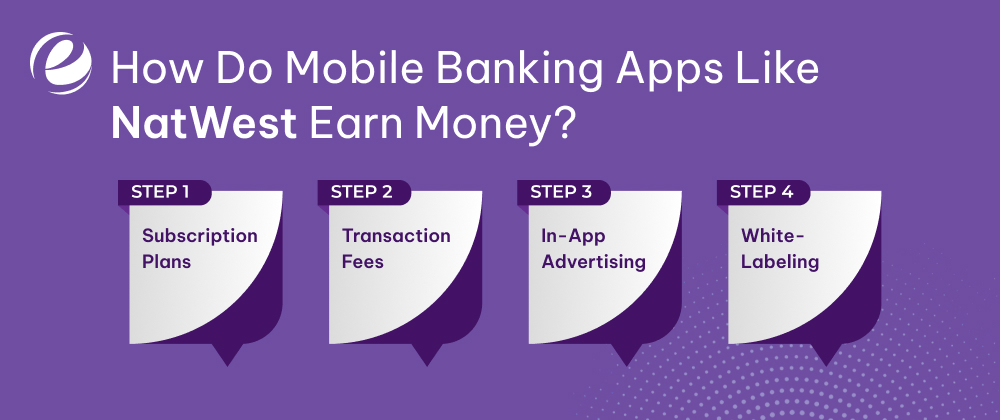
Although mobile banking apps are primarily a digital extension of financial services, they offer a range of revenue-generating opportunities. Banks and FinTech firms can utilize established monetization strategies to increase efficiency and enhance customer experiences.
1. Subscription Plans
This is a great business model for banks to generate revenue. The model may offer monthly, quarterly, or annual subscription options, allowing customers to access a variety of premium banking features.
2. Transaction Fees
Banks can charge minimal fees on specific transactions, such as international money transfers, fast payments, and peer-to-peer (P2P) transactions. This method ensures revenue generation while maintaining user-friendliness.
3. In-App Advertising
Banks can collaborate with third-party service providers, such as insurance companies, investment platforms, or mortgage lenders, to offer relevant financial services within the app. Banks can earn commission-based income for each successful referral made in this manner.
4. White-Labeling
Banks with advanced digital infrastructure can monetize their applications by offering white-label banking services, allowing other financial institutions and FinTech startups to access their services. Banks can generate profits through licensing fees.
Why Hire EmizenTech For Mobile Banking App Development Like NatWest?
Now that you are well-equipped with knowledge about cost of mobile banking app development, the factors that affect their development cost, now is the time to bring your concept to life by partnering with EmizenTech.
EmizenTech is a leading bank application development company across the UK, offering a wide range of solutions that transform your idea into a user-friendly, robust banking app. Our app development team keeps up-to-date with the most recent banking developments, making sure the app you choose to build is built using modern technology.
We’ve worked with top and emerging companies, delivering tangible results. When you work with us and you gain access to our team of committed developers who excel in developing high-quality apps.
Conclusion
The investment you make in a mobile banking app like NatWest can yield significant profits by attracting new customers and increasing customer engagement. With the proper tools, processes as well as strong focus on security, it’s feasible to develop apps that match the popularity of popular banking apps.
As mobile banking becomes an essential aspect of contemporary life, the need for user-friendly, feature-rich and safe banking applications has never been higher. If you take a careful look at the features of your app, its technology stack, and layout, you will be able to work to keep your costs within the budget, while making sure that the app is efficient and secure.
Keep in mind that the most important thing is to find a balance between cost and quality and to ensure that the app is in line with the user’s expectations and the requirements of regulatory authorities.
FAQs
What's the estimated timeframe to build an app similar to the NatWest?
The timeframe for developing banking app typically ranges between four months and one year, or even more, based on the project's complexity as well as the experience of the FinTech firm developing the app. The more intricate your app concept is, the longer it's going to take to create.
How can I cut costs without losing the quality of my app?
If you prioritize features and implement the MVP strategy, and make use of cross-platform development, you will be able to cut costs while maintaining quality. By partnering with a skilled developer can assure high-quality outcomes.
What's the most economical method of developing an application for iOS and Android?
Cross platforms development frameworks like React Native or Flutter allow developers to build one code base that functions for both iOS as well as Android significantly cutting the development cost and amount of time.
What are the potential risks associated with cutting expenses too heavily when developing apps?
Cost cutting will result in poor performance and a lack of features essential to the app as well as a poor quality of user experience. It's crucial to balance saving money while maintaining the functionality and quality of the application.



 +1 (989) 535-9295
 info@emizentech.com
 emizentech


