
 Add us as a preferred source on Google
 Have you ever wondered what makes apps like OfferUp so popular with such a vast number of users? How can you create one for yourself? With the rise in the number of people searching for convenient and local ways to buy and sell used items, there has been explosive growth in peer-to-peer marketplace apps.
The big three, Facebook Marketplace, OfferUp, and Mercari, have changed the way people trade with their communities, and it is all done on the go using their smartphones.
If building an app like OfferUp is in your mind, then this blog is just what you need. In this blog, we are going to discuss the top 10 OfferUp alternatives, their great features, the way these apps work, the challenges faced by users, and last but not least, the cost of building one from the ground up.
This guide has everything you need, whether you are a startup, an entrepreneur, or a business owner who wants to enter the resale market and is looking for an ecommerce mobile app development to turn an idea into a real, scalable app.
So, let us dive in and find out what it takes to develop the next desirable buy-and-sell app!
Market Statistics and Trends (2025–2030)
Booming Peer-to-Peer (P2P) Marketplace Market
- By 2024, the worth of the global P2P marketplace industry was estimated to be around USD 1.54 billion.
- According to Credence Research, the market is predicted to grow to around USD 6.27 billion by 2032, with an average annual growth rate of 19.2% from 2024.
The sector has seen unprecedented growth in demand for such apps as OfferUp that enable consumers to transact among themselves.
Rapid Expansion of Second-Hand Goods Market
- The used goods market, including clothing, furniture, and electronics, was roughly valued at USD 523.3 billion in 2024.
- The market is projected to reach approximately USD 1.45 trillion by 2032, with a 13.6% CAGR.
The growth signals a shift in the consumer’s mindset toward sustainable and cost-effective shopping, hence creating markets similar to the OfferUp app.
Strong Growth in Mobile App Spending
- As per Grand View Research, the global mobile app market had a value of approximately USD 252.9 billion in 2023.
- It is anticipated that the figure will be nearly USD 626.4 billion by 2030, with a CAGR of 14.3%.
With mobile app usage and spending increasing, investing in a well-designed marketplace app makes strong business sense.
Widening Peer-to-Peer Payment Usage
- The total transactions of P2P payments globally amounted to USD 2.62 trillion in 2022 and are expected to reach USD 9.72 trillion in 2030, according to fintechfutures.com. The rate of increase over the period of t is 17.8% CAGR.
The fact that mobile payments will gradually become the norm means that in-app transactions must be accommodating for smooth integrations and, hence, essential for apps like OfferUp.
What is OfferUp App, and How Do Apps Like OfferUp Work for Buying and Selling?
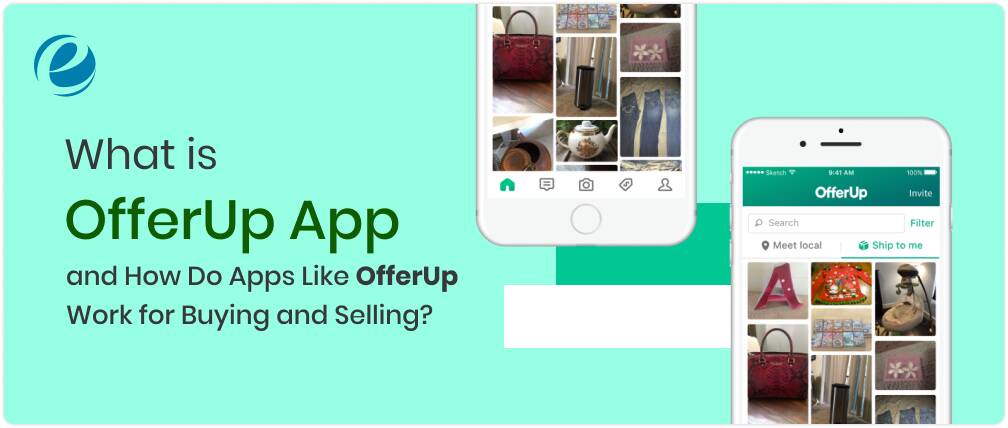
OfferUp app is a well-known mobile marketplace application that enables local users to buy and sell things. It is often referred to as a more mobile-friendly and updated version of classified websites like Craigslist. OfferUp app is used by people who post their second-hand products, such as furniture, electronics, and so on, and then they connect with the buyers who are nearest to them.
How Do Apps Like OfferUp Work?
OfferUp app and similar apps are built on a peer-to-peer model, which allows ordinary users to list their items and find buyers directly without going through any middleman. Such platforms are extremely simple and free to list on, and they provide a secure local trading environment.
User Registration and Profile Creation
Users need to make a profile first, by email or through social media, in order to start buying or selling. Moreover, they complete the information and upload a profile photo to gain trust in the community.
A good user profile is essential for trust and good communication between buyers and sellers.
Product Listing with Photos and Descriptions
The sellers are allowed to take photos of their item, input a short description, the price, and post the listing.
Such listings are offered only for people who are located nearby; thus, local buyers can easily discover what is available in their area.
Search and Browsing Options
The buyers, definitely, can add some filters to their search to narrow down the results in a specific category, location, price, or keywords.
Based on distance, the app presents pertinent listings, thus helping users effortlessly find their requirements.
In-App Messaging
People can chat with each other in the app to get information, bargain, or decide when and where to meet.
In-app messaging gives privacy and makes the conversation easy and safe.
Safe Transactions and Meet-Ups
Typically, apps like OfferUp are not designed to process payments. The seller and buyer decide on a place where they can meet in person and then carry out the transaction using cash or e-wallets.
Some platforms also have shipping and online payment options built in to make sure things are safer and more convenient.
Ratings and Reviews
Upon completing the transaction, users can score each other or write a review reflecting how they got along.
Reviews and ratings build trust and make it easier for other people to decide if they should work with a new buyer or seller.
Well, OfferUp is one of the places people go most often when they need an OfferUp alternative. This is mainly due to their user-friendly interface, fast setup, and a strong focus on community trust. Besides, these apps turn down this level of mobile e-commerce app development, which allows them to provide personal and location-based shopping experiences.
Key Features to Look for in Apps Like OfferUp
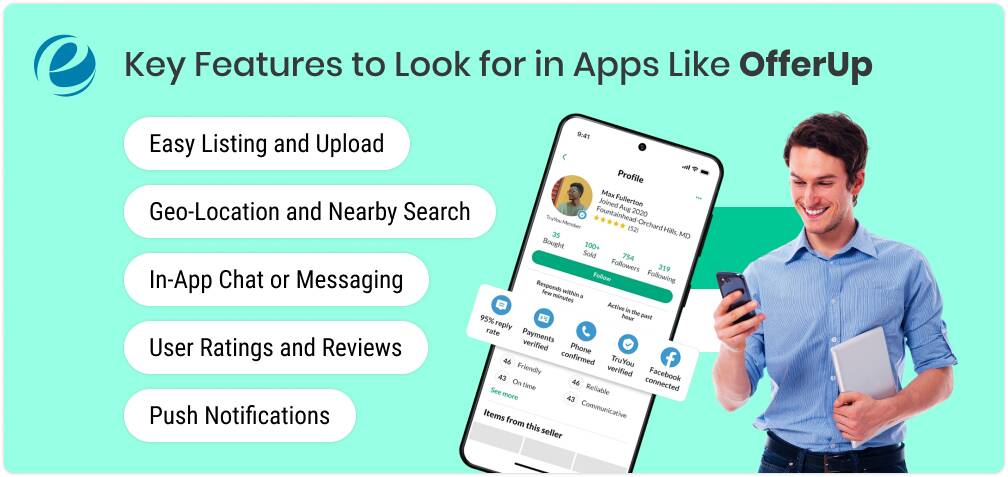
In the process of developing or using apps like OfferUp, it is of great importance to figure out which features these platforms comprise that are the keys to their ease of use, safety, and success.
The following features make it possible to have a seamless experience, irrespective of whether you are creating your own app like OfferUp or looking for an OfferUp alternative. From user-friendly listing tools to secure messaging and location-based search, these features help to make your second-hand ecommerce apps effective.
Easy Listing and Upload
Users must be given the opportunity to rapidly upload pictures of the product, write a short description, and decide on the price with only a few steps.
A fast and uncomplicated listing process not only encourages the sellers to contribute more items but also makes the app more active and stocked with new products.
Geo-Location and Nearby Search
The geolocation feature assists in pinpointing the exact location of the buyer and the seller, which will be crucial in deciding a place for the meeting and delivery of the goods. Additionally, the buyers will be assured of the safety of the transactions because they will be happening in their area.
In addition, some apps incorporating the geolocation feature may ask users for their location. Then, they may suggest some cool things to do around the user. It would be more difficult and unwieldy to manually input the user’s town.
In-App Chat or Messaging
The buyers and sellers need to have chat capability in-app for them to be able to ask questions, negotiate prices, or confirm the details of the pickup.
Safe in-app messaging not only makes communication more convenient but also helps keep the address details confidential.
User Ratings and Reviews
Equally, the transaction is going on, and both parties have the opportunity to rate and review each other.
This way, the community gets strengthened through trust and also assists the users in making the right choices before getting into a transaction.
Push Notifications
The right-time alerts of new messages, listings, offers, or updates keep users engaged.
The notifications become a significant factor in both the improvement of user activity and the facilitation of the process whereby sellers can respond to interested buyers more quickly.
Those features are the basis of an ecommerce app development journey. In addition, such features are also frequently found in the best apps, such as the OfferUp app. If you are planning on building a marketplace app, concentrating on these essentials will enable you to offer a user-friendly and competitive product in the fast-growing ecommerce development space.
Top 10 Best OfferUp Alternatives for Buying and Selling
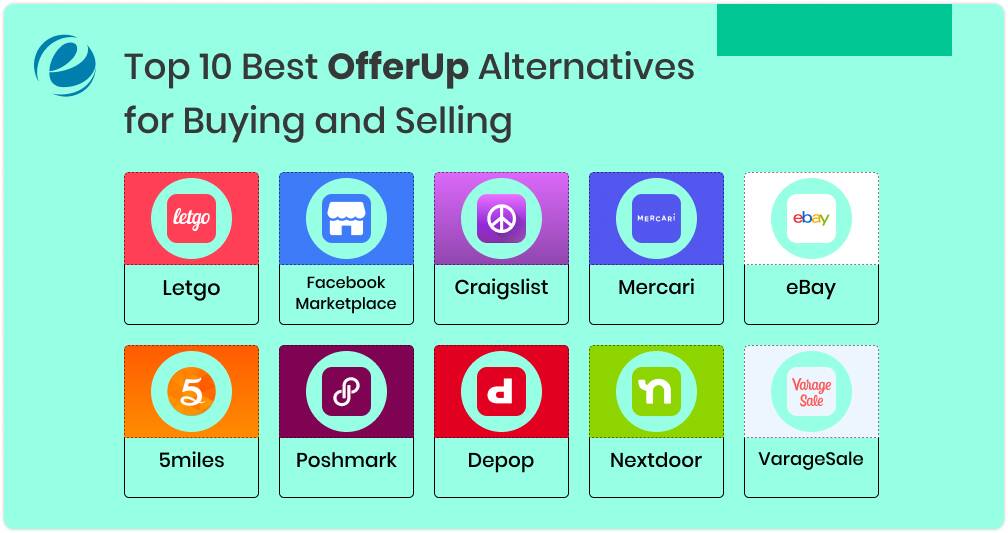
OfferUp is the most popular local marketplace app, although it is not the only one. Numerous users look for other apps like OfferUp that are similar and also better in their features to sell and buy used items. If you want to make a local deal or an online shipment, or if you like niche categories, there are a lot of alternatives that can satisfy your needs. Some of the top OfferUp alternative
| App / Platform | Launch Year | Platform | App Size (approx.) | Downloads / Users | Key Notes |
| Letgo | Jan 2015 | iOS, Android | ~50 MB | 30 M+ downloads; 13 M+ MAU in 1st year eleconomista.es | Merged into OfferUp in 2020 |
| Facebook Marketplace | Oct 2016 | Web, iOS, Android | — | 1 B+ MAU globally | Over 1 B listings by 2021 |
| Craigslist | 1995 | Web, limited iOS | — | Millions of listings daily (no mobile download figures) | Classic classifieds platform |
| Mercari | Jul 2013 | iOS, Android | ~90 MB | 100 M+ downloads (2017) | Supports national shipping |
| eBay | 1995 | Web, iOS, Android | ~60 MB | 1 B+ downloads | Large-scale ecommerce with auctions and fixed-price listings |
| 5miles | Jan 2015 | iOS, Android | ~70 MB | 10 M+ users, $1 B+ in sales | Focuses on a 5-mile radius, includes services and jobs |
| Poshmark | May 2011 | iOS, Android | ~80 MB | 80 M+ users | Fashion-focused resale, social profile elements |
| Depop | 2011 | iOS, Android | — | 35 M+ users (2024) | Gen Z-focused, fashion resale with social style |
| Nextdoor | 2011 | Web, iOS, Android | ~100 MB | Neighborhood scale: millions of users | Primarily for neighborhood groups with buy/sell sections |
| VarageSale | 2012 | iOS, Android | — | Expanding in US, Canada, and Europe | Trusted community-based marketplace, user verification |
Letgo (Now merged with OfferUp)
Before Letgo merged with the OfferUp app, it was most certainly known for its smooth user experience and a large community of local sellers.
Facebook Marketplace
A well-trusted and widely used platform that creates a marketplace by connecting buyers and sellers through their Facebook profiles.
Craigslist
One of the oldest and simplest classifieds platforms, perfect for various purposes from furniture and gadgets to services and rentals.
Mercari
This is a simple app that is dedicated to shipping all over the country; it gives its users the ability to sell from all categories.
eBay
A leading global e-commerce giant. It allows its users to bid or simply buy on fixed-price listings and provides trustworthy buyer protection policies.
5 miles
This is an app that lets users sell whatever they want within five miles of their current location. It is a mixture of a local selling app and a social one; it has user ratings and payments within the app.
Poshmark
If users have clothes that they do not need, then Poshmark can be a great platform to sell them, especially if the garments are from the fashionista niche.
Depop
This app combines shopping with social media, making it the ideal place for young people to have access to vintage fashion and one-of-a-kind pieces.
Nextdoor
Introducing a community app that, among many other features, has a buy and sell section for people who live nearby and want to keep things local.
VarageSale
According to VarageSale, buyers and sellers should do it through verified accounts to ensure that they are dealing with reliable people and safe transactions.
Apps like OfferUp extend users’ capabilities, categories, and methods of buying and selling not only locally but also across the country. If you want to create your own marketplace by developing an ecommerce mobile app, analyzing these platforms can provide key insights and inspiration.
Common Challenges Faced on Apps Like OfferUp (and How to Overcome Them)
While OfferUp app is a place where buying and selling local items becomes convenient and easy, app users face a number of challenges that can affect their experience positively. Trust, scams, and low-quality listings are the main concerns that are common to all OfferUp alternatives.
Luckily, there are ways that can be used by users and developers to make the apps run smoother and solve problems at the same time.
Fake Listings and Scams
Most people who use these apps are definitely affected by never-ending worries about fake product posts or dishonest sellers.
Solution: The application developers can set up the options for the veracity of the user profiles, put in place the moderation procedure of high-level quality, and use the AI employments for recognizing the fraudulent behavior in the conversation to reveal the suspicious listings.
Lack of Trust Between Buyers and Sellers
These kinds of apps are mainly designed to deal with strangers. Thus, the users are most likely not trusting enough, and they will not want to meet or make a deal.
Solution: In case the users build their trust among the community by using these services and get the positive impact of the ratings, reviews from other people, and the identity verification of trustworthy persons, then they will be able to do away with the doubts and move on with the decision.
Poor Communication
Unintended messages or incomplete conversations can create more problems than they solve or result in a situation where no transaction has occurred.
Solution: An in-app chat that has features such as read receipts, quick replies, and push notifications included can go a long way in making communication faster and more understandable.
Limited Payment and Shipping Options
Not every app has a feature of secure payment or shipping, which in turn affects the number of users who can download and use the app.
Solution: The combination of secure payment via the app and a shipping service that is flexible and convenient can skyrocket the number of app users.
Low-Quality Product Listings
Unclear pictures and uninformative description texts can result in customers walking away.
Solution: Provide listing tips, photo guidelines, and automated quality checks to make sure that the posts of the products are professional and appealing.
Beyond addressing these issues, thus improving users’ experience, one can also gain increased user engagement, which ultimately leads to a greater trust factor, among others, crucial for an app like OfferUp. For businesses mulling over the possibility of ecommerce app development, an early resolution of the stated points can result in a more reliable and safer marketplace to trade.

How Much Does It Cost to Build an App Like OfferUp?
The cost of developing an app like OfferUp depends on various factors like design intricacy, features, the place where the development team is, and the tech stack. If you decide to create a simple buy-sell app or a fully-featured marketplace like top OfferUp alternatives, the cost can be anything within a large range. In order to assist in estimating your development budget based on the level of features and the required roles, below is a breakdown.
If you want to create such an app, then you have to select the best ecommerce app development company that can make the best and most effective strategy for your project. It can definitely save time and money.
| Role | Basic App (USD) | Advanced App (USD) | Complex App (USD) |
| UI/UX Designer | $1,500 – $3,000 | $3,000 – $6,000 | $6,000 – $10,000 |
| Frontend Developer | $3,000 – $6,000 | $7,000 – $12,000 | $12,000 – $18,000 |
| Backend Developer | $4,000 – $7,000 | $8,000 – $15,000 | $15,000 – $25,000 |
| Mobile App Developer (iOS/Android) | $5,000 – $8,000 | $10,000 – $18,000 | $18,000 – $30,000 |
| QA & Testing | $1,000 – $2,500 | $2,500 – $5,000 | $5,000 – $8,000 |
| Project Manager | $2,000 – $3,000 | $3,000 – $5,000 | $5,000 – $8,000 |
| Total Estimated Cost | $16K – $30K | $33K – $61K | $71K – $99K+ |
Step-by-Step Guide to Building a Buy and Sell App Like OfferUp
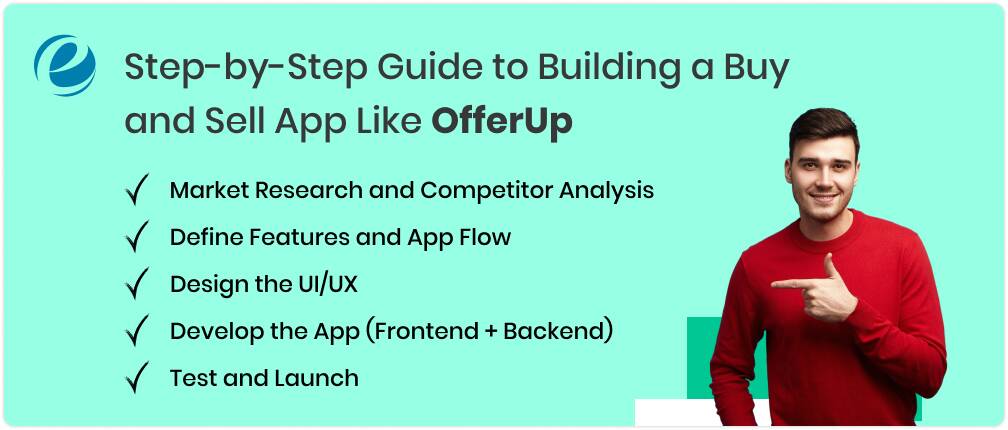
Are you in the process of developing a mobile app like OfferUp for local buying and selling? Such an app would be perfect for today’s digital world, especially if the number of ecommerce mobile app launches continues to boom.
It does not matter if you intend to go after various second-hand items, niche markets, or community-based trade; still, the fact that following a structured development process is a must cannot be forgotten. A simple step-by-step roadmap will guide you in initiating the process easily.
Market Research and Competitor Analysis
The first thing that you should do is to analyze the market, your target audience, and the top apps like OfferUp. Survey users’ favorite things, their pain points, and what features they consider missing in the OfferUp app and other apps like OfferUp.
Thus, you can come up with a solution that is more relevant and friendlier to users, which will differentiate you from other OfferUp alternatives.
Define Features and App Flow
Choose essential features that include, for instance, user profiles, product listings, chat, and payment integration. Besides, the path a user goes through from registration to checkout should be decided.
Steps to easily find and keep successful ecommerce applications and smooth navigation are very important for the app’s usability and the development of e-commerce products.
Design the UI/UX
Develop simple, inviting, and mobile-friendly interfaces for buyers and sellers. Try to make everyone’s listing and browsing experience seamless.
Excellent design improves trust and is a shortcut for user adoption, especially in peer-to-peer marketplaces like the OfferUp app.
Develop the App (Frontend + Backend)
Make a choice of tech stack and start coding. Frontend deals with the appearance of your app, whereas backend manages logic, databases, and APIs.
If you want, you can also hire a full-stack team or an e-commerce development company that can take care of this step professionally.
Test and Launch
Before going live, run the app at its pace to find any bugs and check the speed, security, and performance of different devices.
Once you have got the green light from all, open it to the Android and iOS platforms and start collecting user feedback for further improvement.
In this way, you can build a scalable, secure, and user-centered app like OfferUp.
Why Choose EmizenTech to Develop Apps Like OfferUp?
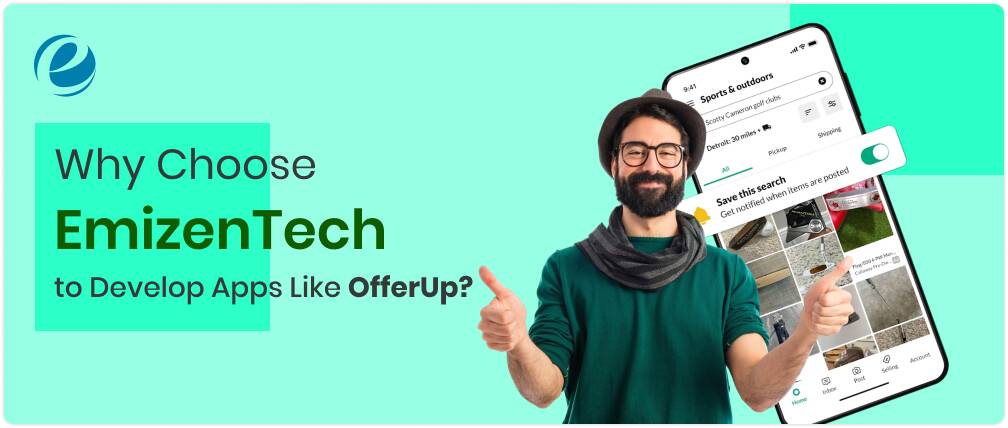
If you want to create a powerful and easy-to-use app like OfferUp, collaborating with a team of the right people is essential. We at EmizenTech are an experienced ecommerce app development company and have assisted businesses in launching high-performing marketplace apps that are perfectly customized to their needs.
We are able to provide all the services you require, from concept to launch, including design, development, testing, and support. Our experience over the years enables us to convert your idea into a user-friendly, feature-packed, and scalable app that your users would love.
- Our developers have already made several buy-and-sell platforms and, thus, perfectly predict what features, designs, and flows are the best.
- Our company’s UI/UX team concentrates on smooth and clear interfaces, which keep users involved and increase app usage.
- Our company does not believe in standardized items. We construct tailor-made applications in accordance with your ideas, objectives, and financial plan.
- Our expert team members utilize modern and scalable resources to guarantee that your app operates quickly and is prepared for the future.
- Regardless of whether it is planning and designing or developing and providing support after launch, we are with you every step of the way.
- The core of the enterprise is in the development of ecommerce and mobile application solutions, and we obtain the highest industry standards for every project.
Final Words
Creating apps like OfferUp is a smart move in a post-peer-to-peer ecommerce world. A well-designed OfferUp app can be used for multiple purposes, such as listing second-hand goods and enabling secure local transactions, and can bring great value to both users and businesses.
In this step-by-step guide, we have extensively covered the working of such types of apps, essential features, most popular OfferUp alternatives, potential challenges, timelines, and budget estimates, along with the process of developing an app like OfferUp.
If you are planning to introduce your own marketplace to the buy-and-sell segment, choosing the most suitable ecommerce development partner is the most important. EmizenTech, with its rich experience in ecommerce app and mobile app development, can be your reliable partner in creating a high-performance, user-friendly, and unique app that will beat the competition.
FAQs
How much does it cost to develop an app like OfferUp?
The estimated cost to develop an app like OfferUp can vary between $16,000 and $100,000+. It totally depends on the functionality, design, and complexities of the app.
How long does it take to build a buy-and-sell app like OfferUp?
Well, roughly 3 to 6 months for a basic app and up to 9+ months for a complex version with all features is usually the time period required.
What tech stack is used to build apps like OfferUp?
Developers often use these technologies: Frontend: React Native / Flutter Backend: Node.js / Django Database: MongoDB / PostgreSQL Cloud: AWS / Firebase APIs: Google Maps, Payment Gateways, Chat SDKs
Can I launch the app on both Android and iOS?
Yes, you can launch the app on both Android and iOS by using cross-platform technologies like Flutter or React Native with one codebase.
Is it possible to customize the app with unique features?
Absolutely. You can add custom features like auction-style bidding, in-app payments, ratings, or advanced filtering to make your app stand out and engage in the market.



 +1 (989) 535-9295
 info@emizentech.com
 emizentech


