
 Add us as a preferred source on Google
Thinking of launching a website or web app but still can’t choose between Bubble.io vs WordPress? That’s perfectly okay. A plethora of tools are available at your disposal, and it is easy to feel overwhelmed when it comes to selecting the right platform, especially when both offer excellent features but for different purposes.
Bubble.io is a no-code app development platform that is known for allowing non-developers to create full-featured web apps without having to write even one line of code. Meanwhile, as per the Kinsta, WordPress is the most widely used content management system (CMS) in the world that is powering more than 43.6% of websites and is ideal for blogs, business sites, and eCommerce.
With the insatiable need for fast and flexible digital solutions, both platforms are in sync with playing a lead role at the center of the future. For instance, low-code/no-code is the category according to Statista on Bubble.io. The market is opening and moving land at full speed, which will make $65 billion by 2027, and this reflects the rate at which businesses are adopting visual development tools.
This blog post compares the two platforms of Bubble.io vs WordPress in terms of features, usability, expenditure, versatility, and more to help you decide on the suitable one for your dreams, be it a blog, a business website, or a fully functional web application.
What is Bubble.io?

Bubble.io is a no-code platform that enables users to create web applications without writing a single line of code. It offers a visual drag-and-drop interface where you can design, develop, and launch fully functional apps quickly and efficiently.
If you are making a startup MVP, internal business tool, or customer-facing web app, Bubble.io has a wide range of features, such as custom workflows, database integration, and responsive design, at your disposal.
Bubble.io was born to be an ideal No-Code App Development hero for entrepreneurs, startups, and businesses who want to give life to their digital ideas without hiring developers.
What is WordPress?
WordPress is one of the biggest content management systems (CMSs) worldwide. It is used to develop many kinds of websites-from the most candid ones that exist as blogs to a fully-fledged eCommerce store. Being Open Source and user-friendly, it allows the building and managing of websites without advanced computer programming skills for a novice and an experienced developer alike.
With thousands of themes and plugins, WordPress makes it easy to customize sites. Whatever your needs are for a blog or a business, it gives you the flexibility, scalability, and community support to get started fast. It is also a big part of the core services in WordPress Development Services offered by web agencies and freelancers.
Bubble.io vs WordPress: Core Differences
Choosing the right platform for your website or web app depends largely on your goals, technical skills, and customization needs. The question of Bubble.io vs WordPress is what many ponder when being pulled between an up-and-coming no-code web app builder and an age-old content management system.
Creating digital experiences is the main advantage we have for both platforms, the major difference being their functionalities, flexibility, learning approaches, and uses. Let’s go through the main differences to get an idea of which one is best for your next project.
| Feature/Criteria | Bubble.io | WordPress |
| Type of Platform | No-code web app development platform | Content management system (CMS) |
| Best For | Custom web applications, MVPs, dashboards | Blogs, websites, eCommerce, business sites |
| Ease of Use | Moderate (visual editor, logic-based workflows) | Easy for beginners (intuitive dashboard) |
| Customization | Highly customizable for web apps through visual logic | Customizable via themes and plugins |
| Plugins & Extensions | Limited third-party plugins; API integrations available | Thousands of themes & plugins available |
| Development Style | Visual programming, no-code logic building | Template-based, plugin-enhanced site building |
| Hosting | Built-in hosting included | Requires separate hosting or via managed WP services |
| SEO Optimization | Basic SEO features, more effort needed | Strong SEO support with plugins like Yoast SEO |
| Cost | Free plan available; paid plans for app scaling | Free core; additional costs for hosting, themes, and plugins |
| Ideal For | Entrepreneurs, startups, no-code developers | Bloggers, marketers, small businesses, agencies |
Do you need an interactive web app with dynamic workflows (Bubble.io) or a content-rich, SEO-optimized website (WordPress)? Then, knowledge of the main differences between these platforms is essential. If you want to have the possibility to use the most adaptable platform without doing any coding, Bubble.io is the ultimate solution in no-code app development.
However, if you intend to set up a blog or a marketing site, the WordPress option, along with the professional WordPress Development Services, might be more suitable.
Pros and Cons of Bubble.io
It is very important to get acquainted with the platform’s strong and weak spots before you decide to work on a new project using Bubble.io. Basically, Bubble.io has a list of pros and cons that you can check here.
If you find Bubble.io’s pros and cons compatible with your development goals, you will be able to make a decision.
Pros of Bubble.io
No Coding Required
Bubble allows building sophisticated web applications with no programming at all, the main advantage of which is for non-developers and startup founders.
Highly Customizable
Its visual editor allows you to build unique workflows, database structures, and app logic that can perfectly satisfy your needs of creating custom features.
Built-In Hosting and Deployment
Bubble takes care of hosting, deployment, and scaling. Consequently, you are free from the burden of setting up servers or carrying out maintenance.
API Integration Support
Bubble gives you the possibility to connect with the APIs of other tools and services thereby opening the door to more powerful features.
Ideal for MVPs and Startups
It really is a fantastic option if you want to rapidly create and release MVPs or internal tools using limited funds and without a big development team.
Cons of Bubble.io
Learning Curve for Beginners
Even though it is no-code, Bubble implicitly demands time to learn how its workflows, logic, and database systems perform effectively.
Limited SEO Capabilities
Compared with WordPress, Bubble only has essential SEO features. For content-rich sites, the need for a little more work will be indispensable indeed.
Not Ideal for Simple Blogs or Brochure Sites
Bubble might be too complicated if your aim is just to have a static website or a blog, unless you want to turn it into something else.
Fewer Plugins and Templates
Bubble is much less saturated with plugins and templates than WordPress; thus, a smaller number of options may be available to users.
Performance Can Vary
For extremely heavy or complicated applications, performance can come into focus if you do not optimize your workflows and use the paid plans.
These pros and cons demonstrate that Bubble.io can be a very effective tool, especially for those who are experimenting with custom web development without hiring a full dev team. Nevertheless, for content-oriented websites or blogs, traditional platforms like WordPress might still be preferable.
Pros and Cons of WordPress
WordPress is an absolutely well-known and reliable platform for creating websites. For various types of websites, such as a personal blog, a website, or an online store, WordPress is highly suitable due to its numerous features and ability to adapt to different needs.
In spite of this, it also has some good and bad points, just like any other platform. To consider WordPress as an option, we outline its pros and cons.
Pros of WordPress
Beginner-Friendly
WordPress’s simple interface and straightforward installation procedure make it perfect for newbies who have no or little technical skills.
Highly Customizable
Changing the look of your website and adding more features can be done by just choosing from thousands of themes and plugins in a few clicks.
Strong SEO Support
WordPress is SEO-friendly and has plugins like Yoast SEO that can improve your site’s ranking on search engines.
Large Community & Support
It’s not too hard to find people who are willing to help you with your problems, a large community all over the world, lots of documents, and forums make it possible.
Scalable for All Website Types
WordPress is the right choice for your business growth since it can grow with it through WordPress Development Services, from simple blogs to huge e-commerce stores.
Cons of WordPress
Requires Regular Maintenance
To keep your site safe and work smoothly, it is necessary to often update themes, plugins, and WordPress core.
Security Vulnerabilities
Hackers may take advantage of WordPress, which is among the open-source platforms and is highly popular, to make cyberattacks if you do not secure it properly.
Can Become Heavy with Plugins
Lots of plugins could decrease your website speed performance and bring incompatibilities with other plugins.
Hosting and Domain Needed Separately
Unlike Bubble.io, Handlers are responsible for managing the domain and hosting setup for a WordPress site.
Customization May Need Coding
Going beyond the themes and plugins there are still some cases where codes must be written or developers asked for help.
WordPress is excellent for content-driven websites, blogs, and marketing sites, but it might not be ideal for custom web apps. If you want complete freedom and don’t want to write any code, a no-code platform such as Bubble.io might be more suitable, especially for no-code app development or dynamic applications.
Tools & Plugin Integrations: Powering Your Website the Smart Way
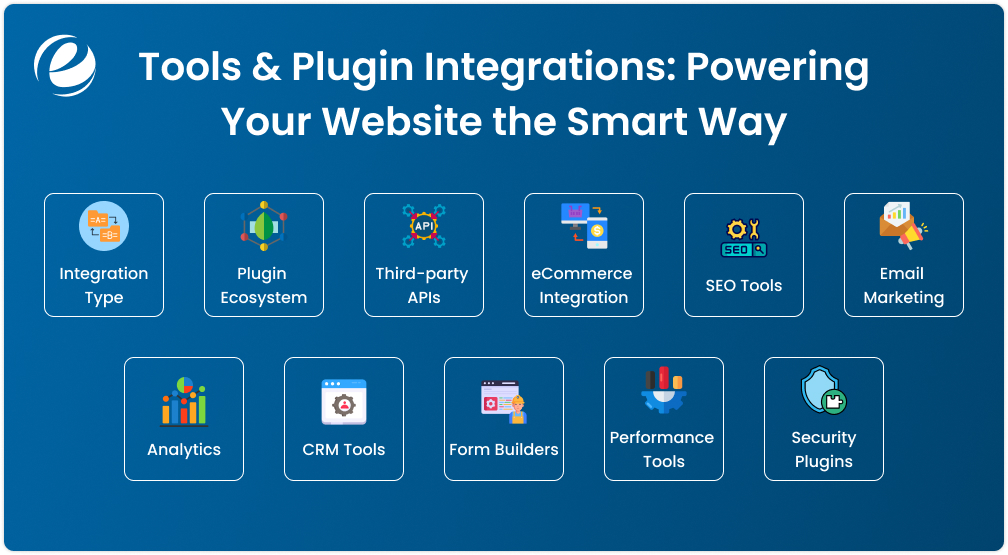
Building integrations to a website or web application would enhance functionality, user experience, and performance. Both Bubble.io and WordPress provide tools and plugin support, but they are very different. While WordPress has been featured for a large library of plugins, Bubble.io leans heavily into API integrations and custom element building.
Let us consider integration approaches on both platforms and the tools available on each so that you can make the best choices for your project.
| Integration Type | Bubble.io | WordPress |
| Plugin Ecosystem | Limited built-in plugins; relies on external APIs and Bubble plugins | Extensive plugin library (50,000+ plugins available) |
| Third-party APIs | Strong API connector to integrate tools like Stripe, Airtable, Twilio | Can use APIs via plugins or custom coding |
| eCommerce Integration | Stripe, PayPal, custom checkout setups via APIs | WooCommerce, Easy Digital Downloads, and more |
| SEO Tools | Basic built-in; manual SEO configurations required | Yoast SEO, All-in-One SEO, Rank Math |
| Email Marketing | API integration with Mailchimp, SendGrid, etc. | Plugins like Mailchimp for WordPress, MailPoet |
| Analytics | Google Analytics via manual embed or plugin | Plugins like MonsterInsights, Site Kit by Google |
| CRM Tools | Custom integrations via API (e.g., HubSpot, Salesforce) | HubSpot, WP ERP, Jetpack CRM plugins available |
| Form Builders | Built-in form builder with workflows | WPForms, Gravity Forms, Ninja Forms |
| Performance Tools | Built-in performance settings (limited) | Caching & speed plugins like WP Rocket, W3 Total Cache |
| Security Plugins | Security managed by Bubble’s infrastructure | Wordfence, Sucuri, iThemes Security |
The choice depends on what type of project you are building. You want Bubble.io’s in-house no-code integrations through APIs or WordPress’s heavy plugin approach.
For custom apps with flexible logic, Bubble’s API-centric approach works best. WordPress shines for content-rich websites that need fast and easy extensions, particularly when coupled with expert WordPress Development Services or Custom Web Development Services.
Bubble.io vs WordPress: Pricing Comparison
Cost is the most important factor in choosing the right platform to host a website or web application. While both Bubble.io and WordPress have a free version to allow the user to try out the platform, their overall pricing differs greatly depending on features, hosting, customization needs, and scalability.
Bubble.io has an all-in-one pricing model, including hosting, while WordPress has pricing components for hosting, domain, themes, and plugins. Here is a detailed cost comparison between Bubble.io and WordPress for you to better consider which one fits your budget and business needs.
| Cost Component | Bubble.io (Annual Est.) | WordPress (Annual Est.) |
| Platform/Plan Cost | $348 – $1,428+ | Free (core), $0 – $120 (managed WP) |
| Hosting | Included | $36 – $360 |
| Domain | $10 – $15 | $10 – $15 |
| Themes/Templates | $0 – $200 | $0 – $100 |
| Plugins/Extensions | $0 – $300+ (via API/marketplace) | $0 – $300+ |
| Development Cost | $500 – $5,000+ (if outsourced) | $300 – $10,000+ |
| Maintenance | Included | $100 – $500+ |
| Total Estimated Cost | $850 – $7,000+ | $450 – $11,000+ |
Both platforms can be relatively inexpensive, depending on their intentions. If Bubble.io is an all-in-one no-code environment for building and scaling web apps, Bubble.io offers great value and deserves to be called a startup’s best friend.
In contrast, WordPress is great for content-based websites and blogs where the budget is flexible, and you can go to free resources, Expert WordPress Development Services, or Custom Web Development Services, whichever way you choose at any given time.
Bubble.io vs WordPress for Developers
If we are talking about development flexibility and ease, both Bubble.io and WordPress are aimed at different categories of developers. However, Bubble.io is a good platform for no-code and visual developers who want to build their web apps, whereas WordPress gives more control to traditional developers through access to code, PHP, and the plugin ecosystem.
Let us now compare the platform’s performance from a developer’s point of view.
Bubble.io for Developers
No-Code Visual Programming
The Bubble enables developers to visually construct apps and work with workflows and drag-and-drop components without writing code. Useful for quick prototyping and MVPs.
Limited Custom Code Access
Although Bubble is quite strong, it limits both backend and front-end code modification, which can be a problem for the devs who are the most advanced and want to have full control.
API Integration Ready
Developers have the opportunity to connect with the outside world through APIs, thus creating an easy-go event for the outside world.
Built-In Hosting and DevOps
Bubble will solve the server, hosting, and deployment problems most efficiently, thus leaving more time for development work.
WordPress for Developers
Full Code Access
WordPress is very flexible, and it gives the customer total rights to theme files, plugins, and PHP scripts, which is ideal for custom development and advanced site customization.
Extensive Plugin Ecosystem
Developers can use the vast number of plugins and decide if they want to develop their own or use existing ones to add new features.
Flexible Design and Layouts
Developers can develop new themes right from the very beginning or modify the existing ones with the help of HTML, CSS, JavaScript, and PHP.
Self-Managed DevOps
Needs developers to take care of hosting, performance optimization, and updates, perfect for people who just want to have full control over their environment.
Why is Emizentech the Right Partner for Your Bubble.io or WordPress Project?
Both Bubble.io vs WordPress are leading platforms for creating apps and websites. Bubble.io is geared toward users who are interested in no-code app development or immediate MVPs, while WordPress would be more suitable for developers who desire coding freedom, open-source flexibility, and customization capabilities that can be further enhanced by WordPress Development Services.
If you’re planning to build a no-code web app with Bubble.io or create a content-rich website with WordPress, choosing a suitable development partner can either make or break your project. At Emizentech, we provide the right mix of technical skills, creativity, and confirmed experience to assist you in accomplishing your objectives shortly, smarter, and with the highest quality results. Here are the reasons why we are the best choice for your next project.
- Since our team is experienced in both Bubble.io and WordPress, we can find and construct the most suitable solution for your requirements, such as an MVP, a scalable app, or a marketing site.
- We don’t support the idea of one-size-fits-all. We create each part, design, function, and feature just like your brand and business model, whether it is a visual Bubble app or a dynamic WordPress website.
- During all stages, from planning to launch and maintenance, we are at your service. You cannot have any worries about updates, hosting, or performance, all of these we do and all of these you benefit from.
- We are always occupied with creating solutions that are not only visually attractive but are also fast, safe, user-friendly and SEO-optimized.
- We have extensive years of experience in high-performing custom web development services and have helped businesses across eCommerce, healthcare, education, and more by using the right mix of tools and technology.
Emizentech is your trusted partner. Whether you are considering no-code app development on Bubble.io or planning a site with our WordPress Development Services, we are here to bring your dream to reality smoothly and effectively.
Final Words
Choosing between Bubble.io vs WordPress ultimately comes down to your project goals, technical expertise, and budget. Bubble.io is the most no-code platform, which makes it easier to create while still providing scaling and flexibility if you want to create a web app without coding quickly. On the other hand, WordPress, which is a content-driven platform that combines user-friendly plugins and powerful SEO tools, is still the most trusted CMS for thousands of users.
The pros of the two platforms are that Bubble.io is a great visual app development platform, and WordPress serves well for content management and customization. Whatever you go for, having a competent development team can be of great benefit. Emizentech is here to help you out. We have great knowledge in both platforms, we provide customized No-Code App Development, dependable WordPress Development Services, and complete Custom Web Development Services for you to get started faster, better, and smarter.
Are you still confused about which platform fits your business perfectly? We are here to assist you in the decision-making process and also enable you to transform your concept into a productive digital solution.

FAQs
Which is better for beginners, Bubble.io or WordPress?
WordPress is what a beginner would want to build a blog or a website. Bubble.io has some learning curve but is wonderful if anyone wants to do no-code app development.
Can I build an eCommerce site with both platforms?
While WordPress offers WooCommerce for eCommerce, Bubble.io enables custom eCommerce apps through API integrations. The option is available for both.
Is Bubble.io free to use?
Bubble.io has limited free plans, while the paid plans start at $ 29 a month.
Q4. What’s more SEO-friendly, Bubble.io or WordPress?
WordPress is more SEO-friendly by default, with plugins like Yoast SEO.
Do I need hosting for both platforms?
WordPress needs hosting separately. Bubble.io has hosting included in the price.
Can I integrate third-party tools in both?
Yes. Bubble.io relies on APIs for integration, while WordPress uses plugins for integration.
Which is better for web apps – Bubble.io or WordPress?
Bubble.io is better for building dynamic web apps. WordPress is best for content-heavy websites.



 +1 (989) 535-9295
 info@emizentech.com
 emizentech


