 Add us as a preferred source on Google
 Are you tired of surfing slow websites, avoiding clumsy content updates, and struggling with systems that cannot keep up with your growing digital requirements?
Well, It’s time to see the future: Headless CMS.
Contrary to traditional content systems, which secure your content to one website design, on the other hand, headless CMS lets you create content once and use it anywhere. This includes your website, mobile app, social media, and even smart devices.
Fast, flexible, and built for businesses that want to remain ahead in the digital competition, headless CMS solution is it all. No matter who you are-marketer, developer, or business owner—headless CMS solutions are changing the way content is created and shared and just might be your business’s next need.
What is the Future of Headless CMS Solutions (Content Management)?
According to MaiaResearch, the headless outspread CMS (Content Management System) market is gaining momentum due to increasing requirements for flexible and scalable delivery solutions for content over multiple channels. By projection, the global headless CMS market is to approximate up to $1.3 billion by the year 2025, having a compound annual growth rate (CAGR) of 22% from 2021 to 2026.
The grounds for the growth are several: (Source – MarkWideResearch)
- Omnichannel Content Delivery: The headless CMS solutions offer organizations the ability to deliver coherent and personalized content experiences across websites, mobile apps, IoT devices, and so forth, in line with the increasing demand for omnichannel strategies.
- Decoupled Architecture: A headless CMS decouples the back-end content repository from the front-end presentation layer, affording much more flexibility and scalability to get digital content out to market more quickly.
- E-Commerce Integration: E-Commerce businesses are applying headless CMS more and more to create dynamic and engaging shopping experiences, integrating smoothly with multiple platforms and technologies.
- Regionally, North America is in the lead in the headless CMS market, propelled by advanced technological innovations and absolute importance on digital transformation. Europe and the Asia Pacific regions are also in massive expansion, with companies in those regions increasingly adopting headless CMS solutions for amelioration of their digital content strategies.
- Unqualifiedly, the future of headless CMS solutions seems quite bright, with a promise to see lots of market growth and widespread embrace in the coming times. Organizations belonging to different domains are now realizing the advantages that headless CMS have to offer in providing flexible-scalable-personalized digital experience.
What is a Headless CMS?
A headless CMS is basically a content storage that enables a well-structured content model associated with a whole bunch of RESTful APIs. Once the content is in the headless CMS by the creative teams, applications that require that content can then reach the APIs into their systems to grab the content. For example, such APIs could be used for About Us pages (mission statements) to pull product data for an online catalog, documentation pages, or email campaigns.
Writers typically write content for a headless CMS and do not think about how it looks on the page. They write to provide information and not the design. The headless CMS process makes a quick entry, as authors can frame content before the systems’ designs are fully complete. Besides, if the organization intends to revamp its website, the content can be used to make design decisions regarding a particular headless CMS.
Moreover, updates by the writers become a single touchpoint that synchronizes all channels within the organization, enabling easy omnichannel experience management without a particular investment in a digital experience platform.
How Does a Headless CMS Work?
Headless CMSs use APIs to deliver content for seamless presentation, be it on a site, device, or some other digital touchpoint. This brings with it the reuse of content from a headless CMS for any use case in the omnichannel customer experience scenario and any channel(s) that may come up in the future.
On the other hand, without flexibility, monolithic systems such as WordPress and others strongly integrate the front end with the back end, closing you in as to how content can (and cannot) ever be visualized.
Think of it this way: headless architecture and APIs define the primary job of a Content Management System without a frontend: a headless CMS holds and manages content seamlessly. It does not care how you use that content.
Additionally, display platforms, such as websites or mobile applications, have the job of presenting that content to humans. They don’t care how the content is stored or managed. The APIs are very helpful attributes of connection that will allow those backend systems (read: headless CMS) and frontend systems (read: website) to talk back and forth in the manner the digital team desires.
Key Features of Headless CMS Solutions
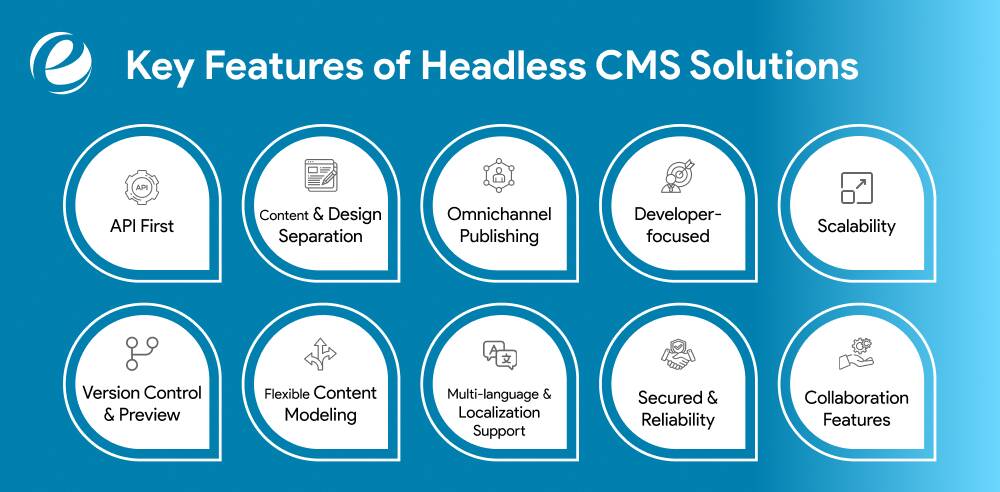
Below are some crucial features that made Headless CMS powerful and easy to work for modern businesses:
1. API First
In a headless CMS solution, content is delivered to any device (from web page to app to smartwatch) using application programming interfaces (APIs), such as REST or GraphQL.
2. Content & Design Separation
Separating content from the design so that your team can update text, images, or blogs without involving code.
3. Omnichannel Publishing
Create content once and push it everywhere, including the website, mobile app, social media, and digital displays, with just a few clicks from a centralized dashboard.
4. Developer-focused
Headless CMSs provide developers with total freedom to build unique experiences using any tools and frameworks they prefer, including React, Vue, or Next.js.
5. Scalability
Headless CMS solutions grow along with you. From 1K users to 1M, they can handle traffic while providing faster performance.
6. Version Control & Preview
You can keep a complete record of all content changes made, with a preview of any updates ahead of publishing and a simple rollback option if needed, much like Google Docs for content.
7. Flexible Content Modeling
You can set your content structure according to your requirements—pages, products, blogs, or anything else—using reusable content blocks and custom fields.
8. Multi-language & Localization Support
You can easily manage content in multiple languages, making it a perfect fit for companies with a global audience focus.
9. Secured & Reliability
With no backend open for public access, your content is all the more assured. Plus, most Headless CMSs have in-house security and backup.
10. Collaboration Features
Your content team, editors, and developers can all collaborate in real-time and not trip over each other.
Difference Between a Headless CMS And a Traditional CMS
Well, for better consideration and difference, we create a table that explains the actual difference between a Headless CMS and a Traditional CMS in simple terms:
| Feature | Headless CMS | Traditional CMS |
| Definition | A CMS where the content is stored separately from the presentation layer (front-end). | A CMS that combines both content storage and front-end presentation. |
| Content Management | Focuses purely on managing content. The content is delivered via an API to any front-end. | Manages both content and the design of how it’s presented to users (front-end). |
| Flexibility | Very adaptable — enables content delivery not only to websites but also to applications and other delivery platforms (e.g., smart devices, IoT). | Not flexible — confined to delivering content to a specific website. |
| Technology Stack | Compatible with almost any programming language and framework. | Pre-installed tools and templates incorporate specifications, restricting flexibility to any one technology stack, such as PHP, HTML. |
| Front-End Control | There is no control over how the contents are presented (the front is separated, so you control that part). | Direct control over both the content and its display (front-end tied to CMS). |
| Ease of Use | Usually, it requires developers to build the front end differently. | Easier for nontechnical users; everything is built-in for you. |
| Speed and Performance | Faster and scalable enough due to appliances with the concentration of application on content utilization through an API. | While slower because the content and the design tightly bond and, consequently, the design can become voluminous. |
| Examples | Contentful, Strapi, Sanity, Ghost. | WordPress, Joomla, Drupal. |
| Use Cases | Perfectly suitable for websites and applications services that should deliver content over multiple platforms. | Ideal for simple websites and applications that are not highly customizable for different purposes. |
| Customization | Highly customizable and requires more development work for a tailored solution. | Offers limited customization without additional coding. |
In short, headless CMS solutions focuses just on organizing content and allows flexibility for creators to determine how to display the content, while a Traditional CMS provides both content management and the way it’s shown on a website, which makes it easier for non-technical users but less flexible overall.
Note: Do you want to know how to create text images category block CMS in admin? If you are interested then consider this guide.
What is the Difference Between a Headless CMS and a Decoupled CMS?
The emergence of decoupled CMS is a reflection of headless CMS. Some of those traditional CMS merchandisers have built APIs on top of their systems and marketed them as “decouples.”
Often, the above terms get interchanged but completely have different meanings. A headless CMS solution exists where content and code have been separated, but it hasn’t got a frontend presentation layer attached to it. A decoupled CMS also separates content from code but is connected in some manner to a presentation layer or head.
What this practically rages down to is that content from a headless CMS can be used anywhere, and everywhere it is required, regardless of the presentation layer. A decoupled CMS separates content from code and thereby gains some flexibility, but it still has to be linked with a final presentation format, most frequently a website.
Top 7 Headless CMS Softwares in 2025
1. Contentful
- Founded: 2013
- User Base: In 2021, Contentful counted over 30,000 members internationally: developers and content creators.
- Key Metrics: Contentful is housing about 200,000 digital experiences across industries.
- Official Website: https://www.contentful.com/
2. Contentstack
- Founded: 2018
- User Base: Many enterprises have taken advantage of Contentstack; user numbers, however, are not stated to any public body.
- Key Metrics: The “Best Headless CMS” award for 2020 was given to the platform for its robust functionalities.
- Official Website: https://www.contentstack.com/
3 Sanity.io
- Founded: 2015
- User Base: Sanity.io served an ever-growing community of developers and content teams of users increasingly adopting its platform.
- Key Metrics: The platform is reputed for its features that allow real-time collaboration and flexible content modelling.
- Official Website: https://www.sanity.io/
4 Storyblok
- Founded: 2017
- User Base: Storyblok has grown rapidly across more than a hundred countries, including many famous brands such as Adidas and Oatly.
- Key Metrics: The platform supports more than 100,000 users and is a recognized leader in the headless CMS market.
- Official Website: https://www.storyblok.com/
5 Hygraph
- Founded: 2018
- User Base: Hygraph includes a variety of clients around the globe, but user numbers have not been published.
- Key Metrics: The platform contains features like multi-region content delivery, advanced localization, and the serving of content in over 40 global markets.
- Official website: https://hygraph.com/.
6 Prismic
- Founded: 2013.
- User Base: Prismic has served thousands of companies over the last 10 years as a website maker.
- Key Metrics: It has received 21 excellences from G2, thus proving its credible industry reputation.
- Official Website: https://prismic.io/.
7. Uhbraco
- Founded: 2004
- User Base: Worldwide, Uhbraco serves 700,000-plus websites, especially strong in Europe.
- Key Metrics: Community-enriching offerings are cloud and on-premises, with more than 200,000 members.
- Official Website: https://umbraco.com/
Use Cases for Headless CMS
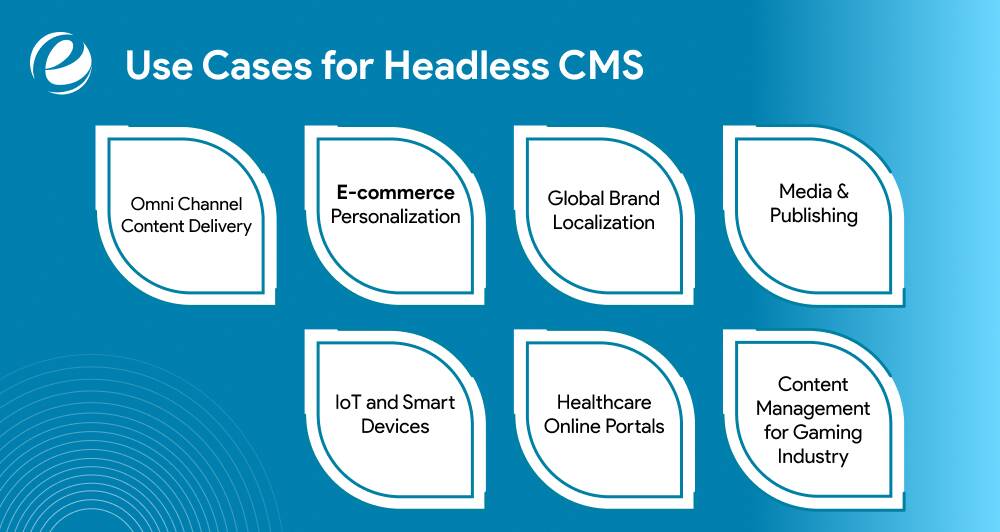
1. Omni Channel Content Delivery
Companies like Nike use headless CMS solutions to manage content across websites, mobile applications, smartwatches, and in-store digital signage. This method ensures consistency across the brand while also enabling content updates with little time and effort and without changing the entire system.
While content would be created and delivered quicker, developers and marketers are able to act independently. The API-first modus operandi ensures the right content is delivered to the right user at the right time using their device and location. A/B testing and constant data-centric optimization allow user engagement to improve. Thus, it gives Nike a consistent experience with room for customization across the digital and physical spheres.
2. E-commerce Personalization
Target relies on a Headless CMS to manage product listings, descriptions, customer reviews, and promotions in real-time for various platforms. E-commerce businesses need quick updates to their content, and the headless approach ensures smooth syncing across mobile apps, websites, and third-party marketplaces.
This makes any such change easy to implement year-round regarding promotions, customized recommendations, and localized pricing without affecting backend systems. AI-engines touch into the CMS to personalize shopping experiences relative to user behaviour and preferences. It also accelerates page-load times via API-first mechanisms that store lightweight structured data. Target can also experiment with new digital storefronts and UI designs without adversely affecting backend operations.
3. Global Brand Localization
Coca-Cola, a brand that prides itself on being truly global and omnipresent in different markets, has adopted Headless CMS solutions that offer the most efficient localized content management. The centralized repository helps greatly in maintaining brand consistency while allowing regional changes to be made. The CMS delivers language-specific content dynamically, based on the user’s geographical location and browsing preferences.
Local marketing teams should be able to create, edit, and launch campaigns tailored to their own target audience–but without compromising the global identity of the brand. This flexibility allows Coca-Cola to easily run distinct local promotions, update product details, and even change messaging to suit different cultures. Hence Coca-Cola remains active worldwide while presenting uniformity in brand presence in all markets.
4. Media & Publishing
The New York Times uses a Headless CMS to distribute news articles and editorial content across digital media platforms, including its website, mobile apps, Apple News, and Google AMP. The decoupled content structure serves to let journalists focus on optimizing content creation, with developers honing its presentation toward the different platforms.
Real-time API-driven updates allow breaking news to be everywhere else in an instant, without exceptions. The CMS also houses personalized recommendations for content to increase reader engagement and retention. For subscription models, seamless delivery of content enriches the user experience.
5. IoT and Smart Devices
Using headless CMS solution, Tesla manages content updates within its in-car infotainment systems, which enables a smooth experience for drivers. Unlike any other CMS format, the headless way allows software updates, UI shifts, and new functionality downloads without a complete reboot of the system. In real-time, the CMS runs new applications for navigation updates, voicing assistants, music streaming services, and even several dashboards with vehicle information. Through an
API-based content delivery model, Tesla assures that drivers always have an up-to-date and enriching flavor of infotainment without compromising a bit on the performance of their vehicles. Adding over-the-air updates opens the way to new functionality without adding friction to the overall driving experience of that user.
6. Healthcare Online Portals
A Headless CMS is a way by which Mayo Clinic engages in the delivery of updated and reliable medical content over websites, mobile apps, and chatbots powered by AI. A good, strong, robust content management system is central to the needs of health organizations in offering resources on accurate medicine, treatment guidelines, and even patient education material.
Being a headless architecture, it allows live updates over the web for disease outbreaks, medical research, and upcoming trends in healthcare. With the assurance of HIPAA compliance for data protection, it seamlessly personalized content according to the needs of patients. It puts voice assistants and AI-based chatbots into action by providing instant medical information to users.
So, using a headless architect, Mayo Clinic makes the information more accessible to patients, allowing them to verify credible health information across all digital touchpoints.
7. Content Management for Gaming Industry
Epic Games uses a Headless CMS for management of in-game content updates, live announcements, and downloadable expansions. The CMS enables real-time updating without causing interruptions to the performance of the game so that players are not disturbed while playing. It also allows for creating content of local interests, including localized in-game promotions, new feature rollouts, and event notifications.
With API-driven content management, Epic Games can update leaderboards, game news, and player rewards across PlayStation, Xbox, PC, and mobile. In addition, new skins, characters, and game modes can now be introduced without undergoing frequent software patching. This flexible, scalable approach enhances user engagement and ensures that every gaming experience is fresh.
Implementation Steps of Headless CMS for Your Business
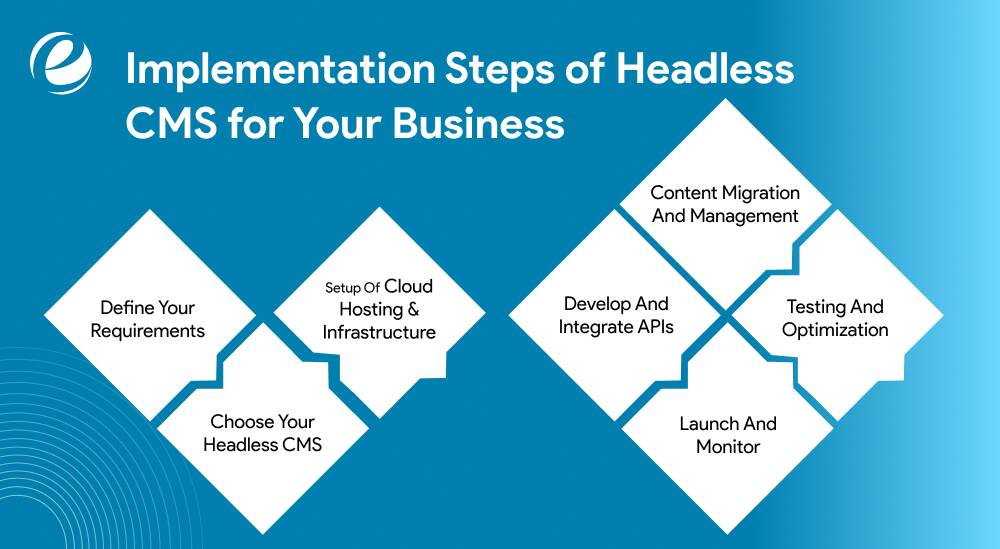
1. Define Your Requirements
Identify your objectives regarding headless CMS. Specify those requirements, such as the provision of multi-channel content delivery and seamless integration with existing systems.
2. Choose Your Headless CMS
your ideal match from a wide assortment of sources, including Contentful, Strapi, or Sanity- on the basis of flexibility, scalability, and ease of use.
3. Setup of Cloud Hosting & Infrastructure
Decide about self-hosted or cloud-hosted solutions ensuring safety and performance.
4. Develop and Integrate APIs
Integrate all your platforms, whether frontend frameworks, mobile apps, or else using APIs and use those in-couplings to flow all your content seamlessly.
5. Content Migration and Management
Put the information into the new CMS from its older version and organize it properly. Set up all workflows for easy access and updates.
6. Testing and Optimization
Ensure thorough testing of response from APIs for speed of content delivery and for overall integration; these must be performed before nationwide deployment.
7. Launch and Monitor
Implement the system, have staff trained on it, and provide consistent and continuous performance monitoring for improvement.

Cost of Implementing of Headless CMS
The implementation cost of Headless CMS solutions includes various factors, including setup, development, integration, and maintenance. The complete Headless CMS implementation cost depends on the selected platform, hosting, API usage, and customization requirements. Below is a breakdown of potential costs associated with Headless CMS implementation.
| Cost Component | Estimated Cost Range | Description |
| CMS Subscription | $0 – $3,000/month | Free (open-source) options or premium plans like Contentful, Strapi, or Sanity. |
| Hosting & Infrastructure | $10 – $500/month | Cloud hosting (AWS, Vercel, Netlify) or self-hosted solutions. |
| Development & Integration | $2,000 – $50,000 (one-time) | Costs for developers to integrate APIs, front-end, and backend systems. |
| Content Migration | $1,000 – $10,000 (one-time) | Moving existing content into the new CMS and structuring it properly. |
| Plugins & Extensions | $0 – $2,000 (one-time or monthly) | Additional tools for SEO, analytics, or automation. |
| Maintenance & Support | $500 – $5,000/year | Ongoing updates, security patches, and technical support. |
| Training & Onboarding | $500 – $5,000 (one-time) | Educating teams on CMS usage and workflows. |
Total Estimated Cost:
- Small Business: $2,000 – $10,000
- Mid-Sized Business: $10,000 – $50,000
- Enterprise: $50,000+
Note: Do you also want to know in detail about Adobe experience manager then you can consider this Adobe experience manager guides, this will help you.
Why Invest in Headless CMS for Your Business?
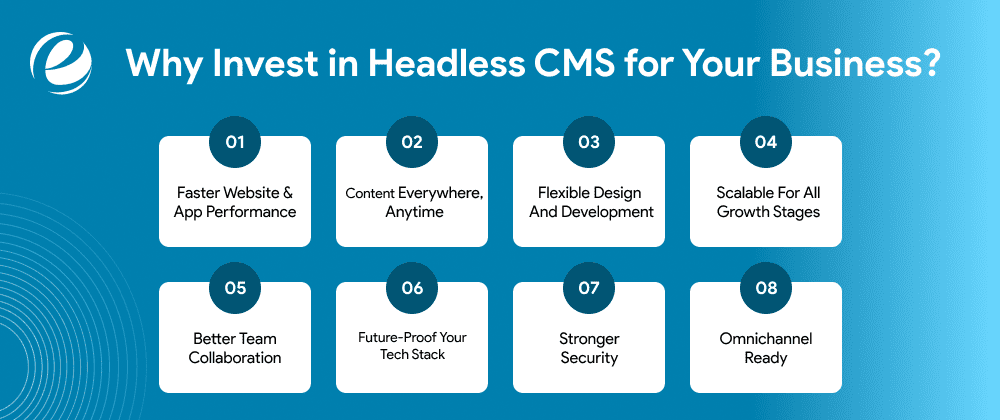
Here are a few reasons why a headless CMS solution is worth an investment. Look at these pointers and make up your mind to invest your money in this system.
1. Faster Website & App Performance
A Headless CMS decouples content from design, thereby developing faster-loading pages — a win-win for user experience and SEO.
2. Content Everywhere, Anytime
You can publish your content to the web, mobile apps, smart devices, etc., all in one shot.
3. Flexible Design and Development
These developers are free to create custom experiences without restrictions imposed by an inflexible CMS structure.
4. Scalable for All Growth Stages
Whether a baby start-up or an already established growth company, headless CMS solutions will easily give you more traffic, more content, and more platforms to thrive.
5. Better Team Collaboration
Your content and development teams can work in parallel to give updates without waiting on each other.
6. Future-Proof Your Tech Stack
Tech modifications quickly. A Headless CMS allows you to update or change a tool without an entire overhaul of your system.
7. Stronger Security
There’s less risk of direct attacks on your live website because the backend content is separate from the frontend.
8. Omnichannel Ready
A headless CMS solution makes it extremely easy if you want to be present everywhere: web, mobile, voice assistants, etc.
Why Choose EmizenTech for your Headless CMS Solutions?
Choosing a partner for your headless CMS needs is the first step toward creating a seamless content management experience. Here is why we are different:
1. Expertise & Innovation
Our qualified developers develop custom-made headless CMS solutions that facilitate seamless integration while ensuring future-proof performance.
2. Scalable & Omnichannel Approach
Our professionals deliver web, mobile, IoT and beyond content with a CMS that will grow with you.
3. Customization & Flexibility
We develop CMS solutions that suit your requirements and support frameworks such as React, Angular, and Vue.js.
4. Security & High Performance
We ensure secure and fast content delivery with encrypted APIs, role-based access, and optimized speed.
5. Seamless Integrations
Connect easily to CRMs, e-commerce platforms, analytics, and marketing tools to run a smooth workflow.
6. Cost-Effective & Time-Saving
Our expert developers believe in sharing content across different platforms and saving both development time and operational costs.
7. Dedicated Support
We at Emigentech’s continuous support, maintenance, and updates keep your CMS efficient and reliable.
Nutshell
A headless CMS solution provides a business with flexible, scalable, and seamless content delivery across multiple platforms. Choosing the solutions derived from the expertise of our experts ensures you have a safe, high-performance system that is customized to your needs. Just as integrations are enormous, so is managing costs and support dedicatedly. Nothing shall stay behind your content strategy as it rolls into the digital world.
Our headless CMS solutions are helping enterprises enhance user experiences through efficient and effective management of digital assets, save costs by reducing the time of initial deployment, and reduce content management time across digital channels such as web, mobile, and many more. From a startup to an enterprise, our headless CMS evolves and grows with your changing needs. Let us help you in developing a headless CMS system.
Want to upgrade your content management system? Get in touch with us today!
FAQs
What is a headless CMS, and how does it differ from a traditional CMS?
A headless CMS consists essentially of a Content Management System involved in its use beyond the display. As opposed to a classic CMS, its content is presented through APIs for a greater diversity of delivery channels, such as web pages, mobile applications, and even IoT devices.
What are the best benefits of using headless CMS solutions?
The benefits of using this headless CMS include omnichannel content delivery, improved scalability, faster response times, improved third-party integration, and an overall better customization scope. This means that the organizations can formulate new excellent engaging digital experiences.
Is a headless CMS ideal for all businesses?
Absolutely, a headless CMS is then appropriate for startups, enterprises, e-commerce organizations, media companies, and non-profit organizations whose content falls under different platforms. This solution suits businesses that view content flexibility and scalability as very significant and personalized experiences.
How secure is a headless CMS in comparison to a traditional CMS?
A headless CMS provides better security than a traditional CMS because it decouples the back end from the front end, minimizing the possibilities of direct database access and plugin attacks. Prevented from presenting anything by itself, it becomes less vulnerable to everyday SQL injection and cross-site scripting (XSS). Nonetheless, this security relies on protecting the API and authentication mechanisms and ensuring good implementation by others.
How much does it cost to design a headless CMS solution?
The cost of developing headless CMS solutions is different based on the features and the integrations. Other interpretations in pricing are due to the differences in the required levels of customization and the various effects of API and other development costs, security, and ongoing maintenance. Contact us for personalized pricing according to your business needs.


 +1 (989) 535-9295
 info@emizentech.com
 emizentech


