
 Add us as a preferred source on Google
 Have you ever wondered how financial institutions or banks keep track of millions of customers’ information and manage to offer personal services? Well, CRM in Banking Industry plays a vital role; hence, modern customer relationship-management systems (CRM) are tools that are helpful for banks and all, used to run their business, and to manage millions of individual records.
With the help of this article, you can get complete knowledge about CRM software for banks, which will be explained and understood in terms of what it is, why it is essential, and the main features that it presents. You’ll also discover how partnering with expert CRM developers can help your bank grow and stay competitive.
Consequently, you will understand the meaningfulness of the banking customer relationship management solutions that are instrumental in customer-acquisition and retention activities, as well as invaluable in the adaptation to modern digital business.
Future Outlook: CRM in Banking Industry (2025–2033)
The CRM in banking industry will witness a massive surge during the period 2025-2033, owing to factors including next-gen customer experiences and the application of AI and machine learning in the Banking Industry.
Key Market Projections
- Market Size Growth: According to Spherical Insights, the global market for Banking CRM Software is set to increase from $33.01 billion in 2023 to $60.52 billion in 2033, showing a CAGR of 6.25%.
What is a CRM in Banking Industry?
A CRM in banking industry is a Customer Relationship Management system that is specifically built for banks and financial institutions. It helps banks maintain customer information, follow their interactions, and create better relationships with clients. This system allows banks to propose personalized and specific services to customers, to gain a better insight into the customer’s needs, and to increase customer satisfaction.
Automated Banking CRM Software enables banks to perform administrative tasks, keep an eye on customer activities, and provide targeted services such as offers for loans or investment advice. These tools also empower customer service teams to be quicker and more efficient when handling queries. Armed with CRM services, banks can not only achieve customer satisfaction but also enhance customer loyalty and achieve long-term performance effects.
These systems are one of the most essential components in the digital transformation of present-day banking, regardless of the source of their origin (i.e., a CRM software development company that offers a CRM solution, etc.).
Key Features Of Banking CRM Solutions
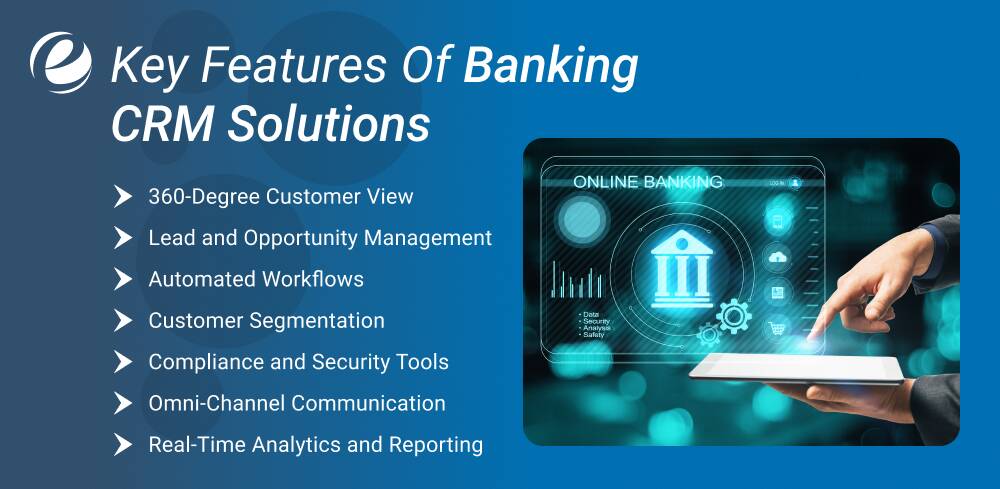
Traditional customer management systems cannot satisfy the extensive demands of the modern bank. At this point, Banking CRM Solutions come out as they offer rich functionalities that permit banks to understand their customers better, standardise services, and bring up the efficiency to an even higher level. Here are some of the main features of CRM software for banking industry
1. 360-Degree Customer View
A Banking CRM provides not only the data of each customer’s account but also their transaction history, communication record, preferences, etc.
Why it matters: With this fully detailed figure, bank employees can meet the customers’ needs more personally and efficiently, thus being in a position to create customer trust and loyalty.
2. Lead and Opportunity Management
This feature allows banking institutions to keep track of new customer inquiries, make follow-up communications for leads, and win sales opportunities such as loan applications or credit card offers.
Why it matters: It makes sure that no lead from a potential client is lost in the process of transforming it into a customer.
3. Automated Workflows
CRMs in the banking sector churn out follow-up emails, reminders for renewals, or service alert notices through software automation.
Why it matters: Automation makes it easier for bank staff to be on time and use the same language all the time, thus they can handle all the communication in a quick and consistent manner.
4. Customer Segmentation
CRM offers several criteria for segmenting its customers, such as behaviour, preference, location, financial status, etc.
Why it matters: Automation saves time and reduces errors, helping banks offer timely and consistent communication.
5. Compliance and Security Tools
On the avenue to excellence in banking, CRM software, and amongst its top features, the security of customer data and effective ways to respect the customer’s privacy by the banks (KYC) and GDPR rules emerge.
Why it is important: In the banking industry, customer data protection and compliance with the laws are the two issues that should always be top priorities.
6. Omni-Channel Communication
Banking CRM is at a stage where coexisting via multiple channels (i.e., email, SMS, calls, chatbots, and even mobile apps) is achievable.
Why it matters: Clients can reach out to their bank on the platform with which they are comfortable, thereby increasing satisfaction and support quality.
7. Analytics and Reporting
A good CRM solution can provide live input on customer trends, employee performance, and the quality of services.
Why it matters: Leaders will have the opportunity to come up with the right solutions and be quicker at detecting problems. Consequently, they will enhance the banking industry with factual and not exaggerated data.
Moreover, using these features, banks not only enhance customer experiences but also drive customer engagement in the fast-paced) market. By collaborating with a professional CRM software development agency or company, banks can develop their CRM systems to be responsive and align with their unique needs and business objectives.
Step-by-Step Guide to the Banking CRM Process
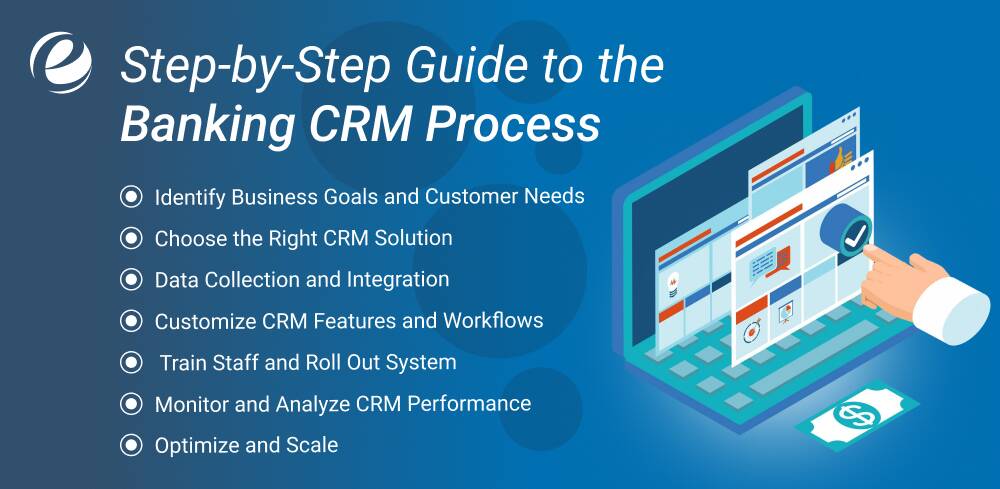
An effective customer relationship management system built in the banking sector is composed of several consistent steps. These steps have helped banks to improve customer experiences, to simplify their operations, and to increase their services cost-effectively. Here is a simple, step-by-step iteration of the Banking CRM process:
1. Identify Business Goals and Customer Needs
The process is initiated by outlining the goals to be achieved by the bank, for example, customer service enhancement, product sales increase, or response time gain. Concurrently, customers’ desires and dissatisfactions should be paid attention to.
2. Choose the Right CRM Solution
Bankers have to choose a CRM system that is industry-specific and fits the operational requirements of the banking sector. This may mean buying a tool off the shelf or going to a software development company or agency to create a system.
3. Data Collection and Integration
Next, the data is collected from different customer touchpoints, e.g., websites, mobile apps, call centres, and branch visits, and then it is matched in the CRM system to create only one view for the data.
4. Customize CRM Features and Workflows
The CRM is adjusted according to the bank’s processes. This might involve adding tools such as automated reminders, lead management tools, or custom dashboards that are adjusted to various sections.
5. Train Staff and Roll Out System
The employees are being taught how to make the best use of CRM. Once the training is completed, the system is released in the various arms or outlets of the bank.
6. Monitor and Analyze CRM Performance
After the implementation, the bank keeps checking its performance with the help of analytics and reports. This gives an idea of not only whether the CRM is supportive of customer service and business operations but also how well it does so.
7. Optimize and Scale
Based on the performance figures, CRM is now optimised and scaled to cover the business expansion requirement. Usually, banks work with CRM development companies to enhance features and expand system capabilities.
Financial institutions or banks can completely revamp their customer relationship with the help of this step-by-step CRM process. Through the assistance of proficient CRM development companies, they can create effective techniques that will produce customer loyalty and additional income.
Use Cases Of Banking CRM Software
Banking CRM Software is designed to handle a wide range of tasks outside of just customer support. It helps banks improve operations, boost customer satisfaction, and increase sales. Here are some everyday and powerful use cases of CRM in the banking industry:
1. Customer Onboarding
Customer Relationship Management software creates an innocent and straightforward path for new customers entering your bank.
A bank powered by a CRM system can carry out automatic customer registration actions, such as data gathering, know-your-customer verification, and account establishment. Clients stay informed on time and get the help they need during their journey, which makes their banking with the bank for the first time wonderful and meaningful.
2. Lead Management and Conversion
Banks have the possibility to keep track of and guide potential customers down the path from the first interaction to the acquisition of loyal clients.
The software application revolves around customer relationship management, which is responsible for storing and distributing leads. It also helps in keeping the leads properly followed, meaning that no potential clients are left untouched.
3. Customer Service and Support
CRM systems step up the way banks communicate with their clients regarding the services they provide and handle the problems they face.
The given dataset and conversations database provide an easy way for support teams to reach the relevant data quickly. Through this, the team is quicker in responding and has a high level of accuracy, thus creating a high satisfaction index among customers and trust.
4. Personalized Product Offers
Banks are actually the ones using CRM data to lead customers to the right financial services and products that they need the most.
Having the information about customer behaviour, their payments, and chosen products, a CRM tool not only confirms the product options but also shows features and advantages of the service, and so on. This means that the main difference between the services or products offered is the subject, which makes the service more attractive to the customer and prompts the customer to make the purchase.
5. Cross-Selling and Upselling
With the help of CRM software, banks can market additional products/services to customers who possess accounts with them.
A customer having a savings account triggers the system to offer a loan or a fixed deposit plan. Such personalized offers are targeted to a customer’s specific profile and needs, thus being the go-to source for more earnings.
6. Relationship Management for High-Value Clients
Banking establishments make use of platforms utilising CRM to give priority service to their premium or high-value clients.
A manager who is fully committed to the customer can not only note down the clients’ passions and problems but also can suggest and provide necessary support to them. At the end of the day, this will not only improve loyalty and prolonged engagement but also lead to customer satisfaction.
7. Regulatory Compliance and Risk Management
Using CRM, banks remain compliant with financial regulations and are also able to identify, evaluate, and manage hazards adequately.
It ensures that all client details are saved in a manner that is in line with the requirements of the Financial Action Task Force and Anti-Money Laundering regulations or the Basic Law of the European Union on Data Protection. Alerts, as well as the right to inspect the records kept, will enable the banks to make fewer mistakes, comply with laws, and be safe from legal actions.
Why is EmizenTech Your Go-To Partner for Banking CRM Services?

Selecting the right CRM partner has the potential to be a game-changer for the level of customer interaction and service growth at your bank. The Banking CRM Solutions from EmizenTech are customer-specific and designed to cover all the different requirements of the range of products, such as both retail and private banking, or credit unions.
Not only that, the CRM systems offered by EmizenTech are also intelligent, scalable, and secure to ensure that their customer relationships are positively transformed.
- We don’t take an approach that is one size fits all. Our developers construct CRM systems that meet your bank’s specific needs, communication strategies, and customer engagement.
- Our Banking CRM Solutions have made it very easy to integrate your present banking software, mobile apps, and third-party services, resulting in an uninterrupted operation of the business processes.
- By applying AI (Artificial Intelligence) along with data analysis, we create the possibility for banks to receive the current behaviour of customers, which has been a key input for offering the right products and services at that moment, and for extending efficient and timely support.
- When it comes to security, our CRM systems consist of a set of compliance tools (including KYC, AML, and GDPR), and they are also equipped with strong data protection features that will ensure both the bank and its customers’ safety.
- Be with your clients no matter what channel of communication they opt for; email, SMS, mobile apps, and web portals, with a tool that not only does the tracking from the different platforms but also has a communication automation feature that is centered.
- We provide the full scope of CRM services, beginning from analysis & design and ending with development, release, and support, led by our consultants and developers.
- If the bank expands, the CRM system should grow in parallel. Our products are both flexible and scalable, which can adapt well to the ever-changing digital service expansion in the future.
If you have EmizenTech as your CRM technology partner, you are not acquiring software only, you are buying a CRM solution that will work in your bank’s favor, make the delivery of services strikingly good, build a lot of strong and long-lasting customer relationships, and keep you ahead of the competition as well.
Final Words
The banking industry must be quick to implement changes due to the ever-increasing customer expectations of today’s digital world. A robust CRM software for the banking industry
Furthermore, the application of Banking CRM Software gives the banking sector an opportunity to form solid relationships with its clients and, at the same time, adhere to efficient solutions.
The growth and customer satisfaction of both a traditional bank and a digital-first institution will be significantly impacted by the right Banking CRM Solutions. In addition to this, it is a key point that the company is dealing with a technical development company, such as EmizenTech, to obtain not just the best CRM systems but also the ones that are customised, secured, and future-proof.

FAQs
How much does Banking CRM software cost?
It’s best to get a quote from a trusted CRM software development company as the cost of the software can differ based on features, customization, and company size. Simple solutions can set you back a few thousand dollars, but those that are tailor-made may set you back a bit more.
How long does it take to implement a Banking CRM system?
Simply put, the time required to implement a new CRM system directly correlates to its complexity. In general, the most straightforward CRM setup can work in a few weeks, while a complete custom solution may take a bit longer, from 3 to 6 months or even longer.
What technologies are used to build Banking CRM software?
The following are the standard technologies: Frontend: React, Angular, or Vue.js for user interfaces Backend: Java, .NET, Node.js, or Python for business logic Databases: SQL Server, MySQL, or MongoDB for storing data Cloud Platforms: AWS, Azure, or Google Cloud for hosting and scalability AI & Analytics: Machine learning tools for customer insights and automation
Can CRM be integrated with mobile banking apps?
Yes, CRM systems are typically designed to be easily combined with mobile apps so that customers can experience a seamless journey through a variety of channels.
Is it possible to upgrade or scale the CRM system later?
Yes, the latest CRM applications have been developed with the ability to scale in mind. This makes it possible for banks to not only extend the functionality of the system by adding features but also to serve a larger client base, as the business continues to grow.





 +1 (989) 535-9295
 info@emizentech.com
 emizentech


