 Add us as a preferred source on Google
 A few years ago, most B2B buyers still depended heavily on sales calls, emails, and manual ordering processes. Today, business customers expect the same convenience they get from consumer eCommerce websites: fast search, personalized pricing, mobile-friendly ordering, and real-time inventory visibility without waiting for a sales representative.
The global B2B eCommerce market is about to increase to 36.86 trillion in 2026 and continues growing as manufacturers, wholesalers, and distributors invest heavily in online commerce. However, the buyer behavior is also changing: around 83% of B2B buyers now prefer ordering through digital channels, while most buyers research products online long before speaking with a sales representative.
In this guide, you will learn about B2B eCommerce website development in 2026, including platforms, features, trends, integrations, challenges, and strategies that actually support the long-term growth of your business.
What Is B2B Ecommerce Website Development? Why Does it Matter?
B2B eCommerce website development is the process of creating an online platform designed for business-to-business transactions. It focuses on complex purchasing needs such as bulk orders, custom pricing, and secure account management.
There are some reasons why eCommerce website development matters:
- Automating the sales process allows for handling more orders without proportionally increasing staff.
- The digital transformation becomes necessary, so having a robust online portal prevents revenue leakage faster.
- It can replace the slow and manual process with a digital workflow with the help of some automation tools.
So, to implement these functionalities on your website, you have to choose the right partner for guidance for a better business-to-business interface.
Must-Have Features of a B2B Ecommerce Website
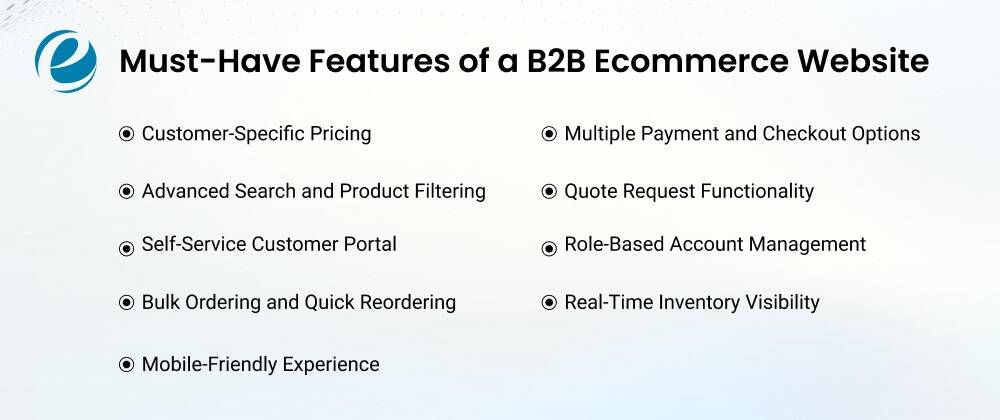
A successful B2B eCommerce website needs speed, accuracy, personalized pricing, and smooth purchasing workflows. The best B2B eCommerce websites are the ones that remove friction quietly in the background while making complex buying processes feel surprisingly simple through effective wholesale website design strategies.
Customer-Specific Pricing
B2B buyers work with negotiated contracts, bulk discounts, and account-based pricing structures. A strong B2B eCommerce website should allow businesses to display custom pricing automatically for different customer groups.
Advanced Search and Product Filtering
Most B2B buyers already know what they’re looking for before visiting a website. That’s why advanced product search matters so much. Fast SKU search, technical filters, product specifications, and intelligent category organization help buyers place orders faster.
Self-Service Customer Portal
Modern B2B buyers prefer handling routine tasks without depending on sales representatives constantly. A self-service portal allows customers to reorder products, track shipments, manage invoices, download documents, and update account information independently.
Bulk Ordering and Quick Reordering
B2B customers rarely purchase single products one at a time. Many buyers place large-volume orders or reorder the same inventory regularly. Features like quick order forms, bulk uploads, saved carts, and one-click reordering make the buying process significantly faster.
Mobile-Friendly Experience
Buyers research products, check inventory, or approve orders directly from their phones during work hours. Websites that load slowly or feel difficult on mobile devices usually create unnecessary friction, especially for returning customers trying to complete urgent purchases quickly.
Multiple Payment and Checkout Options
B2B payment processes are more complicated than standard eCommerce transactions. Businesses require purchase orders, invoice-based payments, credit terms, bank transfers, or partial payments instead of simple card checkouts.
Quote Request Functionality
Many B2B purchases involve custom pricing discussions before checkout happens. Quote request functionality allows buyers to negotiate pricing, discuss bulk quantities, or request custom procurement terms directly through the website.
Role-Based Account Management
B2B purchases involve multiple employees within the same company account. Role-based permissions allow businesses to assign different access levels for procurement teams, finance departments, managers, or administrators.
Real-Time Inventory Visibility
Inventory accuracy matters heavily in B2B eCommerce because delayed or unavailable stock can disrupt entire business operations. Buyers expect real-time inventory updates before placing orders, especially for high-volume or recurring purchases.
B2B Ecommerce Website Development Process
The development of a B2B website is a strategic process focusing on complex functionality and system integration, especially for enterprise eCommerce platforms. Below, you will see the development methods you need to scale your website from scratch:
Step 1: Planning & Goals
Firstly, you have to define the real objective for the development that you want to achieve with B2B eCommerce and identify the target audience.
Step 2: Platform Selection
In this phase, you have to select a platform that supports your B2B features and goals for the desired business outcome that are reliable for business needs.
Step 3: System Integration
Select the integration components you want to link to your website, which are ERP, CRM, and inventory systems, to automate the workflows.
Step 4: Feature Prioritization
You must focus on the crucial B2B functionalities that improve your website’s functionality and improve the efficiency of the products and services.
Step 5: UX Design
Always prioritize a smooth experience for the users, including fast and simple navigation and ordering processes for seamless workflow.
Step 6: Testing
You have to conduct extensive testing for the security checks to identify the loopholes in your website, and also you can implement robust measures like SSL certificates.
Step 7: Launch and Optimize
At last, launch the site and monitor the performance regularly by checking the analytics tools to refine the user experience.
So, with the help of this process, you can easily develop a B2B eCommerce website for your business with all the functionalities.
Custom B2B Ecommerce Website Development vs Ready-Made Platforms
You all know that choosing between custom and ready-made options presents a significant challenge, balancing total control with speed to market. However, consider analyzing your business carefully to manage things more smoothly.
Custom B2B eCommerce
Custom B2B eCommerce development is the process of building an online storefront from scratch to meet the business requirements. It is designed to align with the business’s existing workflow, rather than forcing the business to fit into a pre-existing template.
Key Advantages:
- Strategic Control: You can easily handle the coding area without tying yourself to a vendor’s roadmap.
- Advanced B2B Logic: The website can easily handle the negotiation of prices, multi-user accounts, and real-time ERP and CRM sync.
- Optimized Performance: The custom store sees 20-35% higher long-term ROI and better SEO.
Ready-Made Platforms
These are the B2B SaaS solutions that are pre-developed platforms, like Shopify Plus and BigCommerce. It provides a set of standard features using templates for design and offers a plug-and-play experience with limited core code flexibility.
Key Advantages:
- Speed and Affordability: You can deploy quickly with the help of pre-built templates and lower initial costs.
- Security and Stability: The platforms provide managed security patches, payment certificates, and server updates.
- Ecosystem: You can access thousands of pre-vetted apps and a large community for troubleshooting.
So, for the B2B wholesale solutions, you must consider taking help from a trusted website development company for the custom solutions for long-term stability in this competitive marketplace.
Best Platforms for B2B Ecommerce Website Development
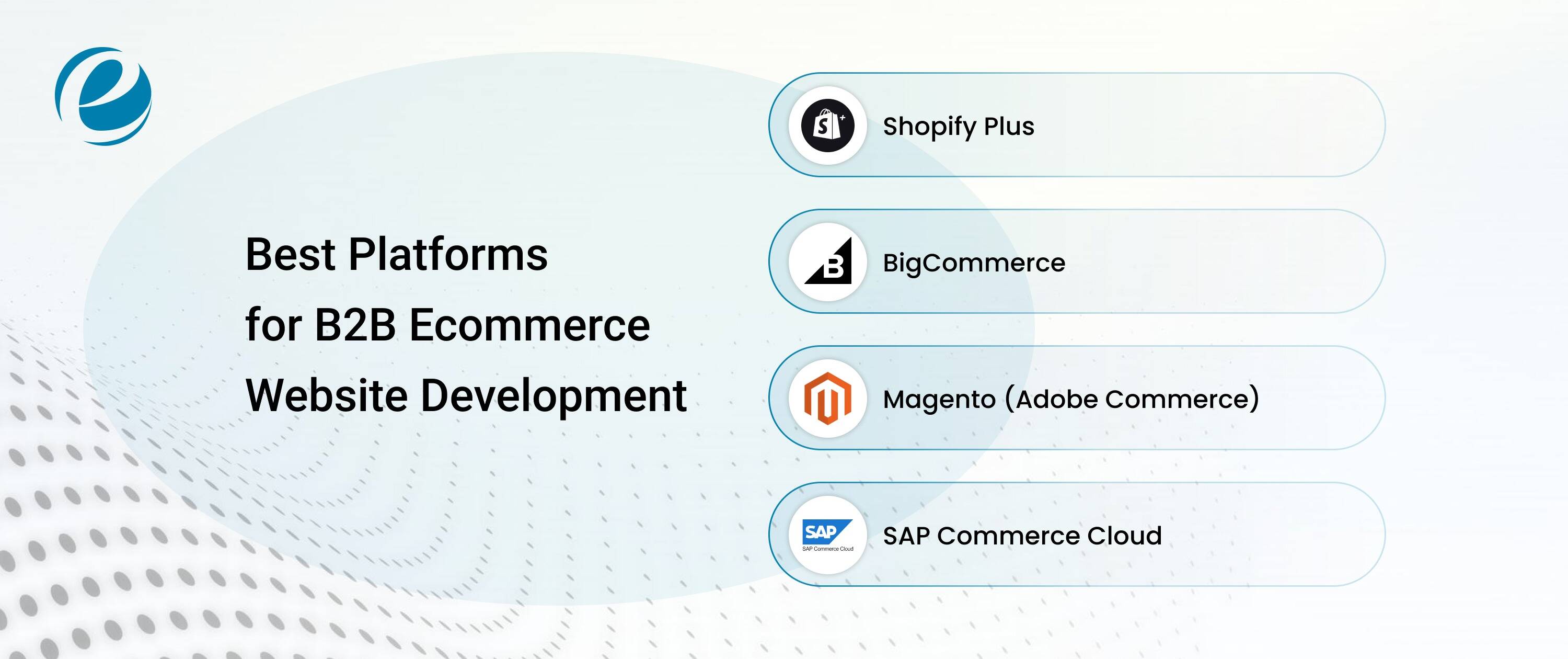
There are so many e-commerce platforms for website development all over the internet that make the process smoother for businesses. Here are some of the best platforms that help you to stand out in this competitive marketplace:
Shopify Plus
Shopify Plus has become a popular choice for B2B eCommerce website development because it’s relatively easy to manage compared to heavier enterprise platforms. It works well for the companies that are handling both wholesale and direct-to-consumer sales without managing overly complicated infrastructure in the backend. It offers a 29% better TCO than the other development companies.
BigCommerce
BigCommerce is recognized for its Open SaaS architecture that combines the speed and security of a cloud-hosted system with the flexibility of open-source software. The platform supports custom pricing, multi-storefront setups, and flexible integrations quite well. Many businesses choose it because it offers more backend flexibility while still avoiding the maintenance challenges common with self-hosted platforms.
Magento (Adobe Commerce)
Magento for B2B is chosen by businesses with complicated B2B operations and highly specific eCommerce requirements. It gives companies far more control over customization, pricing structures, and buyer workflows than most platforms. This platform enables the sellers to negotiate quotes entirely online and then assist their customers by completing their digital transactions.
SAP Commerce Cloud
SAP Commerce Cloud is built for large enterprises managing complex B2B operations across different regions, warehouses, and customer groups. It’s useful for businesses that are already working within the SAP ecosystem because, with that, the integrations feel more connected. The companies with large-scale operations value the long-term operational stability it provides.
So, these are common platforms, but among these, you have to find the best B2B eCommerce marketplace platform for your online business. However, make sure that they implement all the crucial functionalities that match your goals.
How Much Does B2B Ecommerce Website Development Cost?
The cost of B2B eCommerce website development depends on the complexity of the apps and the features that businesses choose to implement in their projects. With the help of the table below, you can easily identify the general costs of the development:
| Website Complexity | Approximate Costs |
| Basic MVP B2B Site | $10,000-$30,000 |
| Mid-Market B2B Site | $30,000-$100,000 |
| Advanced B2B Site | $100,000-$250,000+ |
So, these are the general costs of B2B eCommerce website development, and for this, you have to focus on the things that can primarily change with the proper timing.
Key Integrations Required in B2B E-commerce Website Development
These are the key integrations that you must include in your B2B eCommerce website development for a smooth client experience:
- ERP Integration: The ERP is used to sync inventory, procurement, and accounting systems to avoid delays. It is used to connect the storefront with the backend system that reduces manual errors.
- CRM Integration: B2B buyers expect businesses to remember their preferences, pricing agreements, and previous orders without constantly repeating information. It helps sales and support teams stay aligned while giving customers a more consistent experience.
- Payment Gateway Integration: A strong payment integration helps reduce unnecessary back-and-forth while making the checkout process feel far less complicated for long-term clients by enabling secure payments.
- Inventory Management Integration: Buyers placing large or urgent orders expect stock visibility to be accurate at all times. This system updates itself according to changes made across warehouses or suppliers.
- Marketing Automation Integration: It helps businesses to stay visible during that process without constantly sending manual follow-ups. The key is making communication feel helpful and timely instead of repetitive or aggressively sales-focused.
Common Challenges in B2B Ecommerce Website Development
The challenges in B2B eCommerce website development revolve around complex processes like backend systems, managing cataogs and customer experience. Here are some of the mistakes that you make at the time of development:
Complex Pricing Structures
Pricing in B2B eCommerce website development rarely follows a single structure. One small pricing mismatch can create confusion quickly when repeat buyers expect the same negotiated rates every single time they reorder.
ERP and CRM Integration Issues
A lot of B2B eCommerce problems actually begin behind the scenes. When ERP systems, CRMs, and eCommerce platforms fail to sync properly, inventory numbers become unreliable and order processing slows down.
Managing Large Product Catalogs
B2B companies continue adding products for years without properly restructuring their catalogs. However, the repeat buyers search for exact SKUs, so even slightly confusing menus can interrupt their purchasing decision.
Poor Mobile Optimization
Many B2B eCommerce projects still overlook mobile optimization, even though buyers constantly check products and reorder inventory from phones. Most buyers simply move on if completing a purchase feels harder than it should.
Customer Experience Expectations
Modern B2B buyers expect eCommerce websites to feel smooth, swift, and personalized from the beginning. Older systems struggle when the customer data stays disconnected across different business platforms.
Security and Data Protection
The platforms handle sensitive contracts, payment information, and customer records daily. Even a small security issue can damage long-term client relationships and create trust problems that take years to rebuild.
So, these are some of the common challenges that you may face during the development process of the website. However, it is crucial to explore the mistakes that B2B businesses commit and ways to overcome them.
Future Trends in B2B Ecommerce Website Development
As the market changes every day, customers want to transition from a manual to an automated system for a smooth process. Below, you will learn about some crucial future trends that you can implement in your B2B e-commerce website development:
Agentic AI and Automation
AI is slowly becoming part of everyday B2B eCommerce operations. Most businesses are using it for practical things such as inventory tracking, pricing suggestions, order processing, or handling repetitive support requests. Gartner predicts that 40% of enterprise applications will include AI agents by 2026, which shows the direction of future developments.
Omnichannel Ordering
B2B buyers rarely stick to a single platform anymore. A customer might browse products on mobile during the day, compare suppliers on a marketplace later, then complete the purchase through a desktop portal. That’s precisely why omnichannel ordering matters now. Businesses need connected systems so customers get the same experience no matter where they buy from.
Self-Service Commerce
A lot of B2B buyers simply prefer handling routine purchases themselves. They don’t always want to call sales teams for repeat orders, invoices, or stock updates. Self-service portals make that easier. Buyers can log in, reorder products, track shipments, and manage accounts on their own time, which honestly makes the process faster for everyone involved.
RevOps and Unified Sales Channels
One major shift happening in B2B eCommerce is the move toward unified sales operations. Sales, marketing, customer support, and eCommerce teams can’t really afford to work separately anymore. RevOps helps businesses bring everything together so customer information stays consistent across channels. That usually leads to smoother communication and fewer frustrating gaps in the buying process.
Mobile-First Experience
Mobile usage in B2B eCommerce keeps growing, and buyers now expect websites to work properly on every device. Many purchasing decisions happen during commutes, meetings, or quick product research sessions on phones. Studies show that about 80% of B2B buyers use mobile devices during the buying process, which makes mobile optimization difficult to ignore anymore.

Why Partner with Emizentech for B2B eCommerce Website Development
EmizenTech is a reliable eCommerce service provider for B2B and B2C businesses. We provide custom solutions for platforms like Magento, Shopify, and WooCommerce. Our focus is on building solutions that can boost your platform sales by managing bulk orders. When you take help from our eCommerce development services, we make sure to integrate all the futuristic technologies by including AI automations for smoother website performance. Our developers also provide ongoing support so that you can ensure that your online store is performing well for the customers.
Conclusion
After learning all the concepts, you may understand that the B2B logic is complex. This is why you have to choose a suitable eCommerce development company that has expertise in AI technologies. However, integrating automated features is crucial because the B2B market is growing and customers demand automated online channels. A properly developed B2B site is more than a digital storefront; it is a sales machine that supports the complex buying workflows.
FAQs
How is B2B eCommerce different from B2C?
In B2B eCommerce, businesses sell to other businesses, which have higher order values and complex purchasing decisions involving multiple stakeholders. However, B2C eCommerce targets individual consumers with emotional purchasing.
What are the best B2B eCommerce platforms?
These are some of the best B2B eCommerce platforms for 2026 that you can consider:
1. Shopify Plus
2. BigCommerce
3. Adobe Commerce
4. OroCommerce
5. Virto Commerce
6. Shopware 6
So, with the help of these platforms, you can easily establish your B2B eCommerce store.
What are the integrations that are crucial for a B2B eCommerce site?
The crucial integrations for a B2B eCommerce website are ERP for inventory, CRM for customer data, PIM for product accuracy, and payment modules.
What payment methods should a B2B site support?
A B2B site should support a mix of traditional and digital payment methods, including eChecks, credit and debit cards, wire transfers, net terms (Net 30/60), and digital wallets.
Can I offer different pricing to different customers on a B2B eCommerce website?
Yes, you can offer different pricing to different customers on a B2B eCommerce website. You can personalize the pricing based on customer groups, order volume, specific customer contracts, or location.
How long does it take to develop a B2B eCommerce site?
The development of a B2B eCommerce website can take 3 to 8 months; that depends on the complexity of the website, large product catalogs, custom integrations, and specialized user roles.
What are the modern B2B eCommerce trends of 2026?
The B2B eCommerce trends include AI personalization, self-service portals, mobile commerce, data integration, voice commerce, and more.



 +1 (989) 535-9295
 info@emizentech.com
 emizentech


