 Add us as a preferred source on Google
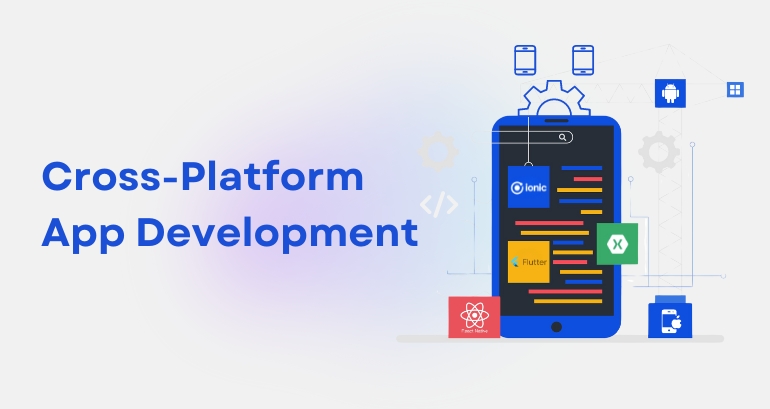
The app development industry has seen significant progress in recent years, and the use of cross-platform applications has become a crucial strategy for those seeking to expand their reach. Using cross-platform frameworks not only reduces costs and speeds up development but also opens the door to innovative opportunities and enhances the user experience.
These tools make it easier to manage, maintain, and update apps across multiple devices and operating systems, saving time and resources. With new advancements, businesses can now reach a broader audience by providing a consistent experience across iOS, Android, and web platforms. This flexibility has made cross-platform development a popular choice for modern app development.
Today, more businesses and developers are moving toward modern frameworks that enable their applications to run on multiple platforms. However, with numerous frameworks to choose from, selecting the right one can be a challenging task. To make the decision easier, this blog will explore some of the top cross-platform frameworks, helping you choose the best option for your project.
Market Statistics For Cross-Platform App Development
As applications continue to gain popularity, cross-platform development has become a crucial strategy for businesses. Here are some essential market statistics about cross-platform app development that developers and companies should be aware of.
- The cross-platform app development framework market is expected to grow from $15.67 billion in 2025 to $2.60 billion by 2034. This represents a CAGR of 11.75% over the forecast period (2025 to 2034).
- Between 2018 and 2022, the value of the cross-platform app development framework market increased by approximately 21.3% compound annual growth rate (CAGR). Looking ahead, the market is expected to expand at a compound annual growth rate (CAGR) of 16.8% over the next decade, potentially reaching a value of $444.7 billion.
- The U.S. cross-platform app development framework market is projected to reach $1,104.7 billion by 2033, with an anticipated increase of $82.3 billion over the next decade.
- Overall, approximately one-third of mobile developers utilize frameworks and technologies for cross-platform development, while the remaining developers employ native software.
What Is a Cross-Platform App Development Framework?
Cross-platform mobile app development is a developer’s approach that leads to the creation of software applications completely compatible with multiple mobile operating systems.
In simple terms, cross-platform software is designed to run on multiple platforms, such as Android and iOS. This means that the apps developed on this framework are versatile and efficient, saving development costs and time. But the excitement lies in its consistent user experience across every platform, a key advantage in today’s competitive app market.
List of Best Cross-Platform Frameworks for Mobile App Development
1. Ionic

Ionic is a cross-platform app framework based on AngularJS and is one of the most unique and popular options available in the mobile app development space. It enables developers to access native platform controllers using a combination of languages, including HTML5, JavaScript, CSS, and a Cordova wrapper. Ionic enables developers to create a beautiful user interface while incorporating user-friendly functionality into their app. Because the apps built with this framework are dynamic and native-like, Ionic is an excellent choice for developing Progressive Web Apps (PWAs).
Mobile App Examples:
Sworkit Fitness & Workout App, Untappd, JustWatch, Shipt, Sanvello
Programming Language:
Python, Java, JavaScript, PHP, Go, Swift, C
Features Of Ionic
- It’s an open-source front-end framework, meaning developers can modify the code structure to suit specific needs while saving a significant amount of time. Delivers high competition to contender Ionic in the Ionic and React Native war.
- Based on the SAAS UI framework
- Specially designed to work on mobile operating systems
- Another of its prominent attributes is that it is built on AngularJS, which makes it simple to add HTML syntax extensions, fundamental functionality, and valuable yet engaging features and components to the program.
- One of the critical advantages of cross-platform development tools is the use of Cordova plugins, which provide access to device-built-in functions such as the Camera, GPS, and Audio Recorder.
- Ionic’s popularity among developers stems from the fact that it gives apps a native-like experience. It assists in developing cross-platform apps and ensures that they run smoothly across multiple platforms.
Ionic Usage Statistics
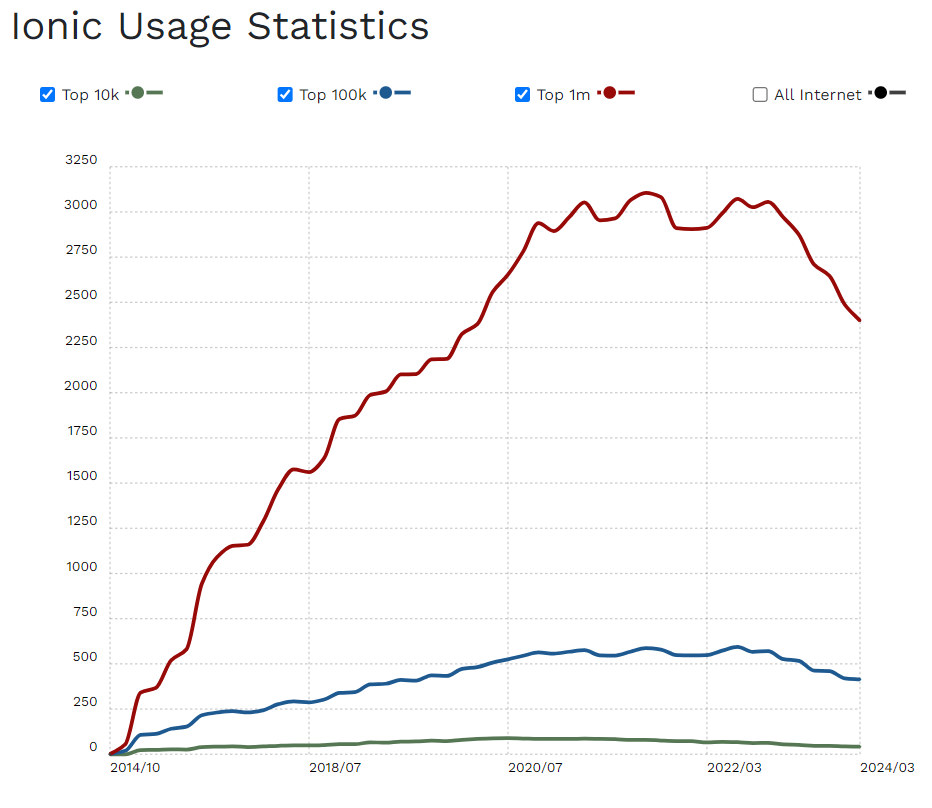
According to BuiltWith, approximately 466,454 websites utilize Ionic, which includes hosting data, location information, and contact details, among other details.
2. React Native

A JavaScript framework enables users to create actual code and give the app a native feel. Due to its outstanding capabilities, React Native is favored by developers and businesses that prioritize devising productive solutions. It’s fortunate that React Native, like Ionic, is an open-source, cross-platform app framework. As a result, it has a vast community to help it grow and improve by addressing issues, enhancing its features, and adding new ones. React Native combines the advantages of JavaScript and React.js and the ability for developers to write modules in Objective-C, Swift, or Java. Likewise, developers can perform complex operations, such as image editing and video processing, that are not part of the framework APIs by using native modules and libraries in React Native cross-platform projects.
Mobile App Examples:
Facebook, Skype, Instagram, Tesla, Walmart, Airbnb, SoundCloud,
Programming language:
JavaScript
Features Of React Native:
- Based on React, one of the top-class JavaScript libraries
- One of the benefits of cross-platform development is that it only takes one-time code (WORA) for platforms like Android and iOS. It eliminates a significant drawback of competing frameworks: developers must code twice for the same program on different platforms.
- One-time coding cuts the app’s development time in half and keeps the expense of developing a React Native app minimal.
- React Native is remarkably compatible with third-party plugins like Google Maps.
- React Native places a strong emphasis on the user experience, resulting in a highly responsive interface. It implies that the React Native environment reduces the time it takes for applications to load and provides a pleasant user experience.
React Native Usage Statistics
Per a survey conducted by Stack Overflow in 2023, about 54% of developers who worked with React Native prefer to continue with this framework.
3. Flutter

Flutter is the youngest of all cross-platform frameworks and holds a special place in the modern market. Here’s the exciting part: being an open-source, cross-platform app framework, it was built to expedite iOS and Android app development. Flutter allows apps to function on multiple platforms with a uniform and dynamic approach.
Mobile App Examples:
Alibaba’s Xianyu, Hamilton, myBMW, Reflectly, NTFY, Google Ads
Programming Language:
Dart
Features Of Flutter
- Flutter encourages the use of a portable GPU, which renders UI elements efficiently and allows it to function with up-to-the-minute interfaces.
- Flutter’s reactive framework eliminates the need to update the UI contents manually. The only thing Flutter app developers need to do now is update the variables, and the UI changes will be reflected.
- The Flutter cross-platform app framework is an excellent choice for producing a Minimum Viable Product (MVP) because it accelerates the development process while being cost-effective.
- Developers may quickly and easily recreate a widget tree and understand the code changes.
- Flutter comes with a built-in graphics engine. If they followed this path, developers would not have to worry about creating distinct interfaces for Android and iOS.
Flutter Usage Statistics
As reported in January 2023, 7,00,000+ apps in the Play Store were developed with Flutter.
Learn more: Flutter vs. React Native: What is better for app development?
4. Xamarin

Xamarin is a .NET developer platform built using programming languages, tools, and libraries to craft varied applications. By supplying add-ins to Microsoft Visual Studio, Xamarin enables developers to make Android, Windows, and iOS apps within an IDE using IntelliSense and code completion.
Mobile App Examples:
FreshDirect, Olo, Alaska Airlines, BBC Good Food, Novarum DX,
Programming Language: C#
Features Of Xamarin
- C#, a modern cross-platform app development language that leverages Objective-C and Java, is used to create apps for the Xamarin framework.
- Eliminates hardware compatibility issues. It also encourages native libraries, which opens a path for customization and native-level functionality.
- Xamarin supports the direct incorporation of Objective-C, Java, and C++ libraries. This makes it one of the most remarkable cross-platform frameworks because it allows developers to utilize various third-party codebases written in Java, C++, and Objective-C.
- Xamarin accelerates and reduces the cost of mobile app development.
- Offers compile-time checking that, in the long term, helps developers attain well-functioning apps and witness fewer run-time glitches.
Xamarin Usage Statistics

5. NativeScript

NativeScript is an ideal choice for developers exploring WORA functionality. Additionally, NativeScripts proffers all native APIs, allowing developers to reuse existing plugins directly from NPM for existing projects. NativeScript creates stunning, accessible, glitch-free, and platform-native UI without WebViews. Developers must define it once, and NativeScript will adapt to run on any platform. They can even tailor the user interface to particular devices and screens.
Mobile App Examples:
ActiveLook, Breethe – Meditation & Sleep App, Checkpoint Curly, Dresden App, eLichens Air.
Programming Language: JavaScript
Features Of NativeScript
- Unlike React Native, NativeScript provides developers with a comprehensive web resource that includes plugins for various applications. Third-party solutions will inevitably become obsolete as a result of this.
- NativeScript enables developers to quickly access native Android and iOS APIs without requiring in-depth knowledge of native development languages.
- For programming, it utilizes Angular and TypeScript.
- NativeScript invokes local strategies from libraries and supports package managers like CocoaPods and Android Arsenal.
NativeScript Usage Statistics
As reported in June 2023, NativeScript had earned GitHub contributors and 7,262 commits.
6. Node.js

Node.js is built on the Chrome V8 JavaScript engine. It is an open-source environment that backs up scalable networking apps and server-side development. Node.js is inherently responsive and highly effective for cross-platform apps.
Mobile App Examples:
LinkedIn, Netflix, PayPal, Uber, GoDaddy
Programming Language:
JavaScript
Features Of Node.js
- Flexible to handle various concurrent connections at one time.
- All Node.js APIs can be regarded as asynchronous, which means they aren’t blocking. This means servers running Node.js don’t have to wait for data from APIs. After calling one API, it instantly moves on to another. The server can acquire a response from the previous API call using a notification mechanism programmed in Node.js.
- The Node.js library is speedy at executing code.
- Node.js cross-platform programs do not buffer data. Alternatively, it outputs data chunks.
- Node.js employs a single-threaded model with event-looping functionality to produce smooth and flawless apps. This event mechanism allows the server to respond non-blocking, allowing for greater scalability.
- Slow apps benefit from Node.js applications since they reduce reaction time.
Node.js Usage Statistics
According to the Stack Overflow Developer Survey 2023, Node.js has garnered around 42.65% of the votes, gained popularity, and is commonly used.

Also Read: How To Hire a Node.js Developer?
7. Appcelerator Titanium

A free and open-source app development platform, Appcelerator Titanium enables developers to build cross-platform, native mobile apps using their existing JavaScript skills. Examining the Titanium architecture, you can better understand how to use it to create native mobile apps.
Programming Language:
JavaScript
Features Of Appcelerator Titanium
- Offers tools for faster application development, indicating rapid prototype creation and evaluation of user interaction with UI.
- ArrowDB (a schema-less data store) helps developers install data models to eliminate any extra effort required for setup, ultimately.
- Allows integrations of continuous delivery systems, such as SCM solutions.
Appcelerator Titanium Usage Statistics
8. PhoneGap

PhoneGap (Cordova) is a significant phenomenon for cross-platform app development, utilizing HTML5, CSS, and JavaScript. Developers also gain access to cloud solutions, enabling them to share the app development process within the community for feedback. Another significant advantage of PhoneGap is that it supports built-in device features, including cameras, storage, and GPS.
Mobile App Examples:
DHS Program, Paylution, HealthTap, TripCase
Programming Language:
HTML, CSS, and JavaScript
Features Of PhoneGap
- It provides access to embedded payment systems, such as the App Store and Google Play Store.
- Applications developed using PhoneGap are eligible to run on leading OS platforms with negligible differences.
- PhoneGap allows developers to use other libraries like Mootools, Sencha Touch, and JavaScript.
- Due to the pluginable architecture of the framework, the APIs can be extended in a modular way.
Note* Adobe discontinued PhoneGap, Apache Cordova, and PhoneGap Build on 1st Oct 2020.
Adobe
9. Apache Cordova

A hybrid open-source framework, Apache Cordova allows web developers to leverage HTML, CSS, and JavaScript content to build a native app for multiple mobile platforms. Additionally, the apps execute within the wrappers, targeting every platform and relying on standard-compliant API bindings to access data, sensors, and network status from every device.
Mobile App Examples
JustWatch, Sworkit, FanReact, Pacifica, SparkChess, Buildr, Clever Baby, Keepe
Programming Language
CSS3, HTML5, and JavaScript,
Features Of Apache Cordova
- Cordova includes several core components that are required by any mobile application. These components provide the foundation for an app, allowing us to focus on developing the logic.
- This program is responsible for creating processes and installing plugins for various platforms.
- Cordova plugins enable an application to access device functions, such as the camera, battery, and contacts.
Apache Cordova Usage Statistics
10. Sencha Touch Now Merged With Ext JS

Sencha Touch, first released about a decade ago, aids in developing web-based cross-platform apps. It is commonly used to construct efficient applications that employ hardware acceleration techniques. Sencha Touch allows developers to build well-tested, securely connected UI components and libraries. Massive corporate apps can be developed and maintained efficiently using Sencha Touch.
Programming Language:
HTML5, CSS3, and JavaScript
Features Of Sencha Touch Now Merged With Ext JS
- Popular for having native-looking themes built-in for all major platforms, including BlackBerry, Android, Windows Phone, iOS, etc.
- It comes with an excellent agnostic backend data package for working with data sources.
- Sencha Touch enables Cordova integration for native API access, one of its most well-known capabilities.
- Provides code compatibility between old and new versions.
- Includes collections of 50+ built-in widgets and display of rich UI specially made for mobile platforms like forms, carousels, toolbars, lists, menus, etc.
Note* Sencha Touch is not supported now, but its functionality for developing mobile apps has been fused with Ext JS
Sencha
11. Codename One

Codename One is an open-source toolkit that permits developers to craft cross-platform Android, desktop, iOS, and web apps using Kotlin or Java. This multi-platform app development generates native OS binaries that can be uploaded to Google, Microsoft, or Apple.
Mobile App Examples:
BeRider, HBZ, Arrivu, yHomework, Oxbridge Academy, Jubilee Motor
Programming Language:
Java or Kotlin
Features Of Codename One
- Developers can build their apps using IntelliJ IDEA, Eclipse, or NetBeans. The essential requirement is that the Codename One plugin be installed on either IDE.
- Codename One unifies different concepts and technologies into a single facade.
- Codename One backed up the ability to build an offline “in-house” build cloud, which was eliminated using Codename One build servers.
Codename One Usage Statistics
Per a report by Codename One, around 180m applications are installed across platforms, and about 40k developers use this for their projects.
12. Kivy

Kivy is a multi-platform Python GUI development library on iOS, Android, Windows, OS X, and GNU/Linux. It aids in developing apps that utilize cutting-edge multi-touch user interfaces. Kivy’s core concept enables developers to create an app once and deploy it across all devices, making code reusable and deployable, and facilitating quick and easy interaction design and prototyping.
Mobile App Examples:
Snake by Andy Russo, Snu Photo Manager, Cydrea Music, Cydrea Music
Programming Language:
Python
Features Of Kivy
- Extensive support for TUIO, mouse, keyboard, and OS-specific multi-touch events.
- Kv language helps in designing custom widgets effectively. It separates UI design from Python code, making it easier for developers and designers to collaborate.
- Kivy offers a robust animation system that lets developers craft dynamic and smooth transitions within their apps.
- Leveraging the full potential of multitouch capabilities, Kivy enables users to interact with the application using multiple fingers simultaneously.
13. Corona SDK

Corona SDK allows developers to create 2D mobile apps for all major platforms, including Kindle and Windows.
It allows developers to design mobile and game apps ten times faster. The backend framework works magnificently and is based on Lua, a lightweight and multi-paradigm programming language. The language focuses on the most critical aspects of development, including extensibility, speed, scalability, portability, and ease of use.
Furthermore, it is a free framework that supports testing and is compatible with both macOS and Windows.
Mobile App Examples:
Tiny Boxes, Gunman Taco Truck, Grow Beets Clicker, Ava Airborne
Programming Language:
Lua scripting language
Features Of Corona SDK
- 1,000 APIs programmed into it allow developers to create sprite music, animations, object tweening, audio, native elements, Box2D physics, data, and many other features.
- It reacts almost promptly to code changes while providing a preview of the app’s performance on an actual device.
- Almost 200 plugins, including in-app advertising, analytics, media, and hardware functions, are supported.
Corona SDK Usage Statistics
By 2027, the global Software Development Kit (SDK) market is expected to reach $4,350 million, with a compound annual growth rate (CAGR) of approximately 11.78%.
14. BeeWare

BeeWare is a suite of libraries and tools that enable users to write native GUI applications in Python using a single codebase. A collection of open-source tools and libraries, BeeWare assists developers in writing Python apps with native UI that can be deployed across varied platforms. The multi-platform app development framework aims to offer users a variety of tools to build rich user interfaces for desktop and mobile software, and then deploy them to devices.
Programming Language:
Python
Features Of BeeWare
- Helps users develop apps with a rich interface using Python.
- Runs on tvOS, iOS, macOS, Android, Windows, and more
- The BeeWare suite of tools is licensed under the BSD license and is flexible for modifications.
- Beeware utilizes native functionality and widgets, as opposed to the theme-based approach.
- Provides tools that facilitate debugging, development, and analysis of Python projects.
BeeWare Usage Statistics
15. RubyMotion

RubyMotion is a commercial toolchain for OS X, iOS, and Android development using the Ruby programming language. The RubyMotion Apps execute in an iOS simulator with a read-eval-print loop (REPL). Package managers like CocoaPods or manual methods can be used to include 3rs-party-Objective-C in a RubyMotion project.
Programming Language:
Ruby
Features Of RubyMotion
- The RubyMine IDE includes code completion and visual debugging for the RubyMotion toolchain.
- Projects can be developed using any text editor.
- With the development of version 2.0, RubyMotion supports the development of applications for OS X and iOS.
- Examples include A Dark Room for iOS, A Dark Room for iOS, 37signals’s Basecamp for iPhone, and the Bandcamp iPhone app.
- RubyMotion plans to support Android in version 3.0.
RubyMotion Usage Statistics
Benefits of Cross-Platform App Development Frameworks?
To build multi-platform solutions, cross-platform frameworks help businesses save resources, money, and time by facilitating developers to craft a single codebase that can run on varied platforms.
Let’s scan more benefits of cross-platform app development:
- Quick Development Time: By reusing code and repeating the benefits of the built-in functionalities of the framework, you can speed up the development process rather than building a native app from scratch.
- Wider Market Reach: By allowing your app to be deployed on both Android and iOS platforms using a single code, you can reach a broader customer base, thereby expanding your business.
- Cost-Effective: Writing less code will demand a more minor development team; a cross-platform development framework can be more cost-effective for tight-budget projects.
- Uniform Design: Frameworks typically provide UI components that adapt to each platform’s design language, ensuring a cohesive user experience across all platforms.
- Easy Integration: Various frameworks offer seamless integration with third-party APIs and libraries, enabling the quick inclusion of desired functionalities into the app.
- Performance: Some frameworks may have some limitations compared to completely native apps, but careful development and optimization can reduce them.
- Community and Support: The best cross-platform mobile app development frameworks usually have active and large communities that offer valuable forums, tutorials, and resources for learning and troubleshooting.
How to Choose the Best Framework for Your Project?
Selecting the proper cross-platform app development framework depends on various parameters relevant to your project.
1. Define Your Project Needs
Your project requirements are essential when choosing the best cross-platform app development framework. Needs can include app functionality, performance requirements, target platforms, and the expertise of the development team, among others.
2. Conduct Deep Research and Compare Frameworks
Next, conduct thorough research and compare the frameworks available for your Android app development.
Consider checking their tools, features, learning curve, community support, and other factors.
While considering your project needs, research frameworks and experiment with prototypes. You will have numerous choices for cross-platform app development frameworks that hold top positions.
How Can EmizenTech Help You with Android and iOS Mobile App Development?
EmizenTech is a one-stop solution for building custom mobile applications for Android and iOS. The firm employs a team of experienced developers who utilize advanced technologies, such as Flutter and React Native, to create top-quality apps that perform smoothly on both platforms.
Hire hybrid developers from EmizenTech who will guide you throughout the process, from project understanding to designing, development, and app launch.
So, whether you need an enterprise-grade solution or a consumer-focused app, EmizenTech holds the expertise to convert your vision into an actual product.
Conclusion
In the dynamic mobile app development landscape, picking the right tools and cross-platform frameworks is essential for success. Consider your project needs carefully, find the strengths and weaknesses of the top cross-platform app development frameworks in 2024, and consult a Hybrid App Development Company. This way, you can make sound decisions that go perfectly with your app.
Still trying to understand!
Connect with a Mobile App Development Company and leave everything to it, from choosing a cross-platform framework to designing, developing, and launching.
FAQs
What Is the Best Cross-Platform Framework?
The user can choose from a wide range of cross-platform app frameworks available on the current market. These frameworks will ensure smooth sailing for your apps on a native app and various other platforms. Some of the popular choices are Flutter, Ionic, React Native, NativeScript, and Corona SDK.
How Do You Make a Mobile App Cross-Platform?
The solution is smooth. Choosing an excellent cross-platform app development company with the experience and right tech stack required for effective app development.
Which Is Better, React Native or Xamarin?
The answer to this query is highly tailored to the company's specific needs and project requirements. While React Native has many appealing features, such as Hot Loading and rich libraries, it might not be the best fit for your project. Xamarin can be a compelling option for various reasons, including the near-native user experience.
What Is the Best Cross-Platform Framework?
The user can choose from a wide range of cross-platform app frameworks available on the current market. These frameworks will ensure smooth sailing for your apps on a native app and various other platforms. Some of the popular choices are Flutter, Ionic, React Native, NativeScript, and Corona SDK.
Which Is Better, React Native or Xamarin?
In terms of development tools, Xamarin is a better option than Flutter, as it is easier to use and results in faster and iteration-free processes.
Why Is Xamarin Better than Flutter?
In terms of development tools, Xamarin is a better option than Flutter, as it is easier to use and results in faster and iteration-free processes.
Which Frameworks Are Used in iOS?
React Native, SwitUI, Flutter, and Kotlin Multiplatform Mobile are some of the frequently used frameworks for iOS.
What Is the Most Used Mobile Framework?
The most used mobile Framework is "React Native"
Which Is Better: Native Script vs. React Native?
Both belong to the cross-platform category and deliver relatively homogeneous benefits. However, in some fields, React Native performed exceedingly well in contrast to NativeScript; for instance, React Native renders apps by using SDKs that turn it into a highly performant framework to deliver faster UI. Additionally, React Native is more inclined toward native performance than NativeScript.



 +1 (989) 535-9295
 info@emizentech.com
 emizentech


