
 Add us as a preferred source on Google
 There’s a store owner somewhere right now, at 11 p.m., copying the day’s Shopify orders into their accounting software by hand. One typo in an SKU and the whole chain wobbles: the wrong product ships, inventory drifts, and finance loses a Friday trying to make two reports agree when they never were. Anyone who has actually run an online store knows the mess behind the scenes. Orders land in one place.
Stock counts sit somewhere else. Invoices live in their own little world, and customer info gets scattered across whatever tools the team happened to be using that year. eCommerce ERP integration helps fix that chaos. It links all those systems so they pass information to each other automatically, without someone manually typing the same number into three different screens. For your reference, consider this blog your guide to ERP integration.
What Is eCommerce ERP Integration? And Why Is It Important for Ecommerce Businesses?
ERP stands for enterprise resource planning; it’s one big system that tracks what a business needs. Inventory. Orders. Accounting. Shipping details. When that system connects to an online store, that’s what people mean by eCommerce ERP integration. The store and the ERP stop being two separate worlds and start updating each other automatically.
Why bother? Because small mix-ups turn into real losses pretty quickly. Sell something that is quietly out of stock, and a customer walks away annoyed. An accidental typo on an invoice and you’re chasing missing money for weeks. Integration takes that monotonous work off a person’s hands so the team can focus on what needs judgment, not data entry.
What you actually get out of it:
- Fewer errors. Nearly every wrong-address, wrong-SKU, wrong-price incident traces back to manual re-entry.
- Real-time inventory updates. If your website shows more stock than you actually have, customers order things you can’t deliver. If it shows less stock than you actually have, those extra items just sit unsold with no one buying them. Neither number should be wrong.
- Faster shipping. Orders hit the warehouse in seconds instead of whenever someone finishes typing.
- One version of the truth. Finance, ops, and marketing read the same numbers instead of three different exports.
- Room to grow. A manual process that survives 50 orders a day dies at 500. I’ve watched it happen.
B2B raises the stakes. B2B ecommerce ERP integration has to handle customer-specific price lists, credit limits, bulk orders, negotiated terms, and data that exists only in the ERP. If your storefront can’t read it, your sales team is quoting blind.
How Does eCommerce ERP Integration Work?
It works in a simple way: the store and the ERP connect through something called an API, basically a note-passing system. The second an order comes in, or a customer updates their address, that update gets sent to the ERP instantly. No waiting around, no one sitting there retyping it by hand. One system, the ERP, handles pricing and stock. The other, the website, handles product descriptions and content. Keeping them separate means a problem in one doesn’t break the other. For each piece of information, only one system should be the source of truth. Usually the ERP owns prices and stock, and the website owns content.
| Approach | How it works | Suitable for |
| Point-to-point (native connectors) | A pre-built plugin links one platform to one ERP | Small catalogs, standard workflows |
| iPaaS / middleware (Celigo, Boomi, MuleSoft, Alumio) | A hub between systems handles mapping, queuing, retries | Multi-channel sellers, messier logic |
| Custom API integration | Developers build a connector against both systems’ APIs | Odd workflows, legacy ERPs, high volume |
Key Features of an ERP Integrated eCommerce System
A properly built ERP-integrated e-commerce setup gives you multiple ways to boost your business productivity.
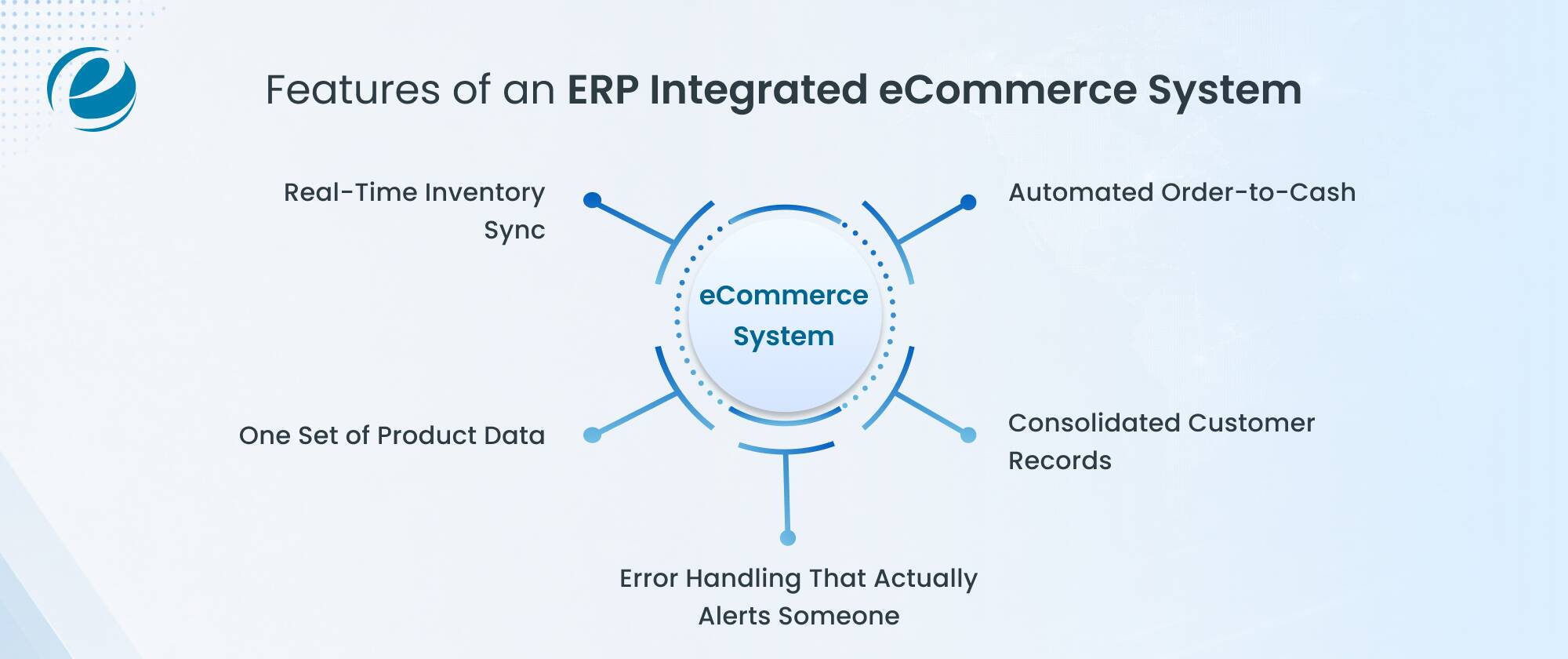
Real-Time Inventory Sync
Stock updates across every channel the moment a sale, return, or purchase order lands. Buffer-stock rules keep you from overselling when traffic spikes.
Automated Order-to-Cash
Orders become ERP sales orders on their own: payment capture, invoicing, revenue recognition- no human touch.
One Set of Product Data
SKUs, variants, price tiers, tax classes: managed once in the ERP (or a PIM), published everywhere.
Consolidated Customer Records
Order history, credit status, support tickets in one place. For B2B ecommerce ERP integration, this isn’t nice-to-have; account managers need the whole picture, or they’re guessing.
Error Handling That Actually Alerts Someone
Failed syncs should queue, retry, and wake somebody up. Not silently drop orders. Teams never ask about this one until the first outage. Ask about it.
Top 5 Ecommerce Platforms That Support ERP Integration
Choosing a platform, or thinking about re-platforming? Proper ecommerce development services can help you pick one whose API model aligns with your ERP rather than fighting it. However, businesses need to understand the best options available. To help, here is a carefully curated list of the top 5 e-commerce platforms.
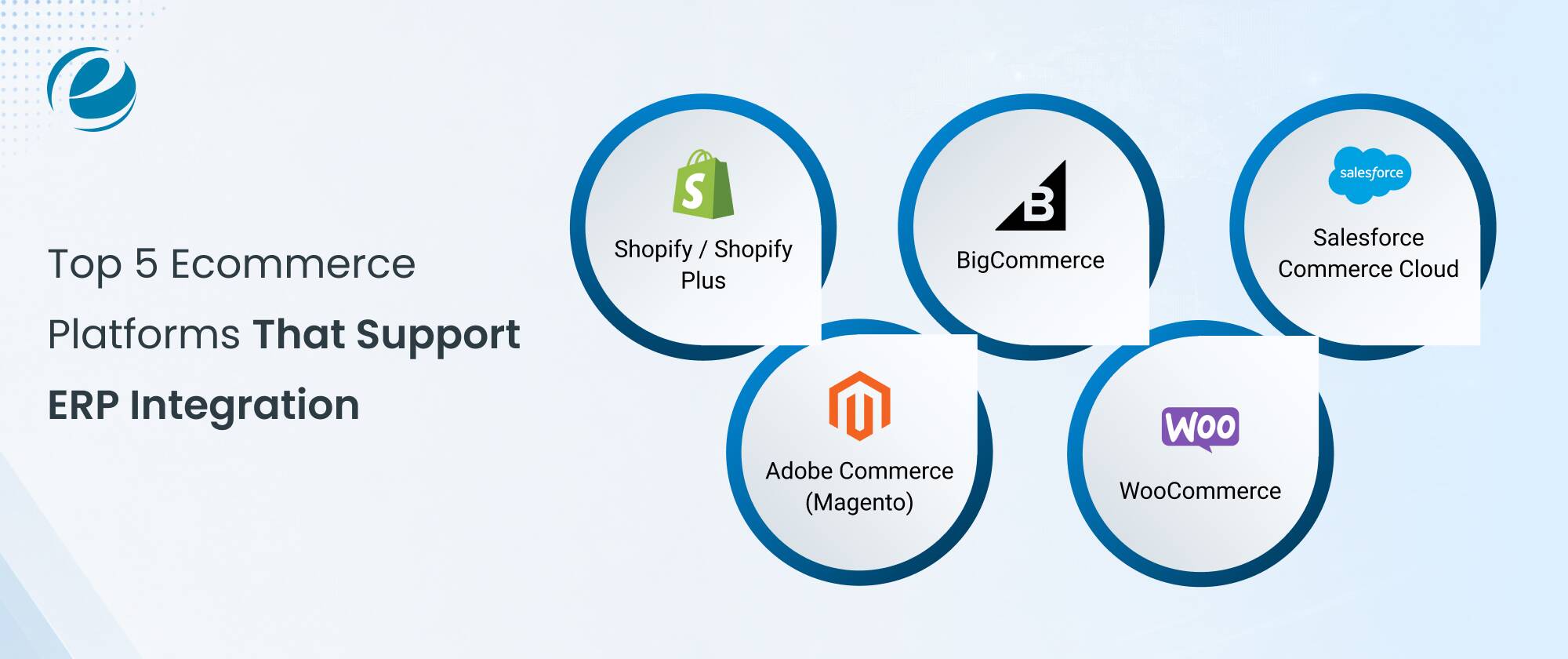
Shopify / Shopify Plus
Clean APIs and an enormous connector ecosystem. Connectors exist for NetSuite, SAP, Dynamics, and Odoo. The default answer for fast-growing D2C brands, and usually the right one.
Adobe Commerce (Magento)
Heavier, but you can bend it further. Customer ERP integration with ecommerce logic is easier here than on closed SaaS platforms. Good for complex catalogs and B2B.
BigCommerce
One of the best e-commerce models that works on an API-first model with generous rate limits. Quietly popular with mid-market B2B sellers.
WooCommerce
Affordable and flexible on WordPress. Pairs fine with Odoo or ERPNext, though your hosting quality decides how reliable any ecommerce website integration with ERP will be. Skimp on hosting, suffer on sync.
Salesforce Commerce Cloud
Enterprise territory. Makes sense mostly when Salesforce CRM already runs your world.
How to Integrate eCommerce with ERP: Step-by-Step Process
Here’s how experienced teams handle an eCommerce ERP integration: how to integrate ecommerce with ERP without breaking a live store:
Audit and map your data
List every entity: orders, SKUs, customers, taxes, and where it lives today. Write down the edge cases: bundles, gift cards, partial refunds. The edge cases are where projects die.
Choose your approach
Connector, middleware, or custom, based on volume, complexity, and budget. Once you’ve done that, pick a system of record per data type. In writing. Which system wins conflicts?
Design the sync logic
Frequency, direction, field mappings, error rules per flow. Once done, build in a sandbox. Never against production. Every serious ERP and platform offers staging. Use it.
Test the ugly scenarios
Split shipments, cancellations, two buyers grabbing the last unit at once, currency rounding, weird tax cases. Dedicated ecommerce testing services earn their fee right here; bugs found after go-live cost several times more.
Go live in phases
Inventory first, usually. Verify and then order. Then financials. Track sync latency, failure rates, and accuracy weekly for the first quarter. Boring work, but this is the part of ERP integration for ecommerce that decides whether it holds up long-term.
Mistakes to avoid:
- Syncing everything in real time (expensive, rarely needed)
- Leaving historical data migration for “after launch”
- Letting both the storefront and the ERP edit prices
- Having no rollback plan for go-live day
How Much Does eCommerce ERP Integration Cost?
Understand the factors that influence the cost of eCommerce ERP integration, including business size, customization, and implementation complexity. A clear budget helps you plan for both upfront investment and long-term value.
| Approach | Upfront | Ongoing | Timeline |
| Native connector/plugin | $0–$5,000 | $50–$500/month | Days–2 weeks |
| iPaaS / middleware | $10,000–$40,000 setup | $500–$3,000/month | 4–10 weeks |
| Custom API integration | $25,000–$150,000+ | Maintenance retainer | 2–6 months |
What pushes the price of ERP ecommerce integration up: more sales channels, highly customized ERPs, B2B pricing complexity, legacy ERP versions without modern APIs, historical data migration, multi-currency or multi-entity accounting.
And budget for afterward, honestly. Any ecommerce integration with ERP needs monitoring, updates when either side changes its API, and re-mapping as the catalog grows. Managed support and maintenance usually account for 15–20% of the build cost per year. Cheaper than the emergency call, every time.
How to Choose the Right ERP Integration Partner
The partner matters more than the tool. The ERP integration ecommerce market is full of generalists, so filter hard: Not sure where to start? A short ecommerce consulting engagement to pin down requirements before you commit to a build is probably the cheapest insurance in the whole project.
Both sides of the connection. Ask for the exact combination they work with, like “Magento plus SAP Business One,” not a vague answer like “we do integrations.” A specific answer tells you they’ve actually done this pairing before.
Business fluency, not just API fluency. Good ERP integration ecommerce people talk about order-to-cash and inventory policy before they mention endpoints. That’s what separates generic ecommerce integration with ERP from a build shaped around your margins.
Documentation habits. Field mappings written down, not living in one developer’s head. When that developer leaves- and they leave- you’ll care.
Testing discipline. Ask how they handle race conditions and failure recovery. Watch how fast they answer.
Post-launch support. Response times, monitoring, and who pays when a platform API update breaks the sync.
Future Trends in eCommerce ERP Integration
The future of eCommerce ERP integration is being shaped by AI, automation, and cloud-based technologies. These innovations are helping businesses streamline operations, improve decision-making, and deliver more personalized customer experiences.
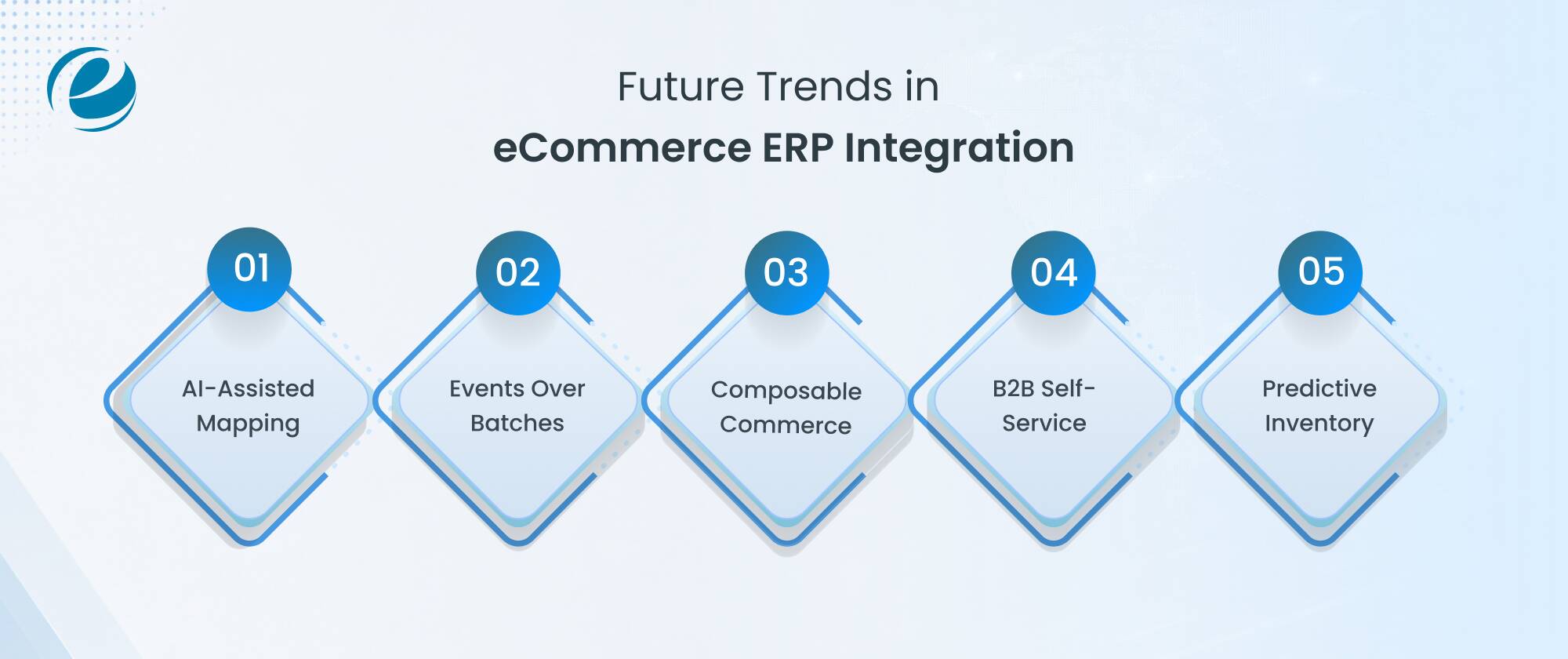
AI-assisted mapping
Tools that suggest field mappings and flag anomalies a spike in failed syncs, an inventory jump that makes no sense before a human notices.
Events over batches
Webhooks and streaming are replacing scheduled jobs. Sync measured in seconds is becoming the baseline expectation, not the premium option.
Composable commerce
MACH-style setups don’t treat the ERP as one giant plugin attached to everything. Instead, the ERP is just one service among several, and they all talk to each other through APIs.
B2B self-service
Buyers want live ERP data in the storefront: contract pricing, credit balance, order history. They’re getting it.
Predictive inventory
Integrated systems feeding demand forecasts that adjust reorder points on their own. The direction is plain enough: ecommerce website integration with ERP is moving from “sync on a schedule” to “one continuous system.” Batch jobs will soon feel like fax machines.
Why Choose EmizenTech for eCommerce ERP Integration?
EmizenTech has spent over a decade doing ecommerce and ERP software development under one roof, which happens to be exactly what integration work demands, since most shops know one side well and fake the other. The team has shipped ERP and ecommerce integration projects across Shopify, Magento, BigCommerce, and Salesforce Commerce Cloud, and connected to SAP, NetSuite, Odoo, and numerous custom ERPs.
In practice, that means certified platform developers, field mappings documented for every project, sandbox-first builds, structured QA, and post-launch monitoring so your ecommerce website integration with ERP keeps working long after the go-live celebration. Quick connector or full custom build for hairy B2B workflows, the scope follows your operations. Not the other way around.
Final Verdict
To sum this up, eCommerce ERP integration isn’t really an IT project. It’s an operations upgrade that happens to involve code. When done well, ERP and ecommerce integration kills manual work, keeps inventory honest, speeds up shipping, and puts every team on the same numbers. Done badly or not at all, it quietly taxes every single order you ship.
FAQs
How long does it take to integrate ecommerce with an ERP system?
Plugins: days. Middleware: usually 4–10 weeks. Custom builds: 2–6 months depending on how messy the data is. Rushing an eCommerce ERP integration timeline is the single most common cause of post-launch data problems.
Can I connect multiple sales channels to one ERP?
Yes, it's one of the best arguments for middleware-based ERP integration with ecommerce, which funnels orders from the web, marketplaces, and apps into a single ERP feed.
Do small businesses need ERP integration for ecommerce?
If you're re-typing orders or running inventory in spreadsheets, yes. The threshold is lower than most owners assume, around 20–30 orders a day, in my experience.
What's different about b2b ecommerce ERP integration?
Account-specific pricing, credit limits, approval workflows, bulk handling. All of it lives in the ERP, so tight integration is no longer optional.
What happens if the sync fails?
A well-built integration queues the failure, retries, and alerts your team. If yours fails silently, fix that before anything else on this page.



 +1 (989) 535-9295
 info@emizentech.com
 emizentech


