
 Add us as a preferred source on Google
 Two businesses walked into our inbox last year with nearly the same app brief. One had a $22,000 quote from a freelance team. The other was holding a $94,000 proposal from a US-based agency. Same features, same platforms; both were Flutter.
Neither quote was wrong, exactly. That gap is the whole story.
Flutter has taken over cross-platform development for good reason. One Dart codebase runs across iOS, Android, web, and desktop. Google backs it. Over 500,000 production apps run on it. And yes, it genuinely saves 30–40% versus building separate native apps for each platform.
But “it depends” doesn’t help you plan a budget. So this guide breaks down the Flutter app development cost in 2026, the way we actually think about it, phase by phase, by region, and including what happens to the number once AI-integration enters the picture. We’ll also tell you when Flutter probably isn’t the right framework for your project, because that conversation matters too.
Flutter App Development Cost in 2026: Quick Overview
These numbers aren’t optimistic estimates. They reflect what production-ready apps actually cost when design, backend, QA, and launch are all included, and not just the coding part.
| App Type | Cost Range | Timeline | Best For |
| MVP / Basic | $8K–$25K | 1–3 months | Proof of concept, internal tools |
| Standard App | $25K–$80K | 3–6 months | B2C apps, eCommerce, marketplaces |
| Complex App | $80K–$200K | 6–10 months | SaaS, fintech, healthcare platforms |
| Enterprise | $200K+ | 10+ months | Multi-platform, ERP integrations |
The bulk of the Flutter app development projects we handle at Emizentech fall in the $25K–$80K range that covers custom UI, user authentication, backend integration, and full App Store and Play Store deployment.
One thing to watch for is that if an agency quotes $8,000 for what you consider a “standard” app, you should ask exactly what’s included. QA, backend development, and UI design are the three line items that tend to vanish from suspiciously low quotes.
Phase-by-Phase Cost Breakdown: Where Does the Budget Actually Go?
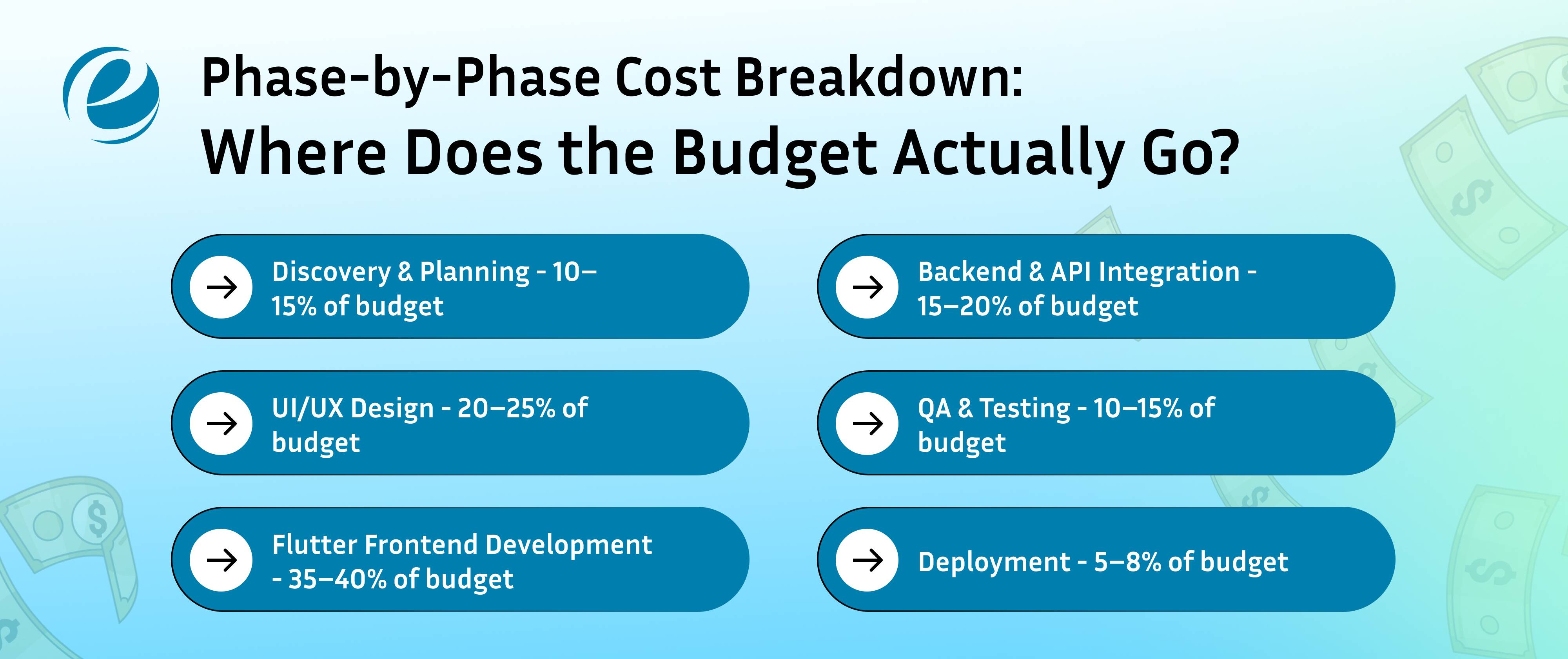
Agencies quoting $50,000 are pricing a similar scope broadly. What separates a trustworthy estimate from a vague one is whether it can tell you how that number breaks down across the actual phases of the project.
Here’s how it typically splits:
Discovery & Planning – 10–15% of budget
This is where the project gets defined properly: user stories, wireframes, tech stack decisions, and a requirements document. Skipping or compressing this phase to “save money” is the most reliable way to spend twice as much fixing problems mid-build. Budget $5,000–$12,000 here on a mid-size project.
UI/UX Design – 20–25% of budget
Figma screens, interaction prototypes, and design systems. A template-based interface sits at the cheaper end. Custom branded UI with micro-animations, bespoke navigation patterns, and a full component library is a very different scope. That gap — basic versus polished — can be $5,000 versus $40,000+. It’s not an exaggeration.
Flutter Frontend Development – 35–40% of budget
The highest single cost. Widgets, screens, state management (Riverpod, Bloc, Provider depending on the app’s complexity), animations, and making everything work responsibly across screen sizes. Senior Flutter developers cost more per hour, but they write maintainable code. Junior developers writing messy widget trees will cost more in long-term maintenance than the upfront savings are worth.
Backend & API Integration – 15–20% of budget
Firebase is the sensible starting point for apps that don’t need a heavily custom backend, faster to set up, and cheaper initially. Node.js or Django backends cost more but handle complex business logic and data ownership properly at scale. Every third-party integration (Stripe, Google Maps, push notifications, CRM connections) adds real development hours — auth tokens, error handling, and testing all take time.
QA & Testing – 10–15% of budget
Unit tests, widget tests, integration tests, and manual testing across a device matrix. This phase gets squeezed when budgets get tight. The outcome is predictable: bugs ship, fixes get rushed, users complain. It’s not a phase you want to cut.
Deployment – 5–8% of budget
App Store and Play Store submission, CI/CD pipeline setup using tools like Fastlane or Codemagic, and environment configuration. Not glamorous, but it’s real work that low-ball quotes routinely omit.
Quick math: for a $50,000 Flutter project, design and development combined typically account for around 60% of the total budget, roughly $30,000. Discovery, QA, and deployment share the remaining $20,000.
6 Key Factors That Determine Your Flutter App Development Cost
Most of the variation between quotes comes down to these six things:
Feature count and complexity
A user login and a home feed are categorically different from real-time chat, live GPS tracking, or multi-role dashboards. Every feature adds design scope, development hours, and QA cycles.
UI/UX depth
Standard Material Design components sit at one end. Fully custom interfaces built with Rive animations and bespoke design systems sit at the other end. They’re genuinely not comparable in cost.
Backend choice
Firebase is faster and cheaper to get started with. A custom Node.js or Django backend costs more but handles complex business logic and long-term data ownership far better. The right choice depends on your app’s trajectory, not just your day-one budget.
Third-party integrations
Stripe, Google Maps, push notification services, and CRM or ERP connections. Each one involves SDK setup, authentication, error handling, and testing. They’re not plug-and-play.
Target platforms
Mobile-only is the cost baseline. Adding web or desktop support to a Flutter project typically adds 15–25% per platform, because responsive layouts and platform-specific behaviors need separate work.
Timeline pressure
Nobody mentions this one, but it’s real. A project that needs to ship in 8 weeks instead of 5 months requires more developers running in parallel, more coordination overhead, and less time for QA to do its job properly. Compressed timelines routinely add 20–30% to total project cost.
Flutter Developer Hourly Rates by Region (2026)
Where your team is based is one of the biggest cost levers you have. Here’s what rates look like across regions and experience levels:
| Region | Junior Dev | Mid-Level Dev | Senior Dev |
| India | $18–$30/hr | $30–$50/hr | $50–$75/hr |
| Eastern Europe | $35–$55/hr | $55–$80/hr | $80–$110/hr |
| US / Canada | $80–$120/hr | $120–$160/hr | $150–$200+/hr |
| UK / W. Europe | $70–$100/hr | $100–$140/hr | $130–$180/hr |
Freelancers look cheaper per hour, but they bring real trade-offs: no structured QA, a single point of failure if they go dark, and no ability to scale the team when the scope grows. Agencies cost more but give you a PM, developers, QA, and someone who is actually accountable if something goes wrong.
India-based Flutter development teams deliver senior-level work at 50–60% lower cost than equivalent US or UK agencies. That’s not a quality compromise, but it’s a structural cost difference. Same skill level, different market economics.
You must check out how you can hire Flutter developers at Emizentech based on engagement models such as dedicated teams, fixed-price projects, and staff augmentation.
How Much Does an AI-Powered Flutter App Cost?

This comes up in almost every project brief now. Chatbots, personalized content feeds, smart search, document scanning, etc., i.e., what used to be a differentiator is becoming a baseline expectation in many app categories.
Flutter handles AI integrations well. The cost impact depends almost entirely on which features you’re adding and how you implement them.
| AI Feature | Added Cost | Notes |
| AI Chatbot (OpenAI / Gemini API) | +$5K–$15K | Fastest to integrate; ongoing per-call API costs |
| Personalised Recommendations Engine | +$10K–$25K | Needs a user behaviour data pipeline |
| Image / Document Recognition (ML Kit) | +$8K–$20K | Works well with Flutter’s camera plugins |
| Voice Assistant Integration | +$10K–$30K | Requires speech-to-text plus an NLU layer |
| Custom ML Model (your own data) | +$30K–$80K | Full data control, no per-call cost long-term |
Pre-built API versus a custom model: Which one actually makes sense?
Integrating OpenAI or Google Gemini is the fastest route to AI features. Development time is relatively short, and the ongoing cost is per API call, typically $0.002 to $0.06. For most apps starting out, this is the right call.
A custom ML model trained on your own data is a different decision. The upfront cost is $30,000–$80,000 higher. But you own the model entirely, your data never leaves your infrastructure, and there’s no per-call cost once it’s deployed. For fintech development or healthcare platforms where data privacy is non-negotiable, the custom model often makes more financial sense over a 2–3 year horizon.
Real example: One of our eCommerce clients added AI product recommendations to a $45,000 Flutter app. The integration added $18,000 to the project. Within the first quarter post-launch, average order value moved up measurably. Emizentech has built AI-integrated Flutter apps for clients in eCommerce, healthcare, and fintech.
When Flutter Is NOT the Right Choice?
Every development agency will tell you Flutter works for everything. We’re not going to do that.
There are projects where Flutter will create more problems than it solves:
- Apps that need deep native hardware access, such as complex Bluetooth LE protocols, AR headset integrations, or advanced wearable OS APIs. Flutter can bridge to native code, but those bridges are fragile and maintenance-heavy. Native iOS and Android just handle this more reliably.
- 3D-heavy games: Flutter is fine for casual games and light animations. If you need real 3D rendering, physics engines, or anything resembling a proper gaming environment, use Unity or Unreal. They exist for exactly that reason.
- Teams that are already fully committed to Swift and Kotlin. Migrating to Flutter means retraining or replacing your existing developers. In some situations, that transition costs more than the single-codebase saving is worth. A proper mobile app development company can tell you which direction makes more sense for your specific team.
- Platform-exclusive OS features: Certain CarPlay capabilities, specialized watchOS APIs, and a handful of platform-specific features either aren’t on Flutter’s roadmap yet or require so many native bridges that the single-codebase advantage disappears entirely.
If Flutter does fit your project, and for most businesses building cross-platform apps, it genuinely does, find out how to keep the cost reasonable in the following section.
5 Ways to Reduce Flutter App Development Cost
These aren’t tricks. They’re just the ways to consistently keep projects on budget:
- Start with an MVP. Build the core of what makes your app useful, ship it to real users, and use actual feedback to decide what to build next. Skipping the full-vision-upfront approach typically cuts early-stage spend by 30–40%.
- Use Flutter’s open-source packages. pub.dev has 40,000+ packages. State management, payment gateways, cameras, maps—if it’s a common need, there’s a maintained package for it. Using one instead of building from scratch can save several days of development time per feature.
- Use Firebase for your backend initially. It handles authentication, databases, storage, and notifications without needing a custom server. For apps that don’t need complex backend logic from day one, Firebase cuts 15–20% off the initial build cost. You can move to a custom backend later.
- Write a proper SRS before development starts. Scope creep — features added mid-build because the requirements weren’t clear upfront — is the most common cause of budget overruns. A detailed Software Requirements Specification document reduces “but I assumed…” conversations significantly.
- Work with a senior India-based Flutter agency. The rate difference versus US or UK agencies is 40–60%. At that saving, you can afford a more experienced team, more thorough QA, or both.
Final Thoughts
Flutter app development cost in 2026 isn’t a single number; it’s a combination of what you’re building, who’s building it, where they’re based, and what AI complexity you’re adding. A $25,000 MVP and a $150,000 platform are both legitimate Flutter projects. The difference is scope, not some judgment about whether you’re doing it right.
What matters is working with a team that tells you where every pound of the budget is going, is honest when Flutter might not be the right choice, and has enough experience to know what actually needs to be in version one versus what can wait.
Emizentech has delivered 200+ Flutter applications for clients in eCommerce, healthcare, fintech, and enterprise, with a senior India-based team that brings the expertise of a top-tier agency at a cost structure that makes sense for your business.
FAQs
How much does Flutter app development cost?
Anywhere from $8,000 for a lean MVP to $200,000+ for a full enterprise platform. Most businesses building a proper production app with real design, backend, testing, and deployment land between $25,000 and $80,000. The main drivers are feature complexity, UI depth, backend requirements, and where your development team is located.
Is Flutter cheaper than native app development?
Usually, yes, by around 30–40% versus building separate native iOS and Android apps. One codebase means lower developer costs, simpler QA, and lower ongoing maintenance overhead. The savings are most obvious for startups and growing businesses that need both platforms. See how we approach cross-platform development for more context.
How long does it take to build a Flutter app?
A lean MVP is typically 1–3 months. A standard business app runs 3–6 months. Complex SaaS or enterprise builds are usually 6–12 months. These assume a properly staffed team working through the full project lifecycle — discovery, design, development, QA, and launch.
What is the hourly rate of a Flutter developer in India?
Junior developers charge roughly $18–$30/hr. Mid-level developers are $30–$50/hr. Senior Flutter developers with 4+ years of production experience run $50–$75/hr. Agency rates sit slightly above individual developer rates, but include project management, QA, and accountability. Hire Flutter developers at Emizentech to see current team options.
How much does it cost to add AI features to a Flutter app?
Depends on the feature and implementation approach. A chatbot built on OpenAI or Gemini API adds $5,000–$15,000. A personalized recommendation engine is $10,000–$25,000. Image or document recognition using ML Kit sits at $8,000–$20,000. Custom ML models trained on your own data cost $30,000–$80,000 more, but cut out ongoing per-call API fees and give you full data control.
What are the ongoing maintenance costs for a Flutter app?
Plan for roughly 15–20% of your initial build cost per year. On a $50,000 project, that's $7,500–$10,000 annually. This covers Flutter SDK updates, iOS and Android OS compatibility fixes as new versions ship, security patches, and small feature iterations. Backend hosting and third-party API subscriptions sit on top of this. Emizentech's mobile app maintenance services include all of the above.



 +1 (989) 535-9295
 info@emizentech.com
 emizentech


