
 Add us as a preferred source on Google
 Let’s be honest, people are tired of the deal they’ve been getting on social media. Hand over your data, watch targeted ads, get banned without explanation, and earn nothing while the platform profits from your attention. It’s a terrible deal, and users know it.
That’s a big reason why Web3 social media has gone from a crypto talking point to something investors are treating seriously. The global Web3 social media platforms market was at $7.2 billion in 2024 and is projected to hit $471 billion by 2034, growing at a CAGR of 51.90%. The decentralized social network segment alone is forecast to reach $61.8 billion by 2034.
In this guide, you will learn about Web3 social media app development, its features, costs, and new technologies that you can use in your apps, too. Also, you will learn about monetization methods for generating revenue from these apps.
What is a Web3 Social Media App? And Why Are Businesses Investing in It?
A Web3 social media app is a social platform built on blockchain infrastructure rather than corporate-owned servers. Users connect via a crypto wallet; their content, profile, and social connections are theirs, not the platform.
Compare that to today. When you post on Instagram, Instagram owns the relationship. They can delete your account, change the algorithm, and monetize your content however they want. A Web3 social app flips that. The platform is a front-end layer; data lives on-chain or on decentralized storage, and users carry it with them across apps.
In concrete terms:
- No central authority deciding what gets seen or who gets suspended
- Creators earn tokens directly from their audience
- Authentication via wallets like MetaMask or Phantom, not corporate-managed credentials
- A platform decision can’t take down content stored on networks like IPFS
Why Businesses Are Actively Investing
The simplest answer: traditional social media has broken trust, and that gap is an opportunity.
Data breaches, shadow banning, and arbitrary takedowns have created a real demand for alternatives. Regulatory pressure (GDPR in Europe, evolving US legislation) is making centralized data ownership increasingly risky to defend against.
By 2027, around 25% of businesses will build services around Web3 applications. Getting in before that wave is why smart companies are moving now, often working with an experienced social media app development company to accelerate the build.
Must-Have Features of a Web3 Social Media App
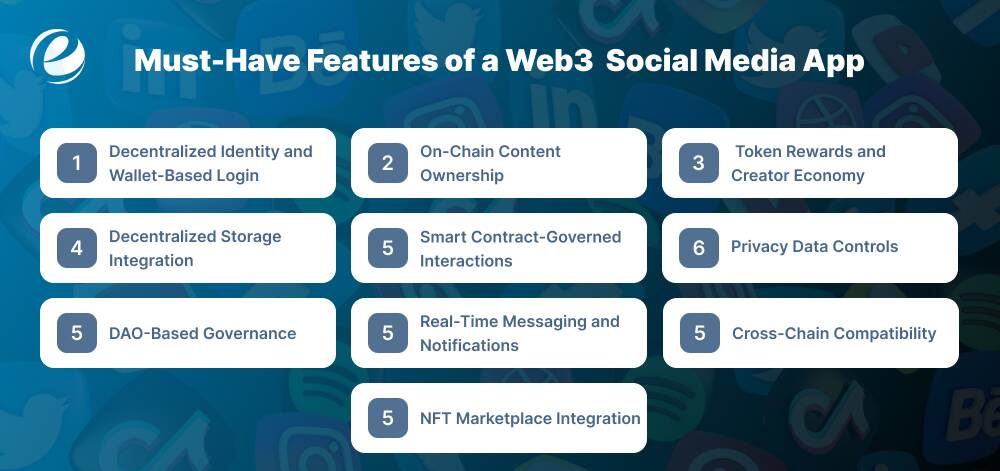
Some features aren’t optional; without them, you’re just building a regular app with a token bolted on. Below, you will learn about the features that play a huge role in your Web3 social media app development:
Decentralized Identity and Wallet-Based Login
Users connect via Web3 wallets, and they tie their identity to that wallet, not your database. Decentralized Identifiers (DIDs) let users maintain one persistent identity across platforms. If your app shuts down tomorrow, their profile still exists elsewhere.
On-Chain Content Ownership
Posts, videos, and articles can be tokenized as NFTs that give creators verifiable, on-chain proof of ownership. The smart contracts govern royalties and licensing automatically, where no middleman is involved.
Token Rewards and Creator Economy
Users earn native tokens for creating content, engaging, and curating. This is what makes blockchain social media app development genuinely different: the economic model runs in the user’s favor. It also solves the cold-start problem; early users have a real financial reason to participate.
Decentralized Storage Integration
Content stored on IPFS or Arweave doesn’t live on your servers. It’s distributed across the network, censorship-resistant, and can’t be deleted by a single platform decision.
Smart Contract-Governed Interactions
Tipping, subscriptions, and content gating are all executed through audited smart contracts. These transactions are transparent and tamper-proof. Users don’t have to trust the platform; they can read the contract.
Privacy Data Controls
The users decide what data gets shared and with whom. Zero-knowledge proofs (ZKPs) allow the verification of things like age or credentials without revealing the underlying personal information.
DAO-Based Governance
The token holders vote on moderation policies, fee structures, and platform rules. It’s messier than a CEO making decisions, but it builds user loyalty that’s almost impossible to replicate on a centralized platform.
Cross-Chain Compatibility
Locking users into one chain is a mistake. A solid decentralized social networking app supports Ethereum, Solana, Polygon, and BNB Chain, meeting users where their assets already are.
NFT Marketplace Integration
If users own tokenized content, they’ll want to trade it. These are the built-in marketplace features that add an economic layer and keep users engaged longer than a standard social feed.
Real-Time Messaging and Notifications
The app’s encrypted messaging with the help of protocols like XMTP or Waku keeps communications private. On-chain notifications keep users in the loop without routing everything through a centralized server.
Advanced Technologies Used in Web3 Social Media App Development
The tech stack for a Web3 social media app development includes blockchain layers, decentralized storage, identity protocols, and privacy infrastructure simultaneously. Below, you will learn about some of the eye-catching technologies that developers are using in the apps:
Blockchain Protocols and Smart Contract Platforms
Ethereum remains the default choice for smart contract work due to its extensive tooling, highly audited libraries, and strong security reputation. High gas fees push most consumer-facing projects toward Layer-2 solutions like Polygon or Arbitrum.
Decentralized Storage Solutions
IPFS is the workhorse content addressed by hash, not server location. Arweave handles permanent storage with a one-time payment model. Filecoin adds economic incentives to keep IPFS files reliably available rather than just technically accessible.
Decentralized Identity (DID) Standards
Frameworks like Ceramic Network or ENS implement the W3C DID spec, letting users own their digital identity across platforms. This is the backbone of true data portability in a Web3 social media platform development project.
Zero-Knowledge Proofs (ZKPs)
ZK tech lets you verify something is true without revealing the underlying data, age verification without collecting a birthdate, and credential checks without exposing documents. zk-SNARKs and StarkWare’s STARK proofs are both finding real use in social platforms for exactly these cases.
Oracles and Cross-Chain Bridges
Chainlink oracles pull real-world data on-chain. LayerZero and Wormhole let assets and messages move between networks. Both become essential infrastructure as a platform scales.
Frontend Technologies
React.js, Next.js, or Vue.js handles the interface, integrated with Web3 libraries like ethers.js or Wagmi. Teams working in mobile app development typically use React Native or Flutter for cross-platform delivery, with WalletConnect for wallet integration on mobile.
AI Integration
AI is finding a real role in Web3 social platforms’ content recommendation, spam detection, and moderation at scale. The key design principle is keeping AI governance on-chain so the community retains control, rather than delegating it to a small technical team.
Web3 Social Media App Development Process
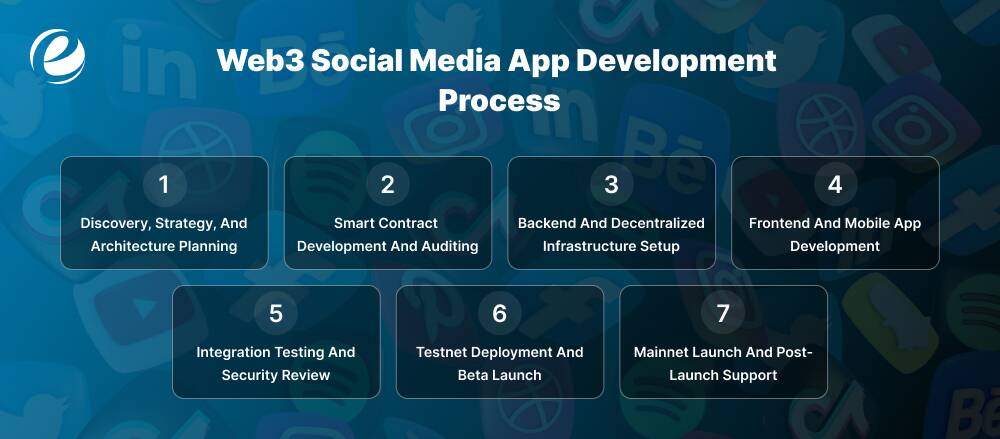
Building a Web3 social platform means building a product, a financial system, and community infrastructure simultaneously. Below, you will see how a serious team approaches your web3 social media app development:
Phase 1: Discovery, Strategy, and Architecture Planning
Before writing a line of code, you need clear answers: Who is the app for? What does the token economy look like? This phase produces a technical architecture covering blockchain, storage, identity, and frontend layers, plus competitive analysis.
Timeline: 2-4 weeks
Phase 2: Smart Contract Development and Auditing
The team builds and unit tests the core contracts covering identity, content ownership, token logic, and governance internally. Then they are sent to the third-party auditor, such as CertiK, Trail of Bits, or OpenZeppelin, for further processing.
Timeline: 4-8 weeks
Phase 3: Backend and Decentralized Infrastructure Setup
The Graph Protocol is set up to index on-chain data and make it searchable in real time. Furthermore, the storage nodes are provisioned, API gateways handle off-chain metadata, and then the notification infrastructure goes live.
Timeline: 4-6 weeks
Phase 4: Frontend and Mobile App Development
The blockchain interactions are not the hard part; instead, the challenge is making wallet onboarding feel natural to someone who has never used MetaMask. The UI needs to abstract enough complexity that a non-crypto user can participate without a tutorial.
Timeline: 6-10 weeks
Phase 5: Integration Testing and Security Review
In this phase, the developer performs testing on every user flow, load testing under realistic traffic, and a final security pass that covers both the smart contract and application layers. This phase catches the errors and problems that unit tests miss.
Timeline: 2-4 weeks
Phase 6: Testnet Deployment and Beta Launch
The platform goes live on a public testnet on Ethereum, Ripple, Stellar, and Matic Polygon, and a controlled beta group puts it through real-world usage. The users’ feedback shapes the final refinements of the apps before launching.
Timeline: 2-4 weeks
Phase 7: Mainnet Launch and Post-Launch Support
Full production deployment with monitoring, incident response protocols, and ongoing contract upgrades using proxy patterns. Community governance proposals start coming in; that’s a sign things are working.
Pro Tip: Don’t skip the smart contract audit to save money. A professional audit costs $10,000–$50,000. A post-launch exploit can cost multiples of that in funds, user trust, and press coverage you don’t want. The best hire mobile app developer teams will push back if you try to cut this step. Listen to them.
Cost to Develop a Web3 Social Media App in 2026
The cost of Web3 social media app development depends on the feature scope, the number of blockchains you support, team’s location, and whether you are building from scratch. Here is a general breakdown of the costs:
| App Complexity | Approximate Costs | Timeline |
| Basic dapp MVP | $40,000-$80,000 | 2 to 3 months |
| Mid-Level App | $80,000-$150,000 | 4 to 6 months |
| Advanced App | $150,000-$300,000+ | 6 to 12 months |
So, these are the general costs of the web3 social media apps. Each additional blockchain network adds development and testing time that can make a difference in initial costs.
How Web3 Social Media Apps Make Money?
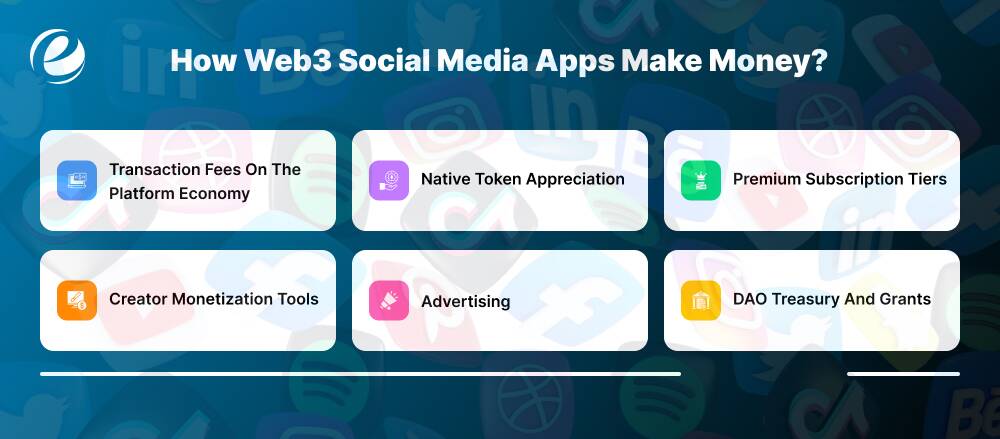
The revenue models here don’t rely on surveillance advertising; they are built on platform activity, which means incentives actually align with making the product good. Below, you will learn some methods through which you can make money from web3 social media apps:
Transaction Fees on the Platform Economy
Every on-chain transaction, NFT sale, tip, and marketplace purchase carries a small protocol fee flowing into the platform treasury or to token stakers. At real transaction volume, the fee becomes a meaningful passive income stream.
Native Token Appreciation
Platform growth drives demand for the native token. When the incentive design is right, this creates a flywheel; adoption grows the token, token value attracts more users, and more users grow adoption.
Premium Subscription Tiers
Many platforms offer premium tiers with better analytics, higher content visibility, or API access paid in fiat or native tokens. Decentralized doesn’t mean everything has to be free.
Creator Monetization Tools (Revenue Share)
The platform takes a cut of creator subscriptions and content sales, typically 2-10%, compared to the 30-50% Web2 platforms charge. Lower fees attract better creators. Better creators attract bigger audiences.
Advertising (Community-Governed and Privacy-Respecting)
The opt-in advertising lets the users choose to view ads in exchange for token rewards. However, advertisers pay for real, consensual attention. The platform earns the facilitation fee. Everyone’s deal is clearer than the surveillance model.
DAO Treasury and Grants
As a platform matures, its DAO treasury accumulates value from fees and token reserves, funding development, ecosystem grants, and partnerships, compounding returns by growing the ecosystem rather than extracting from it.
Why Choose EmizenTech for Web3 Social Media App Development
There’s no shortage of shops claiming Web3 expertise right now. The harder question is whether they understand social product design as well as smart contracts, because a technically sound platform nobody wants to use is still a failure.
EmizenTech has a genuine track record in blockchain app development, cross-chain architecture, DeFi integrations, and production deployments across Ethereum, Polygon, Solana, and BNB Chain. That breadth matters when your platform needs to operate across multiple networks from day one.
Another advantage is that most people experience social media on their phones. EmizenTech’s mobile app development team builds iOS and Android experiences that make wallet interactions feel natural, and reducing that friction is one of the most underrated factors in Web3 adoption.
If you are planning for decentralized social media app development, then you can trust our team for this collaboration. Our team will provide you with all the information related to the development costs and procedure. Let’s start this journey together!
Conclusion
After reading this guide, you have understood that Web3 social media app development is complex work: smart contracts, tokenomics, decentralized identity, and governance design. However, doing it wrong is expensive in ways that go beyond the development budget. But that difficulty is also why the opportunity is still available. Most of the mainstream market hasn’t been built yet.
Whether you are exploring decentralized social media app development for the first time or have a clear concept ready to build, choose a partner who understands both the technical and community dimensions. Before you start the initial process, just get this thing in your mind: a Web3 social media app is not just software; it’s an economy you are launching.
FAQs
What is a Web3 social media app?
A Web3 social media app is a decentralized networking platform that is built on blockchain technology. In contrast to the traditional platforms, it gives users direct ownership of their accounts, digital identity, and content using cryptographic keys.
How much does it cost to develop a Web3 social media app in 2026?
The development of a Web3 social media app ranges between $50,000 to $250,000 for a robust platform. The initial price also depends on the app complexity, features, and the developers' team location.
What are the key features of a Web3 social media app?
The Web3 social media apps replace the centralized corporate control with blockchain technology. The key features are user-owned identity via crypto wallets, full data control, censorship resistance, and token-based economies.
Which blockchain is best for Web3 social media app development?
For the Web3 social media app development, the best blockchains depend on your architectural needs of the apps, but Optimism and Solana are the leading choices for businesses nowadays.
How do Web3 social media apps make money?
Web3 social media apps generate revenue through transaction fees on digital assets, platform subscriptions, advertising, and the sale of premium features that are available on the app.



 +1 (989) 535-9295
 info@emizentech.com
 emizentech


