
 Add us as a preferred source on Google
 Fractional CTO costs vary widely and coming to a practical figure can be overwhelming and time-consuming.
Some founders keep startup-friendly pricing in mind as they start with decision-making, but they end up receiving an enterprise-level quote. Others seek low fractional CTO hourly rates but end up paying far more for reworks later. This whole confusion commonly arises from one action: comparing fractional CTOs like contractors instead of executive leaders.
Before you ask, “How much does it cost to hire a fractional CTO?” here’s what you need to know: this role is not cheaper than hiring a full-time CTO. It is just different as an engagement model. Rates depend on authority, business stage, and other commitments, like time.
In this section, we have explained fractional CTO costs using real pricing structures that you’ll see in 2026. Continue reading to find the answers you are looking for.
Fractional CTO Rates at a Glance
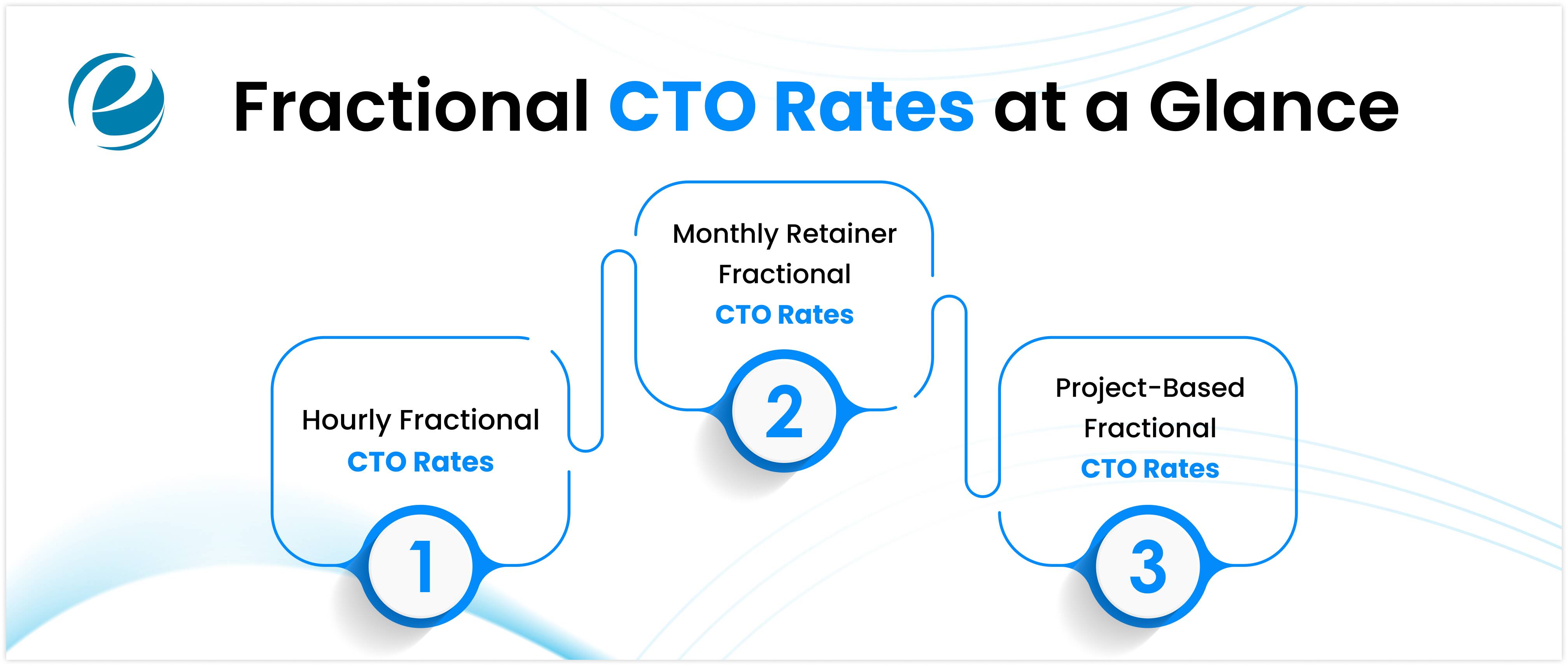
Here below is how fractional CTOs are typically priced in the market.
| Pricing Model | Typical Range | When It’s Used |
| Hourly Rate | $120 – $300 per hour | Short-term advisory, audits, architecture reviews |
| Monthly Retainer | $4,000 – $15,000 per month | Ongoing leadership, startup and scale-up phases |
| Project-Based | $8,000 – $40,000+ per project | Platform rebuilds, migrations, major launches |
Note: Each engagement model serves a different purpose for different business needs. Choosing the wrong one can inflate fractional CTO costs without adding value to the project.
Hourly Fractional CTO Rates
Fractional CTO hourly rates in 2026 fall between $120 and $300, again, depending on factors like responsibility, geography, and experience.
This engagement model is suitable for businesses/projects where the scope is less and time-sensitive. If you are seeking a professional only for advisory purposes, expect the rates to be at the lower end. However, the figures go up as you add responsibilities like accountability of execution and decision-making.
That said, opt for hourly pricing if you need:
- A technology audit
- Architecture or stack evaluation
- Vendor or agency review
- Short-term strategic guidance
If you’re seeking leadership, this engagement model won’t work. CTO’s value compounds over time. Paying for ongoing decision-making on an hourly basis can leave your project scattered with fragmented, vague discussions.
Monthly Retainer Fractional CTO Rates
Most businesses prefer a monthly retainer. This is the engagement model where fractional CTO rates align perfectly with actual leadership value. In fact, 40% of fractional professionals also use the retainer model.
Fractional CTO costs for monthly retainers fall between $4,000 and $15,000, based on factors like company stage, commitment, and authority.
Early-stage startups usually sit at the lower end, while scaling companies with teams, infrastructure, and investor pressure spend higher.
Consider hiring a fractional CTO if your expectations from them include:
- Technology roadmap ownership
- Decision-making around the architecture and scalability
- Developer and vendor oversight
- Regular leadership involvement
This is the most common structure for companies that want to hire fractional CTOs for long-term association, not just consulting.
Not to mention, this figure cannot be compared to a fractional CTO salary. The reason is simple: Typically, a full-time CTO costs $180,000–$250,000 annually before equity. Companies use this model to prevent this commitment while still getting senior judgment. For a detailed comparison, see Fractional CTO vs Full-Time CTO in this section ahead.
Project-Based Fractional CTO Rates
In 2026, project-based fractional CTO costs typically range from $8,000 to $40,000+, depending on project complexity and accountability.
In scenarios where outcome matters more than ongoing involvement, businesses often prefer to spend on project-based fractional CTO rates. Instead of retainers or billing hours, the CTO simply commits to a specific scope with defined deliverables.
You can hire a fractional CTO under this model if you are looking for guidance with:
- Platform or architecture redesigns
- Cloud migrations or modernization
- MVP rescue or stabilization
- Pre-investment or pre-acquisition technical due diligence
Note, project pricing helps the most when you are clear with timelines, responsibilities, and decision authority. It breaks down when your project scope involves the chance of shifts in leadership and development, or even extension.
Not to mention, this model often becomes more expensive than a retainer when you extend it to a longer stint.
Factors That Affect Fractional CTO Rates
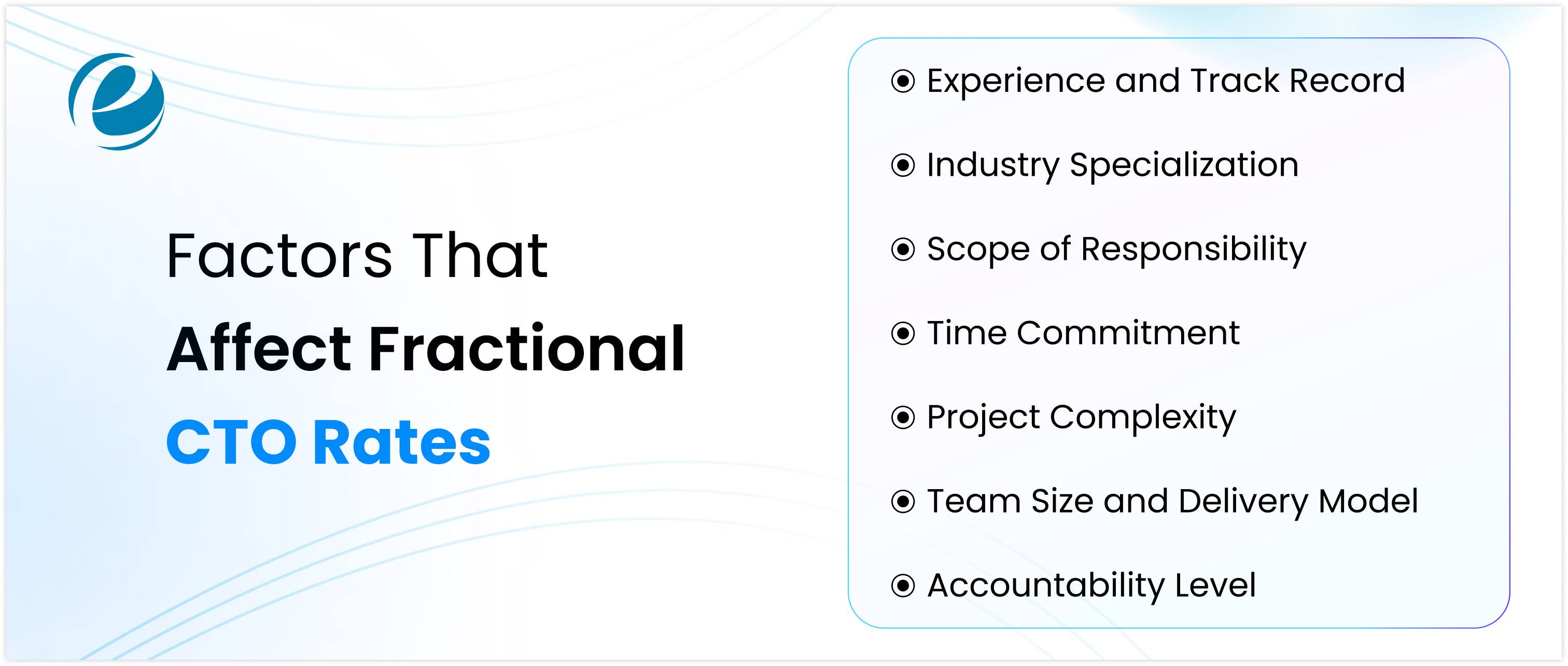
Fractional CTO hourly rates or costs are not fixed. As we mentioned above, the costs shift based on responsibility, risk, and involvement, not just titles or years of experience.
Now let’s discuss the different factors that influence the number to a larger extent.
Experience and Track Record
Experience is one of the biggest factors to impact fractional CTO rates, as it helps gauge the certainty. For example, a CTO who has worked on multiple AI development projects will bring understanding that newer candidates simply don’t have.
The cost is higher when a professional brings a strong track record in product launches, turnaround situations, and scaling phases. The premium projects less mistakes, make faster decisions, and a lower risk of technical debt. Not to mention, this is especially important for high-stakes businesses.
Industry Specialization
Businesses looking to hire fractional CTOs always prefer profiles that reflect expertise in their industry. CTOs who specialize in domains like AI, fintech, healthcare, or security charge higher rates because the scope for error is smaller. After all, a professional with specialization in eCommerce development services is more likely to deliver results with attention to detail, compared to a CRM expert.
Moreover, data sensitivity, compliance requirements, and regulatory exposure increase responsibility. These details ultimately take the cost higher. In fact, businesses operating in regulated industries can also prevent risks and delays in exchange for a higher fractional CTO rate for domain-aligned expertise.
Scope of Responsibility
The scope can turn the numbers upside down. Advisory profiles sit at the lower end of fractional CTO costs. This role is all about reviewing decisions, validating architecture, or providing strategic input.
On the other hand, we have an ownership role. This changes everything. When businesses hire fractional CTOs for defining the roadmap, approving architecture, and taking full accountability for outcomes, they spend significantly more.
Time Commitment
Timing is about both availability and responsibility. The cost of hiring a fractional CTO who works on one fixed day per week is less in comparison to the cost for one who attends calls, joins discussions, and responds to technical tasks in real time.
The latter comes with faster decision turnaround, flexible access, and deeper involvement, but also boosts the fractional CTO rates.
Project Complexity
The cost of hiring fractional CTOs varies depending on how simple or complex a product is, making it one of the crucial factors in cost estimation.
A business running multiple apps, regulated workflows, and third-party integrations is different from a startup with a single platform where users are limited. When systems grow and become more interconnected, the cost rises too. This ultimately influences the CTO’s pricing.
Team Size and Delivery Model
Leadership has a lot to do with people. For managing a small internal team, you need less coordination. On the other hand, overseeing multiple offshore development partners or vendors demands more flexibility in communication.
A fractional CTO serving as the central authority across teams leads to an increase in meetings, delivery tracking, and conflict resolution. This leadership load is built into fractional CTO rates.
Accountability Level
Accountability is the most straightforward divider here! If the fractional CTO is accountable for a range of actions like platform stability, delivery timelines, budget optimization, and scalability, their pricing should sit closer to executive compensation.
In fact, at this level, comparing the cost to a fractional CTO salary totally makes sense.
Fractional CTO Rates by Company Stage
Company scale and stage matter a lot when calculating fractional CTO costs. Here is how:
Early-Stage Startups
Early-stage or pre-seed startups usually hire startup fractional CTOs for guidance with direction, validation, and MVP planning. Hence, the rates sit at the lower end and focus more on product decisions and architecture than scale.
Growth-Stage Companies
Fractional CTO costs increase once revenue, funding, or users enter the picture. Companies at this stage prefer hiring fractional CTOs for managing scale, stability, and team performance. For them, it is best to invest in monthly retainers.
Scaling and Enterprise Businesses
For scaling companies, hire fractional CTOs to fulfill their expectations with full-time roles, without using a permanent contract. The cost here reflects executive ownership, system reliability, and business-critical decision-making.
Fractional CTO Rates by Region
Geography still influences fractional CTO rates, though less than it used to.
North America
This region has the highest fractional CTO costs globally, ranging from $10,000 to $16,000 per month. Seasoned professionals often charge premium retainers for their experience with scaling, compliance, and investor expectations.
Europe
In Europe, the figure varies largely by country. Western Europe stands closer to North America, charging between $5,000 and $12,000 per month. On the other side, Eastern Europe brings cost flexibility without ruining the technical depth, charging between $4,000 and $9,000 per month.
Asia
Several enterprises and startups invest in talent in Asia due to lower average rates that range from as good as $2,000 to $6,000 per month. The fractional CTO leadership in Asian countries offers a solid balance between budget and expertise.
Fractional CTO vs Full-Time CTO
Choosing between a fractional CTO vs full-time CTO is a matter of how much leadership your business actually needs at the moment.
A full-time CTO is ideal for organizations that need daily technical ownership, constant team management, and long-term strategic continuity. On the other hand, a fractional CTO is best for businesses that require high-impact decisions, architectural control, and senior oversight without the cost and rigidity of a permanent executive role.
Here’s a clearer differentiation between the models.
| Factor | Fractional CTO | Full-Time CTO |
| Engagement Model | Part-time or contract-based | Permanent executive hire |
| Cost Structure | Flexible fractional CTO rates | Fixed salary + benefits |
| Time Commitment | Limited, needs-based | Full-time, daily involvement |
| Best For | Startups and growing businesses | Large or scaling enterprises |
| Strategic Ownership | High-level direction and oversight | End-to-end technical ownership |
| Financial Risk | Low, adjustable over time | High, long-term commitment |
Hire a Fractional CTO at the Right Rates, with EmizenTech
Even as we talk about fractional CTO costs, the end goal is to find a professional who aligns leadership depth with the business stage. At EmizenTech, businesses can access experienced Fractional CTO services and hire dedicated developers to accelerate product development, reduce hiring complexities, and scale technology initiatives efficiently.
With us, companies hire fractional CTOs who bring a mix of real-world product, architecture, and scaling experience, all without inflating costs or overengineering the platform. We structure engagement models based on
- Clear responsibilities
- Defined outcomes
- Realistic time commitments
Whether you need long-term leadership or short-term guidance, we make sure you pay for impact and not just availability.
Wrapping Up: Fractional CTO Costs
Fractional CTO rates are not limited to a bracket, instead a number of factors comes into play, impacting the ranges. The pricing depends on the project, responsibility and scope of role, platform complexity, not to mention accountability, among several other factors varying from business to business.
By aligning roles and responsibilities correctly, you can expect the fractional CTO to deliver senior leadership without any risk of premature full-time hires. This position is especially beneficial for startups and growing businesses in terms of flexibility, clarity, and control.
The key is choosing the right engagement structure. In the end, the right fractional CTO doesn’t reduce costs by cutting corners but by making fewer mistakes.
FAQs
How much does a fractional CTO cost per month?
Monthly fractional CTO costs typically range from $4,000 to $15,000, depending on involvement level, responsibility, and company stage. More embedded leadership falls toward the higher end.
Are fractional CTOs cheaper than consultants?
In most cases, yes. Consultants focus on advice. Fractional CTOs take ownership. While hourly rates may look similar, fractional CTOs deliver better long-term value by preventing costly missteps.
Can a startup afford a fractional CTO?
Yes. Many startups engage fractional CTOs precisely because they can’t afford full-time executive hires. The fractional model keeps leadership costs flexible and aligned with growth.
How many hours does a fractional CTO work?
The timelines vary by engagement. Most fractional CTOs work between 8 and 32 hours per month. They scale up during important phases like launches or system updates.
Do fractional CTOs take equity?
It depends on the business and fractional CTOs. Some do take equity (especially in early-stage startups). Note, this arrangement is determined by the involvement level, risks involved, and long-term commitment.




 +1 (989) 535-9295
 info@emizentech.com
 emizentech


