
 Add us as a preferred source on Google
Key takeaways
- Software developer soft skills determine whether work shipped on a remote team actually solves the right problem.
- Clean code built on a misunderstood requirement is still a wrong answer.
- Skipping documentation just moves the cost of a decision onto whoever inherits it next.
- Career-success research consistently favors interpersonal skill over raw technical depth.
- Weak communicators cost more over a project’s life than what they save on an hourly rate.
Soft skills of a software developer are the communication, time-management, and collaboration abilities that decide how well a developer works on a team, separate from how well they code.
On remote teams, these skills matter even more than in an office, because there’s no hallway conversation to catch a misunderstanding before it turns into a missed deadline.
In this guide, you will learn what these skills are, why they matter more remotely, the ten skills that matter most, and how to screen for them when hiring.
What Are Software Developer Soft Skills?
Software developer soft skills are the non-technical habits that decide how well a developer communicates, collaborates, and adapts on a team, separating them from how well they code. Communication, time management, adaptability, and accountability all fall under this category.
The soft skills of a software developer show whether their work actually holds up on a team, not just whether it compiles. Let’s understand why these skills matter in remote development teams.
Why Soft Skills Matter More in Remote Development Teams
Soft skills matter more on remote teams because there’s no informal, in-person moment left to catch a misunderstanding before it turns into a real problem. In an office, a lot of miscommunication gets caught by accident; someone overhears a conversation, notices confused body language, or clears things up in the hallway.
Remote teams don’t get that safety net; they have to catch every misunderstanding on purpose, through a message, a call, or a status update. That’s exactly why soft skills for a software developer matter so much more once the team stops sharing a space.
Without them, here’s what tends to happen:
- Unclear updates lead to duplicated work.
- Skipped questions turn into wrong assumptions, and wrong assumptions become rebuilds.
- Time zone gaps leave teammates blocked for hours with nobody to ask.
- Small misunderstandings surface weeks later, usually as a missed deadline.
If you want to hire remote developers successfully, then treat the issue as a real filter during hiring, not an afterthought, because a distributed team makes both good and bad communication habits louder.
10 Essential Software Developer Soft Skills Every Remote Team Needs
In the section below, you will learn about some of those success-driving soft skills for software developers who work remotely:
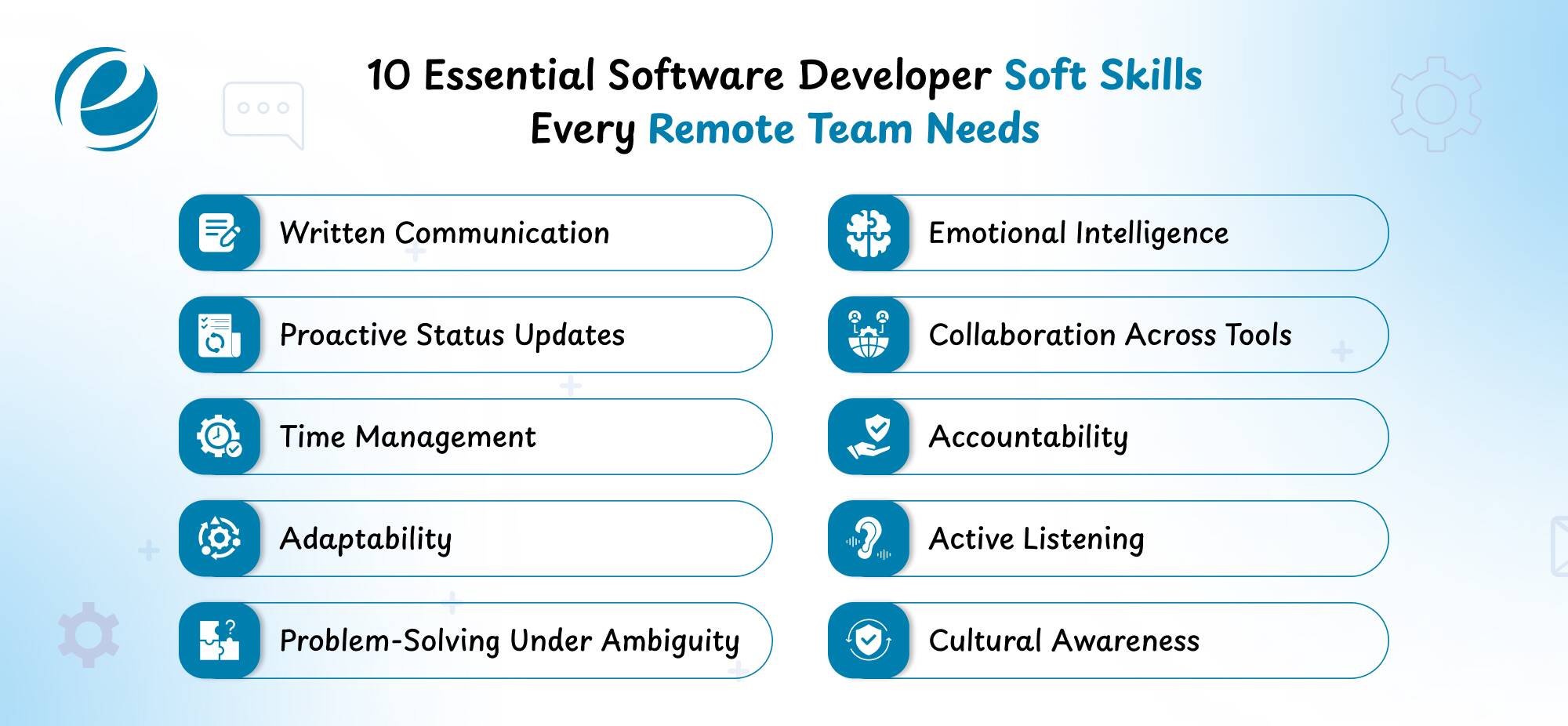
1. Written Communication
Most remote work happens over Slack messages, PR comments, and Jira tickets instead of calls. A developer who writes clearly, without ten follow-up questions needed to understand them which can save everyone time. Vague updates cause more confusion than staying quiet would, and they pile up fast across a busy sprint.
2. Proactive Status Updates
Nobody can see your screen when you work remotely. Good developers flag a blocker before someone asks for an update. Waiting to be chased is one of the fastest ways to lose a manager’s trust, even if the actual work is fine.
3. Time Management
Different time zones mean less overlap and fewer chances to sync live. Developers need to protect focus time while still being available when it matters. Get that balance wrong, and you either burn out from constant context-switching or quietly become the bottleneck everyone’s waiting on.
4. Adaptability
Tech stacks shift, priorities change, and requirements get rewritten mid-project. Developers who adjust without much complaint stay genuinely useful. The ones who freeze every time something changes end up holding the whole team back, even when their code itself is perfectly fine.
5. Problem-Solving Under Ambiguity
You can’t always get an instant answer on a remote team. Strong developers make a reasonable call, write down why, and keep moving instead of sitting stuck at a single point, waiting on a reply that might be late on the basis of their time zone.
6. Emotional Intelligence
Tone is hard to read in a text message and handling it is one of the important soft skills for developers. Developers with decent EQ give feedback without starting a fight, stay level during a production incident, and notice when a teammate’s gone quiet for the wrong reasons.
7. Collaboration Across Tools
Git, Jira, Notion, Slack, and Loom are the tools remote work runs on. Switching between them without friction, and actually using them to keep others in the loop, isn’t a bonus skill anymore. It’s just the responsibility now, whether people like it or not.
8. Accountability
Nobody’s watching you remotely. The best developers own their deadlines without needing clients to remind them twice, and if something’s going to slip, they say so early, not the night before it’s due, when there’s no time left to adjust.
9. Active Listening
On a call full of accents, echoes, and unreliable WiFi, nodding along isn’t listening. Repeating back what you heard, or asking one simple clarifying question, is what actually prevents someone from building the wrong thing for an entire week.
10. Cultural Awareness
Global teams mix holidays, communication norms, and work styles that don’t always match up. Developers who notice and adjust, instead of assuming everyone works the way they do, keep cross-border collaboration a lot smoother than you’d expect going in.
That’s the real list of the soft skills of a software developer. This matters even more for startups, where a single miscommunication can eat a real chunk of a small budget. Software development for startup engagements leaves little room for a developer who needs constant hand-holding.
Why Technical Skills Alone Aren’t Enough for Remote Development Success
Technical skill alone isn’t enough for remote success because it only shows what a developer can produce on their own, not whether they communicate clearly, manage their time, or collaborate without someone watching over them.
A brilliant piece of code built on a misunderstood requirement is still wrong, no matter how clean it looks, and a developer who skips documentation just hands the next person a harder problem to solve later.
This is exactly the gap that software developer soft skills fill: the difference between someone who ships fast and someone who ships correctly.
How Strong Soft Skills Improve Remote Team Performance and Project Outcomes
Fewer misunderstandings mean less rework. Less rework means projects stay closer to schedule and budget. That’s really the whole mechanism; it’s not more complicated than that.
Teams with strong communicators tend to see:
- Fewer requirement mismatches, because developers ask before building instead of after.
- Faster code reviews, since pull requests come with context instead of just a variant.
- Fewer surprises at standup, because blockers get flagged the day they happen.
- Smoother handoffs, since well-integrated developers don’t need constant re-explaining.
This is why examining the software developer soft skills is now part of the hiring process, rather than being added later. If you follow a real process for hiring remote developers, build these skills into the interview itself, rather than trusting they’ll sort themselves out once someone’s on the team.
Why Businesses Trust EmizenTech for Remote Software Development Teams
EmizenTech vets every developer for both code and communication before we place them on a client project. That’s one of the reasons why we say, “hire a dedicated developer risk-free.” We also offer a 14-day money-back guarantee if the client is not fully satisfied with the developers.
Here’s what that looks like in standard procedures:
- Structured interviews that test how a candidate explains a technical decision.
- Written communication samples reviewed before a developer is even shortlisted.
- Real collaboration scenarios instead of just whiteboard problems.
Whether a business needs one specialist or a full distributed pod, EmizenTech’s remote software development model uses the same standards to screen both the technical depth and soft skills for software developers.
Final Thoughts
When hiring a software developer soft skills are a crucial aspect in addition to technical knowledge, delivery speed, code quality, and how long a team actually stays stable. Technical screening tells you if someone can code. Soft skills screening tells you if they can do it reliably on a distributed team, without someone checking in on them every day.
The strongest remote hiring processes test for both. Most engineering leads learn these lessons the hard way, usually after a technically sharp hire struggles to fit into a distributed workflow. It’s also worth thinking about the numbers behind that decision.
When you figure out the cost of hiring dedicated developers, a technically sharp but poorly communicating hire often ends up being pricier than a slightly more expensive one who communicates well. Make sure to plan these things early.
FAQs
1. Why do remote software developers need soft skills?
Remote teams lose in-person cues like body language and quick clarifications, so developers have to communicate proactively, manage their own time, and resolve ambiguity through clear, written collaboration.
2. Which soft skills matter most when hiring developers?
Written communication, proactive status updates, time management, adaptability, and accountability matter most; these directly affect how smoothly a developer works within a distributed team.
3. How do you assess a developer's soft skills?
Use structured interviews, written communication samples, collaborative coding exercises, and reference checks that focus specifically on teamwork and reliability under deadlines.
4. Can software developers improve their soft skills?
Yes. They respond to deliberate practice, feedback training, better documentation habits, and structured communication routines, which can noticeably improve them over time.
5. How does EmizenTech evaluate developer soft skills?
EmizenTech combines technical interviews with communication assessments and real collaboration scenarios, so every placed developer performs well on both fronts.



 +1 (989) 535-9295
 info@emizentech.com
 emizentech


