
 Add us as a preferred source on Google
Hiring a full-time CTO too early is an expensive move, but not hiring technical leadership at all is even worse. Some startups take the third route: Hiring a fractional CTO. In many cases, growing businesses build products without the architectural depth and clarity needed. They depend on developers to make strategic decisions that were not part of their hiring process. Months pass and one day, they realize that the product may be working, but it is not scaling. The costs are high, but there is no fix in sight.
A fractional CTO solves these problems, including those in the technical infrastructure that most growing companies are unaware of. They bring senior-level decision-making into business without committing to a full-time payroll. With CTO job postings witnessing a rise of up to 27%, this role is a win for both businesses and seasoned professionals.
Continue reading this article to learn what is fractional CTO, what roles and responsibilities are assigned to them, and more.
What is Fractional CTO?
A Fractional CTO is an experienced Chief Technology Officer who joins a company for a specified number of hours, days, or months, instead of joining full-time. The idea of this role is to help businesses make the right decisions at the right time, so they don’t need to hire a leader for a full-time job.
This role is not about delivery, instead it focuses on direction. Fractional CTOs guide developers, decide what should be built, how it should be built, and what actions a business should avoid at all costs.
You’ll often see fractional CTOs working with:
- Early-stage startups validating their first product
- Funded startups preparing for scale
- Non-technical founders managing dev teams
- Businesses rebuilding or modernizing legacy systems
This model is especially common in startup fractional CTO engagements, where speed, clarity, and cost control matter more than titles.
Roles and Responsibilities of a Fractional CTO
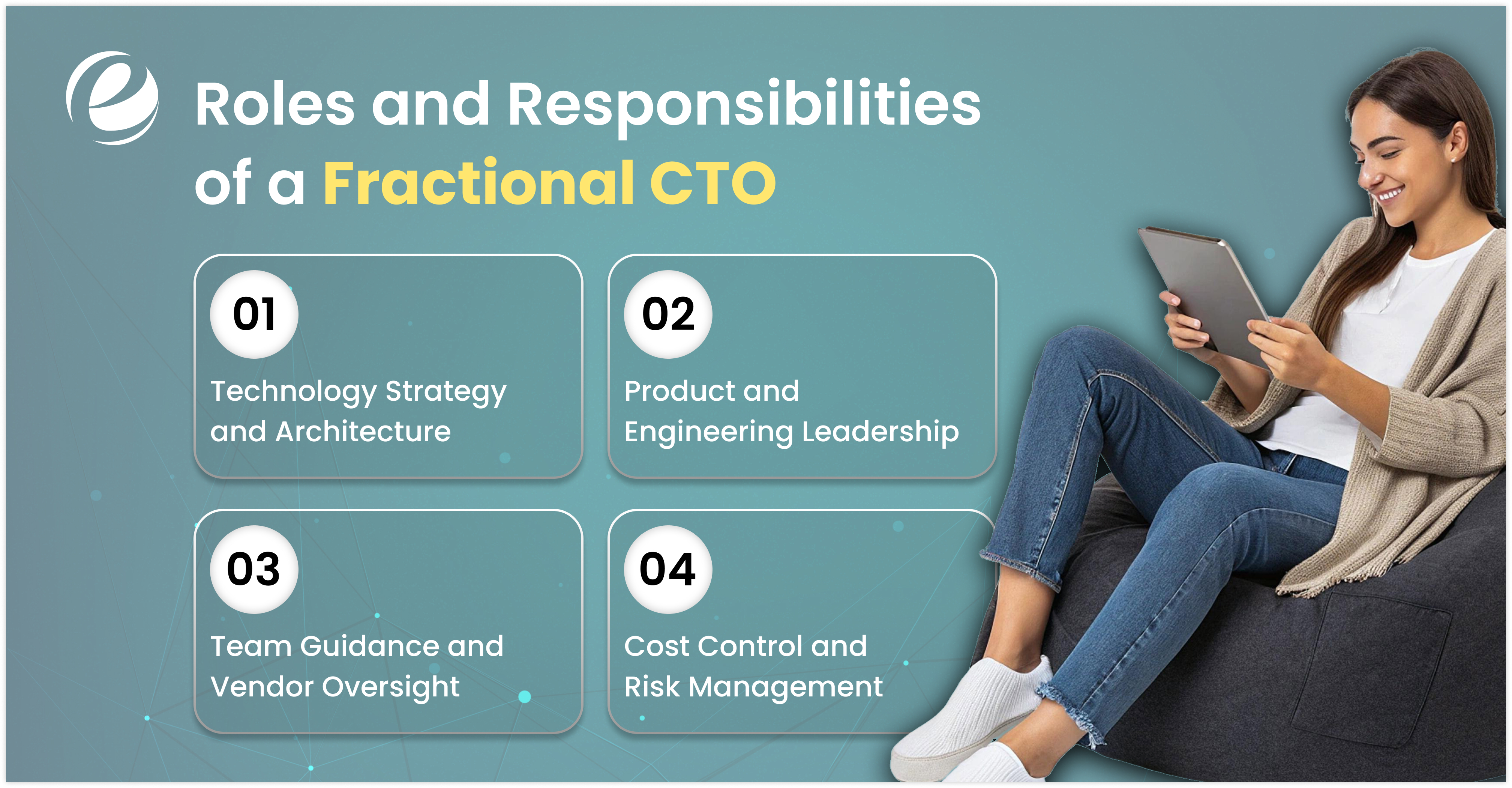
Understanding roles and responsibilities is crucial to actually understanding what is fractional CTO and how they help drive business growth.
The role plays is responsible for making decisions for a business, especially startups. Instead of just meetings, businesses hire fractional CTOs to get expert strategies, direction, and execution that align with their goals.
Here’s a list of what a fractional CTO does:
Technology Strategy and Architecture
A fractional CTO is responsible for designing a full-fledged roadmap based on business goals and challenges. This covers the selection of the right technology stack, prevention of long-term technical debt, and bringing scalable architecture to life.
Product and Engineering Leadership
Fractional CTOs align product vision with engineering performance, breaking vague ideas into developable features. They set clear standards of development, review architecture decisions, and make sure that the product can evolve without non-stop rewrites.
Team Guidance and Vendor Oversight
Instead of micromanaging, fractional CTOs mentor developers and evaluate performance. They act when team members lose the hang of a project. If external vendors or agencies are involved, they act as the technical authority, protecting the business from poor delivery and inflated timelines.
Cost Control and Risk Management
Financial efficiency is one of the biggest fractional CTO benefits. The role helps businesses avoid overengineering, reduce unnecessary tooling costs, and make informed trade-offs between speed and stability. Not to mention, this directly influences fractional CTO cost and long-term technology spend.
Benefits of Hiring a Fractional CTO
Hiring a fractional CTO is a calculated move that businesses make to get the best of both worlds. This model helps them get senior technical leadership without investing in a full-time commitment before the timing is right.
When the model is planned and used correctly, the fractional CTO benefits businesses in many ways, showing improvements in quality, speed, and long-term cost control.
Access to Broader Perspective and Experience Without Full-Time Cost
When companies hire a fractional CTO, they get years of real-world experience in architecture, scaling, and technical leadership. What’s better is that they get all of these perks without committing to a full-time fractional CTO salary. For example, a seed-stage SaaS startup engaged a fractional CTO part-time and achieved a 224% ROI over three years, with faster architecture decisions and technical due diligence. In short, this model gives the freedom to pay for decision-making and direction, not time spent at the desk.
Faster, More Confident Technical Decisions
Ownership without clear, defined scope ends up slowing down the team. A fractional CTO removes this bottleneck. They define priorities, approve architectures, and close open loops, keeping the pipeline and coordination smooth-sailing. This ultimately allows developers to build faster, especially when decisions don’t float. In one of the cases, fractional CTO leadership accelerated CI/CD implementation and team scaling, enabling 40% faster deployments and measurable increase in engineering throughput during critical growth phases.
Reduced Technical Debt and Rework
Most reworks on technical areas come from rushed or poorly guided decisions at the beginning of the project. For instance, choosing scalable APIs or modular architecture early prevents painful rewrites when users or data volume spikes. This leads to overspending on the development. A fractional CTO designs systems with scale in mind, preventing costly technical debt in the future. In fact, this factor alone can offset fractional CTO costs within months
Better Oversight of Developers and Vendors
A fractional CTO works as the technical authority, be it for an outsourced team or internal. Their role involves reviewing work, questioning timelines, and not to mention, protecting the business from underdelivery or over-the-board experimentation. This helps founders stay in control without becoming technical gatekeepers.
Flexibility as the Business Scales and Evolves
This is one of the biggest benefits of hiring a fractional CTO. They scale with the business. This means that you can increase their involvement during critical phases and shrink it when stability returns or the workload simmers down. This flexibility is not possible with permanent executive hires.
When Should You Hire a Fractional CTO?

You should hire a fractional CTO when technology decisions start impacting your business growth and there’s no one to own the outcomes.
Here are the common scenarios that indicate the need to consider hiring a fractional CTO:
- Growing or expanding a business
- Bridging leadership gaps
- Bringing in expertise and required to develop a product
- Scaling users, revenue, or infrastructure
- Managing developers without technical leadership
- Preparing for funding, audits, or acquisitions
- Accumulating tech debt without a clear plan
How Much Does a Fractional CTO Cost?
Fractional CTO costs range from $4,000 and $15,000 per month. However, the figure varies greatly depending on a number of factors. These include:
- Responsibility
- Involvement
- Project complexity
- Region
- Business stage
Also, engagement models like hourly and project-based options impact the rates too. Tap here to read a detailed guide on fractional CTO rates.
How to Hire a Fractional CTO?

While understanding what a fractional CTO and what they do is important for making a hiring decision, the recruitment process involves more considerations than just basic knowledge.
Here’s how to hire a fractional CTO for effective results:
Step #1: Define the Problem and Scope
Defining the problem is the first step to hiring a fractional CTO. From vendor control to scaling issues to architecture, highlighting the problem helps you define what assistance you expect from a professional.
Step #2: Check Skills, Beyond Technical Knowledge
Here are the key things to evaluate before shortlisting candidates:
- Ability to break business goals into technical priorities
- Experience with similar company stages or industries
- Clear communication with non-technical stakeholders
Step #3: Select Engagement Model
Define the engagement properly. Decide whether the role requires hourly support, a monthly retainer, or project-based involvement. This will keep the project rolling smoothly and without any conflicts.
Step #4: Interview and Select the Right Fractional CTO
During the interview, ask questions around business and strategy alignment, experience and relevance, delivery, and team management. Think through it and make a deliberate choice. The right fractional CTO is one who has a hang of your business context, asks the right questions, and demonstrates confidence in making trade-offs.
Step #5: Confirm Accountability and Decision Rights
Clearly communicate with your fractional CTO about where responsibility begins and ends. Clarify if they will make decisions regarding architecture, along with responsibilities like vendor management, hiring input, delivery timelines, or budget oversight.
Common Myths About Fractional CTOs
The fractional CTO model is a shift from traditional leadership thinking, and that’s where most misconceptions begin.
Here below are some common myths that businesses come across when understanding what is fractional CTO.
Myth #1: “They don’t get involved in operations”
This is the most common myth about a fractional CTO. The role owns the practical side of the project by staying involved, revisiting outcomes, and adjusting direction when required. The accountability gap between a fractional CTO and a consultant is stark. This is why the former delivers more long-term value.
Myth #2: “They’re only suitable for early-stage startups”
Fractional CTOs are not limited to early-stage companies. Even enterprise businesses hire them for transitions, platform rebuilds, or to fill leadership gaps. The model works best whenever flexibility is required more than permanence.
Myth #3: “Lower cost means lower commitment”
A fractional CTO with clear authority often shows strong ownership. This model reduces payroll risk, not leadership quality.
Myth #4: “They don’t lead teams effectively without being full-time”
Fractional CTOs set standards, make crucial decisions, and hold teams accountable, leading with clarity and structure. In fact, teams often perform better with focused leadership than with always-on oversight.
Hire a Fractional CTO with EmizenTech
Hiring a fractional CTO should reduce vagueness and risks, not add to them. At EmizenTech, businesses can access experienced Fractional CTO services and hire dedicated developers to build scalable products, accelerate development timelines, and reduce hiring complexities.
With us, brands hire fractional CTOs who combine hands-on product experience with strategic oversight. They work closely with founders, leadership teams, and developers to bring structure to technology decisions, reduce technical reworks, and guide teams toward scalable outcomes.
Our engagement model includes:
- Well-defined roles, responsibilities and authority
- Realistic, outcome-driven roadmaps
- Flexible involvement that scales with business needs
Whether you need short-term direction or long-term leadership, get in touch with our team to meet the seasoned professional you are looking for.
Summing Up: Fractional CTOs for Strategic Guidance
Now that we have discussed what is fractional CTO, one thing should be clear: This role isn’t a temporary fix, instead it brings strategic leadership that can leave a lasting effect on the project evolution.
The role helps you remove the gap between planning, execution, and direction. That’s not all. A fractional CTO brings senior-level judgment, architectural clarity, and technical leadership, all without making you commit to a full-time executive.
When hired at the right time and aligned smartly, this role is all you need to move faster, prevent costly mistakes, and scale confidently.
FAQs
How many hours does a fractional CTO work?
It depends on the engagement. Most fractional CTOs work between 8 and 32 hours per month, with the flexibility to scale up during launches, migrations, or critical growth phases.
Can a fractional CTO manage a full tech team?
Yes. A fractional CTO can lead internal teams, oversee vendors, and manage distributed or offshore developers. Leadership effectiveness depends on authority and structure, not full-time presence.
Is a fractional CTO suitable for mid-sized companies?
Absolutely. Many mid-sized companies hire fractional CTOs to manage scale, reduce technical debt, or guide platform modernization without committing to a permanent executive role.
Does a fractional CTO write code?
Typically, no. The role focuses on strategy, architecture, and leadership. Some may review code or guide best practices, but execution remains with the development team.
How long should a company engage a fractional CTO?
There’s no fixed timeline. Some companies engage fractional CTOs for a few months during critical phases, while others retain them long-term until full-time leadership becomes necessary.





 +1 (989) 535-9295
 info@emizentech.com
 emizentech


