
 Add us as a preferred source on Google
 Is it possible that AI can generate product descriptions, recommend items, engage in conversation with customers, and even create designs for fashion? In today’s rapid digital era, the answer is definitely affirmative, and that is the extent of Generative AI in ecommerce
Generative AI is not only for the automation of tasks, but it is also a kind of innovative thinking and creation that can be done only with human input. It enables enterprises to be more productive, economize, and generate more sales, simultaneously providing a hassle-free and captivating customer journey.
In this article, we will discuss everything about Generative AI in ecommerce
If you are keen on enhancing customer experience, automating product content, or even preparing yourself for the future of AI-driven retail, this article is the perfect starting point for you.
Global Market Size & Growth (2025-2030)
- According to The Business Research Company, $0.88 billion in 2024 → $1.04 billion in 2025, reflecting a CAGR of 18.8% for Generative AI in ecommerce.
- By 2029, the market is expected to reach $2.06 billion, maintaining a CAGR of 18.6%.
Retail & eCommerce
- In 2024, the enterprise Generative AI market for retail and ecommerce
was valued at around $589.9 million. The market is expected to witness a staggering CAGR of 42.5% over 2024-2030.
Longer-Term Forecast (2025–2034)
- As per Precedence Research, the overall Generative AI in ecommerce
market was $833 million in 2024, and it is projected to reach $3.52 billion by 2034, at a CAGR of 15.5% during the 2024-2034 period.
Wider Enterprise Generative AI Outlook
- The overall addressable market for enterprise Generative AI (across sectors) is projected to soar from $22.2 billion in 2025 to $109.4 billion by 2030, representing a robust CAGR of 37.6%.
| Year | eCommerce | CAGR |
| 2024 | $0.88 B | — |
| 2025 | $1.04 B | 18.8% |
| 2029 | $2.06 B | 18.6% |
| 2034 (extended) | $3.52 B | 15.5% (2024–34) |
Overview of Generative AI in Ecommerce
Generative AI in ecommerce
This technology meets consumer needs and helps businesses save time and money. As Generative AI in retail and ecommerce
Advanced AI technologies continue to evolve, and they are becoming a vital part of modern digital strategies, making shopping smarter, faster, and more engaging.
Top Use Cases of Generative AI in Ecommerce
Generative AI in ecommerce
To elucidate, here are some of the most amusing use cases of Generative AI in the Retail and ecommerce
Automated Product Descriptions
Generative AI tools can use data discourse to produce instant, unique, and SEO-friendly product descriptions. With this, time is saved, and the consistency can be maintained across large catalogs; thus, the user experience and search visibility are improved.
Product Recommendations
AI implies that a business can give maximum results in response to product suggestions that come from the patterns recognized in customers’ buying and behavior. This results in the maximum engagement and conversion rates.
AI-Powered Chatbots for Customer Support
The generative AI bots can render the customer service aspect efficient by responding to queries, taking returns, or complaint requests from them in the virtual environment, and thus providing a support system that is more human-like and faster. Further reading is provided in our article on how generative AI works.
Dynamic Email and Ad Content Creation
Generative AI can be used by retailers to make marketing content in the form of intro mail or ad copies, which are per customer segment, that will drive maximum open rates and sales to target a particular customer segment.
Visual Search and Image Generation
AI-driven generative technologies in the retail and eCommerce
Inventory and Demand Forecasting
Artificial intelligence models can predict future product consumption and inventory requirements, thus helping businesses plan more efficiently and avoid an excess or shortage of stock.
These examples of implementation demonstrate the extent to which the collaboration with an AI app development company or an ecommerce
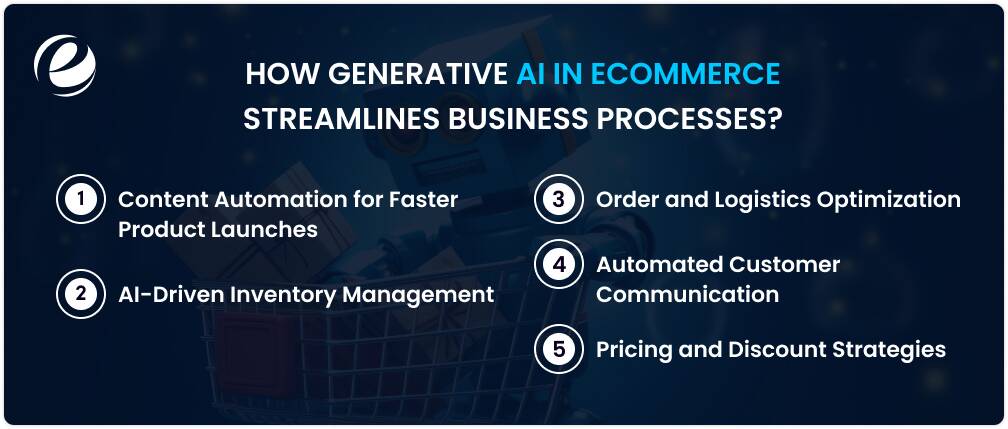
How Generative AI in Ecommerce
Generative AI in ecommerce
Content Automation for Faster Product Launches
Swiftly creating product titles, descriptions, and tags by generative AI tools significantly lightens the load of launching new products in stores with large inventories.
AI-Driven Inventory Management
Generative AI extends its predictive powers by capturing the work of seasonal trends and past sales, using this data to come up with the best inventory forecast, and thus, it saves a lot of time and money for the business.
Order and Logistics Optimization
AI can also come up with predictive models that can help figure out the most efficient route for delivery, the speed of the warehouse operations, and the number of workers, which in the end can lead to a faster supply chain process.
Automated Customer Communication
Generative AI takes care of the communication part, such as answering FAQs, sending transactional updates, automating emails, messages, and support tickets. All of these are carried out by AI without human intervention, and hence, response time is shortened.
Pricing and Discount Strategies
Using market data and buying behavior, generative AI helps create dynamic pricing models and discount offers to drive sales and profitability.
Such intelligent solution integration enables companies to work together with an AI Development Services provider or an ecommerce app development company to reach new heights of automation and efficiency in their digital commerce businesses.
How Generative AI in Ecommerce
Generative AI in Retail and Ecommerce
It is like a human in terms of creativity and decision-making, and hence, the computer-assisted businesses can automate content creation, customer interaction enhancement, and business decision-making that is more intelligent. To begin with, we will look at the way this technology operates in the ecommerce
Data Collection and Training
The AI models of a generative type get trained on huge datasets that include the customers’ data, the products they own, the reviews they give, and behavior patterns. This helps the AI learn how customers interact with products and services online.
Natural Language Processing (NLP)
With the help of NLP, the AI can comprehend human language and produce something similar. Generative AI in Ecommerce
Image and Content Generation
Deep learning-based generative AI can create new high-quality images or even imitate new product designs depending on customer preferences. This technology is especially useful for fashion, furniture, or other items.
Recommendation Engines
Generative AI considers users’ browsing history, purchase behavior, and user interests to suggest the most relevant products, which not only improves but also increases sales.
Adaptation
The AI models think all the time, and this helps them to understand new things better and be able to follow the changes in the market throughout the day, which makes the system become smarter with time.
For better understanding, check out the detailed guide on What is Generative AI. Additionally, a suitable AI App Development Company can be very beneficial in deploying these technologies in your e-commerce efficiently.
Step-by-Step Guide to Integrating Generative AI in Ecommerce
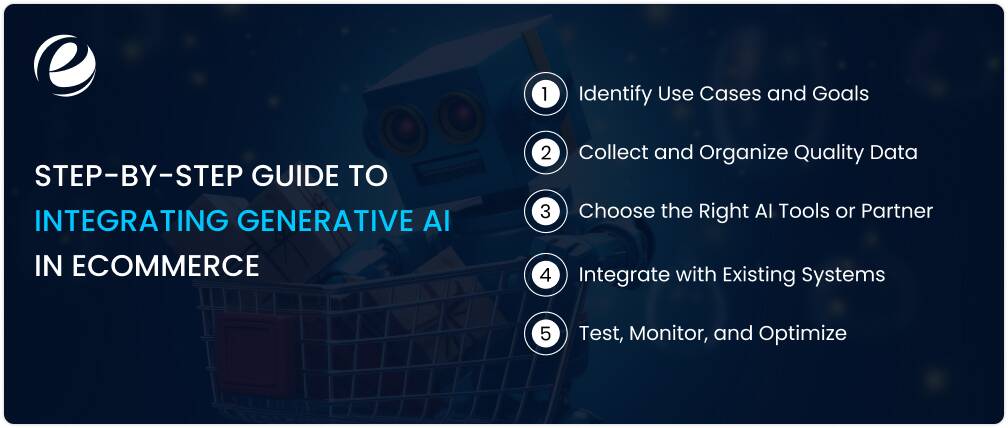
A strategic approach is necessary for the implementation of Generative AI in ecommerce
If your line of trade is a small-sized online store or a considerable retail platform, the following list includes measures for successfully bringing Generative AI into your ecommerce
Identify Use Cases and Goals
The very first step is determining the areas your AI tool could work for you best: product content creation, customer support. There is a great advantage in having goals in scoping the project as well as fitting in the success criteria.
Collect and Organize Quality Data
Generative AI models rely heavily on data. Make sure your customer, product, and sales data are good data types, clean, well-organized, and readily accessible. High-quality data is needed for AI to generate good results.
Choose the Right AI Tools or Partner
Select trusted platforms or work with a professional AI Development Services provider who understands your industry needs. You can also cooperate with an e-commerce app Development Company to integrate AI features directly into your store or app.
Integrate with Existing Systems
Make sure that the AI tools are compatible with your current tech stack, for example, as they are CMS, CRM, or inventory software, and there is no need to worry about them working in harmony with your operations or causing any disruptions.
Test, Monitor, and Optimize
First, train the AI capabilities in stages and then check their performance and reactions. Since AI computer models constantly learn, stay with them and changes are beneficial to the success of the partnership.
Taking the right steps and having a reputable e-commerce development Company in your corner to facilitate adopting and scaling Generative AI in retail and ecommerce
How LLMs Enhance Generative AI in Ecommerce
Large Language Models (LLMs), such as GPT-4, have a tremendous influence on Generative AI in ecommerce
LLMs are the main reason behind the vast generative AI, and these are also the set of technologies that empower ecommerce
Human-Like Product Descriptions
LLMs can rapidly generate several natural-sounding product descriptions for different products. Apart from having a larger quantity of quality content, it also saves time and ensures that the information is consistent across large inventories.
Conversational AI for Customer Support
LLMs facilitate human-like AI-powered conversational agents to talk with users in a more complex way and answer customer questions with more precision, which finally results in a higher support quality and customer satisfaction.
Smarter Search and Discovery
LLMs bring a more powerful lift to the search tool by allowing it to understand user intent even when only vague or casual conversations are used. The shoppers will then be able to look for the correct products more quickly.
Multilingual Content Generation
Among the virtues of LLMs stands out the fact that they can perform and create in multiple languages. This allows ecommerce
Marketing Messages
Using data on customer behavior, LLMs can create promotional emails, SMS campaigns, and push notifications that increase engagement and conversions.
Businesses can maximize these capabilities by partnering with a professional AI app development company that focuses on the implementation of LLMs for AI Development Services in the ecommerce
Future Trends of Generative AI in Ecommerce
The prospects of Generative AI in Retail and ecommerce
Starting from eliminating the customers’ discomfort of choosing, to opening fully AI-driven shops, the following years will set new rules in the game of business-customer connection. Here are some key future trends to watch:
Hyper-Personalized Shopping Journeys
Generative AI will be able to go further than just simple product recommendations and will offer shopping experiences, after considering the browsing habits, the mood, and even the interactions. This will go a long way in improving customer satisfaction.
AI-Generated Influencer Content
One of the options is that brands rely on AI-generated characters or digital influencers to help them with social media content, product reviews, and promotional videos. Besides, this will help them save money for marketing and be faster in campaign delivery.
Virtual Try-Ons and AI Styling Assistants
Concurrently, AI can also improve the virtual try-on tool after it has been elaborated for fashion, eyewear, and cosmetics. AI agents can further assist by completing the wardrobe based on individual preferences and popular trends.
Voice Commerce with Generative AI
Moreover, the shopping experience with voice will be much more conversation-like and advanced; users will be able to easily search, compare, and make purchase decisions all through natural language usage.
AI-Driven Product Development
To be more specific, generative AI will make the creation of products in terms of design aligned with customer feedback and market trends.
In order to be ready for these future trends, companies must collaborate with a trustworthy ecommerce app development company or an AI development services provider who is capable of implementing the most recent AI technologies in their digital platforms.
Emizentech’s Generative AI Development Services for Ecommerce
At Emizentech, we aim to build intelligent, customized solutions with the help of Generative AI for ecommerce. Developing for online companies in specific fields to be capable of automating operations, improving user experience, and scaling their business with next-generation AI technology.
Maybe you want to automatically develop product content, implement smart systems, or provide customer support via AI? You can rely on us. As a leading AI app development and ecommerce company, we offer deep domain knowledge combined with testing and tools to give you an outcome that matters.
- According to your specific business requirements, we create AI features that are customized, ranging from product recommendations to auto-generated content.
- We also go beyond handling AI integration by looking after the entire journey, such as strategy, design, deployment, and maintenance, so you can concentrate on growth.
- We guarantee that our AI models are perfectly compatible with platforms such as Shopify, Magento, WooCommerce, and additionally with custom ecommerce
settings. - Our team of experts regularly keeps an eye on and upgrades your AI instruments so that they perform at their best and have a concrete effect.
- We focus our efforts on building solutions that are in line with your growth and can be modified to future cases of generative AI and technological changes.
Our professionals can assist you in unleashing the full potential of Generative AI in retail and ecommerce
Final Words
Generative AI in ecommerce
Once you have decided to take on AI for your ecommerce

FAQs
What’s the future of Generative AI in eCommerce
Generative AI will make hyper-personalization, AI influencers, intelligent voice shopping, and operational automation happen, thereby changing eCommerce
How is Generative AI used in retail and eCommerce?
Automated content creation, marketing, smart chatbots, demand forecasting, and even helping with virtual try-on are some examples of how it can make shopping simple and satisfying.
What are the key benefits of Generative AI for eCommerce
Generative AI saves time, reduces manual effort, increases customer satisfaction, conversions, and overall operational efficiency.
Can small eCommerce
Any business, even less established, can consider utilizing cheap AI services or an AI App Development Company to get features such as AI chatbots, smart recommendations, and content automation.
How much does it cost to implement Generative AI in eCommerce
The cost depends on the needs, but if you fancy the most basic of AI features, prices can start somewhere from $5,000 to $15,000 and can shoot up for more custom, advanced tooling. The right e-commerce development Company can provide fitted pricing depending on what you want to go for.




 +1 (989) 535-9295
 info@emizentech.com
 emizentech


