
 Add us as a preferred source on Google
 Generative AI in education has become a new way of learning, teaching, and evolving. Still in its ‘emerging’ phase, this type of artificial intelligence is redefining how people in the education sector perceive and act on learning designs and assignments. In fact, the engagement rate in generative AI tools is picking up pace, with 44% of children actively interacting with them. And here are the key reasons behind this enthusiasm: Accessibility, speed, and personalization in every aspect of learning and training.
The global Gen AI in education market is expected to reach from US $268 million in 2023 to US $8,324 by 2033. As a result, businesses in the sector are optimistic about investing in education app development. Does this read like your plan, too? Continue reading to explore the scope and benefits of this rapidly growing technology, along with the challenges that must be addressed.
What is Generative AI in Education?
While it is easy to have a rough idea of the benefits of Generative AI in education, let’s also understand what this concept even means and who it is meant for.
Generative AI in education is simply the implementation of advanced artificial intelligence systems (read multimodal generators and large language models). The AI systems are used to create original content for various educational purposes, including assessments and feedback, mainly for educators and learners. From learning pace to engagement to performance, these systems use and analyze a variety of data. And here’s what people in this industry get in turn: Study plans, quizzes, guides, and more.
For educators, solutions powered by generative AI work as a speed enabler. It enhances efficiency in lesson designing, administrative duties, and grading. And students can use it to get quick, personalized feedback on their performance. Gen AI is an excellent technology for fostering creativity, enhancing access to better education, and even personalizing lessons. These capabilities can help diverse learners adapt to educational practices flexibly.
How Generative AI is Used in the Education Sector
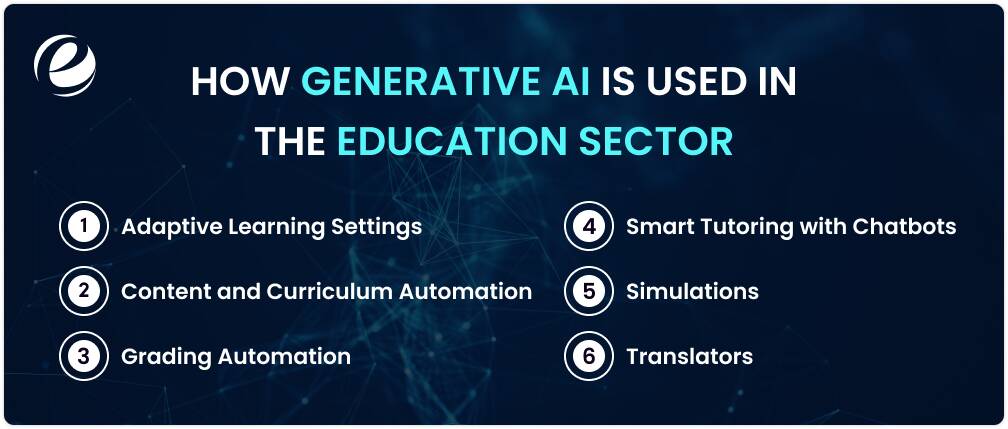
Digital learning systems are picking up a different pace with generative AI serving as a catalyst for change. Capabilities like personalization and automation are becoming primary goals for both: The institution looking to engage students more, and the education app development company building smarter solutions.
Are you a student wondering how you might access the benefits of generative AI in education? Or an edtech startup aiming at the smart use of AI in education app development? This list of use cases will give you a clue on what you can achieve.
Adaptive Learning Settings
Generative AI enables adaptive learning at a considerable scale, making it a valuable addition to the education sector. AI systems create lesson plans, assessments, and exercises by interpreting the specific learning styles and pace of every student. This is one of the most common use cases of generative AI in education, where every learner gets the perfect level of challenge as per their unique skills. Several leading edtech platforms are integrating AI in education app development to leverage this shift, promoting mastery and motivation.
Content and Curriculum Automation
Content creation has always been time-consuming, given that it takes a good deal of brainstorming, research, and then articulation and editing. Gen AI in education is saving up a significant share of time spent on this process. It helps educators and instructional designers quickly generate worksheets, lesson plans, multiple-choice questions, flash cards, and more materials. What makes these solutions a topic of discussion is their ability to curate the content in the exact tone, format, and length that one commands them to deliver. And how is this possible? It is AI models that are trained on massive amounts of data that adapt the content for different learning goals and grade levels.
Grading Automation
Assessment checking is not a cakewalk and would take a good chunk of time to be wrapped up without an error. However, humans are prone to mistakes, and despite the eagle-eye supervision, an omission or two can go unnoticed. One of the much-needed use cases of generative AI in education is the power to remove these challenges from the grading process once and for all. It automates the task, flags the areas where students face issues in learning, highlights the problems that a teacher manually may not be able to, and suggests the best course of action to address the learning challenges. The feedback it provides is not just fast, but is also constructive and straight to the point.
Smart Tutoring with Chatbots
A new generation of tutors has entered the education industry with the inception of Gen AI. These are AI-powered tutors that can interact with students in a human-like tone. The purpose of this application of generative AI in education is to automate learning to an extent. Smart tutors handle routine work, like guiding a student through complex math problems, clarifying doubts, and quizzing them to test their knowledge. This use case is quite prevalent in the education app development space, where learning apps and skill app development are leveraging intelligent tutoring on a large scale.
Simulations
Generative AI powers up virtual learning setups with simulations, making education fun and rewarding. The virtual environments simulate scenarios involving different concepts and situations, like human cells in biology or ancient civilizations in history. It paints the picture of those explanations so vividly that it enhances both student engagement and comprehension.
Translators
Gen AI is as good at teaching and translating languages as it is with all the use cases we read about above. It creates multilingual content and provides students with exposure to cross-cultural concepts easily. In fact, this application of AI in education app development is on the rise. Language learning apps simulate natural, human-like conversations with learners, generate speaking prompts, and offer grammar lessons. It’s just like a conversation between a tutor and a student.
Benefits of Generative AI in Education
More and more institutions are using Gen AI in education. Developers are exploring the potential of this AI in education app development. At the crux, it is the great level of efficiency and deeper learning experiences that are pushing this technology to fame.
Here is a roundup of the benefits of generative AI in education that make it an essential reason to use it across different academic purposes.
Personalized Learning for Everyone
Gen AI in education is redefining the way students receive education. The content is highly tailored to the unique learning pace, knowledge scale, and other preferences (like the way they want to learn). Since nothing is static and is rather flexible, it drives more engagement and fosters long-term academic growth while improving comprehension. With its adaptability, AI-powered education ensures that no student is left behind.
Less Workload, More Speed
There’s only so much that teachers and instructors can do in one day. Their routine often involves planning, grading, and managing classes. This is as hectic as it seems. The space is shifting with the leverage of Generative AI in education app development. It automates basic tasks (like creating assessments or handling communications with parents), ultimately freeing up time for educators.
Enhanced Accessibility
Technology is breaking down barriers when it comes to access to education. Generative AI solutions feature voice synthesis, captioning, and screen readers. These capabilities are handy for people with special needs. Add to that the multilingual content generation. It allows individuals to learn their preferred language. With features like these, education surpasses limitations that would be imposed in the name of geography and disabilities.
Feedback
One of the key benefits of Generative AI in education is its ability to provide instant feedback on interactions, assignments, and performance. Students can use this to quickly check where they are going wrong and correct the mistakes. It could be a math problem or an essay structure, the technology spots and communicates the odds.
More Engagement than Ever
AI-generated videos, quizzes, simulations, and animations are sprucing up learning experiences. If a student learns faster with video over books, Gen AI will accommodate their learning style in an instant. These tools bring visual and interactive twists to the academic content, making difficult subjects easier to grasp.
Creativity and Critical Thinking
While Generative AI in academic settings is primarily being used to fetch content, the technology also collaborates with students for projects. It helps them write short stories, generate design prototypes, brainstorm fresh ideas, and whatnot! This can improve critical thinking and creative skills among students.
Relevant Content
Content keeps on changing, thanks to the fleet-footed shifts in technology, science, and other trends. This drives regular updates in educational content, which, if not addressed right away, can become outdated. Gen AI solutions work smarter. They can scan and summarize current events, research, and policy revisions, and implement them in the existing lessons. Learners leverage this by receiving the most recent and accurate information.
Learning Insights
Gen AI solutions monitor learning progress and gather and analyze data. What teachers get is valuable insights into the performance of every student. The tools share actionable information on where each student is struggling, find gaps, and even anticipate performance trends. These numbers support proactive intervention, improving the quality of education for everyone on a personalized level.
Mental Health Features Integration
This is one of the underrated benefits of generative AI in education. A number of AI tools now have integrations for mental health and well-being. This includes mood check-ins, wellness tools, and journaling prompts. Should AI recognize any stress pattern or a hunch of disengagement, it prompts quick support and even referral.
Support
AI assists schools and educational platforms in delivering guidance to thousands of students simultaneously. This mitigates the gap between institutions and staff strengths, which would often pose a challenge. With technology, educational entities ensure consistent and quality support to each and every student, irrespective of the head count.
Limitations and Ethical Issues of Generative AI in Education
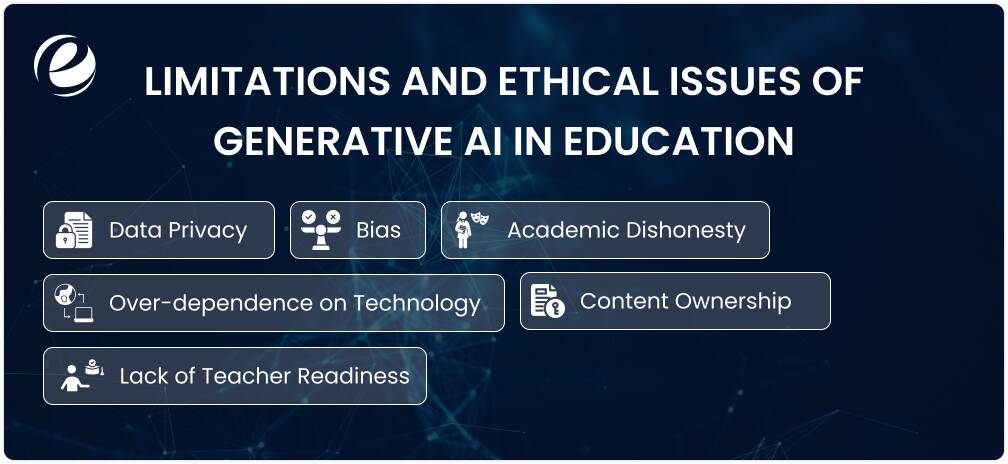
As per what we have discussed about generative AI in education so far, here is one thing that’s clear: This technology is here to reshape task management and learning experiences in the academic world. However, where there’s technology, there’s collective doubt about its ethical standards. There’s also a debate about the challenges that it might bring behind the pack of benefits.
Here’s a list of potential ethical concerns and challenges of implementing Gen AI in education:
Data Privacy
Gen AI education tools are able to share massive amounts of content in seconds because they are regularly fed on a world of data. That has gradually become a topic of concern. Since it has student data, including academic performance and behavioral analysis, the question that arises is about the level of privacy this data has. Is it really under digital surveillance? People also wonder if it is handled inadequately, and end up causing identity theft or data breaches. It calls for educational institutions and education app developers to follow strict data governance frameworks while complying with global privacy regulations.
Bias
AI systems tell you what they have been told in some way or another. This means that they might pass on statements and content with bias related to language, gender, race, and socioeconomic background. While advanced Gen AI solutions in education and other industries have risen above this challenge, there’s still a long way to go before technology starts telling ethical from unethical behavior.
Academic Dishonesty
Writing essays and brainstorming creative ideas have become smooth-sailing for students now that they use Gen AI tools for academics. However, AI in education app development and classrooms has left academic integrity in a questionable spot, calling for strict boundaries. In a survey, 51% of college students admitted to having used AI for assignments. This clearly indicates the need for updated honor codes and redesigning assessments to promote genuine learning.
Over-dependence on Technology
One of the biggest challenges of generative AI in the education industry (in fact, among all users) is the growing attachment to the technology. When students and teachers use Gen AI academic tools excessively, they are likely to develop dependency on automation for every little task. In a global survey of 1600 university faculty members across 28 countries, 82% expressed worries that students are growing reliant on AI tools. This is alarming for skill development, like collaboration, creativity, and critical thinking, that is crucial to navigating real-world life. There have to be strict guidelines for maintaining the balance between human teaching and technology-driven assistance.
Lack of Teacher Readiness
Not all educators and trainers are ready to use generative AI in teaching. It requires proper training to make sure that the tools do not go underutilized and are also not misused. This is becoming one of the growing challenges of generative AI in education. Teachers should be encouraged to use the technology confidently and smartly, through certifications and hands-on workshops.
Content Ownership
This one’s a major concern with generative AI, which has made headlines on social media platforms, too. Since Gen AI solutions for academics can create essentially all types of materials, here’s the question many are asking: Who owns this content? Is the teacher, or a student, or wait, the tool itself? The answers are not clear, and legal frameworks around this topic are also vague. This has led to confusion, especially in education app development aspects.
Future Trends of Generative AI in Education
What does the future hold for this technology in the learning space? Let’s understand in this roundup of top Gen AI in education trends.
Hyper-Personalized Learning Ecosystems
AI is expected to adjust content based on academic ability and respond to unique emotional states, learning styles, attention span, and learning preferences. The Gen AI education tools are all set to deliver fully customized learning journeys, unlocking more engagement than ever.
Conversational Bots
Natural language models are increasingly becoming more advanced. This indicates full-fledged development in multilingual bots and voice tutors, facilitating conversational partners for learners and educators. These solutions are primarily intended to help students improve pronunciation and offer personalized communication.
Immersive Learning
Gen AI implementation in education apps is going to be fueled by dynamic AR/VR educational environments. They will act as platforms for practical learning opportunities, ensuring speedy development.
Emotional Awareness
AI educational tools are expected to work with better emotional context, which makes the technology promising for more valuable interactions in the future. The tools will easily identify the mood of the student, decoding factors, motivation, and overall mental wellness, and offer responses.
Ethical Considerations
We will also see the rise of regulatory frameworks in the implementation of Gen AI in education. Institutions, app developers, and governments will introduce robust strategies to make these solutions not only useful but also transparent, fair, and safe.
Thinking of Building a Gen-AI Education Platform? Let’s Discuss with EmizenTech!
Behind ground-breaking Gen AI solutions for the education industry, there are factors like expertise, flexibility, and scalability that help set a strong foundation for the future. At EmizenTech, a leading AI app development company, we bring them all together to create solutions for today and tomorrow.
The global Gen AI in education market is growing at a CAGR of 41%, depicting just the right time for you to set foot in the industry as the leader of these solutions. Here’s what our end-to-end AI development services do to make your vision a reality:
- Fully custom education Gen AI solutions
- Integrations in existing systems
- Design and prototyping with a user-first mindset
- A technology stack that strikes the balance with unique project needs
- Comprehensive solutions
We also provide a suite of post-launch services to ensure your Gen AI tool walks in harmony with market trends and your evolving goals. That’s not all. Connect with our AI experts to understand the scope of the project and create an effective roadmap.
Redefine Learning with Gen AI in Education App Development
Generative AI has pushed the educational processes into new possibilities, making almost everyone in the industry think from a fresh perspective. Educational institutions are seeking viable ways to implement these solutions in the learning environment. While challenges like student dishonesty and dependency are there, they don’t sideline the wonders this AI can do for educators and learners alike. Many global brands have already leveraged their capabilities, and some are planning to take the first step. If you are one of the latter, now is the right time to act on it, create a future-proof strategy, and hire top Gen AI developers who align with your vision. Get in touch with our experts to know how you can benefit from this project and how to approach it.
FAQs
Can generative AI be used in education?
Yes, Gen AI in education is gaining popularity for many reasons, including access to personalized learning materials, assistance with content creation, tutoring, and automated grading. It is used in education to improve student engagement and unlock access for students to diverse learning styles.
What is generative AI for academic purposes?
Gen AI for academic purposes is the use of AI systems for teaching, learning, and research purposes. It includes content generation for materials like essays, quizzes, and summaries.
What is an example of generative AI in education?
ChatGPT is one of the best examples of Gen AI in education. It helps students understand complex subjects in the easiest of ways, drafts essays for them, and even solves math problems. On the other hand, teachers use this tool to create assignments, lesson plans, and feedback for every individual.
What is a future application of generative AI in education?
Generative AI in education is expected to enable adaptive learning systems that help students fulfill all their academic needs. Simulated virtual classrooms with AI teaching assistants are also awaited in the industry.




 +1 (989) 535-9295
 info@emizentech.com
 emizentech


