
 Add us as a preferred source on Google
 Which grocery ecommerce platforms will actually help your business grow in 2026 and beyond? The selection of grocery e-commerce platforms has evolved beyond store creation because businesses now require complete control over their delivery operations, inventory management, subscription systems, and customer interactions.
According to Globe News Wire, the global online grocery market is projected to grow from USD 670.8 billion in 2025 to USD 2.23 trillion by 2035, at a 12.8% CAGR from 2026 to 2035, showing strong demand for grocery e-commerce platforms.
The best ecommerce platform for grocery operations depends on your business model because you need different solutions for local sales and multiple store operations, and developing a full grocery application for iOS, Android, and web platforms. In this guide, we will cover everything about grocery e-commerce platforms, compare the top grocery platforms and key features, and discuss “which platforms should I target for my grocery app (iOS, Android, Web)?” and much more. So, let’s start with key features!
Key Features to Look for in Grocery Ecommerce Platforms
Before choosing grocery ecommerce platforms, focus on evaluating the core features required to manage grocery-specific operations, rather than relying on standard ecommerce capabilities.
Real-time inventory control
The right grocery platforms should update stock instantly so customers do not order unavailable items. This requirement applies to products such as fresh produce, dairy, and other high-turnover items.
Weighted item support
The platform should handle items sold by weight, such as fruits, vegetables, meat, and bakery products, with clear pricing logic.
Delivery slot management
The best ecommerce platform for groceries must let customers choose delivery dates and time slots. This helps businesses control their order processing while maintaining punctuality for the delivery service.
Pickup and local delivery options
A strong grocery setup should support curbside pickup, local delivery, and zone-based service rules. It provides a better user experience while allowing businesses to deliver to more customers.
Subscription and repeat order tools
The platform should support subscriptions, saved items, and quick reordering features to make repeat purchases of frequently used products simple and efficient.
Mobile-first design
Grocery ecommerce platforms should provide a fast, seamless, and app-like experience across all devices, as most users shop on smartphones.
POS and ERP integration
The platform should integrate seamlessly with your store software for pricing control, order tracking and inventory management. This solution helps to decrease both manual tasks and the rate of mistakes.
Top 10 Grocery Ecommerce Platforms
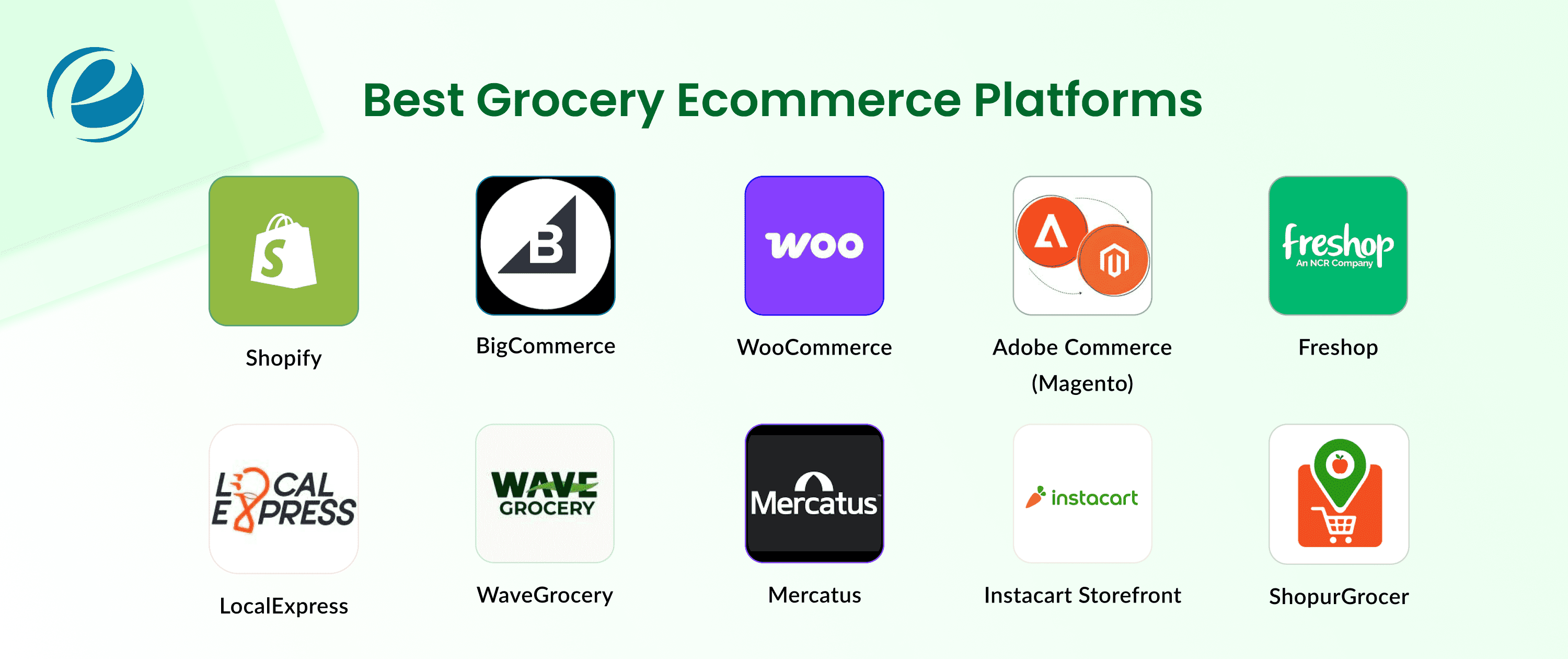
The best grocery eCommerce platform requires evaluation based on store dimensions, financial resources, delivery requirements, and the degree of branding, automation, and operational control that you want to maintain.
Shopify
Shopify serves as an effective platform for small grocery businesses that require fast market entry. This provides simple installation procedures together with a vast application library and advanced design capabilities, but grocery operators must pay additional fees to access the necessary grocery functionalities.
Pros:
- Easy to set up and manage.
- Large app store for grocery features.
- Good for mobile-friendly storefronts.
Cons:
- Grocery tools often need paid apps.
- Delivery logic is not native.
- Extra fees can add up.
Cost:
- Starts at about $39/month.
BigCommerce
BigCommerce provides essential eCommerce capabilities for grocery businesses that experience ongoing development. The platform enables business growth through its features, which allow multiple transactions to proceed without restrictions, although its dedicated grocery functions require additional setup work.
Pros:
- Good for growing grocery stores.
- No platform transaction fees.
- Strong built-in catalog tools.
Cons:
- Fewer themes than some rivals.
- Smaller app ecosystem.
- Can be complex for beginners
Cost:
- Starts at about $39/month.
WooCommerce
WooCommerce provides complete control over website design and functionality for businesses using WordPress. It is highly flexible and well-suited for development teams, but it requires ongoing technical management, including hosting, updates, and plugin maintenance.
Pros:
- Highly flexible and customizable.
- Low starting cost.
- Works well with WordPress.
Cons:
- Needs hosting and maintenance.
- Plugins can create conflicts.
- More setup work than hosted platforms.
Cost: The plugin is free, but hosting, themes, and extensions add to the overall cost.
Adobe Commerce (Magento)
Adobe Commerce serves large grocery enterprises that require advanced customization and complex operational management. It offers strong performance and advanced capabilities, but these features can be excessive for small businesses without dedicated IT support.
Pros:
- Very powerful and scalable.
- Great for complex catalogs.
- Strong customization options.
Cons:
- Expensive to run.
- Needs technical expertise.
- Setup takes more time.
Cost:
- Starts at about $22,000/year.
Freshop
Freshop enables grocery stores to build ecommerce platforms that integrate seamlessly with their in-store operations. This enables supermarkets to manage their advertising materials, customer loyalty programs, and specialized operational processes for specific departments.
Pros:
- Built for grocery businesses.
- Supports pickup and delivery.
- Good for store and app integration.
Cons:
- Not ideal for tiny stores.
- Pricing is not public.
- May need onboarding support.
Cost: $650 per store per month.
LocalExpress
LocalExpress provides an optimal solution for grocery stores that require AI-powered catalog management and delivery service solutions. The platform enables businesses to manage their online ordering processes across web, mobile, and kiosk systems
Pros:
- Good for multi-location grocers.
- Supports web and mobile ordering.
- Useful for delivery workflows.
Cons:
- Can be complex to implement.
- Not a budget-friendly choice.
- Less suited to very small shops.
Cost:
- Custom grocery app development can range from $40,000 to over $400,000.
WaveGrocery
WaveGrocery is designed for grocery-specific eCommerce operations, supporting features such as weighted product handling, delivery route optimization, and order substitutions. It provides a purpose-built solution for grocery businesses that require industry-specific functionality without relying on multiple third-party extensions.
Pros:
- Grocery-specific features.
- Supports weighted items.
- Good for delivery routing.
Cons:
- Not ideal for small stores
- Premium pricing
- Requires setup and onboarding
Cost:
- Subscription‑based, usually in the low hundreds per month, with possible extra charges for custom implementation.
Mercatus
Mercatus enables grocery businesses to manage multiple sales channels with integrated shopping experience customization and order fulfillment capabilities. The solution helps large retail businesses achieve their customer retention goals while improving their operational efficiency.
Pros:
- Strong omnichannel support.
- Good for personalization.
- Built for grocery operations.
Cons:
- Enterprise-focused.
- Custom setup needed.
- Pricing is not transparent.
Cost:
- Custom Quote.
Instacart Storefront
Instacart Storefront is a retail solution that allows grocery stores to quickly set up online ordering and delivery through Instacart’s existing marketplace infrastructure. It helps retailers launch digital storefronts without building a system from scratch, leveraging Instacart’s delivery network and user interface.
Pros:
- Fast to launch.
- The delivery ecosystem is built in.
- Easy for retailers to start online sales quickly.
Cons:
- Less control over branding.
- Platform dependence.
- Limited customization compared with custom builds.
Cost:
- Custom or partner pricing.
ShopurGrocer
ShopurGrocer provides a white-label grocery application for small businesses looking to launch their own branded grocery app without extensive development work. It enables businesses to quickly deploy a platform while maintaining full brand identity and operational control.
Pros:
- Quick to launch.
- Grocery-focused setup.
- Good for white-label use.
Cons:
- Less flexible than custom builds.
- Smaller ecosystem.
- Recurring fees apply.
Cost:
- Costs typically range between $500 and $1,000+ per month.
How to Choose the Right Grocery Platform?
The right grocery ecommerce platform should align with your store size, delivery requirements, and budget rather than simply choosing the most commonly used software.
Start with your business model
Your local store needs, regional chain requirements, and supermarket needs will all differ from one another. The best ecommerce platform for grocery should support your exact operations.
Check grocery-specific features
You should not select a general online store tool that cannot manage weighted items, substitutions, and delivery zones. These features matter in real grocery workflows.
Think about integration needs
Your grocery platforms should connect with POS, ERP, payment gateways, and delivery tools. This method enables efficient business operations while eliminating unnecessary tasks.
Compare total cost, not base price
Compare the total cost, not just the base price. Some grocery e-commerce platforms appear affordable but charge for apps, customization, hosting, and maintenance, which rapidly add up.
Plan for growth
The platform should be able to support more products, more orders, and possibly a grocery app later. Picking a scalable grocery e-commerce platform helps avoid costly migrations in the future.
Which Platforms Should I Target for My Grocery App (iOS, Android, Web)?
Your grocery application development requires you to select an e-commerce solution that operates on iOS, Android, and web platforms through a single system rather than separate implementations. This ensures complete synchronization of all data, inventory, and order information.
iOS—For a premium mobile experience
iPhone users expect fast, simple, and feature-rich applications. A strong grocery ecommerce platform should offer smooth iOS integration with quick checkout, saved preferences, and a clean user interface aligned with Apple’s design standards.
Android—For wider market reach
The grocery application needs to operate effectively on multiple devices because Android dominates most regions. The right grocery platforms should support Android‑friendly frameworks, store publishing, and scalable performance.
Web—For search, discovery, and flexibility
A web store lets customers browse, compare prices, and place orders from any device while boosting SEO and organic traffic. The grocery e-commerce platform requires a unified web store system that maintains real-time synchronization with both the iOS and Android applications.
Use a shared backend
Your grocery business should use a single backend system for native apps and PWA development to manage inventory, pricing, and order processing. This reduces redundancy and ensures smooth operational consistency across all platforms.
Choose app-ready platforms or custom development
You need to determine whether the platform enables you to develop a grocery application with your brand name through app integration or custom mobile application development. Grocery app development plays a vital role in driving business growth at this point.
Final Remarks
Your business needs will determine the best grocery e-commerce platform based on your store size, delivery method, and your plans for business expansion. The two grocery ecommerce platforms, Shopify and BigCommerce, provide fast solutions, but grocery-native tools like WaveGrocery and Freshop deliver better results for complex business operations. Evaluate your budget, app requirements, and desired level of customization before finalizing your decision.
The most effective grocery ecommerce platform helps increase sales, streamline order management, and simplify operations to support long-term business growth. Your platform selection should align with your expansion plans and directly influence the overall cost to build a grocery app.
FAQs
What is the best grocery e-commerce platform for small businesses?
Small businesses typically use Shopify and WooCommerce as their primary grocery ecommerce solutions because these platforms offer budget-friendly and flexible options that allow quick setup and immediate operations.
Which grocery platforms are best for delivery and pickup?
The grocery platforms WaveGrocery, Freshop, and LocalExpress provide excellent options because they support both pickup and delivery services, along with features such as delivery zones, product substitutions, and order tracking capabilities.
Can I build a grocery app on Shopify or WooCommerce?
Yes, platforms enable users to create grocery applications through their systems, but users need extra plugins and custom development work or third-party applications to achieve complete mobile functionality.
How much does it cost to set up a grocery e-commerce platform?
The cost of setting up a grocery ecommerce platform ranges from basic monthly subscription plans to enterprise-level pricing, depending on the platform you select, the features required, and the level of customization needed.
What should I prioritize when choosing a grocery e-commerce platform?
You should evaluate grocery-specific functionality, integration with your existing store systems, delivery capabilities, scalability, and overall cost of ownership.



 +1 (989) 535-9295
 info@emizentech.com
 emizentech


