 Add us as a preferred source on Google
Running an ecommerce business today means making dozens of high-stakes decisions every week, like how much inventory to stock, which customers to re-engage, what price to set and where to spend your ad budget. Most businesses still make these calls based on gut instinct or last month’s reports. And the problem with this process is that by the time the data catches up, the opportunity has already passed.
That’s exactly where predictive analytics ecommerce strategies are flipping the script. Instead of reacting to what already happened, you’re anticipating what’s about to happen. Retailers using predictive models are reducing overstock, recovering lost revenue, and delivering shopping experiences that feel genuinely personalize. According to McKinsey, personalization driven by data can lift revenues by 10 to 15 percent and predictive analytics is the engine behind it.
This guide breaks down what predictive analytics in ecommerce is , where it creates the most value, and how you can actually implement it in your store whether you’re running a mid-market DTC brand or scaling an enterprise operation.
What Is Predictive Analytics in Ecommerce?
Predictive analytics ecommerce is the process of using historical business data, machine learning and statistical models to forecast future customer behaviors as well as market trends. Instead of just showing you what happened in the past, it gives your ecommerce business a statistically driven analysis of what is likely to happen next.
You can rely on data analytics services that will help your ecommerce business build and execute exactly these kinds of forward-looking models.
The following comparison table breaks down the core differences of predictive vs. descriptive vs. prescriptive analytics in focus, complexity, and application:
| Feature | Descriptive Analytics | Predictive Analytics | Prescriptive Analytics |
| Core Question | What happened? | What might happen? | What should we do? |
| Time Horizon | Past & Present | Future | Strategic Future |
| Complexity & Value | Low complexity; foundational value | Moderate complexity; higher value | High complexity; maximum business value |
| Primary Tools & Tech | Data aggregation, BI dashboards (ex. Tableau, Power BI), summary statistics. | Machine learning, regression models, forecasting algorithms, statistical modeling. | Optimization algorithms, simulations, AI decision engines, heuristics and more. |
| Retail Example | Evaluating last month’s product sales and inventory reports. | Forecasting next month’s product demand based on seasonal trends. | Automatically calculating and scheduling the exact inventory replenishment order to prevent stockouts. |
How It Works:
- Data collection: The system looks at past customer actions, such as purchase history, website clicks, and seasonal buying habits.
- Pattern recognition: AI algorithms find hidden patterns and simpler methods in that data.
- Future prediction: The system uses those patterns to predict future actions, like which products will sell out next month or which customers are about to stop buying.
Why It Matters For Ecommerce
- Smart inventory management: It tells you exactly how much stock to buy so you never run out of popular items and do not waste money on overstocking.
- Personalized shopping: It tracks user behavior to recommend the exact products a customer is most likely to buy, which directly boosts sales.
- Optimized pricing: It dynamically adjusts your prices based on predicted demand, competitor moves, and market trends to maximize your profit margins.
- Customer retention: It flags “at-risk” customers who haven’t bought in a while so you can send them targeted discounts before they leave for a competitor. Pairing predictive retention with proven ecommerce growth strategies gives you the strongest defense against churn.
- Efficient marketing: It predicts which ad campaigns will perform best which provides you with a way to spend your marketing budget only on high-converting audiences.
Key Use Cases of Predictive Analytics in Ecommerce
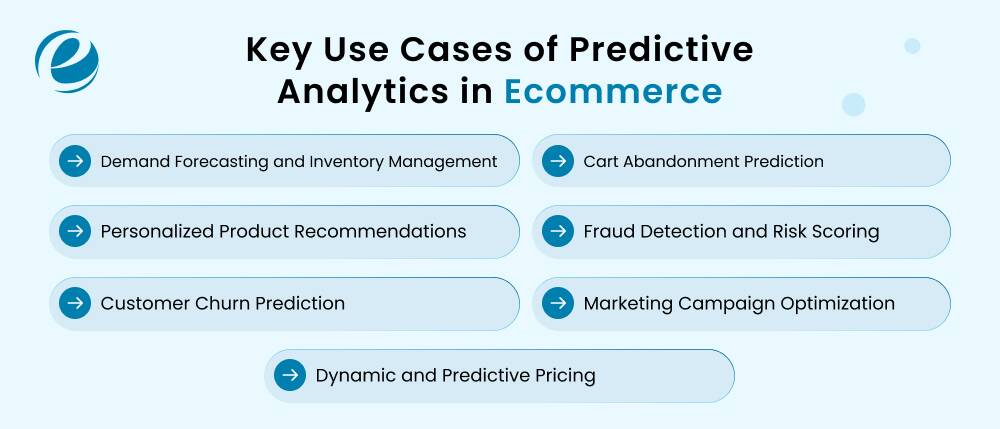
Here is the detailed breakdown of how each key use case of predictive analytics ecommerce works and why it matters for your online business:
Demand Forecasting and Inventory Management
Predictive models examine 12 to 24 months of SKU-level sales history, seasonal trends and also promotions to predict future demand for a product. Most of these forecasts run on time series models, such as ARIMA or Prophet, which pick up trend and seasonality in your sales history.
This use case helps to avoid any stockouts during peak seasons, and reduce overstocking to lower the warehousing costs by using tools like Inventory Planner; that works well for Shopify stores, while BigQuery ML or Vertex AI suit custom builds . You may use this knowledge to work with your suppliers to optimize your supply chain replenishment.
For ex. Walmart uses machine learning to forecast demand item by item & store by store and Inditex, the company behind Zara, relies on live sales data to decide how much of each style goes to which shop.
The result: Fewer stockouts, lower warehousing costs and a leaner, more responsive supply chain.
Personalized Product Recommendations
Algorithms will examine your browsing history, past purchases and click patterns to predict future buying behavior. Most recommendation engines use collaborative filtering, which matches a shopper with other customers who behave like them, and many add content-based filtering that compares product attributes.
This targeting increases your brand’s average order value at checkout through effective cross-selling and up-selling. Real-time updates to product displays improve user experience, and improve conversion rates by using standard tools such as Nosto, Rebuy or even Dynamic Yield.
Take an example from Amazon as it is the textbook case and its recommendation engine drives roughly a third of its sales, a figure that McKinsey has long claimed.
The result: Higher average order values, stronger conversion rates and a shopping experience customers return to.
Customer Churn Prediction
Data models can detect warning signs, such as a drop-off in login frequency, or a reduction in purchases, that suggest a customer is about to abandon a brand using their order history, email engagement and a single ID per customer. Teams usually build this as a classification model, for example logistic regression or random forest, that labels each customer as likely to stay or likely to leave.
Ecommerce businesses catch these at-risk accounts early, and have targeted retention strategies in place by using Klaviyo predictive analytics, GA4 predictive metrics, or Lifetimely on Shopify. This predictive approach will help your companies to win back customers with timely loyalty discounts, personalized outreach or special perks to re-engage with them before they go to the competition.
The result: Improved customer retention rates and a measurable reduction in revenue lost to competitor switching.
Customer Lifetime Value (CLV) Prediction
Customer lifetime value is the total revenue or profit you can expect from a customer over the whole time they shop with you. A predictive CLV model makes that estimate early, usually just after the first or second order, by using signals like the product category bought first, order value, whether a discount was used, and how quickly the consumer came back, all tied to one customer ID across channels using a tool like Klaviyo.
A regression model, or a probabilistic one such as BG/NBD, can then give every customer a projected value, even if they have only bought once or twice. This predictive analytics ecommerce matters because two shoppers can place identical first orders and be worth very different amounts a year later.
The result: Smarter ad spend, stronger retention among your most valuable customers and a clear answer to how much you can afford to pay to acquire a new one.
Dynamic and Predictive Pricing
Algorithms automatically change prices by monitoring competitors’ prices, live demand, stock availability, margin rules and by customer browsing behavior. Under the hood, regression models estimate price elasticity, meaning how much demand moves when your price does.
System adjustments increase prices with peak demand to maximize profit margins and reduce prices to unused inventory. With this automated optimization, you can use Prisync and Competera to manage your merchandising without having to do it manually.
The result: Maximized profit margins during peak demand, and faster clearance of slow-moving inventory without manual intervention.
Cart Abandonment Prediction
The average cart abandonment rate in ecommerce hovers around 70.22%, according to the Baymard Institute. Predictive analytics in ecommerce detect stalls on shipping pages, or item removals to identify cart abandonment risks which happens during active shopping sessions.
This early detection can be detected by GA4 predictive audiences which leads to immediate actions such as, live chat assistance or exit popups. Your system then optimizes the timing of recovery emails, and identifies obstacles in the checkout process; many of which are addressed in detail in this guide on ecommerce checkout optimization.
The result: More recovered carts, a smoother checkout experience and a direct lift in completed orders.
Fraud Detection and Risk Scoring
Predictive systems analyze typing speed, IP locations, device fingerprints and purchase histories to score transactional risk in milliseconds with the help of Signifyd, Riskified and Stripe Radar tools, where this scoring blocks fraudulent orders, to eliminate chargebacks before processing occurs.
Most setups pair anomaly detection, which flags behavior that doesn’t match a customer’s normal pattern, with classification models trained on past confirmed fraud. It also reduces false positives for authentic shoppers, and warns about the suspicious transactions for manual review.
Let’s analyze the situation by using an example where Stripe Radar scores every payment with models trained on data from across the Stripe network. A card that looked suspicious at another merchant can get flagged at yours before the order goes through.
The result: Near-zero chargeback losses, fewer false declines for legitimate customers and faster, safer transaction processing.
Marketing Campaign Optimization
Predictive tools categorize the target groups by channel preferences, messaging resonance and discount responsiveness which helps in maximize return on ad spend. Clustering models group customers with similar behavior into segments, and uplift modeling separates the people who respond because of an offer from the ones who would have bought anyway.
Software like Klaviyo’s forecasts the exact day, and time a customer will open an email to increase engagement and by using GA4 audiences in Google Ads, it controls communication frequencies, prevents message fatigue and reduces unsubscribe rates.
The result: Lower customer acquisition costs, higher return on ad spend and reduced audience fatigue from over-messaging.
Benefits of Predictive Analytics in Ecommerce
The business case for predictive analytics for ecommerce is straightforward once you see it applied across a few use cases. Now, let’s discuss the significant benefits of what is predictive analytics ecommerce:
- Revenue lift: From personalization, dynamic pricing, and better campaign targeting, most businesses see meaningful revenue improvement within the first year of serious implementation.
- Cost reduction: Demand forecasting reduces both overstock and expedited shipping costs. Fraud models reduce chargebacks. Churn models reduce the cost of customer acquisition by improving retention.
- Faster, better decisions: When your pricing adjustments, campaign targeting and inventory replenishment orders are being informed by real-time models, your operational decision-making gets faster, and more accurate simultaneously.
- Customer experience: Personalized recommendations, proactive retention outreach, and seamless fraud detection all contribute to an experience that feels considered rather than generic. Ongoing ecommerce managed services make sure that these systems stay optimized, and aligned with evolving customer expectations.
- Competitive differentiation: As the capabilities of predictive analytics ecommerce become more accessible, the businesses that implement them well will increasingly outpace those that don’t. Early movers build data flywheels; the more data they collect, the better their models get.
Challenges and How to fix Predictive Analytics in Ecommerce?
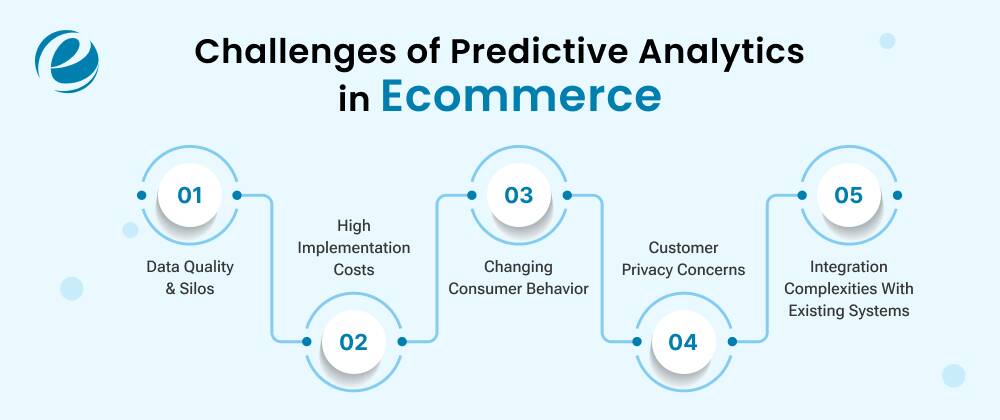
Predictive analytics in your ecommerce store can significantly boost sales, but businesses often face critical hurdles during the integration process. Here are the main challenges and how you can easily avoid them:
Bad Data Quality
Poor, incomplete or duplicate customer data will completely break your predictive models, leading to highly inaccurate sales forecasts and broken product recommendations.
- The Fix: Implement automated data cleaning tools and strict validation rules at checkout to make sure your system constantly captures accurate as well as high-quality customer information.
High Implementation Costs
Building custom predictive models requires expensive software, powerful servers, and highly specialized data scientists, which can easily drain your company’s budget.
- The Fix: Start with affordable, cloud-based plug-and-play AI tools that integrate directly into platforms like Shopify or WooCommerce without needing a developer. Working with experienced ecommerce development services helps navigate these challenges without disrupting live operations.
Customer Privacy Concerns
Modern shoppers are highly sensitive about data tracking, and violating privacy laws like GDPR can result in massive legal fines, and lost trust.
- The Fix: Display transparent privacy policies, secure explicit cookie consent and explain clearly how personalized recommendations benefit the shopper’s overall browsing experience.
Resistance to Change
Your internal marketing and sales teams might distrust automated AI insights, preferring to rely on traditional, outdated gut-feeling business strategies.
- The Fix: Provide hands-on training sessions and run small, low-risk pilot tests to visually prove how predictive insights actively save time, and increase sales.
How to Implement Predictive Analytics in Your Ecommerce Store
Implementing predictive analytics in ecommerce store starts with defining a clear business goal, gathering clean historical data, and selecting the right machine learning model.
Below is the step by step process for implementing predictive analytics ecommerce in your store:
Step 1. Define Your Business Goals
Start by identifying the particular problem that you intend to solve. Whether you need to reduce cart abandonment, optimize pricing strategies or predict future inventory needs you will need to gather, and analyze certain data.
Step 2. Collect, and Clean Your Data
Collect customer information from their website interactions, past purchase histories, social media metrics and email engagement. You must clean this data by removing duplicates, handling missing values and fixing structural errors which makes sure your predictive models work with accurate, and high-quality information.
Step 3. Choose The Right Analytics Tool
Select a predictive analytics ecommerce platform that fits your technical budget, and skill level. Many ecommerce platforms such as Shopify, WooCommerce, and Magento offer built-in AI features, while advanced machine learning analytics tools like Google Analytics 4 provide deeper predictive insights into future user behavior and potential revenue.
Step 4. Build Your Predictive Model
Use your chosen software to create data models focused on your specific goals. These specialized algorithms will analyze your historical data to spot patterns as it will helps you to predict which customers are likely to buy again and which items will sell out fast.
Step 5. Personalize The Shopping Experience
Use your data insights to display custom product recommendations also send automated and targeted emails. By figuring out what a buyer wants next based on their browsing history, you can significantly increase conversion rates as well as it improves your store average order value.
Step 6. Optimize Inventory Management
Demand forecasting models help you avoid stockouts and expensive overstocking. These predictive tools will look at seasonal trends as well as previous sales cycles and tells you exactly how much inventory to order, freeing up warehouse space and improving your store’s overall cash flow.
Step 7. Start Dynamic Pricing
Algorithms that automatically adjust your product prices in real time. The system will analyze your competitors pricing, current market demand and how customers are searching to determine that perfect price point, that maximizes your profit margins without alienating your budget conscious buyers.
Step 8. Monitor And Refine Results
Regularly track the performance of your predictive models against the actual ecommerce sales outcomes, because consumer behaviors change over time, new trends emerge and introduce new products in your store. You must continuously update your algorithms with fresh data to keep your store’s automated predictions reliable and highly accurate.
Step 9. Track KPIs to Measure Success
Decide which numbers will tell you the models are paying off before you launch them and not after. The KPIs to track are:
- Forecast accuracy (MAPE)
- Churn rate
- Average order value (AOV)
- Customer lifetime value (CLV)
- Return on ad spend (ROAS)
- Chargeback rate
Cost of Implementing Predictive Analytics for Ecommerce
The cost range of predictive analytics ecommerce is genuinely wide, and it scales with complexity:
- Off-the-shelf SaaS tools ($500 to $10,000/month): Specialized ecommerce analytics tools like recommendation engines, fraud platforms, and email personalization range from few hundred dollars a month for basic tiers to several thousand dollars for enterprise or high-volume data operations depending on scale and vendor.
- Mid-tier custom implementations ($20,000 to $100,000): Building custom ML pipelines using managed cloud platforms like AWS SageMaker AI or Google Vertex AI matches typical engineering consulting, plus ongoing infrastructure costs
- Enterprise custom builds ($150,000+ annually): Fully dedicated in-house or agency data science teams, ongoing cloud resource allocation and continuous monitoring easily clear this level of requirement.
For most growing ecommerce businesses, the right starting point is a combination of purpose-built SaaS tools for specific use cases like a recommendation engine, or fraud detection paired with a data warehouse for centralizing data. Businesses investing in ecommerce app development should factor in predictive analytics ecommerce capabilities from the architecture stage rather than treating them as an add-on. Full custom model development typically makes sense once you’ve outgrown what off-the-shelf tools can deliver.
Ongoing costs include data infrastructure, model retraining and monitoring. The ROI math is generally favorable where a 5% improvement in conversion rate or a 10% reduction in churn pays for a lot of tooling.
How EmizenTech Helps Ecommerce Businesses Implement Predictive Analytics
Building a predictive analytics ecommerce from scratch is a significant undertaking, and it’s one where having experienced implementation partners makes a meaningful difference. EmizenTech works with ecommerce businesses at every stage of this journey, from initial data architecture through custom model development , and ongoing optimization.
Our team brings advanced expertise across the ecommerce stack from retail software development and platform integrations to custom ML model deployment. Whether you’re a mid-market brand looking to implement your first recommendation engine or an enterprise operation building a sophisticated demand forecasting system, our team is structured to meet you where you are.
For businesses investing in ecommerce app development, we also provide mobile experiences that are built with data collection, and personalization in mind from the start, not bolted on as an afterthought. Our ongoing ecommerce support services provide the operational backbone to keep your predictive systems running smoothly, monitored, refined, and scaled over time.
Conclusion
Predictive analytics ecommerce adoption is no longer a “nice to have” for forward-thinking retailers it’s quickly becoming the baseline for competing effectively. Businesses that learn to integrate customer data into their future-focused decisions will gain an advantage over those that continue to rely on last month’s reports.
The encouraging news is that the barrier to entry has dropped considerably, so you don’t need a team of data scientists to start getting value from predictive analytics. What you need is a clean data, a clear use case, and the right implementation partner to help you build and maintain it over time.
Start with one use case. Measure it rigorously. Then expand. That’s how you build a predictive capability that compounds in value as your data and your understanding of how to use it grows.
FAQs
Can small ecommerce businesses use predictive analytics, or is it only for big brands?
Small businesses can absolutely use it. Many affordable SaaS tools now offer predictive features, such as recommendation engines, email personalization and churn alerts, without requiring any data science expertise or enterprise-level budgets.
How much does it cost to implement predictive analytics for an ecommerce store?
Costs vary widely, where the basic SaaS tools start around $500 per month, while custom ML implementations can run $50,000 or more. The right starting point depends on your data maturity and specific business goals.
What data do you need before starting predictive analytics?
You'll need reliable purchase history, customer profile data, and website behavioral data at minimum. The cleaner and more complete your historical records, the more accurate your predictive models will be from the start.
What's the difference between predictive analytics and AI/machine learning?
Predictive analytics ecommerce is the goal of forecasting future outcomes. AI and machine learning are the tools that power the more sophisticated models. Many predictive approaches use simpler statistical methods that don't require machine learning.
How does predictive analytics help reduce cart abandonment and churn?
By scoring sessions and customer behavior in real time and historical patterns, predictive models identify at-risk users before they leave. This triggers timely interventions, targeted offers, support prompts, or personalized follow-ups that meaningfully improve retention and recovery rates.


 +1 (989) 535-9295
 info@emizentech.com
 emizentech


