
 Add us as a preferred source on Google
 Building a real product on top of an AI model is very different from experimenting with one. Claude, Anthropic’s flagship AI, stands out because it is built from the ground up with safety, long-context reasoning, and developer-grade reliability in mind. For startups that need to move fast without breaking things, that combination matters enormously.
What is a Dedicated Claude AI Developer?
A dedicated Claude AI developer is a specialist who builds, integrates, and optimizes production-grade AI applications exclusively using Anthropic’s Claude ecosystem delivering agentic product builds with low latency, 1M+ token context handling, and strict safety protocols baked in from day one.
Whether you’re automating internal workflows, shipping an AI-native product, or reducing engineering hours in half, the developer behind the model is what separates a proof-of-concept from something that actually ships and scales.
This guide covers everything you need to hire Claude AI developers, the skills that matter, a step-by-step vetting framework, engagement models, and fair rates across regions.
Why Startups Are Choosing Anthropic’s Claude Over Other LLMs
Startups across the USA, India, the UK, and Australia increasingly choose Anthropic Claude over other LLMs for its superior coding capabilities, more natural, less robotic writing style, and developer-first tool ecosystem. For ex., Claude Code helps businesses execute AI solutions faster and more efficiently.
Here are some key reasons you should hire Claude AI developers for startups.
- High Performance: Models like the Sonnet, and Opus series deliver strong performance and excel in software engineering evaluations and complex debugging.
- Terminal-native Tools: Specialized developer tools like Claude Code let your technical teams run terminal commands, fix bugs smoothly, manage multi-file codebases and ship products 30% to 40% faster than with other LLMs.
- Constitutional AI: Claude’s training was based on safety, so it gives results that are predictable and reliable and meet strict compliance needs.
- Assurance Certifications: Claude holds SOC 2 Type II, ISO 27001 and ISO 42001 data certifications. This lets early-stage startups handle B2B client data safely without risking privacy leaks.
- Complex Data Analysis: Claude easily handles multi-layered CSV files, and high-density financial data without returning blank outputs or breaking character limits, an area where alternative LLMs frequently stumble.
- Brand Voice Syncing: Using features like Claude Projects, small startup teams can upload their unique style guides and knowledge bases once, allowing a small marketing team to easily generate the output of an enterprise department.
Key Capabilities to Look for in a Claude AI Developer
Key capabilities to look for when you hire a Claude AI developer for your startup app development company must include API/MCP integration skills, knowledge of prompt engineering, practices in robust data security and other core competencies, which will help you to understand that the hire dedicated AI developer can build reliable, smart and secure applications using the Anthropic framework and ecosystem.
Some of the specific skills that a Claude AI developer should have are discussed here:

- Prompt Engineering: Have knowledge of writing clear instructions, system prompts, and how to use XML tags effectively.
- MCP Server Integration: Must have the skills to securely connect Claude to remote and local data sources through the Model Context Protocol.
- API Integration: They must know how to connect Claude to existing backend systems via the Anthropic API, or cloud platforms like Google Vertex AI, or AWS Bedrock.
- Adaptive Reasoning Management: Sets up effort levels like, standard, high, xhigh and max rather than manually budgeting tokens, letting Claude figure out complexity on its own.
- Agentic Workflows: Can build multi-step autonomous loops where Claude plans, and executes tasks end-to-end.
- Dynamic Tool Discovery: Manages thousands of tools at scale using on-demand regex searches, and BM25-based search to keep context accurate.
- Security and Guardrails: Knows PII masking, content moderation, and safety filters; handles sensitive data according to production best practices.
Developer Skill Matrix
Hiring a dedicated AI developer who has used Claude once is not the same as hiring one who has built with it. Anthropic’s stacks, which include the SDK, Claude Code CLI, and the Model Context Protocol, have their own architecture, patterns, and failure modes. Getting these wrong will cost more to fix than to avoid.
| Capability | Core Skills | Why It Matters |
| Anthropic API & SDK | Prompt caching, extended thinking, tool use, Batch API | Cuts repeated-context token cost up to 90%; handles enterprise-scale volume |
| Agentic Workflows | CLAUDE.md setup, sub-agent orchestration, Claude Code CLI | Runs complex, multi-step engineering tasks end-to-end without manual checkpoints |
| MCP Integrations | Custom MCP server builds, database and API connectors | Gives Claude live access to your existing data systems at runtime |
| Prompt Engineering | System prompt architecture, XML structuring, context tuning | Controls output quality and consistency across Claude’s 200K token context window |
| Safety & Compliance | Scoped permissions, PII handling, audit logging, rate limiting | Keeps deployments production-safe, auditable, and regulatory-ready |
| Evaluation & Optimization | Output benchmarking, latency tuning, cost monitoring | Measurable quality targets with controlled inference spend |
Top Startup Use Cases for Dedicated Claude AI Developers
Dedicated Claude AI developers drive measurable business ROI by transforming standard engineering pipelines into highly automated, agentic systems. By adding Claude directly into the development cycle through API integrations, you can save about 15-25 hours per week and achieve up to a 30% improvement in code delivery efficiency.
Claude is designed to excel in a variety of tasks, which executes multi-step workflows and operate end-to-end tools without the need for constant supervision. You can look at these in-depth startup cases for dedicated Claude AI developers:
1. Codebase Acceleration and Advanced Code Review
Dedicated Claude developers build Claude Code directly into your IDEs and CI/CD pipelines in order to reduce technical challenges.
- 30 to 40% Faster Shipping: High-velocity code generation and automated testing protocols that simplify the code’s features.
- Autonomous Bug Resolution: You can scan codebase dependencies, apply immediate patches and trace errors.
- Legacy Refactoring: Specialized prompt templates handle high-complexity technical debt process of restructuring.
- Automated Pull Request (PR) Triage: Security vulnerability detection and real-time logic checking happen before reviewing the code.
2. Multi-Agent Systems and Low-Code Infrastructure
Startups maximize engineering benefits by hiring top AI developers to build robust, and scalable internal platforms.
- Internal Low-Code Builders: Allowing non-technical staff to set up secured specialized business tools.
- Subagent Architecture: Breaking down the unified processes into specialized subagents that connect to production APIs.
- Sandboxed Execution: Designing secure environments with restricted system permissions in order to complete automated tasks.
- Predictive Tool Routing: Utilizing function calling, and strong structural contracts that eliminate AI hallucinations.
3. Data Infrastructure and Direct Business ROI
The table below shows how Claude AI developers and Model Context Protocol (MCP) developers built high-utility workflows across the primary business sectors:
| Software Vertical | Core Application | Measured Business Impact |
| FinTech | Automated budget variance, anomaly detection, and auditing. | Secured AWS Bedrock/PCI-DSS transaction safety. |
| LegalTech | Multi-tier standard waterfall checking of case law through legal SDKs. | 60 – 70% reduction in billable outside counsel intake fees. |
| MarTech & B2B | Content engine templates for omnichannel campaigns and reports. | 5x increase in output for lean growth marketing teams. |
| Customer Success | Document-grounded, context-aware ticket-routing systems. | 80% of baseline Tier-1 customer tickets are auto-resolved. |
Also Read: What Are Artificial Intelligence Tickets and How Are They Transforming Support Systems?
4. Implementation Framework for Startup Technical Professionals
To successfully integrate a dedicated Claude developer into your organization without creating shelfware then apply this structured onboarding timeline:
Phase 1: High-Complexity Pilot (Weeks 1-6): Pick one pending legacy module, or a cross-service refactor that you don’t want to handle. Assign Claude Code as the primary engineering partner, and measure actual cycles against historical time.
Phase 2: Workflow Standardization (Weeks 6-12): Then, build structured prompt templates for incident debugging, and migrations and put required manual architecture reviews in place for large AI-generated docs.
After those phases, two things matter most:
- Establish a persistent system prompt: A ~1,000-word company context file with your engineering rules and standards.
- Track production value properly: Initial PR counts mean nothing, so measure code quality through line survival rates and cost-per-commit analytics.
Engagement Models: 4 Ways to Hire Claude AI Developers
Hiring Claude AI developers involves four primary engagement models, which include full-time hire, specialist agency, contractor/freelancer, and fractional lead. Choosing the right hiring model depends on your project scope, timeline, and budget.
| Metrics | Full-Time Hire | Specialist Agency | Contractor/Freelancer | Fractional Lead |
| Timeline to Start | 6-12 weeks | 1-2 weeks | 2-4 weeks | 2-3 weeks |
| Cost Range | $190,000 – $320,000 base salary (US market) | $8,000 – $60,000 per month retainer | $80 – $200/hour | $5,000 – $15,000 per month |
| Pros | Offers maximum control and team integration | Immediate access to pre-vetted and AI engineering experts | Fast onboarding and cost-effective for defined tasks | High-level strategic expertise on a flexible part-time basis |
| Cons | Carries a high annual commitment and slow recruitment ramp-up | Requires upfront alignment on governance and scope | Risks fragmented skills and variable long-term availability | Not suited for heavy daily coding execution |
| Best For | Core platforms, foundational IP ownership, multi-year product plan | Multi-agent/MCP system development, compliance-ready setups, or end-to-end delivery milestones | Short-term MVPs, targeted API integrations, or specific feature prototypes | Architecture oversight, prompt/evaluation framework guidance, and evaluating token/cost efficiency |
Step-by-Step Vetting Framework: How to Interview a Claude AI Developer
To interview a Claude AI developer effectively, you must evaluate their ability to design, optimize, and safely execute agentic systems built on Anthropic’s ecosystem. The ideal interview process focuses heavily on production requirements like managing massive context windows, building with the Model Context Protocol (MCP), and minimizing delays.
The step-by-step framework below guides you through setting up and running this technical interview.
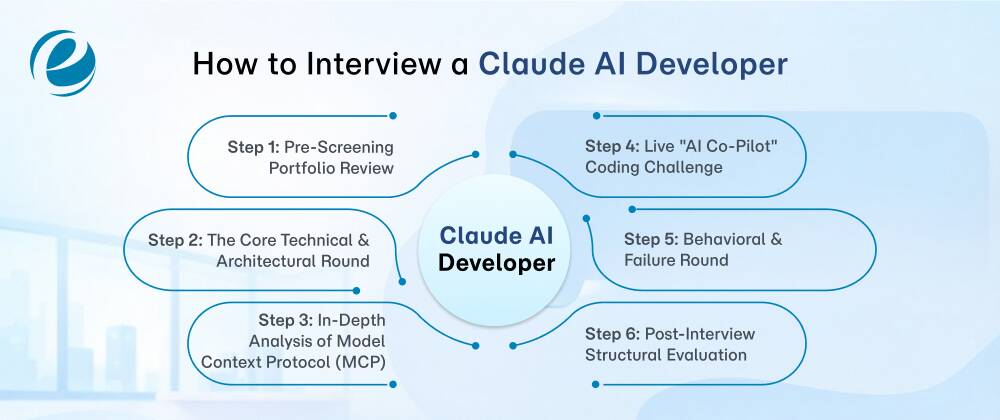
Step 1: Pre-Screening Portfolio Review
Before the interview, look beyond generic web applications. A qualified Claude AI developer should demonstrate specialized knowledge in LLM system design.
- Verify API familiarity: Look for projects utilizing advanced Claude features like prompt caching or adaptive thinking.
- Check for tool use (Function Calling): Look for active code sources where Claude controls external tools or databases.
- Look for Claude Code/Desktop integrations: Check if they have built custom skills or developer-focused automation tools.
Step 2: The Core Technical & Architectural Round
Dedicate the first 30 minutes of the live interview to systemic architectural questions. A beginner developer knows how to write a basic prompt; a senior developer understands structural tradeoffs. Use these targeted prompts:
- Context Window Management: “Claude Sonnet has a massive 200k context window. How do you structure a retrieval-augmented generation (RAG) system to prevent performance degradation near the middle of that window?”
- Adaptive Thinking: “When would you explicitly use Claude’s adaptive thinking versus setting a hard, manually configured reasoning budget?”
- Model Selection: “Walk me through how you choose between Claude 3.5 Sonnet, Claude 4.6 Opus, and Claude Haiku for a high-throughput, customer-facing agent.”
Step 3: In-Depth Analysis of Model Context Protocol (MCP)
MCP is the open standard for connecting AI models to data sources and tools. Any real Claude specialist needs to understand this architecture cold.
- Ask them to explain the difference between an MCP Host, MCP Client, and MCP Server.
- Have them describe building a secure custom MCP server that connects a company’s internal Postgres database to a Claude instance.
- Listen for security awareness; they should mention data sandboxing, row-level access control, and prompt injection mitigation without being prompted.
Step 4: Live “AI Co-Pilot” Coding Challenge
Instead of a traditional test, evaluate how they work with the tools they’ll use daily. Set up a sandbox with Claude Code or Cursor enabled.
Watch for one thing specifically: do they blindly accept Claude’s first code output? Or do they use an “interview first, specification second, code last” approach? Strong candidates will tell Claude to ask clarifying questions about advanced cases before letting it rewrite anything.
Step 5: Behavioral & Failure Round
AI engineering is highly unpredictable. Models update, prompts break, and outputs drift. You need to know how they handle production failures.
- Prompt Drift: “Describe a time a prompt that worked perfectly in development failed completely after an Anthropic model update. How did you diagnose and fix it?”
- Hallucination Mitigation: “How do you implement evaluation guardrails (e.g., using a smaller model like Haiku or an assertion framework) to catch hallucinations before they reach an end-user?”
Step 6: Post-Interview Structural Evaluation
Do not grade on code compilation alone. Score the candidate using a checklist that measures their overall system competence, which is shown in the table:
| Assessment Category | Junior Developer Behavior | Senior Developer Behavior |
| Prompt Engineering | Relies on long, messy, unformatted text strings. | Uses XML tags, system prompts, and prefill strategies. |
| Tool Execution | Hardcoded arguments; weak schema error handling. | Builds dynamic MCP servers with strict input schema validation. |
| Financial/Token ROI | Ignores token burn; doesn’t optimize context. | Utilizes prompt caching heavily to reduce costs. |
Cost to Hire Claude AI Developers: Regional Rate Benchmarks
Hiring a generative AI developer runs anywhere from $15 to $250+ per hour, or $2,000 to $16,000+ per month. Location, expertise level, and engagement type all move that number significantly.
- North America (USA/Canada): $100-$250+/hour for senior Claude or LLM engineers; $80–$110/hour for junior roles
- Western Europe (UK, Germany, Netherlands): $80-$180/hour senior; $60-$90/hour junior
- Eastern Europe (Ukraine, Romania, Poland): $40-$100/hour senior; $30-$45/hour junior
- India: $25-$80/hour for specialized work; $18-$28/hour junior
- Latin America & Southeast Asia: $30-$70/hour
- Offshore Managed Teams: $15-$25/hour for basic tool integrations, production-ready APIs, and agent builds
As we have discussed earlier, the regional cost to hire dedicated developers can also vary based on the engagement models where freelancers and contractors are priced on an hourly basis, depending on the regional bands above which are specifically suited for RAG or API integrations. Whereas specialized AI agencies charge monthly retainers ranging from $8,000 to $60,000+ per month which depend on team size and location, and project scope fees range from $15,000 to $100,000+.
Underlying Tools and Infrastructure Costs
When budgeting for AI development services and Claude integration, such as custom API orchestration or Claude Code, you should expect additional overhead costs beyond developer pay, which are the following:
- Developer Subscriptions: $20 to $100-200 per month based on the pro to max tiers per engineer.
- API Token Overages and Heavy RAG Workflows: $150 to $2000+ per engineer per month, depending on the agent autonomy and token consumption.
Why Startups Partner with Emizentech to Hire Claude AI Developers
Finding a genuine Claude specialist on your own can take months. At Emizentech, we source from a pool of the top 3% Vetted AI Talent engineers who have shipped real Claude integrations across MCP, RAG pipelines, and agentic workflows, not just worked through tutorials. Rated 4.9 on Clutch by verified clients, our track record speaks for itself.
Here is what you get when you hire Claude AI developers through us:
- Onboard in 48 to 72 Hours: Skip the six-week recruiting lag entirely
- 100% Risk-Free 14-Day Money-Back Guarantee: If the fit is not right, you pay nothing
- Full IP Protection and Security: ISO-compliant workflows, binding NDAs, and 100% client code ownership from day one
Whether you need one developer for a targeted MCP integration or a full team for an agentic platform build, EmizenTech matches talent to scope and remains accountable for delivery.
Conclusion
Hiring the right Claude AI developer requires three things that are verified technical depth, a clear engagement model, and a budget that reflects your actual scope. The developers worth paying for understand prompt caching, agentic loops, and MCP architecture, and the frameworks in this guide, from the skill matrix to the interview rounds, give you a reliable way to separate genuine dedicated AI developers from those who have only gone through the docs. The startups winning with AI right now are not the ones with the biggest budgets; they are the ones that put the right builder behind the model first.
FAQs
What is a Claude AI developer?
A Claude AI developer is a software engineer who specializes in building applications on Anthropic's Claude LLMs. They know advanced prompt engineering, context window management, and Anthropic API integration and they connect Claude to external databases, APIs, and enterprise software systems.
Why should my startup hire dedicated Claude AI developers instead of using off-the-shelf wrappers?
Dedicated developers build custom, scalable architecture that keeps proprietary data secure and guarantees full IP ownership. That offers far more flexibility and long-term value than any off-the-shelf wrapper.
How do Claude AI developers reduce API token costs for startups?
They minimize token expenses through Anthropic's prompt caching, automated context trimming, and routing simpler tasks to cheaper models. This prevents the massive budget drain that shows up fast in live production.
How fast can Emizentech deploy a dedicated Claude AI developer?
Emizentech typically deploys a dedicated Claude AI developer within 24 to 48 hours. A pre-vetted talent pool means startups bypass lengthy recruitment cycles and can scale engineering teams immediately.




 +1 (989) 535-9295
 info@emizentech.com
 emizentech


