
 Add us as a preferred source on Google
 After an app idea clicks, developing it feels urgent. However, timelines bring reality to the forefront. More than half of apps take about 4 to 6 months to develop. When partnering with development experts, founders often start by asking how long does it take to develop an app. It’s usually to understand how fast they can move, test, and launch. A basic app can be developed in weeks, but a product that actually sticks with users can take time. The gap is not about speed but the intent of building an app. From decisions to iterations to systems, everything needs to work without failing.
This guide breaks down the different nuances that determine app development timelines so that you can plan your project practically.
How Much Time Does Each Stage of App Development Take?
In the app development process, each stage takes a certain amount of time based on the level of execution and iterations required.
Planning and Requirement Analysis – 1 to 3 weeks
While this phase seems short, it is actually the most important step that decides everything. You define features, user flows, and tech architecture. Timing isn’t usually the primary concern here. Here’s where delays quietly begin.
When stakeholders rush decisions or teams revisit decisions mid-development, timelines ultimately stretch. Those who invest time here move faster later.
UI/UX Design – 2 to 5 weeks
In 2026, design is more about the ease of usability than it is about looks.
According to Forrester’s UX research, a well-designed UI can increase conversion rates by up to 200%, while a better UX can improve it up to 400%. That’s what pushes design timelines, given that it directly impacts success.
Apps with dashboards, tracking, or personalization naturally take longer here because user journeys are more complex.
Frontend and Backend Development – 8 to 20 weeks
The development stage is where all your decisions and preparation start taking shape and where most of the time goes. The frontend handles what users see, while the backend handles how everything works.
Basic apps move fast because they rely on limited logic. But things change when you are investing in custom mobile app development, as they involve:
- Real-time tracking
- Data syncing
- AI integrations
- Customization
So, development eventually slows down because systems require time to communicate reliably. This is also why Android app and iOS app development timelines differ slightly.
Testing and QA – 2 to 4 weeks
Testing isn’t a mere formality but a critical part of the process that prevents costly outcomes later.
IBM highlights that fixing bugs after release can cost up to 15x more than fixing them during development. That’s why serious teams don’t rush QA.
Apps are tested for:
- Performance under load
- Device compatibility
- Data accuracy
Skipping this stage often delays your product in a different way.
Deployment and Launch – 1 to 2 weeks
Deployment is a final phase but not always predictable. For example, Apple’s official App Store review guidelines involve compliance, safety, and performance. which can naturally extend timelines. If you are wondering how long does it take to develop an iPhone app, the answer can vary beyond just development effort.
How App Complexity Affects Development Time
Building a simple app with static content is easy and fast. However, development becomes layered once you add user behavior, analytics, or real-time data.
To sum up, based on complexity:
- Basic apps take 2 to 4 months
- Moderate apps take 4 to 6 months
- Complex, advanced apps take 6 to 12+ months
The difference between basic and complex apps is the way systems work. For example, a login screen won’t take much time, but a setup where user progress gets tracked, analyzed, and adapted to can take sweet time.
Real-World Examples of App Development Timelines
In addition to complexity, timelines also vary greatly depending on industries. Here are some examples of industry-wise app development timelines:
| Industry | Timeline | Functionality |
| Fitness | 3 to 8 months | Tracking, analytics, and personalization |
| E-commerce | 4 to 6 months | Multiple integrations including logistics, and payments), scalability needs for catalogs and demands |
| Fintech | 6 to 12 (or more) | High regulatory compliance, security features, and real-time data-handling |
| On-Demand Apps | 5 to 9 months | Extensive features, user data handling, and real-time capabilities |
| Social Media | 6 to 12 | Real-time tracking, location services, and multi-user workflows |
| AI-Powered Business Apps | 6 to 12 (or more) | Data training, algorithm optimization, and monitoring |
Why Does App Development Take Longer Than Expected?
Most delays in app development projects come from decisions. The biggest issue is scope creep.
- New features enter the process midway, forcing redesign and reworking.
- Small changes take place out of nowhere, shifting timelines significantly.
- Requirements remain unclear, with no one knowing a fixed direction
- Development becomes iterative instead of structured
- Technical challenges (especially integrations and performance optimization) surface during testing
- Delays in feedback, approvals, or alignment slow progress even more
Most projects go through at least 1-2 such issues throughout the lifecycle, facing delays in deployment.
Unmissable Factors that Impact App Development Timelines
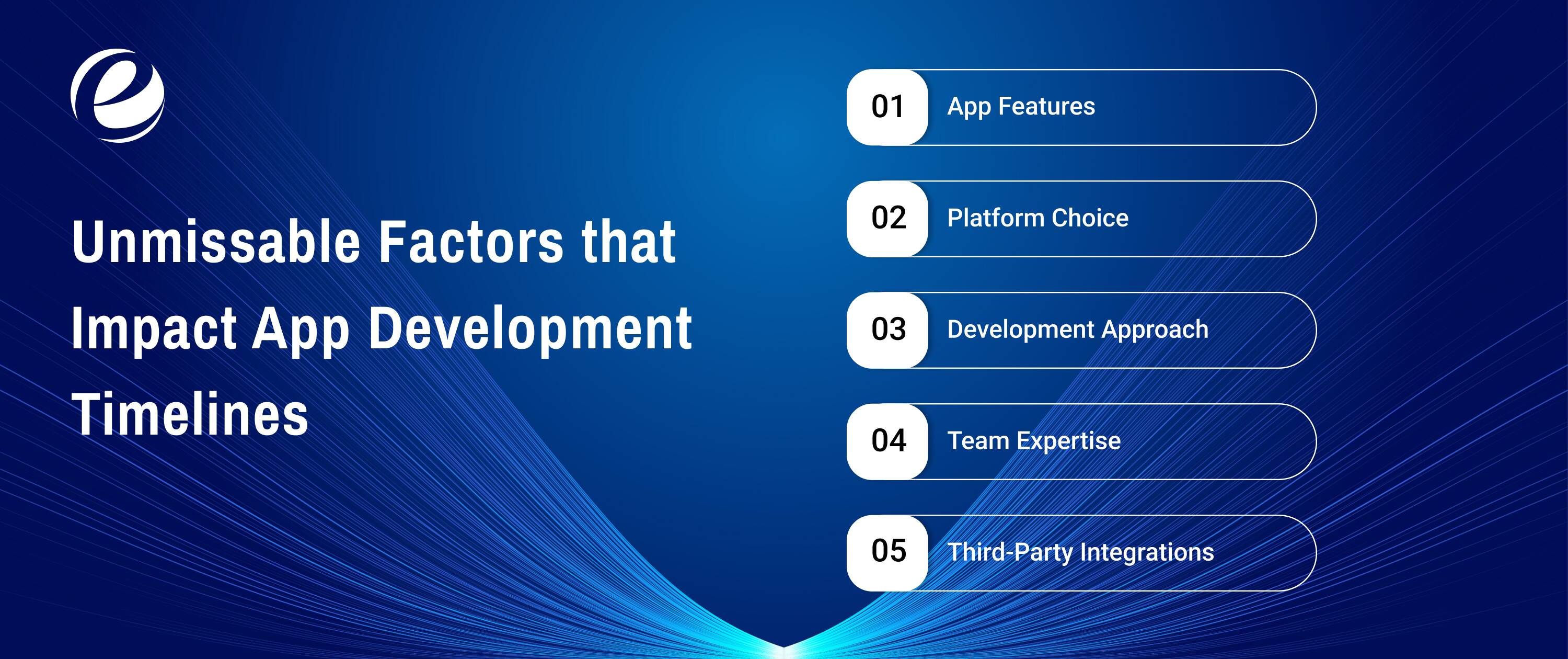
As we discussed earlier, it is execution that decides the timeframe. How you plan and prioritize things and then shape them into reality is how much time it takes to build an app.
App Features
Every feature you add to the app pushes the development cycle, plus integration effort and testing. If your app features real-time tracking or personalization, expect the timeline to go longer than that of those with static content.
Platform Choice
Are you planning to develop native apps for both iOS and Android devices? If yes, expect the development time to be long, as both need separate codebases. On the other side, cross-platform development minimizes the effort. This speeds up project completion and launch, making it perfect for faster launches.
Development Approach
The best mobile and web development company would always use agile methodology to develop an app. It’s because this approach leaves room for faster iterations. However, it requires continuous feedback, meaning that iterations may occur and push timelines forward.
A structured approach, on the other hand, narrows the scope for mid-stage changes but can take longer at initial stages. Striking the balance is the key work within the expected timeframe.
Team Expertise
If you hire mobile app developers with great experience working across types of apps, you may get faster and smarter delivery. The experience helps avoid rework and manage complexities proactively.
Third-Party Integrations
Most companies don’t see this one coming. Integrations like payments, analytics, logistics, or external services (depending on the app and industry) add a significant amount of time, especially when real-time data syncing is involved. Each integration involves phases like setup, testing, and optimization, demanding careful planning.
How to Reduce the Time It Takes to Develop an App?
Get clarity around project timelines, without assumptions or expectations of faster delivery.
- Start with MVP: Investing time in an MVP helps you launch faster, as you only have to work on essential features. It reduces both time and risk.
- Opt for Cross-Platform Development: With this route, you build an app only once and deploy across platforms, cutting development time significantly.
- Be Transparent about Requirements: Don’t leave any room for confusion during development. The more defined and well-communicated your scope, the smoother your execution.
- Use Pre-Built APIs: You can use them for payments, authentication, and analytics. This will accelerate development without compromising quality.
Why Choose Emizentech for Reliable and Scalable App Development?
By choosing the right app development company, you prevent delays before they lead to costly consequences.
Working with an experienced mobile app development company means getting:
- Structured timelines
- Scalable architecture
- Efficient execution
- Customization
- Post-launch support
At Emizentech, we focus on
- Consultation for transparent goal mapping and strategy
- Clear milestones and delivery tracking for effective process
- Scalable backend systems for consistent growth
- Reduced rework in the future through better planning early on
This approach ensures your app is delivered on time and built to grow.
Summing Up
You pretty much have an idea of how long does it take to develop an app: a few months for a basic version and up to a year for a scalable product. What matters is understanding that the difference isn’t just features, but mainly the execution depth.
Want realistic timelines? First of all, try not to speed up the development or ask how fast your mobile app development company can build it. Instead, focus on how well it needs to be built.
FAQs
How long does it take to develop an Android app?
Building an Android app takes 3 to 6 months, including mid-level complexity. However, testing across multiple devices and screen sizes can stretch timelines compared to iOS.
How long does it take to develop an iPhone app?
Just like Android apps, iPhone apps take 3 to 6 months. However, App Store approval and guidelines checks can add extra time post-development.
What affects development timelines the most?
Features, real-time capabilities, integrations, AI, and testing impact the timelines more.
Can I build an app using cross-platform development?
Yes. In cross-platform app development, the app is built using a shared codebase for both iOS and Android.



 +1 (989) 535-9295
 info@emizentech.com
 emizentech


