 Add us as a preferred source on Google
 Think of a mall in one building, but with lots of little shops inside, each run by a different person. That’s basically what a multi vendor ecommerce platform is, except it’s a website instead of a building. One person owns the “mall,” but hundreds of sellers rent space in it to sell their goods. If you’re trying to figure out how this all works, or which platform to actually pick, consider this blog your guide to the 12 best multi-vendor ecommerce platforms. Everything you need to know before choosing the best for your business.
What Is a Multi-Vendor Ecommerce Platform and How Does It Work?
A multi-vendor ecommerce platform has two user types: admins and vendors. One website, tons of different sellers, one shopping cart where a customer can grab a T-shirt from Seller A and a phone case from Seller B in the same order.
Someone builds the website. That’s the admin. They pick the design, set the rules, and decide how payments work.
Vendors join and set up shop. Each one gets their own dashboard, kind of like a back office, to upload products and set prices.
People shop. Everyone’s products get mixed together on the site, so browsing feels like one big store even though it’s really dozens of small ones.
Orders split themselves up. Buy from three sellers at once? The system quietly sends each part of the order to the right vendor. You don’t even notice.
Money gets divided. The admin usually keeps a small cut (a commission), and the vendor gets the rest.
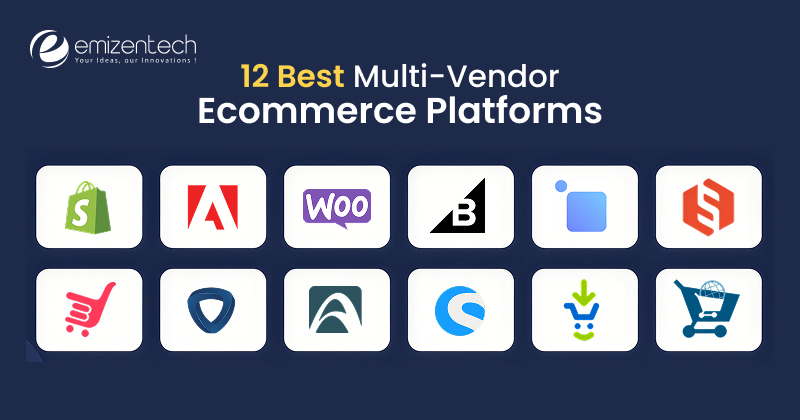
12 Multi-Vendor Ecommerce Platforms: A Complete List
There’s a lot of noise out there about which multi vendor ecommerce platform is “the best.” Some of it’s marketing fluff. Here’s a straight rundown of 12 real options, what they’re good at, and where they fall short.
Shopify
Shopify wasn’t built as a marketplace tool, but slap on an app like Multi Vendor Marketplace, and it becomes a proper multi-vendor ecommerce platform.
Best For: Smaller businesses who want to get moving fast without touching code.
Key Multi-Vendor Features: Vendor dashboards, orders split automatically, commissions handled for you, tons of app add-ons.
Pricing: Roughly $39/month to start, plus whatever the app costs.
Why Choose It: It’s just easy. Even if you’ve never built a website in your life, you’ll figure this one out.
Adobe Commerce
Adobe Commerce suits big, complicated stores and can be shaped into almost anything. It isn’t multi-vendor out of the box; you’ll need extensions like Webkul or Magestore for smoother operation.
Best For: Bigger companies that need things done a very specific way.
Key Multi-Vendor Features: Serious vendor controls, handles multiple currencies, deep catalog management.
Pricing: Custom quote, and yeah, it’s usually not cheap once you factor in development.
Why Choose It: It doesn’t buckle under pressure. Huge catalogs, tons of traffic- it just handles it.
WooCommerce
If your site’s already on WordPress, plugins like Dokan or WC Vendors turn WooCommerce into a working multi-vendor ecommerce platform without starting over.
Best For: Anyone already living in the WordPress world.
Key Multi-Vendor Features: Individual vendor storefronts, commission settings, a system for approving products before they go live.
Pricing: The core plugin is free; the vendor plugins usually run $150–$500+ a year.
Why Choose It: It’s affordable for what you get, and gives you way more control over how things look than most SaaS tools do.
BigCommerce
Cloud-based, fast, and built with real scale in mind.
Best For: Businesses that already know they’re going to outgrow whatever they start with.
Key Multi-Vendor Features: API-friendly vendor apps, solid SEO tools baked in, multi-storefront setups.
Pricing: Starts around $39/month.
Why Choose It: You won’t hit a wall and need to rebuild everything from scratch six months in.
CS-Cart Multi-Vendor
Unlike most of these, CS-Cart was actually designed to be a multi-vendor e-commerce platform from day one, not bolted on later.
Best For: Anyone who wants marketplace features already built in, not stitched together.
Key Multi-Vendor Features: Vendor-specific themes, per-vendor shipping rules, commission system that’s already there.
Pricing: One-time license from about $1,450, or a monthly SaaS plan if you’d rather not pay upfront.
Why Choose It: There aren’t many platforms actually built for this specific job. CS-Cart is one of them.
Sharetribe
Made for people who want to test a marketplace idea without sinking months into building it.
Best For: Startups still figuring out if their idea actually works.
Key Multi-Vendor Features: No-code builder, custom vendor profiles, messaging built right in.
Pricing: Around $99/month to start.
Why Choose It: You can launch fast and cheap, which matters a lot when you’re not even sure the idea will land yet.
Yo! Kart
A dedicated multi-vendor ecommerce platform that many growing businesses rely on.
Best For: People who want to own their marketplace outright, not rent space on someone else’s.
Key Multi-Vendor Features: Vendor subscription tiers, built-in reviews, multiple languages supported.
Pricing: One-time fee starting near $1,299.
Why Choose It: No monthly platform fee eating into your margins forever; you own the code once you’ve paid.
Mirakl
This is enterprise territory. Big retailers use Mirakl to run genuinely massive marketplaces.
Best For: Large companies, global brands; not really for a small shop just starting out.
Key Multi-Vendor Features: AI helps onboard vendors, catch fraud, and manage catalogs at a huge scale.
Pricing: Custom, and it’s enterprise pricing, so expect it.
Why Choose It: It can handle millions of products and thousands of vendors without breaking a sweat.
Arcadier
A cloud marketplace builder that’s especially popular across Asia but is spreading elsewhere too.
Best For: Anyone who wants a quick setup using ready-made templates.
Key Multi-Vendor Features: Drag-and-drop builder, vendor ID verification, flexible commissions.
Pricing: Free tier available; paid plans start around $200/month.
Why Choose It: Speed. You can go from nothing to a working marketplace pretty fast.
Shopware
Shopware comes from Germany and is big across Europe. You get there with plugins, either from its own store or from third-party developers, sitting on a pretty solid API-first core.
Best For: Mid-size and larger businesses, especially in Europe, with developers who don’t mind customizing.
Key Multi-Vendor Features: Through marketplace plugins, you can get vendor dashboards, product approval flows, and commission handling. The core itself brings B2B tools, multi-language and multi-currency support.
Pricing: The Community Edition is free. Paid hosted and enterprise plans are quote-based, so the number depends on your revenue and what you need. Multi-vendor plugins cost extra.
Why Choose It: It scales well, and you control both the storefront and the backend. If you’ve got a dev team and a clear picture of your market, it’s a good base.
Spree Commerce
Spree is an open-source ecommerce framework built on Ruby on Rails. It has a proper multi-vendor marketplace edition built on its core, so you’re not just stacking a plugin on top and hoping it holds.
Best For: Teams that already work with Rails and want a marketplace they fully own.
Key Multi-Vendor Features: Each vendor gets their own account and dashboard, with their own products, orders, and stock. Commissions and payouts are handled, and the API-first design makes headless builds easy.
Pricing: The core is free and open source. The multi-vendor edition and enterprise support are paid, with custom pricing.
Why Choose It: There’s no vendor lock-in, and it bends to your business logic instead of forcing you into a template. The catch is that you really do need Rails developers.
Custom-Built Multi-Vendor Platform
Sometimes none of the ready-made options fit, so businesses hire developers to build their own multi-vendor ecommerce platform from the ground up.
Best For: Companies with weird, specific needs that off-the-shelf software can’t handle.
Key Multi-Vendor Features: Whatever you want, full design freedom, no artificial limits.
Pricing: All over the map, depending on scope.
Why Choose It: Total control. If your business model doesn’t fit neatly into a box, this is usually the answer; here’s more on building a B2B or B2C marketplace from scratch.
Let’s understand this with a carefully curated comparison table.
| Platform | Best For | Pricing | Ownership |
| Shopify | Beginners | From $39/mo | Hosted (SaaS) |
| Adobe Commerce | Large brands | Custom | Self-hosted |
| WooCommerce | WordPress users | Free + plugin cost | Self-hosted |
| BigCommerce | Growing stores | From $39/mo | Hosted (SaaS) |
| CS-Cart | Ready-made marketplace | From $1,450 | Self-hosted |
| Sharetribe | Startups | From $99/mo | Hosted (SaaS) |
| Yo! Kart | Owned marketplace | From $1,299 | Self-hosted |
| Mirakl | Enterprises | Custom | Enterprise SaaS |
| Arcadier | Fast setup | Free–$200/mo | Hosted (SaaS) |
| Spree commerce | Custom marketplaces | custom | Self-hosted |
| SaaS Builders | Small local shops | $30–$150/mo | Hosted (SaaS) |
| Custom–Built | Unique needs | Varies | Fully owned |
How to Choose the Right Multi-Vendor Ecommerce Platform
Don’t overthink this too much. A few honest questions will get you most of the way there. It’s also worth understanding the different types of ecommerce businesses before locking anything in; a marketplace really is a different beast than a normal single-brand store.
What’s your budget, really? Some platforms look cheap upfront but nickel-and-dime you every month forever. Others cost more now, but you own it outright later. Figure out which trade-off actually works for you.
How many vendors do you actually expect? A small local marketplace with 20 sellers doesn’t need the same muscle as one planning for thousands.
Do you need weird, specific features? If yes, a locked-down SaaS tool might frustrate you. A self-hosted or custom option gives more room to move.
Is it actually easy to use? If vendors need a manual just to upload a product, that’s a problem. Same goes for the admin side.
Can it handle payments and shipping per vendor? This should happen automatically, not manually every single time.
Will it hold up as you grow? The best multi vendor ecommerce platform for you now might not cut it in two years; worth thinking about that early. There’s a good read on enterprise ecommerce platforms if scale is something you’re worried about.
How EmizenTech Turns Your Multi-Vendor Ecommerce Idea Into Reality
Picking software is only half the job. Actually building a multi-vendor ecommerce platform that works and that people trust is a whole different story. This is where EmizenTech comes in. The team starts by understanding the business’s needs, then decides whether a ready-made platform makes sense or whether it’s worth building something custom. Every vendor dashboard, every payment split, every shipping rule gets built around how the business actually runs, not squeezed into some generic template.
That’s the core of their ecommerce development services, covering design through to the backend logic nobody sees, but everybody relies on. Got the idea but no technical team? You can hire ecommerce developers who specialize in marketplace-style builds, which saves time and, honestly, a lot of expensive mistakes. EmizenTech also pays close attention to how the whole thing feels to actually use, because a clunky checkout will lose you customers fast. Their customer experience consulting work focuses on keeping that experience smooth.
Final Thoughts
At the end of the day, a multi vendor ecommerce platform is just a bunch of small shops living under one roof. Which one you pick comes down to budget, how big you’re planning to grow, and how much control you actually want. Maybe that’s Shopify. Maybe it’s CS-Cart. Maybe it’s a fully custom multi-seller ecommerce platform built from scratch because nothing else fit.
Doesn’t really matter which; the goal’s the same either way: make it easy for vendors to sell, and easy for customers to buy. Get that right, and the platform basically fades into the background, which, honestly, is exactly what you want.
FAQs
What is a multi-vendor Ecommerce platform?
It's a website where a bunch of different sellers list and sell their own products, all under one roof, with one admin running the show basically a digital mall.
What features should a multi-vendor Ecommerce platform have?
Vendor dashboards, orders that split automatically, secure payment sharing, decent product management tools, per-vendor shipping rules, and a checkout that doesn't confuse people.
How much does it cost to build a multi-vendor Ecommerce?
Depends a lot. Ready-made tools can start around $30–$100 a month. A fully custom build, though, could run from a few thousand dollars well into much higher numbers, depending on how big and complex it gets.
How do I choose the right multi-vendor Ecommerce platform?
Look at your budget, how many vendors you're expecting, how much customization you'll need, whether it's actually easy for people to use, and whether it can keep up as the business grows.


 +1 (989) 535-9295
 info@emizentech.com
 emizentech


