
 Add us as a preferred source on Google
 Managing business operations is fundamentally essential due to ever-increasing competition in the corporate sector. Odoo is an open-source ERP used to manage activities ranging from accounting, inventory, sales, human resources, and more. As per Store Leads, there are 82,377 live stores operating on the Odoo platform
Initially known as OpenERP, Odoo has grown into a complete enterprise solution used by a wide range of industries. What makes Odoo development unique is its flexibility in structure, modularity, and ability to adjust to the requirements of different industries.
Reasons to Choose Odoo ERP
The best way to understand the reason behind the increased popularity of Odoo ERP is by looking at the benefits it offers. Here are some of the major advantages of using Odoo ERP for industries:
1. Cost-Effective ERP Solution
Odoo is an affordable solution that companies can take advantage of. You can install and maintain it easily as compared to many other costly ERP systems. As it is open-source, companies are not required to pay expensive licensing fees. This results in a lower total cost of ownership compared to proprietary ERP systems.
Odoo has a free community edition and a paid enterprise edition. The Enterprise Edition has an additional feature for a fair price. Pricing is flexible so companies can select what best meets their budget and then scale from there.
2. Customizable Modules
Odoo ERP comes with various customization benefits. It has all different modules which can be used to manage various business processes. The features include inventory, accounting, human resources, project management, sales, and more.
Modules can be easily customized according to your business needs. Moreover, as Odoo is open source, businesses can also develop their own applications to address specific needs on Odoo. You have complete control of building and the software can be adapted with your requirements and you can add any systems or features you need.
3. Odoo Integration Capabilities
Well, in this modern business environment integration between different software systems is of the utmost importance. Odoo ERP is very efficient and adaptive in dealing with third-party applications and services.
Odoo can integrate with E-commerce platforms such as Shopify or Magento. It even supports payment gateways like PayPal or stripe. In addition, Odoo integrates with marketing tools such as Mailchimp.
This integration feature also helps businesses to easily sync data across multiple platforms. This ensures every department can easily access the same information. With Odoo API, businesses can also connect the whole digital ecosystem.
4. Cloud-Based and On-Premise Options
Odoo provides businesses with the choice of cloud-based or on-premise deployment. Cloud deployment is great for businesses that need flexibility, speed, and cost savings. It allows remote access, automated updates, and fewer IT expenses.
Businesses that want greater security over the data they store may select an on-premise deployment. This enables them to run Odoo’s servers on their own. They have complete control over data security and the ability to customize.
5. Enhanced Collaboration Tools
Communication and teamwork are essential for any company. Odoo ERP has built-in tools to help teams collaborate more effectively. Features such as task tracking, project management, and document sharing enable teams to collaborate seamlessly.
Odoo’s communications features can allow employees to stay in touch, whether at work or at home. These tools help collaboration and increase productivity. They also assist teams in finishing tasks on schedule and within budget.
6. eCommerce and Website Integration
For retail businesses, Odoo ecommerce development offers excellent e-commerce and web integration features. Then its e-commerce function is valuable for companies who need to establish and handle their online services. ERP system integrated sales, stock and accounting software allows you to monitor transactions in real-time.
Odoo website builder is also easy to use, enabling organizations to build a user-friendly professional website without the need of extensive technical knowledge. This integration between eCommerce and other businesses offers a smooth experience for both businesses and its customers.
7. Scalability and Flexibility
Odoo ERP adapts with your company needs. Its design provides scalability and flexibility. When your business grows, you can easily add users and modules.
It’s not necessary to modify the way you use your system. Whether you are a start-up or an enterprise, Odoo can grow with your business. With Odoo ERP, you can easily fulfil your growing demands.
Additionally, Odoo’s flexibility permits companies to customize the software to meet their needs. Businesses can select modules based on their needs or develop them if needed. This flexibility allows businesses to avoid unnecessary features. They can concentrate on the essential aspects of their business.
8. User-Friendly Interface
Odoo’s user-friendly interface is another reason many companies prefer an ERP program like this. It’s easy and simple layout helps employees understand and navigate quickly, reducing the amount of time required for training and onboarding.
Odoo ERP offers a simple and easy to use ERP. This helps users to easily search for the tools and features they need to complete tasks.
Additionally, Odoo interface is the same across all its applications, offering a seamless user experience regardless of the app in use. A user-centric design boosts efficiency and reduces chances of errors.
9. Open-Source Platform
Odoo is an open-source ERP solution. Its source code is available to anyone who wants it, and businesses can alter it to meet their specific needs.
Odoo is open-source and provides many advantages. It provides lower prices, more flexibility, and has an active community of developers that regularly help improve the platform.
Open-source solutions provide a higher level of transparency. Companies can be confident that their ERP is aligned to its goals and data security requirements. Odoo ERP software development saves you from proprietary software agreements, allowing you to have greater control over your company’s digital configuration.
10. Odoo Business Applications
Odoo offers a variety of applications for various business operations. This includes managing inventory accounting, sales hiring, human resources, and manufacturing. With Odoo, businesses can manage all of their processes from one location.
With such a wide range of applications, Odoo ERP lets businesses consolidate their software requirements. This not only simplifies processes but also decreases the requirement for multiple systems, which saves both time and money.
11. Real-Time Data Access
Odoo ERP gives companies immediate access to crucial data, helping them make informed decisions at all company levels. It includes dealing with inventory accounting, sales hiring, personnel, and manufacturing. Odoo allows businesses to manage all their processes from a single platform.
Odoo ERP is diversified enough to allow businesses to consolidate their software needs. Not only does this make things easier, it reduces the need for lots of distinct systems, saving on time and cost.
12. Customer Relationship Management (CRM)
Odoo ERP has a strong Customer Relationship Management (CRM) module. It aids businesses in managing sales pipelines and customer interactions more effectively. The CRM module lets businesses keep track of prospects and leads, as well as communications with customers, giving a 360-degree view of the customer relationship.
Odoo CRM lets businesses improve customer satisfaction, boost sales, and increase loyalty. It integrates well with other Odoo apps, such as invoicing, sales marketing, and invoicing, and keeps all customer interactions in sync.
13. Strong Community Support
Community support is one of the main benefits of choosing an open-source platform such as Odoo. Odoo has a huge and active community.
This community is composed of users, developers, and partners who work together to enhance the platform. The community assists businesses in finding valuable information, helpful solutions to problems, and custom modules that can enhance users’ Odoo experience.
Odoo provides expert support through its certified partners. These partners can help businesses obtain professional advice and assistance when they require it.
Odoo to Scale Various Industries
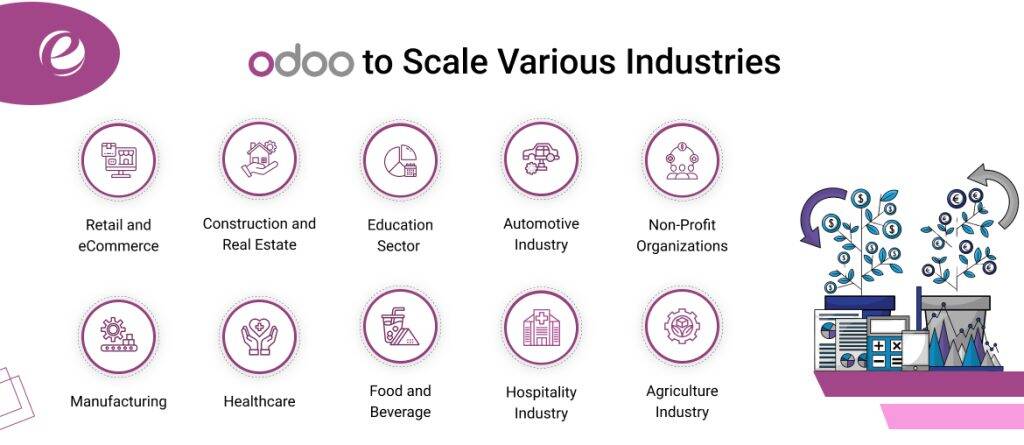
Implementation of Odoo ERP for industries provides flexibility and customization for many industries. Here’s how different industries can benefit from Odoo ERP implementation:
1. Retail and eCommerce
For eCommerce and retail businesses, managing multiple sales channels is vital. It is also essential to manage their inventory effectively. A smooth experience for customers is crucial, too. Retail businesses can benefit from Odoo website development as it offers:
- A fully integrated POS system can work online and offline, making it perfect for physically located stores.
- Integrates with modules for sales and inventory to provide the complete package for online stores.
- Enhances customer relations by monitoring sales activities, coordinating leads, and creating customized marketing campaigns.
With Odoo for retail and eCommerce, businesses can control their stores and online sales through one platform.
2. Construction and Real Estate
The real estate and construction business relies heavily on budgeting, project management, and resource allocation. Odoo for construction and real estate offers:
- It monitors progress, controls budgets, and schedules work in real time. This allows companies to complete their tasks on time and within their budget.
- Controls expenses and anticipates expenses and forecasts. Prepares financial reports to be sure that the business is profitable.
- Check that your materials are in order at the time of need to avoid costly delays.
This control level helps construction firms to complete projects faster. They can also stay within the budget and adhere to deadlines.
3. Education Sector
Universities, schools, and training facilities can use Odoo to simplify administrative work. This includes:
- Controls students’ records and records, including attendance, grades, and schedules.
- Controls employee hiring Payroll, staffing, and reviews of performance.
- Tracks tuition as well as grants and budgeting for universities.
With Odoo for education sector, schools can reduce their administrative workload, allowing teachers and staff to concentrate on students and their education.
4. Automotive Industry
The auto industry faces issues in supply chains, vehicle production, and after-sales support. Odoo ERP implementation provides solutions like:
- Improves the supply chain of automobile accessories and parts.
- Manages relationships with dealerships as well as customers and dealerships.
- Maintains schedules for vehicle maintenance and ensures after-sales services are provided efficiently.
By implementing Odoo for automotive industry, businesses can streamline their operations, improve inventory management, and enhance vehicle servicing processes while maintaining the quality of customer service.
5. Non-Profit Organizations
Non-profit organizations face some special challenges. They have to manage donations, plan activities, and keep their financial documents in order. Odoo ERP offers:
- Manages fundraising campaigns and ensures donors’ engagement.
- It simplifies the organization of events, such as registration, ticketing, and event reporting after the event.
- Assures transparency in the financial system and compliance with the requirements of regulatory authorities.
Non-profits can focus on their goals while also keeping accurate and clear information.
6. Manufacturing
It is important to keep track of production processes in the manufacturing industry. Controlling inventory and ensuring the efficiency of the supply chain is also crucial. Odoo for manufacturing offers special modules, including:
- Monitors every step of the production process, from raw materials to the finished product.
- Automates inventory processes with real-time tracking and monitoring of levels of stock.
- Maintains standards for the quality of products by examining and reporting.
By automating these critical processes, companies can reduce the time between production and lead times, decrease errors, and utilize more resources.
7. Healthcare
Healthcare professionals must maintain patient records, track appointments, and abide by strict guidelines. Odoo for healthcare solutions can be customized to streamline health industry operations such as:
- It makes keeping records of patients and scheduling more efficient.
- Be sure clinics and hospitals get the medical equipment they require whenever needed.
- Manages payroll and schedules for staff. Make sure that the company complies with healthcare regulations.
Odoo can connect to health software. This allows the efficient and secure management of sensitive patient information.
8. Food and Beverage
The food industry requires efficient inventory control, quality control, and safety guidelines. Odoo ERP assists with:
- Checks for perishable items, track the stock level and automate reordering to reduce waste materials.
- Check that food products comply with safety standards. This allows companies to follow regulations such as HACCP.
- Manages customers’ orders, online sales, and promotions for restaurants and food producers.
Odoo for food and beverage businesses can be linked to point-of-sale systems, making it an excellent choice for restaurants and food chains.
9. Wholesale
Distributors and wholesalers manage large quantities of merchandise. They have to monitor and manage these items in a variety of warehouses. Odoo for wholesale offers:
- Organizes the products across several locations and monitors stock levels in real-time.
- Automates the process of processing orders, managing vendors, and procurement.
- Integrates with shipping service providers and streamlines delivery processes.
Wholesalers can keep their stock levels optimum, cut delivery times, and increase the customer experience.
10. Hospitality Industry
Hotels and hospitality companies rely on top customer service and efficient control of staff, bookings, and inventory. Implementing Odoo for Hospitality industry provides:
- Manages reservations for rooms and availability.
- Enhances the guest experience by offering individualized offers and loyalty programs.
- Assists hotels in having enough items for their day-to-day activities.
With Odoo, the hospitality industry can enhance guest experiences while automatizing important backend processes.
11. Agriculture Industry
Agribusinesses and farmers have to manage their livestock, crops, and machinery. Odoo for agriculture industry can help with:
- Monitors the crop cycle, monitors livestock health, and enhances machine use.
- Be sure that fertilizers, seeds, and other resources are available when needed.
- Manages orders, contracts, and relations with suppliers and buyers.
With Odoo ERP implementation, agriculture businesses can run more efficiently, enhancing the efficiency and profitability of their operations.
12. Service Based Industries
Odoo ERP is utilized in industries that rely on services, such as IT services, consulting firms, marketing agencies, and professional services, to manage projects, time tracking, resource allocation, and even billing.
13. Financial Services
Odoo ERP for financial services streamlines and improves businesses’ efficiency. It provides comprehensive modules to help with accounting, invoicing, budgeting, and financial reporting.
With secure transaction monitoring, multi-currency support, and seamless integration, Odoo assures clean monetary management, providing a solid solution for financial companies.
14. Human Resources
Odoo for human resources offers a compelling solution for HR departments looking for accuracy, efficiency, and satisfaction.
Simpler processes, improved data administration, and savings from automation are just some of the benefits that HR departments can leverage.
Odoo ERP vs. Other Competitors
ERP’s capabilities can adapt to your company’s needs and requirements. Odoo ERP system is the most suitable choice for companies of different size and niche. But, various ERP software solutions, like SAP, Oracle, and Microsoft Dynamics, are available now. Odoo ERP offers flexibility, scalability, and ease of integration. Here are the key features that set Odoo apart from other ERP systems:
1. Customizable
Organizations can benefit from Odoo’s modular design, which refers to its capability to be custom-built by adding or removing modules. This allows users to customize the program to their requirements. Customizations are also offered with Microsoft Dynamics, Oracle, and NetSuite; however, they require technical knowledge.
2. Functionality
Odoo provides hundreds of modules and programs for managing business operations. These include CRM (Customer Relationship Management) to manage customer interactions, financial accounting for management, and inventory management to monitor inventory levels. Odoo also offers web management for managing and creating websites, as well as order and sales management to handle orders and sales. There are many other features and modules as well.
3. Target Market
Compared to Oracle and NetSuite, Odoo ERP can be used by businesses of all sizes, from small to medium-sized companies. However, Microsoft Dynamics also provides solutions for both small and large companies.
Odoo is a free, open-source ERP software that provides the best paid models and products. NetSuite and Oracle offer cloud-based subscriptions based on users’ number and functionality demands. Microsoft Dynamics offers on-premise ERP solutions with similar pricing for those who prefer hosting the ERP system independently.
4. User Interface
Unlike Oracle, NetSuite, and Microsoft Dynamics, Odoo ERP features a modern and user-friendly user interface. This layout selection ensures even the users with less technical knowledge can access the system easily.
These modules and applications are available in other ERP software, but they are limited and only specific to some industries and functionalities.
How EmizenTech Can Help You With Odoo ERP Implementation?
Odoo ERP implementation is challenging if it’s done without the support of Odoo experts. That’s why you’ll require assistance from Odoo ERP implementation experts to ensure successful implementation. Simply put, the proper implementation of ERP is crucial to the overall success of your company. It is evident that the success of an Odoo implementation also depends on choosing the right Odoo implementation partner.
We at EmizenTech offer complete Odoo development services to businesses. Our team of experts comprises Odoo consultants (technical and operational), Odoo developers (front-end, back-end, mobile app, etc.), quality analysts, project managers, and many more. Choosing EmizenTech as your Odoo ERP Implementation partner could be the best choice for your enterprise. Hire Odoo developers from EmizenTech to ensure successful implementation of Odoo ERP in your business environment and under the budget.
The Key Takeaway
If you’re thinking about using Odoo ERP to manage your company’s operations, you’ll appreciate its versatility, accessibility, and affordability. Implementing Odoo ERP for industries offers an all-encompassing solution that can be tailored to the unique needs of your business. Odoo is an ERP platform that can be used by every industry, and its open-source nature allows customization and continual development. On the top of it all off, its modular architecture facilitates integration and adaptability.
With a careful implementation of Odoo ERP, business can:
- Streamline the processes
- Better management of clients & candidates
- Enable collaboration and promote communication
- Extract insights from integrated reports
With the rapid change of the business landscape, platforms like Odoo will expand and play a key role for industries realizing their business goals.
FAQs
What are the reasons for picking Odoo?
We recommend using Odoo due to its modular design, cost efficiency, and the possibility of customization to suit the unique and specific needs of every industry.
Why is Odoo better than other ERP systems?
Odoo is famous for its user-friendly user interface, seamless application integration capabilities, and most of all providing a one-stop-shop to make all the processes easy under one umbrella.
What are the competitive advantages of Odoo?
Odoo's competitive advantages are its open-source nature, affordability, numerous customization options, and international community of support, which contributes to the software's ongoing performance.
What makes Odoo a better choice than Oracle?
Odoo is popular among small and mid-sized companies over oracle as it is economical, simple and flexible to customize. For scaling enterprises, this is a solution that is easy to use and can be adapted to different seasons.


 +1 (989) 535-9295
 info@emizentech.com
 emizentech


