
 Add us as a preferred source on Google
 Switching between several tools to manage all aspects of your ecommerce business, like orders, stock, finance, and customer service, is probably exhausting for you. Imagine if there were a single smart system that could do it all effortlessly?
By the year 2026, companies all over the globe will be opting to migrate Magento to Odoo in order to smooth their operations and bring their workflows together. Even though Magento is an efficient and strong online selling platform, its main disadvantage is that it is mostly concentrated on web selling. However, Odoo provides a complete business package along with integrated ERP capabilities that link sales, accounting, inventory, and CRM into a single system.
The combination of the features of both the platforms, the ecommerce and the business automation, is the main reason why many organizations view the migration of Magento to Odoo as a very smart decision that will open up the way for their future growth and scalability.
Ecommerce Platform and ERP Market Growth (2025–2030)
As per Markets & Markets, The worldwide ecommerce platform market is expected to increase from USD 9.07 billion in 2025 to USD 16.5 billion in 2030, with a CAGR of 12.7%, on account of the growth in internet access, mobile shopping, and AI integration.
At the same time, the Odoo customization market is also predicted to be worth USD 3.1 billion by 2030, growing at 14.2% annually, mainly due to the automation of SMEs and the adoption of enterprises.
Step-by-Step Guide: How to Migrate from Magento to Odoo Successfully?
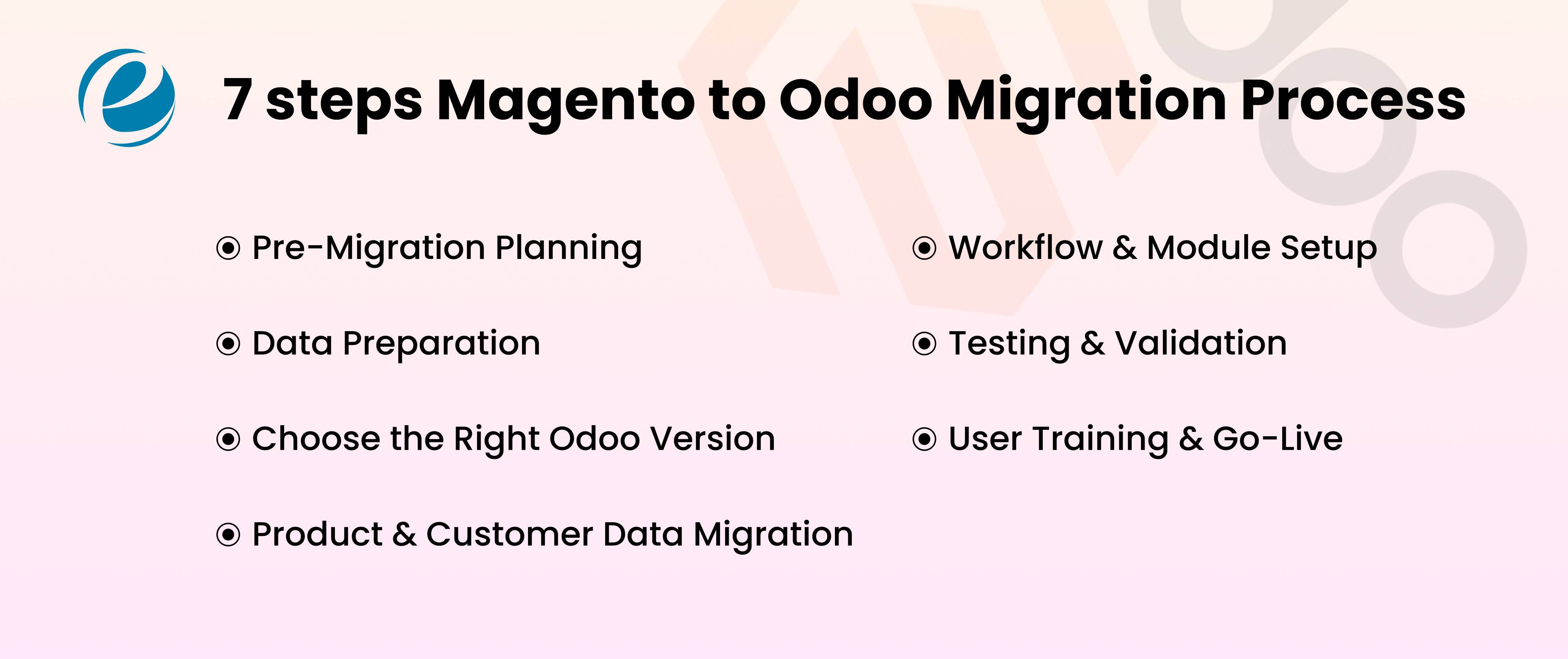
A successful migrate Magento to Odoo involves data analysis, environment setup, mapping, syncing, testing, and training before going live.
Pre-Migration Planning
Evaluate their present Magento setup, which may contain various integrations and extensions of different formats, like connector tools, and choose which data fields, functional areas, and business processes should migrate.
Data Preparation
Once again, conduct Data Preparation, which entails cleaning and organizing existing data in Magento to remove duplicates, formatting issues, and hindrances to quality, usability, and data standards prior to migration to the Odoo platform.
Choose the Right Odoo Version
Next, confirm that you are using the Right Version of the Odoo Platform, preferably the newest version of Odoo, such as 19’s features, which would improve performance and security.
Product and Customer Data Migration
Then, proceed with a product and customer data migration to transfer catalogs, users, and order history using the Odoo-certified migration tools or the assistance of a certified Odoo implementation company.
Workflow and Module Setup
Next, review and set up the necessary Odoo ERP workflows and modules based on sales, accounting, CRM, inventory management, and other modules necessary for a specific industry.
Test and Validate
Conduct test and validation, as necessary, to pilot the workflow and ensure all data will sync appropriately between Odoo ERP and the ecommerce platforms.
User Training and Launch
Train and build the workforce around their usability for Odoo after launch, and monitor usability (and your workforce’s familiarity with Odoo) from a developing company perspective after launch.
Why Managing Magento with Other Systems is Getting Harder?
It is already very difficult to run Magento with separate systems for accounting, CRM, and inventory management. Many ecommerce companies are now coming to the end point that the use of multiple third-party tools is unavoidable, and as a result, they are facing inefficiencies, delays, and increased operational costs.
Manual Data Entry and Duplication
The absence of direct system integration causes the teams to carry out repetitive data entry among the different platforms, with one of these being Magento. This manual process not only introduces mistakes but also hampers the speed of ecommerce operations, thus being a major reason for Magento’s migration to Odoo.
Integration Errors and Data Mismatch
The combination of Magento with third-party accounting or inventory software often results in the occurrence of sync problems and data mismatches. Companies considering Odoo ERP and Odoo migration can get rid of the above-mentioned issues through a single database management system.
High Dependency on Extensions
In many situations, the plugins and add-ons for the Magento connector, together with the CRM or shipping in the company, are heavily used, and that leads to sometimes even compatibility issues during updates. Odoo ERP comes with built-in modules, which means that you won’t have to deal with multiple tools, thus giving you cost and complexity advantages.
Limited Scalability
As companies expand, migration of the ecommerce platform becomes a must since the independent setup of Magento is unable to accommodate large-scale data and inter-departmental communication.
The companies are gradually changing their strategy toward using Odoo ERP as the basic or long-term solution and integration with the ecommerce platforms as the future. Such a smooth process not only simplifies the workflows but also boosts the transparency and greatly reduces the need for third-party applications.
Benefits of Migrating to Odoo
Switching from Magento to Odoo is not just a case of moving an online store, but it is a complete transformation of the business. The merging of all your operations into one platform enables the migrate Magento to Odoo to remove complications in the workflow, cut down costs, and at the same time, enlarge your business to the point of being able to scale up effectively.
All-in-One Business Solution
Magento is a multiple extension-dependent system, while Odoo is a complete ERP system providing integrated modules for sales, inventory, CRM, and accounting. This means that no extra software is required, which in turn reduces the risk of errors in the integration, which are quite common in this type of comparison of Magento vs Odoo.
Cost Efficiency and Fewer Extensions
The use of multiple connector tools or paid plug-ins for Magento drives the operational cost up significantly. However, through the Odoo migration service, the businesses are no longer dependent on the use of built-in modules and free community support, which together make the Ecommerce platform migration more affordable.
Scalability for Growing Businesses
No matter if you are running a little online shop or a big corporation, Odoo ERP will accommodate you with no trouble at all. The modular approach of the platform allows for feature upgrades and personalization without a lot of re-coding, thus preparing your business for future growth in 2026 and beyond.
Ease of Customization
The customization of Magento generally involves not just the hiring of professional developers but also the use of modules like Magento 2 custom module development. In contrast, Odoo ERP offers the possibility of a flexible configuration that requires no extensive coding; hence, the teams are given full authority over the workflows, design, and integrations.
Companies that are focusing on smooth and seamless growth can get the help of Odoo consulting services and Odoo ERP integration with ecommerce platforms to ensure that there are smooth transitions and the performance is sustained in the long run.
How Businesses Saved 40% by Choosing to Migrate Magento to Odoo?
The migrate Magento to Odoo has been a major factor for the majority of e-commerce brands in achieving substantial outcomes. This Odoo migration case study emphasizes the organizations that managed to reduce costs, get more efficient, and exercise more control over their operations after transferring from Magento’s separate tools to the Odoo ERP that has it all.
Magento to Odoo Case Study: Before and After Migration
Before Migration
A mid-sized fashion retailer was using Magento along with various third-party integrations for its CRM, accounting, and inventory. The management of these different systems resulted in frequent integration errors and the need for manual data entry, which was repetitive. The retailer also bought several Magento connector plugins, thus increasing annual costs.
After Odoo Migration
The retailer engaged with an Odoo implementation partner that provided extensive Odoo migration services. Once the transfer of Magento to Odoo ERP was done, all operations in sales, accounting, and logistics were transformed into one platform. Its manual work was reduced by 65% and it saved 40% on integration costs.
Key Results Achieved
Lower Operating Costs: The business was able to eliminate up to 40% of the annual expenses for licenses and maintenance by getting rid of redundant third-party tools.
Improved Data Accuracy: Odoo ERP integration with online selling channels stopped sync delays and thus, data mismatches were reduced.
Faster Customer Response: Non-decentralized customer relationship management led to a 50% increase in customer support speed, which resulted in better customer satisfaction.
Scalable Growth: Thanks to the flexibility of modules and Odoo 19 features, the business was able to easily grow its operations over various online stores.
The collaboration with expert Odoo consulting services and certified teams not only made the migration to the ecommerce platform perfectly smooth but also facilitated future expansions without any downtime. Other companies adopting the same methods have approved Odoo ERP for industries as a strong and modernizing partner for the ecommerce systems with the highest profitability.
Magento vs Odoo: Which Platform Fits Better in 2026?
The choice between Magento vs Odoo might not be easy for ecommerce store owners. Not only that, but Odoo ERP also provides a full-fledged business management system along with sales, accounting, inventory, and CRM modules integrated.
| Feature/Module | Magento Highlights | Odoo ERP Advantages |
| Inventory Management | Real-time stock tracking is totally reliant on third-party extensions or Magento connector tools. | Automatically sells, warehouses, and supplies through a built-in inventory module that syncs them. |
| CRM and Sales | Customer management requires external integrations or CRM extensions. | There is a CRM with strong features included, which is directly connected to the ecommerce and sales modules. |
| Accounting | Invoices and bank reconciliation require separate accounting tools or plugins. | Native accounting and financial reporting are provided within the same system. |
| Customization | Customization quite often involves the development of a custom module for Magento 2 and the knowledge of technicalities. | Odoo migration offers a user-friendly way to customize through flexible modules. |
| Scalability & Cost | High initial and operational costs with limited scalability and flexibility are the main consequences. | Odoo ERP’s cost-effectiveness and adaptability allow it to cater to businesses of any size, from small to large ones. |
Key Highlights
- On the other hand, while the use of multiple tools by Magento adds complexity, Odoo ERP integration with the ecommerce platforms brings everything together in one system.
- Odoo migration services are considered more cost-effective and efficient by those companies that are contemplating the migration of their ecommerce platforms.
- Odoo ERP for industries provides automation, analytics, and multichannel operations, perfect for scalability in the long run.
- Companies can find Odoo developer teams that offer faster, low-cost customization as opposed to the high development efforts needed to hire Magento developer experts.
For complete migration support, consult the Odoo consulting services for the smooth migrate Magento to Odoo or refer to an ecommerce replatforming website migration guide.
Migration Challenges and How to Overcome Them
Migrating from Magento to Odoo can be considered a major leap, but if proper planning and expert support are involved, it can be a smooth and profitable experience. The migration implies tech challenges like data transfer problems, changing processes, and employee opposition; in the end, every NICU will follow the planned smooth way regardless of the difficulties or demands.
Data Migration Complexities
Migrating product catalogs, customer records, and invoices is often regarded as no more than a necessary evil. Nonetheless, using Odoo migration tools in combination with professional Odoo migration services guarantees that all data from Magento will be transferred accurately without any loss or duplication.
Training Teams on Odoo ERP
Employees who are used to Magento’s interface and features will most likely need to undergo training on the Odoo ERP system as a whole. With the assistance of certified Odoo consulting services, companies will be able to train their staff, which will then result in a smooth transition and better utilization of the Odoo ERP features.
Workflow Adjustments
Transitioning from a purely e-commerce Magento setup to an integrated Odoo environment typically involves redesigning the workflows. Your professional Odoo implementation partner will assist you in the flawless mapping of existing processes to Odoo modules.
Integration of Sales and Inventory Data
Real-time synchronization of sales, inventory, and accounting is a must, and this is exactly what Odoo ERP integration with e-commerce platforms does; it automates these processes and eliminates the need for third-party connectors.
Tech Stacks & Tools for Migrating from Magento to Odoo
Migrate Magento to Odoo is a process that necessitates the use of various technological combinations, frameworks, and tools to guarantee the transfer of data that is accurate and the transition that is flawless. The two platforms differ in their technological bases; Magento employs PHP and MySQL, whereas Odoo utilizes Python and PostgreSQL.
Thus, the correct tech stack selection is critical for compatibility, performance, and scalability. A thorough analysis of the main tools that played a part in the Odoo migration and their contribution to the process of delivering a safe and smooth transition of e-commerce platforms is given below.
| Category | Technology / Tool |
| Programming Languages | Python, PHP, JavaScript (jQuery) |
| Databases | MySQL / MariaDB (Magento), PostgreSQL (Odoo) |
| Data Migration Tools | Odoo Magento Connector, Magento 2 to Odoo Migration Tool, Custom Python Scripts, Odoo Migration Scripts |
| ETL Tools | Talend, Apache Nifi, Pentaho Data Integration (PDI) |
| Odoo Modules | Odoo eCommerce Module, Custom Odoo Modules |
| API Integration | Odoo API (XML-RPC/JSON-RPC), Magento API (REST/SOAP), Middleware Tools (Celigo, MuleSoft, Zapier) |
| Cloud & Hosting | Odoo.sh, AWS, Google Cloud, Azure |
| Data Sync & Monitoring | Celery (Odoo), Sentry, Datadog, New Relic |
| Version Control | Git |
| Testing Tools | Odoo Unit Testing, Magento Test Suite |
| Data Cleaning Tools | OpenRefine |
| Business Process Tools | Jira, Trello, Confluence |
Migration toolkits employ myriad ways for achieving human-like migrations. The best practice to avoid loss of data during the migration through one of these tools is to partner with an Odoo implementation company with significant experience or to hire Odoo developer teams specialized in e-commerce platform migration.
User Experience and Interface Comparison
The unified and neat interface of Odoo makes the process of migrate Magento to Odoo more straightforward for all users, from the store manager to non-technical staff.
Simplified Interface for Teams
Magento’s dashboard, which mainly concentrates on ecommerce management, is in contrast to Odoo ERP, which, through its modularity, offers the same easy access to all departments of sales, finance, and inventory. The modular design guarantees that all the departments are on the same platform of working without tool switching.
Ease of Use for Non-Tech Users
Magento often needs technical skills to configure it and to report on it, while the switch to Odoo makes it more user-friendly with its drag-and-drop navigation and well-organized menus, which make everyday tasks easier. This is a good thing because it enables the accounting, CRM, and warehouse teams to get used to the system faster.
Faster Employee Adoption
Switching from Magento to Odoo ERP makes the learning process quicker because Odoo’s user interface is designed for business people rather than developers. It makes the training process less difficult, so people get to the adoption stage faster in the various departments that have been involved after the Ecommerce migration.
Consistent Design Across Modules
Odoo ERP provides a smooth user experience throughout the different applications, from sales to support, while Magento’s modules are viewed separately. Thus, it is a win-win situation for the customer support team as they are able to spend less time integrating systems and more time on making the customer experience better.
For a seamless transfer, certified Odoo consulting services and professional Odoo implementation company support help to get workflows optimized, thus making the employees comfortable with the post-Odoo migration.
The Long-Term Growth Potential with Odoo
Migrating Magento to Odoo is not just a short-lived upgrade, but rather an investment that is already future-ready and that will facilitate the uninterrupted development and the wholesale expansion of your company.
Built for Continuous Expansion
Odoo ERP has enabled businesses to scale up without any hassles, just by adding new modules or new staff without even slowing down the system.
Unlike Magento, which depends on separate extensions, Odoo migration opens up a whole new world for sustainable Ecommerce platform migration and global growth.
Advanced Feature Integration
Odoo 19 introduced a range of features, including AI-driven analytics, automation, and improved reporting systems, which have really changed the whole scenario of how businesses handle intricate operations in a positive way.
An Odoo ERP system that is integrated with a single backend platform facilitates the management of sales, inventory, and finances; thus, it becomes a very proper tool for the management of today’s e-commerce.
Real-World Growth Example
The retail firm that transitioned from Magento to Odoo doubled its market presence in three regions within a year by leveraging Odoo ERP for Retail.
The platform’s flexibility made it easy to integrate the management of new warehouses and product lines without the acquisition of additional third-party tools.
Future-Ready Ecosystem
With the development of technology, Odoo ERP e-commerce platform integration will not only ensure that the business is using the latest tools but also that they are using the most advanced ones, such as AI-driven personalization and high-end logistics tracking, which will keep them in the competitive lane for years.
To ensure the proper setup and optimization of Odoo migration strategies tailored for long-term success, the partnership with expert Odoo consulting services or a reliable Odoo implementation company is a must for sustained business growth.
Ongoing Support and Maintenance Post-Migration
The migration from Magento to Odoo is supported by ongoing assistance, guaranteeing that your system will always be up to date, safe, and fully optimized for e-commerce success in the long run.
Regular Support and Updates
Odoo support and maintenance services keep the performance smooth through regular updates, bug fixing, and compatibility assurance for the Odoo ERP and the connected e-commerce platforms.
Reduced Maintenance Costs
Odoo’s single platform eliminates the necessity for multiple add-ons, which in turn brings down the long-term costs compared to the ones associated with the development services and the third-party integrations for Magento.
Performance Optimization
Post-Odoo migration, Odoo consulting services keep an eye on the ERP modules, speed up the process, and guarantee the real-time syncing of sales, inventory, and customer data.
Sustainable System Growth
Choosing a professional company for Odoo implementation, you will have an efficient Ecommerce migration that will not only allow your business to grow but also avoid having to redesign your system or incur extra costs.
Conclusion: Is Migrating to Odoo Right for You?
For the ecommerce sectors that are expanding, the decision to migrate Magento to Odoo is not only a switch of platforms but also a tactical step towards becoming more efficient and scalable. Odoo ERP provides an interlinked solution that brings together the sales, inventory, CRM, and accounting departments into one ecosystem, while Magento heavily relies on numerous third-party extensions.
Besides, the help of expert Odoo migration services and the use of professional Odoo consulting services will allow companies to carry out a smooth Ecommerce platform migration with the least disruption. The new Odoo 19 features, coupled with the built-in tools, will allow long-term cost reductions, thus the operations will also be simplified, making the Odoo ERP very suitable for companies in need of unified control.
In any case, whether you plan to improve workflows, increase automation, or go for world markets, migration backed by an Odoo implementation firm provides the necessary flexibility and strength for a digital transformation that is sustainable in 2026 and the years that follow.
FAQS
Why should I migrate Magento to Odoo in 2026?
The reason is that Odoo ERP is a complete package solution provider that seamlessly integrates sales, inventory, accounting, and customer relationship management (CRM).
Is Odoo better than Magento for growing businesses?
Sure, Odoo ERP is the one that can grow with your business and will be much more cost-effective and less costly by reducing the dependence on additional plug-ins and third-party subscriptions.
How long does the Magento to Odoo migration take?
Usually, 4-8 weeks, but it depends on how large the store is, the complexity of the data, and how many modules are needed.
Will migrating to Odoo save costs in the long run?
Of course, Odoo provides long-term cost savings by not needing to maintain and subscribe to software for different services.
Who can help with Magento to Odoo migration?
A certified Odoo consultant and Odoo implementation companies will be responsible for ensuring a smooth migration without errors.


 +1 (989) 535-9295
 info@emizentech.com
 emizentech


