 Add us as a preferred source on Google
Have you ever wondered why you can now easily access your favorite services? The rise of on-demand service applications has transformed our daily routines through immediate answer delivery.
According to Grand View Research, the on-demand home services sector will hit $14.7 billion by 2030, growing at a 16.7% CAGR. The first step for entrepreneurs to achieve success requires them to identify the best on demand service apps.
The guide examines the current state of on-demand service applications while showing the latest market trends and features that will help your startup succeed.
What Are On-Demand Service Apps and How Do They Work?
An on-demand service app is a digital intermediary that connects users and service providers in real time. The platforms use their mobile interface to create efficient systems that deliver fast solutions to customer requirements.
- Request: The user selects a service and places an order via the app.
- Matching: Using real-time GPS, the app functions as a digital matchmaker, connecting your request with the closest professional for the quickest service.
- Execution: The provider accepts the task and fulfills the requirement.
- Payment: The payment process enables customers to complete their transactions through integrated gateways, making payments seamless.
- Review: This process uses their rating system to evaluate their experience and helps to sustain high standards of service delivery.
Professional on-demand app development provides the necessary knowledge to create your own platform; you can start developing today.
Why Investing in On Demand Service Apps Is Profitable for Startups
This industry is very profitable due to the shift in consumer behavior toward instant gratification. The best on demand service apps model can be used by startups to attract devoted customers and produce a steady income.
Scalability
The platforms enable startups to establish their operations on a small scale, and they can extend to multiple cities and services without needing extensive physical assets.
User Data Insights
Startups can boost their customer lifetime value and operational performance through personalized user experiences that they create by studying user behavior patterns.
Multiple Revenue Streams
An on-demand service app provides various monetization options through its delivery fees, commissions, featured listings, and subscription packages.
Operational Efficiency
This uses automated dispatching and booking procedures to decrease staffing requirements while cutting down operational expenses. Your business processes will maintain efficiency through on-demand app development, helping you build responsive operations that meet market demands.
High Demand
The present consumer market considers time to be its most important resource. A time-saving solution generates continuous user growth, and this will enable your business to achieve long-term profitability through sustainable operations.
What are the Key Features to Include in an On-Demand Service Apps?
The platform needs to focus on user experience and system dependability because these two factors will help the platform achieve better market differentiation. The correct features must be included in the on-demand service apps because they function as essential tools for maintaining both customer and service provider relationships.
Real-Time Tracking
This feature uses GPS technology to allow users to track their service or delivery progress in real-time, creating trust and decreasing user anxiety through its transparent system of live status updates.
Push Notifications
It maintains user interest through order status notifications, including information about discounts and other system updates. Your audience needs this tool because it serves as the primary means to establish direct contact with them.
Secure Payment Gateways
The on-demand service marketplace mobile application needs to provide various secure payment methods, such as credit cards and digital wallets, and UPI, to create an efficient checkout experience.
In-App Chat
The built-in communication system enables users and providers to exchange information that helps them solve misunderstandings while improving all aspects of delivered service.
Ratings and Reviews
This feature, a feedback loop, creates a system that holds people responsible for their actions. Users who share their experiences create a trustworthy community, enabling high-quality service providers to receive extra work.
14 Best On Demand Service Apps
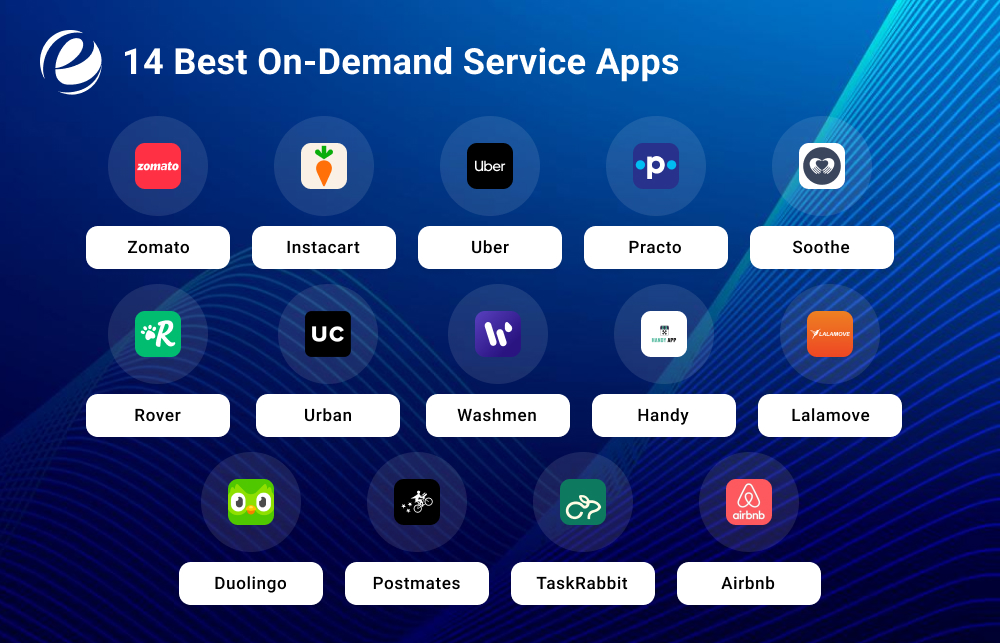
Selecting the right model is the foundation of a successful on-demand app development. As we head into 2026, these 14 platforms are the high standard for user experience and market dominance.
Food & Grocery Delivery
The industry remains a global leader because it allows customers to access nearby restaurants within seconds. One of the key features of on-demand service applications is their ability to optimize delivery routes while providing real-time order tracking, making them a core part of the Best On Demand Service Apps category.
Zomato (Food Delivery)
Zomato allows users to discover nearby restaurants, order food online, and track deliveries in real time. Its wide restaurant network, fast delivery services, and user-friendly experience make it one of the best on demand service apps in the food delivery industry.
Pros:
- Extensive restaurant database.
- Strong loyalty programs.
- User-friendly interface.
Cons:
- High delivery fees during peak hours.
- Heavy reliance on third-party couriers.
- Occasional order delays.
Key Features: Live order tracking, contactless delivery, and AI-based food recommendations.
Cost to Develop: $35,000 – $75,000
Instacart (Grocery)
Instacart transformed the grocery shopping experience by allowing customers to order products from local stores through an on-demand delivery platform. The app offers fast delivery, real-time inventory updates, and convenient scheduling options, helping users receive groceries within hours of placing an order.
Pros:
- Partnerships with major retail chains.
- Same-day delivery.
- Real-time inventory updates.
Cons:
- Markup on store prices.
- Service and delivery fees add up.
- Occasional item substitutions.
Key Features: Shopper communication, delivery scheduling, and digital coupons.
Cost to Develop: $45,000 – $90,000
Transportation & Travel
The current industry operates as more than a ride-hailing service, now offering micro-mobility options and self-driving shuttle services. On-demand service applications enable users to book rides through real-time systems, helping reduce city traffic while delivering customized travel solutions for both visitors and business travelers.
Uber (Ride-Hailing)
This on-demand service app maintains its position as the top international transportation service. This operates as a basic element of modern city transit systems because it delivers real-time location monitoring and dynamic pricing systems.
Pros:
- Massive global driver network.
- Multiple vehicle tiers (Luxury to Economy).
- Highly optimized route algorithms.
Cons:
- Surge pricing can alienate users.
- High competition from local players.
- Variable driver quality.
Key Features: Real-time tracking, SOS button, fare splitting, and multi-stop booking.
Cost to Develop: $45,000 – $100,000+
Healthcare & Telehealth
The industry transformed patient treatment because it enables patients to consult doctors and receive medical tests through their mobile devices. Telehealth users who utilize on demand service applications gain instant access to doctors, which becomes essential for their ongoing treatment of chronic illnesses and their need for mental health assistance.
Practo (Healthcare)
Practo helps patients connect with doctors for online consultations, appointment bookings, and digital healthcare services. The platform also allows users to manage medical records, order medicines online, and access healthcare support from their devices.
Pros:
- Access to verified medical specialists.
- Instant video consultations.
- Digital prescription management.
Cons:
- Cannot replace emergency physical care.
- Data privacy concerns.
- Connectivity issues during calls.
Key Features: Appointment booking, online medicine store, and health record storage.
Cost to Develop: $50,000 – $110,000
Soothe (Wellness)
Soothe is one of the best on demand service apps in the wellness industry, allowing users to book licensed massage therapists for home, office, or hotel appointments. The platform focuses on convenience, flexible scheduling, and personalized wellness experiences.
Pros:
- Highly vetted, licensed therapists.
- Available in as little as an hour.
- Flexible locations (home, office, hotel).
Cons:
- Premium pricing tier.
- Limited to major metropolitan hubs.
- Requires space for a massage table.
Key Features: Therapist matching, preference settings, and gift card integration.
Cost to Develop: $40,000 – $70,000
Rover (Pet Care)
Rover offers a dedicated on-demand service application that allows users to book dog walking and pet sitting services. The app builds trust through verified sitter profiles and complete stay details for pet owners who need reassurance about their pets.
Pros:
- Detailed sitter background checks.
- Included “Rover Guarantee” insurance.
- GPS-tracked dog walks.
Cons:
- Can be expensive for long trips.
- Trusting strangers with pets is hard.
- Limited sitters in some regions.
Key Features: Daily pet journals, photo updates, and instant messaging.
Cost to Develop: $35,000 – $60,000
Home & Personal Services
This sector includes on-demand services such as home cleaning, plumbing, beauty treatments, and personal grooming. These apps connect users with verified professionals, provide transparent pricing, and make it easier to book reliable services whenever needed.
Urban Company (Home Services)
The app enables users to find certified professionals who provide both repair and beauty services. The platform establishes development targets for on-demand applications through its system, which delivers optimal quality results together with clear pricing information for all home services.
Pros:
- Standardized pricing models.
- Vetted and background-checked pros.
- High-quality service guarantee.
Cons:
- Limited availability in rural areas.
- Higher costs than local unorganized labor.
- Booking slots fills up quickly.
Key Features: In-app chat, secure digital payments, and service warranty.
Cost to Develop: $40,000 – $80,000
Washmen (Laundry)
The app removes laundry management difficulties by offering scheduled pickup and drop-off services. On-demand service applications have developed into a new market that brings time-saving solutions to working professionals throughout downtown areas.
Pros:
- Convenient pickup and delivery.
- High-quality fabric care.
- Very simple, one-tap ordering.
Cons:
- Minimum order values apply.
- 2-3 day turnaround for some items.
- Currently limited to specific cities.
Key Features: Bag-based pricing, status notifications, and itemized receipts.
Cost to Develop: $30,000 – $50,000
Handy (Cleaning)
Handy allows users to quickly book professional cleaning and handyman services through an on-demand platform. The app remains popular because it offers verified professionals, background-checked service providers, and convenient scheduling options for reliable home services.
Pros:
- Next-day availability.
- Easy recurring booking options.
- Cash-free transactions.
Cons:
- High pro-turnover rates.
- Strict rescheduling fees.
- Service quality isn’t always uniform.
Key Features: Automated scheduling, pro-ratings, and simple rescheduling.
Cost to Develop: $30,000 – $55,000
Logistics & Courier Services
The modern supply chain system relies on last-mile delivery operations for its basic functions. The on-demand service application provides businesses with a structured system that enables them to monitor their shipments with live updates while they manage their delivery vans and fulfill customer requests for same-day package delivery.
Lalamove (Logistics)
Lalamove operates its delivery service throughout its final delivery process while handling its entire operational logistics network. The application serves small and medium enterprises that need quick, dependable, cost-effective delivery and van services.
Pros:
- Variety of vehicle options (bikes to trucks).
- Instant driver matching.
- Transparent, distance-based pricing.
Cons:
- Mainly focused on metro areas.
- Driver professionalism can vary.
- Limited insurance for high-value goods.
Key Features: Multi-stop delivery, route optimization, and proof of delivery.
Cost to Develop: $50,000 – $95,000
Education & E-Learning
On-demand learning platforms provide students with immediate access to their tutors and specialized educational programs. The industry sustains its growth through the best on demand service apps, which enable students to learn advanced skills through their interactive video features from any location at any time.
Duolingo (Education)
The Duolingo platform uses game elements to create language learning experiences that users can access anytime. The application provides interactive learning experiences that users can access whenever they want, following the “learn on demand” educational model.
Pros:
- Engaging, gamified learning.
- Bite-sized daily lessons.
- Completely free core content.
Cons:
- Ads can be intrusive in the free version.
- Limited focus on advanced fluency.
- Requires consistent daily effort.
Key Features: Progress tracking, leaderboard challenges, and AI speech recognition.
Cost to Develop: $45,000 – $90,000
Hyper-Local Delivery
This category delivers multiple products from local stores to customers within nearby areas. The on-demand service app model enables startups to build digital platforms that connect entire neighborhoods with local retail businesses.
Postmates (Anywhere Delivery)
Postmates operates with its delivery system, allowing customers to send any item to any destination. The on-demand service app demonstrates its capacity to handle different types of local delivery operations.
Pros:
- Delivers from non-partnered merchants.
- 24/7 service availability.
- Wide geographic coverage.
Cons:
- Higher delivery commissions.
- Inconsistent delivery times.
- Acquisition by Uber created interface shifts.
Key Features: “Postmates Party” (shared delivery), real-time tracking, and simple search.
Cost to Develop: $40,000 – $75,000
Gig Economy & Labor
The platforms help users find workers who possess either specialized skills or basic labor abilities to complete particular tasks, which include repairs and assembly work. The category operates through an on-demand service application system that requires users to confirm their identities while they create reviews about their experiences.
TaskRabbit (Odd Jobs)
TaskRabbit connects users who need assembly or moving assistance with skilled Taskers who provide such services. The app maintains its status as a leading on-demand service platform because it delivers dependable manual work services; users can schedule according to their preferences.
Pros:
- A diverse range of service categories.
- Transparent reviews for “Taskers”.
- Flexible scheduling.
Cons:
- Service availability varies by city.
- The platform fee can be high.
- Reliability depends on the individual.
Key Features: Tasker matching, secure payment escrow, and photo sharing.
Cost to Develop: $35,000 – $65,000
Hospitality & Alternative Lodging
This sector operates through the sharing economy system, which enables people to lease their personal living spaces. The application stands among the best on demand service apps because it uses peer-to-peer trust systems and worldwide scalability to revolutionize traditional tourism.
Airbnb (Lodging)
Airbnb changed the travel industry because it enables travelers to rent out extra rooms in their homes for profit. The mobile application stands as the ultimate on-demand service marketplace and provides distinct accommodations for international visitors who want to experience local culture.
Pros:
- Unique and affordable stays.
- Strong community trust system.
- Easy host-guest communication.
Cons:
- Hidden cleaning and service fees.
- Strict cancellation policies.
- Regulatory hurdles in many cities.
Key Features: Interactive maps, 3D home tours, and a secure booking engine.
Cost to Develop: $65,000 – $150,000
How to Choose the Right On Demand Service App Idea for Your Startup?
The selection for an on-demand service app niche demands thorough market research. You need to find a solution that addresses customer issues while your organization maintains its technical and budgetary limits.
Market Research
Find market segments that currently serve users at below their needs. The analysis of leading on-demand service applications will reveal their present operational deficiencies.
Identify Pain Points
The team needs to solve one main problem that occurs repeatedly for its selected audience. Startups that provide essential services to customers will achieve greater success rates during their initial phase.
Analyze Competition
The study of current on-demand service apps enables users to discover their operational advantages and shortcomings. Your brand needs to provide customers with a distinctive value proposition that helps them identify your business as different from all others.
Feasibility Study
The evaluation needs to determine all necessary technical and financial elements. Bring in specialists who understand on-demand app creation to check if your business concept will work and grow in the upcoming years.
Target Audience
Clearly define your target user base before development begins. Understanding user demographics, preferences, and behavioral patterns helps create user experiences that appeal to audiences across specific geographical regions as well as global markets.
What are the latest trends in on-demand application services
Staying ahead of the curve is essential for any on-demand service app. Incorporating modern technology ensures your platform remains competitive and meets modern user expectations.
AI and Machine Learning
Using AI for predictive analytics and Machine Learning to analyze user behavior, Best On Demand Service Apps can automate dynamic pricing and provide hyper-personalized recommendations.
Hyper-local Targeting
Focusing on specific areas enables faster delivery and higher service quality. This trend is gaining popularity in on-demand app development for niche markets that value speed.
IoT & Smart Connectivity
This trend enables devices to request services automatically. For example, a smart fridge could order groceries through an on-demand service app before you even realize you’re out of milk.
Voice Search Integration
As smart speakers become common, allowing users to book services via voice commands is a growing trend that enhances accessibility and user convenience significantly.
Sustainability Focus
Consumers favor eco-friendly brands. On-demand apps are now incorporating “green” options, such as electric vehicle deliveries or plastic-free packaging, to appeal to conscious shoppers.
Final Words
The on-demand service app industry will continue to grow due to technological advancements and evolving customer behavior. In 2026, startups can achieve profitable business growth by implementing effective on-demand service app strategies that combine essential application functions.
User experience should be your first priority when you launch your business in food, health, and home services. Are you ready to develop your own on-demand app? You can turn your innovative idea into a leading digital solution with the help of our professional on-demand app development services.
FAQs
Which on-demand service app idea is most profitable in 2026?
Healthcare and grocery delivery services show strong profitability. The on-demand service apps deliver essential services that maintain steady customer demand and active user retention throughout the competitive marketplace.
How do startups validate an on-demand app idea?
Startups need to create a Minimum Viable Product (MVP) to collect user feedback. This process helps determine whether the on-demand service app effectively solves the identified customer problem.
What features are essential for an on-demand service app?
The app requires essential features, such as real-time tracking, secure payment methods, and a complete review system. The system components build trust between users and service providers to create optimal performance within the top on-demand service applications.
How long does it take to develop an on-demand app?
The development process for a basic on-demand service application requires between 4 and 6 months to complete. The development process for complex platforms that use advanced AI technology requires an entire year to achieve perfection.
What are the Most Successful Industries in On-Demand Service Apps?
The top industries in this market include transportation, food delivery, and home maintenance services. These industries use on-demand service applications to deliver immediate and trustworthy services to customers around the world.



 +1 (989) 535-9295
 info@emizentech.com
 emizentech


