
 Add us as a preferred source on Google
Running a Shopware store on the wrong hosting feels like driving a sports car on a dirt road. The engine is there, and the environment just keeps slowing you down.
Shopware is one of the most capable eCommerce platforms available today, trusted by tens of thousands of businesses across the US and Europe. It handles complex product catalogs, multiple sales channels, and profound customizations with ease. But the platform only performs as well as the shopware hosting underneath it.
This post covers seven practical factors that should guide your hosting decision, what each one means for your store, and the mistakes most store owners catch only after it’s too late. Read the piece below before you commit to a provider.
What is Shopware Hosting and Why Does It Matter?
Shopware hosting is a specialized web hosting environment optimized specifically for the Shopware ecommerce platform. It provides the technical infrastructure, server, configurations, and performance tools required to keep a Shopware store fast, secure, and accessible. It can be delivered as a SaaS/PaaS solution or as self-hosted infrastructure. Unlike generic web hosting, it pre-integrates essential technologies such as MySQL, PHP, Elasticsearch, and Redis caching, which are vital for handling high-volume online shopping traffic.
The hosting environment shapes how your store feels and performs every single day. Here’s why hosting Shopware matters so much:
- Store speed depends entirely on server capacity and configuration. Slow pages push customers away before they reach the cart, and that loss is immediate and invisible in your analytics.
- Hosting determines how your store handles sudden traffic surges. Without the right margin, peak sales periods become the days that most damage your business.
- Server-level security is the hosting provider’s responsibility, and it protects the payment data and personal information your customers trust you to handle with care.
- Uptime sits entirely in the host’s hands, not Shopware’s. Even the best-built store cannot serve customers when the server it runs on goes dark.
- Support response time determines how fast you recover after an outage. The difference between minutes and hours can mean thousands in lost sales and customer trust.
Factors to Look for in Shopware Hosting

Most providers do not design their services with Shopware in mind. The factors below help you evaluate any Shopware hosting provider on what actually affects your store’s performance and reliability.
Performance and Speed
Speed is where every customer experience starts. Shopware runs on PHP, MySQL, and Elasticsearch, and your server needs to handle all three without creating bottlenecks.
Look for NVMe or SSD storage, HTTP/2 support, and CDN availability. Server location is more important than many people realize. A Shopware online store targeting US shoppers, hosted on European servers, will feel noticeably slower for American visitors on every page load. According to Google’s web.dev performance research, load time directly affects user engagement and conversion rates. Pull benchmark results from the provider, not just their marketing copy.
Scalability and Flexibility
Your store will look very different in 18 months from what it is today. Hosting should scale with you, not hold you back when growth picks up.
When hosting Shopware at scale, resource allocation needs to be seamless. Managed Shopware hosting often includes scaling without downtime. That becomes critical during product launches or seasonal traffic spikes when visitor counts can double overnight. Ask your provider directly how they handle sudden load increases. A vague answer is itself an informative answer.
For teams building a store or expanding an existing one, partnering early with an experienced Shopware development team helps you choose infrastructure that actually fits the build.
Security and Compliance
A Shopware store touches payment data, personal details, and order histories. The hosting layer needs to protect it all.
The best Shopware hosting providers include SSL certificates, DDoS protection, a web application firewall, and automated vulnerability scanning as baseline features rather than paid extras. For US merchants processing card payments, PCI DSS compliance is a legal requirement, not a preference. The PCI Security Standards Council outlines exactly what merchants need to meet before accepting online payments. Shopware issues regular security patches, but server-level protection is entirely the host’s responsibility.
Backup and Disaster Recovery
Backups feel unnecessary until the moment they become the only thing that matters.
Daily automated backups are the standard. Point-in-time recovery goes further, letting you restore to a specific timestamp rather than just last night’s snapshot. Check the retention window. Thirty days minimum is reasonable for most stores. Also ask how long a full restore takes in practice. Some providers quote four to six hours. Others deliver in under thirty minutes. That gap matters enormously when your shopware online store is offline.
Uptime Guarantees and SLAs
99.9 percent uptime sounds reliable. That means more than eight hours of downtime per year.
For stores generating real daily revenue, 99.99% is the threshold worth paying for. But the number in the headline matters less than what the service level agreement actually commits to. Some providers exclude scheduled maintenance windows from their uptime calculations. That is not a genuine uptime guarantee. Read the SLA before you sign, not after your first outage.
Support and Customer Service
Server problems for a live Shopware store do not keep business hours. 24/7 support via live chat or phone is the baseline worth requiring.
But the more important question is whether the support team understands Shopware specifically. Generic server knowledge will not help when the issue is a Shopware-specific cache configuration or a PHP extension conflict tied to the platform. Ask the provider directly before signing up. Their answer tells you whether you will be troubleshooting alone at 2 AM.
If you need deeper technical support beyond what your hosting provider offers, you can hire dedicated Shopware developer to manage both the store environment and ongoing hosting configuration.
Pricing and Value for Money
The cheapest plan often becomes expensive due to missing features.
Compare what each pricing tier includes, such as CDN access, number of storefronts, bandwidth limits, SSL management, and whether it includes managed updates. Shopware cloud hosting costs more than shared plans upfront, but it removes the maintenance work your team would otherwise carry week to week. Compare total operational cost, not just the monthly subscription figure.
Cloud vs. Managed vs. Self-Hosted: A Quick Comparison
Choosing the best shopware hosting model often comes down to how much technical control you need versus how much maintenance you want to manage yourself. Here is a direct breakdown between cloud, managed, and self-hosted:
| Features | Cloud Hosting | Managed Shopware Hosting | Self-Hosted |
|---|---|---|---|
| Setup Complexity | Low | Low | High |
| Pricing Model | Pay-as-you-go | Fixed monthly | Variable |
| Performance Control | Medium | Medium | Full |
| Scalability | High | Medium to High | Depends on infrastructure |
| Security Management | Shared | Provider-managed | Fully your responsibility |
| Technical Knowledge Required | Low | Low | High |
| Best Fit | Growing stores | Teams without IT staff | Enterprises with in-house developers |
Shopware cloud hosting works best for businesses that need flexibility without hiring a dedicated infrastructure team. Managed Shopware hosting removes day-to-day maintenance from your plate entirely. Self-hosted environments give full control but require developers who understand both the server stack and the Shopware platform in depth.
Mistakes to Avoid When Choosing Shopware Hosting
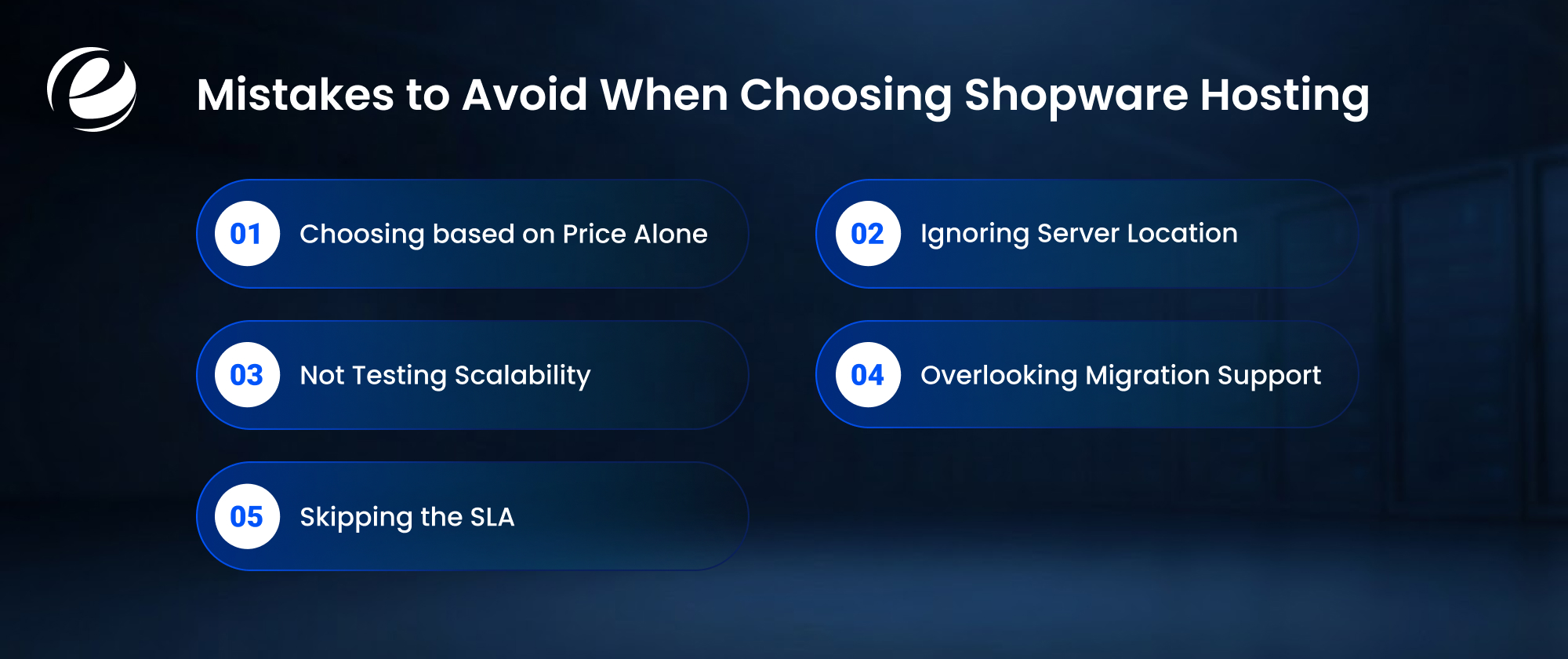
If the same mistakes keep recurring, here are some of the most costly ones to keep in mind when choosing Shopware hosting:
- Choosing based on price alone: Budget hosting saves money on day one and costs more in slow pages, poor uptime, and lost conversions down the line. The math rarely works out.
- Ignoring server location: A Shopware online store targeting US customers but hosted overseas adds delays that every visitor feels on every page.
- Skipping the SLA: Uptime promises only hold if the contract defines remedies for missed SLAs; therefore, read it in full before signing anything.
- Not testing scalability: How the host handles a sudden traffic spike matters more than what the plan page says. Ask before launch, not during one.
- Overlooking migration support. Moving a live Shopware store involves more than copying files. Confirm upfront what migration help the provider actually offers.
According to data published by Think with Google, as page load time increases from one to three seconds, the probability of a user bouncing increases by 32 percent. That is as much a hosting problem as a design one.
Final Verdict
The right Shopware hosting decision touches every part of your store’s performance, from the first page load to the final checkout confirmation.
Start with performance and security as non-negotiables. Then weigh scalability, support depth, and total cost against how your store actually operates day to day. Whether you are hosting Shopware on a cloud platform, a managed service, or your infrastructure, the setup should align with where your business is headed, not just where it sits today.
If you are ready to build or optimize your Shopware store with the right technical foundation, explore Shopware development solutions at Emizentech to ensure a strong start.
FAQs
Reliable hosting keeps your Shopware online store fast, secure, and consistently available. It protects customer data, supports traffic growth, and ensures shoppers can purchase without interruptions that damage trust and revenue. Performance, uptime guarantees, security standards, scalability, and support quality are the core factors. Pricing matters, but the total value per tier tells a clearer narrative than any base monthly cost alone. The main types are shared, VPS, dedicated server, cloud, and managed hosting. Each offers different trade-offs among cost, control, and technical complexity, depending on your business size and available resources. Managed hosting handles server updates, security patches, and performance tuning on your behalf. For teams without dedicated IT staff, it removes operational overhead and keeps the store running reliably. You must look for SSL certificates, DDoS protection, automated backups, firewall configuration, and regular PHP security updates. Shopware stores process payment data, so active vulnerability scanning from your host is not optional. Your provider should offer 24/7 technical support via live chat, ticket, or phone. More importantly, the support team must have actual Shopware knowledge, not just generic server administration expertise. Yes. Redis and OPcache support dramatically reduce server load and page generation time. Hosts that pre-configure caching for Shopware significantly outperform generic setups during high-traffic and flash sale periods.What are the benefits of hosting?
What is important to consider when choosing a hosting plan?
What are the different types of web hosting?
Is managed hosting better than unmanaged for Shopware?
What security features should Shopware hosting include?
What kind of support should I expect from my Shopware hosting provider?
Does caching support matter when choosing a Shopware hosting provider?




 +1 (989) 535-9295
 info@emizentech.com
 emizentech


